WhatTheyThink

Premium Commentary & Analysis

Andy Tribute: Below the Surface, Creo's Acquisition of ScenicSoft

Andy Tribute August 26,

Tuesday, August 27, 2002

Andy Tribute August 26, 2002 -- The recent announcement by Creo that it has reached an agreement to acquire ScenicSoft for a total of $9.5 million in cash, equity and assumption of liabilities, prompts one to ask the question, "Why are they doing it?" Creo already has full access to ScenicSoft’s products through OEM and distribution agreements and is one of the leading resellers of the ScenicSoft products. ScenicSoft is best known for its Preps imposition software, with more than 20,000 seats in use around the world. It also has developed Pandora for packaging layout. ScenicSoft also has a number of other products, mainly brought into its portfolio by the acquisition of Imation Publishing Software (TrapWise, Color Central and Print Central), and Holt Software in Australia (UpFront). ScenicSoft has a wide distribution network through OEM agreements, and through a range of graphic arts distributors worldwide. In terms of Preps it has agreements with Creo and Agfa where Preps is a core component of the Brisque, Prinergy and Apogee workflow systems, as well as reseller agreements with Heidelberg (Delta and MetaDimension), Rampage, Screen (TrueFlow) and Fuji (CelebraNT and Valiano). Fuji has also signed an OEM agreement in September 2001 to integrate Preps, UpFront, Pandora, and Color Central into its Valiano workflow. Acquisition is something that Creo is well used to, and it is not a "not invented here" type of organization. The merger with Scitex’s prepress division (or in reality we should call it an acquisition) is a case in point, where merging the two leading organizations in the field was designed to more than increase the sum of the two parts. Creo has also acquired companies with technologies that complement and enhance Creo’s own developments. A good example was the acquisition of Carmel Graphics in 2000 for $8.5 million. Carmel had almost no working installations of its software, but the View-IT and Submit-IT Internet based applications complemented and substantially added value to the functionality of Creo’s InSite portal application. So why is Creo acquiring ScenicSoft when it has had access to all its applications for eight years, and is probably ScenicSoft’s leading distribution channel? I believe it is all down to Creo’s Networked Graphic Production initiative. This is Creo’s approach to production that goes well beyond what we refer to today as workflow. It is building a totally integrated suite of applications that go from the MIS system with print estimation and ordering, through to the full range of production tools, including links right through into management of the bindery. This also has full Internet connectivity to allow clients and users to access or operate all functions from any location. For this to operate to maximum effectiveness Creo will need more specialized tools than the standard tools it gets through its current agreements with ScenicSoft. In particular this will be linking UpFront for print production planning very tightly into its Printcafe and other third party MIS links, as well as into the downstream of press and post-press finishing operations. Having ownership of the key ScenicSoft applications will allow unique functionality to be built into them for Networked Graphic Production that will differentiate them from the standard products available to its competitors. One market that is very significant for the future for Creo is that of packaging. Here it already has its Brisque Pack and Prinergy PowerPack production suites. The tight integration into these of ScenicSoft’s Pandora and UpFront applications should differentiate them from other packaging applications. Formerly, Creo has used Artwork Systems ArtPro and PowerStepper products in some of its packaging sales, but the ScenicSoft products should eliminate the need for working with Artwork Systems in future. Artwork Systems is already highly competitive against Creo with its full line of workflow and design packages for packaging, and it also works closely with Agfa in supplying software elements for Agfa’s Apogee packaging workflow. Where does this put Creo’s competitors who use ScenicSoft’s products? It has been stated by Creo and ScenicSoft that current product lines will be supported, customer support programs will continue as they do today, and current agreements between ScenicSoft and dealers, distributors, resellers, or strategic partners will remain in force with Creo. This however begs the question of whether such organizations will want to work with Creo in the future. As far as imposition it should not be a problem. There are many excellent imposition packages available today with comparable functionality and performance to Preps that switching to another product will not be a problem. I would fully expect companies like Agfa to be exploring their options. Heidelberg already has its own excellent imposition system, and Preps was only another option. Fuji may be the one with the most problems in switching as it has taken the full range of ScenicSoft products. In the other application areas there are all sorts of similar and comparable products to TrapWise, Color Central and Print Central that switching should not be a problem. UpFront however is a pretty unique application, and Pandora has few competitors, apart from dedicated packaging layout applications from Artwork Systems and Esko-Graphics. Overall this looks like a good deal for Creo. It has acquired a substantial development facility with excellent products at what appears to be a bargain basement price and payments spread over a long period of time. In these volatile times this may also be a secure solution for ScenicSoft. I was surprised to see that Creo's stock price hit an all time low on this announcement. I feel this adds value to Creo for a relatively small investment. The assumed liabilities of $2.3 million I am sure can be creatively utilized by good accounting practices. I wonder, however, in the future whether ScenicSoft will still sell its products so widely or whether it will become largely locked into Creo’s operations. Some products like the Imation Software range of Color Central, Print Central and TrapWise have no relevance within Creo, and perhaps may soon, once again, be looking for another home. Andrew Tribute


Continue reading your article
with a WhatTheyThink membership.

WhatTheyThink Annual Membership

Less than $4/week.

Get unlimited access to in-depth commentary and analysis covering the latest trends, emerging technologies, operational strategies, and key events across every segment of today's printing industry.

Stay informed. Stay competitive. Stay ahead.
WhatTheyThink Day Pass

$5 for 24 hours

Unlimited access to all of WhatTheyThink. Get your Day Pass

Already a member?
Sign In

About WhatTheyThink

WhatTheyThink is the global printing industry's go-to information source with both print and digital offerings, including WhatTheyThink.com, WhatTheyThink Email Newsletters, and the WhatTheyThink magazine. Our mission is to inform, educate, and inspire the industry. We provide cogent news and analysis about trends, technologies, operations, and events in all the markets that comprise today's printing and sign industries including commercial, in-plant, mailing, finishing, sign, display, textile, industrial, finishing, labels, packaging, marketing technology, software and workflow.

Recent Articles from WhatTheyThink

Around the Web: Of Books and Bots

Around the Web: Of Books and Bots

New book “Empire of Ink” is a look at the history and mythology of the American newspaper. A hacked smart lightbulb provides access to banned books. A digital archive reassembles Leonardo da Vinci’s long-cut-apart notebooks. Michelangelo’s secret underground hiding place—complete with the artist’s graffiti. Marie Antoinette may have been history’s first influencer. A worn copy of a 1912 pulp magazine featuring Tarzan sold at auction for $58,560. New book, “The Graphene Handbook - Making Sense of Graphene at Its Inflection Point.” Visa is integrating its payment network into ChatGPT, which should be fun. A humanoid robot plans to climb Everest. A designer who specializes in chairs without legs. Did a flying monk see Halley’s Comet…twice? The British geologist whose goal was to eat as many different animals as he possibly could. Welcome to WhatTheyThink’s weekly miscellany. Read More
Publishing Establishments—2010–2023

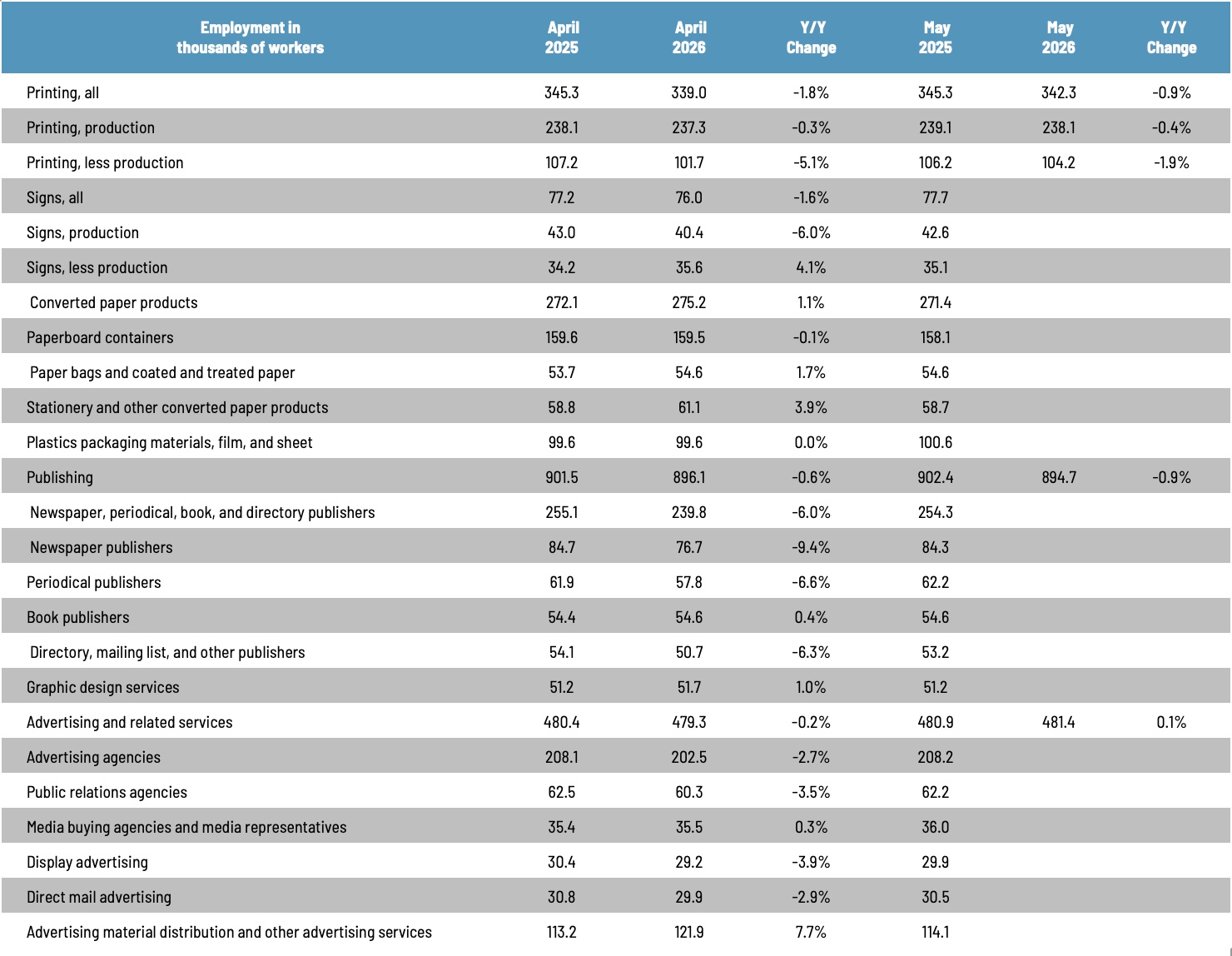
Publishing Establishments—2010–2023

According to the latest, recently released edition of County Business Patterns, in 2023 there were 32,332 establishments in NAICS 511 (Publishing Industries [except Internet]). This represents an increase of 15% since 2010. In macro news, the University of Michigan’s Consumer Sentiment Index is at record lows. Read More

Finishing: Production Inkjet's Next Frontier

Finishing: Production Inkjet's Next Frontier

As production inkjet has advanced, a new primary factor limiting productivity has emerged: finishing. How are PSPs adapting their investment and automation strategies? New research shows many can gain a competitive advantage by focusing on finishing. Read More

HanGlobal Launches New LabStar 330mini at Flexo & Labels Expo 2026

HanGlobal Launches New LabStar 330mini at Flexo & Labels Expo 2026

Discover HanGlobal's newly launched LabStar 330mini digital label press! Get the full show roundup to see how this ultra-integrated, high-performance inkjet solution captured the crowd's attention and redefined narrow-web printing. Read More

Around the Web: Of Food and Feynman

Around the Web: Of Food and Feynman

A book designer who specializes in spine design. The Chinese postal service is using humanoid robots to sort packages. An amusingly overproduced Day Display. Allen Ginsberg’s spoken-word poetry recitation album is being reissued. The winners of this year’s World Food Photography Awards. A retired geneticist launched the online Museum of Plugs & Sockets. A viral warning about a new gas station scam is actually a hoax. What is the world’s longest domestic flight? Aw, et tu, graphene: Skeleton Technologies launches graphene-based GrapheneUPS for AI data centers. What is the quietest spot in the U.S.? Researchers finally cracked Richard Feynman’s “Restaurant Problem.” Malaysia’s kek lapis Sarawak is perhaps the world’s most complex cake. Welcome to WhatTheyThink’s weekly miscellany. Read More