WhatTheyThink

Premium Commentary & Analysis

Developing the Right Mix of Client Care

Shifting consumer expectations are increasing the demand for relevant and personalized communications, so it is becoming ever more vital for print service providers to offer their clients the tools and expertise they need to compete via all channels. This article cites recent research from Keypoint Intelligence – InfoTrends to explore how communication practices are changing.

Thursday, October 11, 2018

Consumers’ shifting expectations are increasing the demand for relevant and personalized communications. As a result, it is becoming ever more vital for print service providers to offer their clients the tools and expertise they need to compete on the print and mail battleground as well as the expanding digital landscape. The customer experience is a metric that is just as important for serving consumers as it is serving the enterprises that are working to capture and keep their business. Keypoint Intelligence – InfoTrends (InfoTrends) recently surveyed 24 mid-tier print service providers to learn about the professionals who make up their client care teams, how accounts are assigned to them, the roles they perform, and how much time they spend serving clients today in relation to two years ago. Our results point to a distinct evolution in communication practices and a general agreement about the importance of enterprise client care.

On average, the mid-tier print service providers we surveyed employ between 4 and 5 customer service representatives, as well as between 3 and 4 sales representatives, account managers, and production/project managers. While sales representatives most often focus on certain industry verticals, other client care employees are usually assigned to their contracts based on the complexity of the account. When respondents were asked how much time they spent with various accounts, 57% spent more time on their most profitable accounts than they did on their least profitable. Meanwhile, nearly a third (29%) spent the same amount of time on all accounts and 14% dedicated the most time to their least profitable accounts. Among all respondents, the average ratio of time spent on the most profitable account versus the least profitable was 3.7 to 1.5.

As would be expected, all of the organizations that we surveyed had sales representatives on staff. On the other hand, at least one of our respondents did not have any customer service representatives, account managers, or production/product managers. This survey also questioned respondents about the client care personnel that performed specific tasks and how much time was spent on these assignments now in relation to two years ago. The table below details the findings and provides some directional insight on these professionals’ expanding duties.


Continue reading your article
with a WhatTheyThink membership.

WhatTheyThink Annual Membership

Less than $4/week.

Get unlimited access to in-depth commentary and analysis covering the latest trends, emerging technologies, operational strategies, and key events across every segment of today's printing industry.

Stay informed. Stay competitive. Stay ahead.
WhatTheyThink Day Pass

$5 for 24 hours

Unlimited access to all of WhatTheyThink. Get your Day Pass

Already a member?
Sign In

About Keypoint Intelligence

Since 1961, the digital imaging industry has relied on Keypoint Intelligence for independent hands-on testing, lab data, and market research to drive product and sales success. Keypoint Intelligence has been recognized as the industry’s most trusted resource for unbiased information, analysis, and awards. Clients have harnessed this knowledge for strategic decision-making, daily sales enablement, and operational efficiency improvements. Keypoint Intelligence continues to evolve with the industry by expanding its offerings and intimately understanding the transformations occurring in the digital printing and imaging sector.

Recent Articles from Keypoint Intelligence

Production Inkjet Printing: Ever Expanding, Ever Evolving

Production Inkjet Printing: Ever Expanding, Ever Evolving

Production inkjet technology has emerged as the cornerstone of today’s printing revolution. Inkjet has become a versatile and efficient solution for print service providers of all sizes. As we move into the future, critical factors like automation, artificial intelligence, and greater media flexibility promise to further enhance inkjet's capabilities while uncovering new opportunities for growth and innovation. Read More
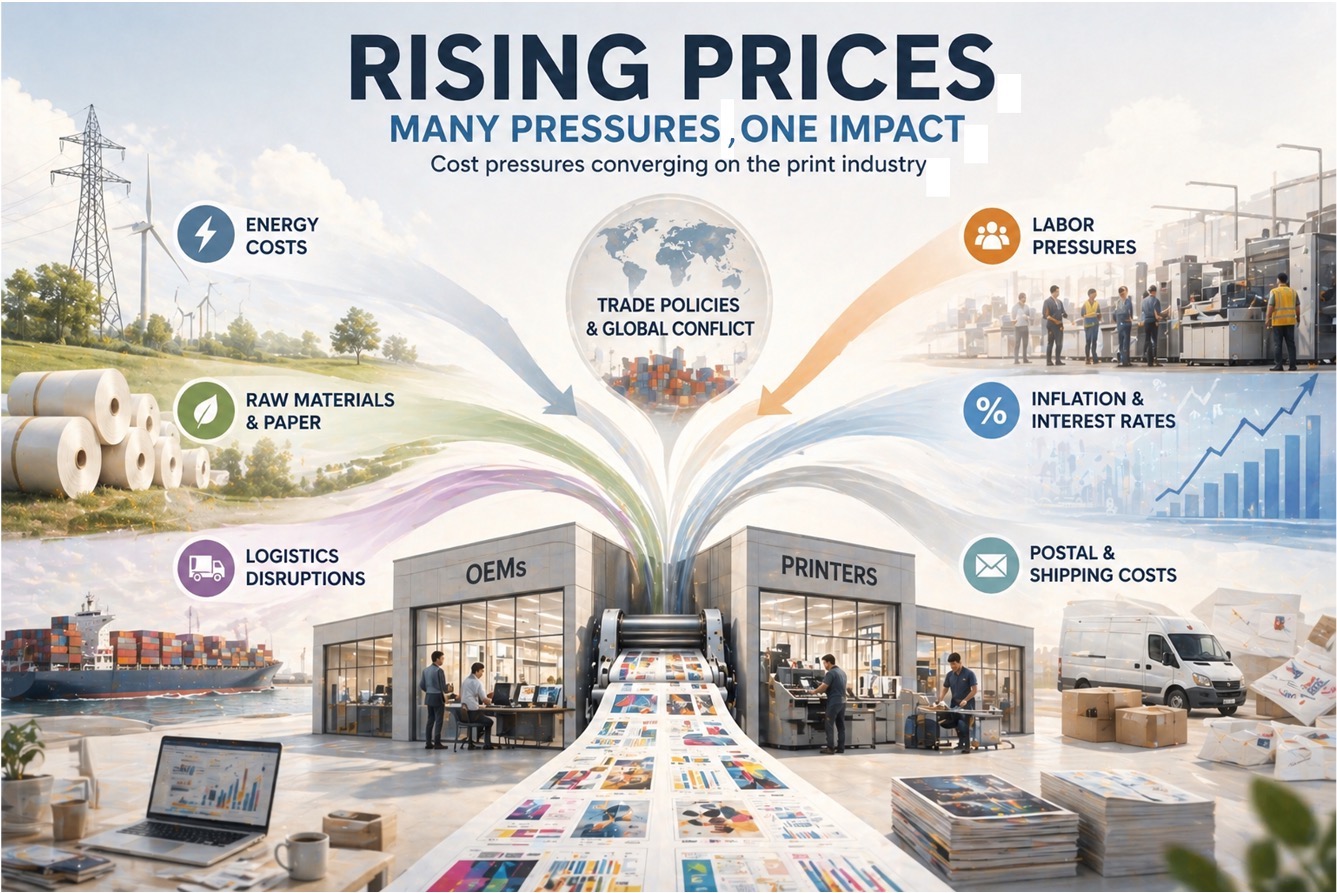
Rising Print Cost Pressures: What They Mean for You

Rising Print Cost Pressures: What They Mean for You

Higher print costs are nothing new, and there’s no sign of them letting up. Factors like energy costs, labor pressures, inflation, logistics disruptions, and postal costs are converging on the printing industry and causing higher prices. Rather than moving in isolation, these factors are combining and intensifying. This article explores some of the key pressures that the printing industry is facing. Read More

10 Things PSPs Should Consider Before Adopting Robotics: What You Need to Know to Begin the Journey

10 Things PSPs Should Consider Before Adopting Robotics: What You Need to Know to Begin the Journey

Labor shortages, production bottlenecks, and growing workflow complexity are forcing print service providers to take a closer look at robotics and automation. In this article, Keypoint Intelligence examines where robotics can deliver the greatest operational impact, the challenges PSPs should prepare for, and the practical steps companies can take to build a more efficient and stable production environment. Read More

The Role of Label Printing in Today’s Landscape

The Role of Label Printing in Today’s Landscape

Label printing doesn’t feature prominently in discussions about the digital transformation or the future of the printed page. Even so, it is one of the most consistently active segments in the broader printing landscape. This article explores the evolving factors that make label printing worth a closer look. Read More

Fostering Connections with Improved Personalization

Fostering Connections with Improved Personalization

Personalized print is a tangible form of communication that can bridge the gap between a customer’s desire to be recognized and the often impersonal nature of digital-only content. This article explores the psychology of personalized print and why it’s such a powerful way for brands to connect with their audience. Read More