WhatTheyThink

Premium Commentary & Analysis

Pricing for Digital Part 1: Overcoming Obstacles on the Path to Profitable Pricing

As digital delivery proliferates within the customer communications market, service providers with a legacy in print have been challenged to devise pricing models that position their operations for long-term sustainability. As part of its recently published research study entitled Pricing for Digital: Exploring New Models for Transactional Communications Delivery, Keypoint Intelligence – InfoTrends conducted more than a dozen in-depth interviews with print service providers in North America to gain a deeper understanding of the primary pricing obstacles that stakeholders face in today’s changing market. The first in a three-part series, this article explores the hurdles that providers encounter in the market and considers the approaches they have developed as they attempt to establish profitable pricing models.

Thursday, May 31, 2018

At the end of 2017, Keypoint Intelligence – InfoTrends published a research study entitled Pricing for Digital: Exploring New Models for Transactional Communications Delivery. As part of this research, we conducted over a dozen in-depth interviews with print service providers in North America to gain a deeper understanding of the primary pricing obstacles that stakeholders face in today’s changing market. One of the primary issues that our interviewees identified was a gradual but significant shift in enterprise transactional communications—the balance of power is transitioning away from business leadership in favor of procurement. In today’s world, heightened consumer expectations of personalization have made the customer experience a paramount concern for providers that are issuing enterprise communications. Unfortunately, enterprise procurement’s fixation on reducing costs in customer communications delivery often takes precedence over improving quality and enhancing value. The print service providers that we interviewed paint a disturbing picture: procurement departments are often out of step with current consumer trends and their methods are frequently viewed as antiquated. This is causing many to question the value that the procurement unit can deliver to enterprise clients and prospects. 

In the course of day-to-day business practices, procurement’s growing influence has made request for proposal (RFP) engagements a fact of life. Procurement representatives are intent on using RFPs to standardize providers’ proposals so they can better compare bidder prices. Unfortunately, procurement departments often have a limited perspective on the intricacies of creating, managing, and delivering transactional communications as well as a desire to keep prospective vendors at arm’s length from internal business owners. As a result, information about the true purpose of transactional communications is incomplete and the burden of financial risk now falls on the procurement rep’s selected vendor.

Due to overly rigid RFPs, procurement policies have become disconnected from the realities of customer communications work. Since the procurement department generally does not understand the details of an individual job, everything is homogenized. This ultimately produces a watered-down request because procurement departments force applicants to fill out RFPs in exactly the same way and disqualify those who deviate from the formula. Providers face difficulties in packaging their specific offerings, demonstrating how their unique capabilities can meet a prospect’s needs, and synergizing services with their own corporate culture. Because these guidelines are so strict, it has become nearly impossible for service providers to accurately represent their costs. To make matters worse, procurement units often expect their outsourcing vendors to match the lowest bid in each category with no regard for the various ways that applicants may have bundled their offerings. This trend puts incumbents—which may include unaccounted costs in their proposals due to their in-depth knowledge of the real need—at a disadvantage against newcomers who will simply provide a price for the requested services. If a new provider wins the contract, that provider will often need to absorb additional costs that are obscured by the imperfect RFP process.


Continue reading your article
with a WhatTheyThink membership.

WhatTheyThink Annual Membership

Less than $4/week.

Get unlimited access to in-depth commentary and analysis covering the latest trends, emerging technologies, operational strategies, and key events across every segment of today's printing industry.

Stay informed. Stay competitive. Stay ahead.
WhatTheyThink Day Pass

$5 for 24 hours

Unlimited access to all of WhatTheyThink. Get your Day Pass

Already a member?
Sign In

About Keypoint Intelligence

Since 1961, the digital imaging industry has relied on Keypoint Intelligence for independent hands-on testing, lab data, and market research to drive product and sales success. Keypoint Intelligence has been recognized as the industry’s most trusted resource for unbiased information, analysis, and awards. Clients have harnessed this knowledge for strategic decision-making, daily sales enablement, and operational efficiency improvements. Keypoint Intelligence continues to evolve with the industry by expanding its offerings and intimately understanding the transformations occurring in the digital printing and imaging sector.

Recent Articles from Keypoint Intelligence

Production Inkjet Printing: Ever Expanding, Ever Evolving

Production Inkjet Printing: Ever Expanding, Ever Evolving

Production inkjet technology has emerged as the cornerstone of today’s printing revolution. Inkjet has become a versatile and efficient solution for print service providers of all sizes. As we move into the future, critical factors like automation, artificial intelligence, and greater media flexibility promise to further enhance inkjet's capabilities while uncovering new opportunities for growth and innovation. Read More
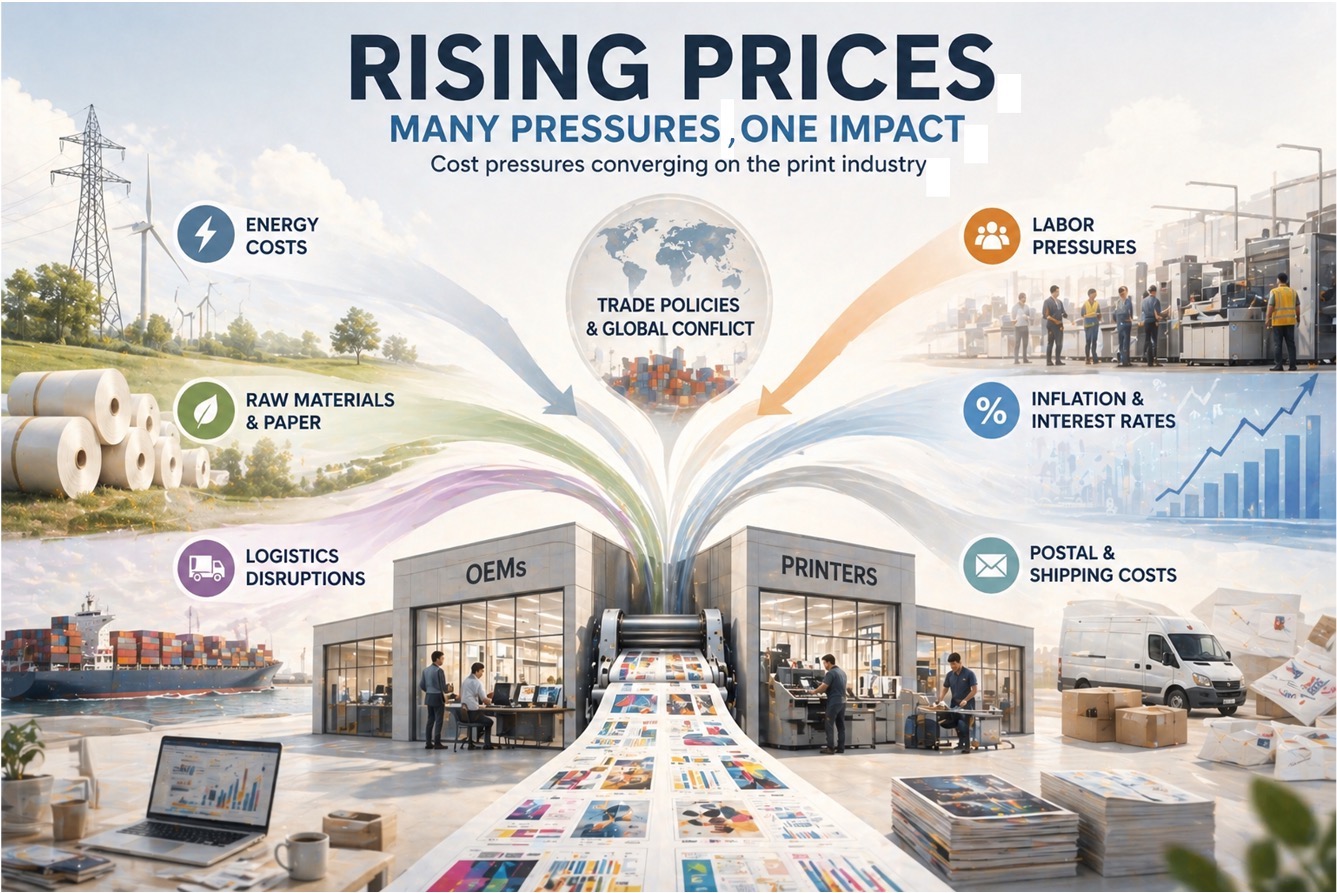
Rising Print Cost Pressures: What They Mean for You

Rising Print Cost Pressures: What They Mean for You

Higher print costs are nothing new, and there’s no sign of them letting up. Factors like energy costs, labor pressures, inflation, logistics disruptions, and postal costs are converging on the printing industry and causing higher prices. Rather than moving in isolation, these factors are combining and intensifying. This article explores some of the key pressures that the printing industry is facing. Read More


10 Things PSPs Should Consider Before Adopting Robotics: What You Need to Know to Begin the Journey

10 Things PSPs Should Consider Before Adopting Robotics: What You Need to Know to Begin the Journey

Labor shortages, production bottlenecks, and growing workflow complexity are forcing print service providers to take a closer look at robotics and automation. In this article, Keypoint Intelligence examines where robotics can deliver the greatest operational impact, the challenges PSPs should prepare for, and the practical steps companies can take to build a more efficient and stable production environment. Read More

The Role of Label Printing in Today’s Landscape

The Role of Label Printing in Today’s Landscape

Label printing doesn’t feature prominently in discussions about the digital transformation or the future of the printed page. Even so, it is one of the most consistently active segments in the broader printing landscape. This article explores the evolving factors that make label printing worth a closer look. Read More

Fostering Connections with Improved Personalization

Fostering Connections with Improved Personalization

Personalized print is a tangible form of communication that can bridge the gap between a customer’s desire to be recognized and the often impersonal nature of digital-only content. This article explores the psychology of personalized print and why it’s such a powerful way for brands to connect with their audience. Read More