WhatTheyThink

Premium Commentary & Analysis

Just the Facts, Ma'am

Here at TrendWatch GA,

Thursday, May 16, 2002

Here at TrendWatch GA, sometimes I think it’s our job to irritate people. Not a lot. Just a little. Just enough to get them out of their comfort zones and encourage them to think differently about their businesses. This is because graphic arts firms generally do not invest in new hardware or workflows until one of two things happens:

1. Their customers start asking for it.
2. They start losing business because of it.

Our job is to show them that this is not a good idea. You see, the irritation that TrendWatch GA sometimes causes isn’t because we are trying to be controversial. It’s because we give the industry "just the facts ma’am" without the sugar coating. Sometimes this is pleasant. Sometimes it isn’t. And sometimes that’s irritating.

Forecasting Means Looking Back

At TrendWatch, we present the facts as we see them based in our extensive interviews, industry contacts, and historical database of market research data. The industry doesn’t have to embrace our opinions, of course. But we certainly recommend considering them.

Since 1995, TrendWatch Graphic Arts has been issuing twice yearly data surveys that touch nearly every critical industry topic, trend, and technology. We publish our methodology so the industry knows where we get our data and why we get the results that we do. And because we ask the same or similar questions survey over survey, these reports often come to different conclusions than other market surveys that are less comprehensive or that provide only snapshots of any given topic at a single point in time.

Needless to say, having this kind of history gives us a unique perspective on the industry. This perspective shows up in our reports in historical trend lines that can go back up to 15 surveys, depending on how long the question has been asked. When you look at certain trends from this vantagepoint, they begin to look very different from the snapshots you read elsewhere. After all, a large part of forecasting the future is looking at the past.

Unfortunately, most printing firms don’t recognize this fact As a result, they don’t recognize the context into which today’s technologies fit, don’t identify emerging opportunities, and fail to see where these technologies are going or the impact they’re having around them. The result? Short-sighted business decisions.

With Six You Get Eggroll

Value-added services is a good example. In our recent Special Report "Value-Added Services: Will the Real Value-Added Please Stand Up?", we discuss the true meaning and implementation of "value-added," but unfortunately, this concept goes over most printers’ heads. In their minds, they hear "diversification," and since they recently added a wide-format printer to their mix, they figure, "I’m doing that."

In reality, value-added services is something completely different, although diversification is part of it. Not understanding this distinction is often the difference between success and failure.

"Value-Added Services" discusses the concept of value-added services within the context of companies who use value-added to succeed even in the worst economic climates compared with those who are stuck in the "Chinese take-out menu" mentality, which really does little, if anything, to pull them out of the commodity marketplace.

We’ve been broadcasting this message in the report, in articles, and in press releases, and printers need to start paying attention. According to PIA Ratios reports, the difference in profitability between PIA Profit Leaders and the industry as a whole was 9% to 3% in 2001. However, industry consultant Bob Rosen has determined that the difference between Profit Leaders and everybody else (in other words, removing the Profit Leaders from the industry average to make a more direct comparison) is near 0%! In other words, if you aren’t a Profit Leader, you’re toast.

Common Denominator for Profit

Fortunately, there is a common denominator we can look to. Companies that are doing well, even in today’s less-than-robust economy, tend to be true value-added service companies. You see, at its core, value-added doesn’t have to do with the technologies they use. Technologies are simply components— tools to be used in the overall value-added solution set.

Value-added has to do with business philosophy, the switch from a manufacturing-centric business philosophy to a customer-centric philosophy. While this switch often results in the addition of technology, it’s not the technology itself that makes the difference. It’s how it is integrated and focused to solve specific customer needs.

This means knowing your customer more intimately than simply taking orders across a desk, which is something many printing firms still don’t know how to do. It also means investing in integrated workflows that focus, not on individual technologies, but how they can be combined to create workflow solutions to solve specific customer needs.

When confronted with these opportunities, most printers reply, "I can’t afford to do that." But when profit leaders tend to be value-added service companies, and when PIA Ratio studies show non-profit leaders averaging 0% profitability, can they really afford not to?

It becomes clearer to us with each new study that those companies who really "get it" when it comes to new technologies are value-added service companies. It is because they understand the true value-added business philosophy that they understand how these other technologies are important to them. This understanding is going to be critical as the industry goes forward in this new business environment.

Divers Down

This is where good, unbiased (translated "sometimes irritating") market research can play a role. Good business decisions about technology and workflows are based on complete information and on a perspective that takes into consideration the wider context in which these technologies reside and are applied. Value-added services — which most printers still see as diversification rather than a critical shift in business philosophy — is a perfect example. In other words, what you don’t know can hurt you. And you won’t even know it’s happening!

Editor’s Note: For more information on TrendWatch Graphic Arts Special Report, including Value-Added Services: Will the Real Value-Added Please Stand Up?, visit www.trendwatchgraphicarts.com.


Continue reading your article
with a WhatTheyThink membership.

WhatTheyThink Annual Membership

Less than $4/week.

Get unlimited access to in-depth commentary and analysis covering the latest trends, emerging technologies, operational strategies, and key events across every segment of today's printing industry.

Stay informed. Stay competitive. Stay ahead.
WhatTheyThink Day Pass

$5 for 24 hours

Unlimited access to all of WhatTheyThink. Get your Day Pass

Already a member?
Sign In

About WhatTheyThink

WhatTheyThink is the global printing industry's go-to information source with both print and digital offerings, including WhatTheyThink.com, WhatTheyThink Email Newsletters, and the WhatTheyThink magazine. Our mission is to inform, educate, and inspire the industry. We provide cogent news and analysis about trends, technologies, operations, and events in all the markets that comprise today's printing and sign industries including commercial, in-plant, mailing, finishing, sign, display, textile, industrial, finishing, labels, packaging, marketing technology, software and workflow.

Recent Articles from WhatTheyThink

Around the Web: Of Books and Bots

Around the Web: Of Books and Bots

New book “Empire of Ink” is a look at the history and mythology of the American newspaper. A hacked smart lightbulb provides access to banned books. A digital archive reassembles Leonardo da Vinci’s long-cut-apart notebooks. Michelangelo’s secret underground hiding place—complete with the artist’s graffiti. Marie Antoinette may have been history’s first influencer. A worn copy of a 1912 pulp magazine featuring Tarzan sold at auction for $58,560. New book, “The Graphene Handbook - Making Sense of Graphene at Its Inflection Point.” Visa is integrating its payment network into ChatGPT, which should be fun. A humanoid robot plans to climb Everest. A designer who specializes in chairs without legs. Did a flying monk see Halley’s Comet…twice? The British geologist whose goal was to eat as many different animals as he possibly could. Welcome to WhatTheyThink’s weekly miscellany. Read More
Publishing Establishments—2010–2023

Publishing Establishments—2010–2023

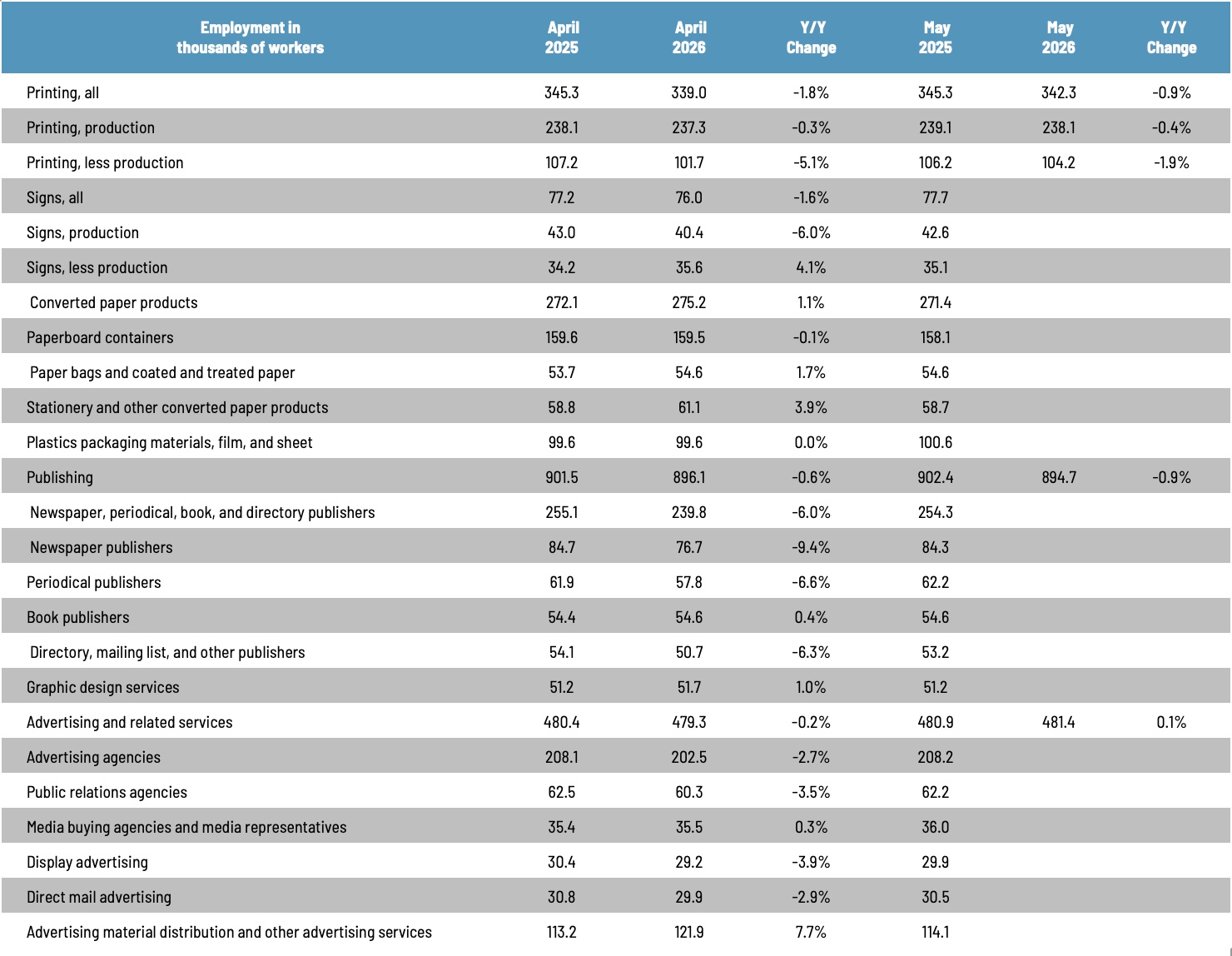
According to the latest, recently released edition of County Business Patterns, in 2023 there were 32,332 establishments in NAICS 511 (Publishing Industries [except Internet]). This represents an increase of 15% since 2010. In macro news, the University of Michigan’s Consumer Sentiment Index is at record lows. Read More

Finishing: Production Inkjet's Next Frontier

Finishing: Production Inkjet's Next Frontier

As production inkjet has advanced, a new primary factor limiting productivity has emerged: finishing. How are PSPs adapting their investment and automation strategies? New research shows many can gain a competitive advantage by focusing on finishing. Read More

HanGlobal Launches New LabStar 330mini at Flexo & Labels Expo 2026

HanGlobal Launches New LabStar 330mini at Flexo & Labels Expo 2026

Discover HanGlobal's newly launched LabStar 330mini digital label press! Get the full show roundup to see how this ultra-integrated, high-performance inkjet solution captured the crowd's attention and redefined narrow-web printing. Read More

Around the Web: Of Food and Feynman

Around the Web: Of Food and Feynman

A book designer who specializes in spine design. The Chinese postal service is using humanoid robots to sort packages. An amusingly overproduced Day Display. Allen Ginsberg’s spoken-word poetry recitation album is being reissued. The winners of this year’s World Food Photography Awards. A retired geneticist launched the online Museum of Plugs & Sockets. A viral warning about a new gas station scam is actually a hoax. What is the world’s longest domestic flight? Aw, et tu, graphene: Skeleton Technologies launches graphene-based GrapheneUPS for AI data centers. What is the quietest spot in the U.S.? Researchers finally cracked Richard Feynman’s “Restaurant Problem.” Malaysia’s kek lapis Sarawak is perhaps the world’s most complex cake. Welcome to WhatTheyThink’s weekly miscellany. Read More