WhatTheyThink

Premium Commentary & Analysis

A New Productivity Medium: How today’s top print firms staff their plants.

Four years ago John,

Thursday, May 09, 2002

Four years ago John, the President of a very large, multi-plant web and gravure printing organization suggested that I come up with a way in which we could bring medium level managers and hourly employees to their organization in a much more cost effective fashion. John was looking for an alternative to the traditional executive search for lower level positions. He needed a mechanism that was fast, efficient and easy to administer.

Furthermore, John needed a way to hire craftsmen with very specific backgrounds and the skill sets that were fundamental to his four plants. Traditional recruiting --newspaper “help wanted” ads, job fairs, and College/University campus recruiting just didn't get the job done -and was too expensive.

This article explains a new “productivity medium” that many industry firms are using to acquire qualified staff - online job boards. I will also illustrate the reasons for this fundamental shift in the hiring process.

Shift in Advertising from Newspapers to Job Boards

The public's acceptance of Internet based job boards has given the newspaper industry considerable concern as there has been a huge shift in expenditures away from traditional media and towards Internet based “help wanted” classified ads. Employers are expected to spend an average of 35% of their classified budgets for online recruiting in 2002. Spending on newspaper classified ads are expected to slide from 28% to 22% of the total recruiting budget in 2002.

According to the Newspaper Association of America, Sunday circulation has dropped by over 3 million copies between 1990 and 2000. Daily circulation has dropped by 6.5 million copies during the same time period. In an attempt to shore up their revenues, newspaper classified ads have become more expensive and less effective as the audience shrinks and the cost per thousand climbs. According to a recent EMA Cost Per Hire and Staffing Metrics Survey, the average cost per hire for a non-exempt Internet hire was $51 while the print advertising cost per hire was $726.

The growth of Internet users combined with the efficiency of Internet job postings has the newspaper industry very worried. In fact, many newspapers have launched their own online job boards to leverage this decrease.

What's Behind the Meteoric Growth of Internet Job Boards?

There are a number of reasons online job boards have enjoyed such rapid growth. According to Jupiter Media Metrics, the number of U.S. Internet users in the year 2002 is approximately 157 million. By the year 2006 there will be well over 210 million users in the U.S. alone! What newspaper can claim that kind of readership?

Companies realizing the potential of the Internet have started shifting their advertising budgets to take advantage of the ability to reach out and touch literally millions of potential candidates with a single ad. Candidates entering the job market from college and technical high schools are connected and are at ease using the Internet for their job searches. Graduating college seniors use the Internet in record numbers to research and apply to companies they feel will fit their skill set. This presents opportunities for graphic arts companies to introduce themselves to this young and vibrant source of new employees.

Some of the larger generalized job boards have been the target of criticism because their ads sometimes elicit over a 1000 responses. Imagine reading 1000 resumes. Specialized job boards servicing vertical niches have seen growth in their subscription base because their candidate base is very targeted and they offer the ability to set up very finite search parameters attracting direct hits for these openings.

Consider a search on a general job board where a printing company posts a job for a sales representative living in the Chicago area. A general job board will potentially drive thousands of responses to that opening while a targeted vertical job board will expose candidates to the opening with very specific talents and experience relevant to the graphic arts industry. Why? Because the candidates that frequent and register with a niche job board do so because they are interested in exploring positions within their area of expertise.

Speed/Control/24x7/Action!

Imagine this: Its Monday morning. Everything is going well in your plant. As you walk over to the coffee machine to grab your second cup of coffee, Bob, your first pressman taps you on the shoulder and asks if he can have a word with you, in private. The door closes and he hands you his resignation letter telling you that he has decided to make a lifestyle change. He will be building porches for a living and his last day is, well, today.

After an unsuccessful attempt at counter offering Bob to stay with you, your next thought is obvious. Time to replace him and replace him fast! You fire up your graphic arts online job board and post the opening. On many industry job boards, you can also browse the database and contact candidates that may have the experience you are looking for.

The whole process took about 10 minutes. Your search is in circulation and the Internet is at work for you, immediately. I know many printers with the exact circumstances in this example that have filled their position within two days.

In the Year 2010

According to the US Census Bureau, by the year 2010 there will be a gap between the number of jobs and the number of people to fill them that will be somewhere around 8.5 million. Sure, as of today the unemployment rates are rather high due to the recent economic downturn. However, over the long run, the competition for skilled craftsmen within our industry will become absolutely intense.

The companies that are learning to use such powerful methods of recruiting and hiring will surely prosper and survive. It is imperative that every graphic arts company, whether large or small, research and find a job board that fits their particular need. They are cost effective, fast and they work.

The low cost and productivity advantages that industry job boards offer should not be ignored. And with margins tighter than ever, every second counts.


Continue reading your article
with a WhatTheyThink membership.

WhatTheyThink Annual Membership

Less than $4/week.

Get unlimited access to in-depth commentary and analysis covering the latest trends, emerging technologies, operational strategies, and key events across every segment of today's printing industry.

Stay informed. Stay competitive. Stay ahead.
WhatTheyThink Day Pass

$5 for 24 hours

Unlimited access to all of WhatTheyThink. Get your Day Pass

Already a member?
Sign In

About WhatTheyThink

WhatTheyThink is the global printing industry's go-to information source with both print and digital offerings, including WhatTheyThink.com, WhatTheyThink Email Newsletters, and the WhatTheyThink magazine. Our mission is to inform, educate, and inspire the industry. We provide cogent news and analysis about trends, technologies, operations, and events in all the markets that comprise today's printing and sign industries including commercial, in-plant, mailing, finishing, sign, display, textile, industrial, finishing, labels, packaging, marketing technology, software and workflow.

Recent Articles from WhatTheyThink

Around the Web: Of Books and Bots

Around the Web: Of Books and Bots

New book “Empire of Ink” is a look at the history and mythology of the American newspaper. A hacked smart lightbulb provides access to banned books. A digital archive reassembles Leonardo da Vinci’s long-cut-apart notebooks. Michelangelo’s secret underground hiding place—complete with the artist’s graffiti. Marie Antoinette may have been history’s first influencer. A worn copy of a 1912 pulp magazine featuring Tarzan sold at auction for $58,560. New book, “The Graphene Handbook - Making Sense of Graphene at Its Inflection Point.” Visa is integrating its payment network into ChatGPT, which should be fun. A humanoid robot plans to climb Everest. A designer who specializes in chairs without legs. Did a flying monk see Halley’s Comet…twice? The British geologist whose goal was to eat as many different animals as he possibly could. Welcome to WhatTheyThink’s weekly miscellany. Read More
Publishing Establishments—2010–2023

Publishing Establishments—2010–2023

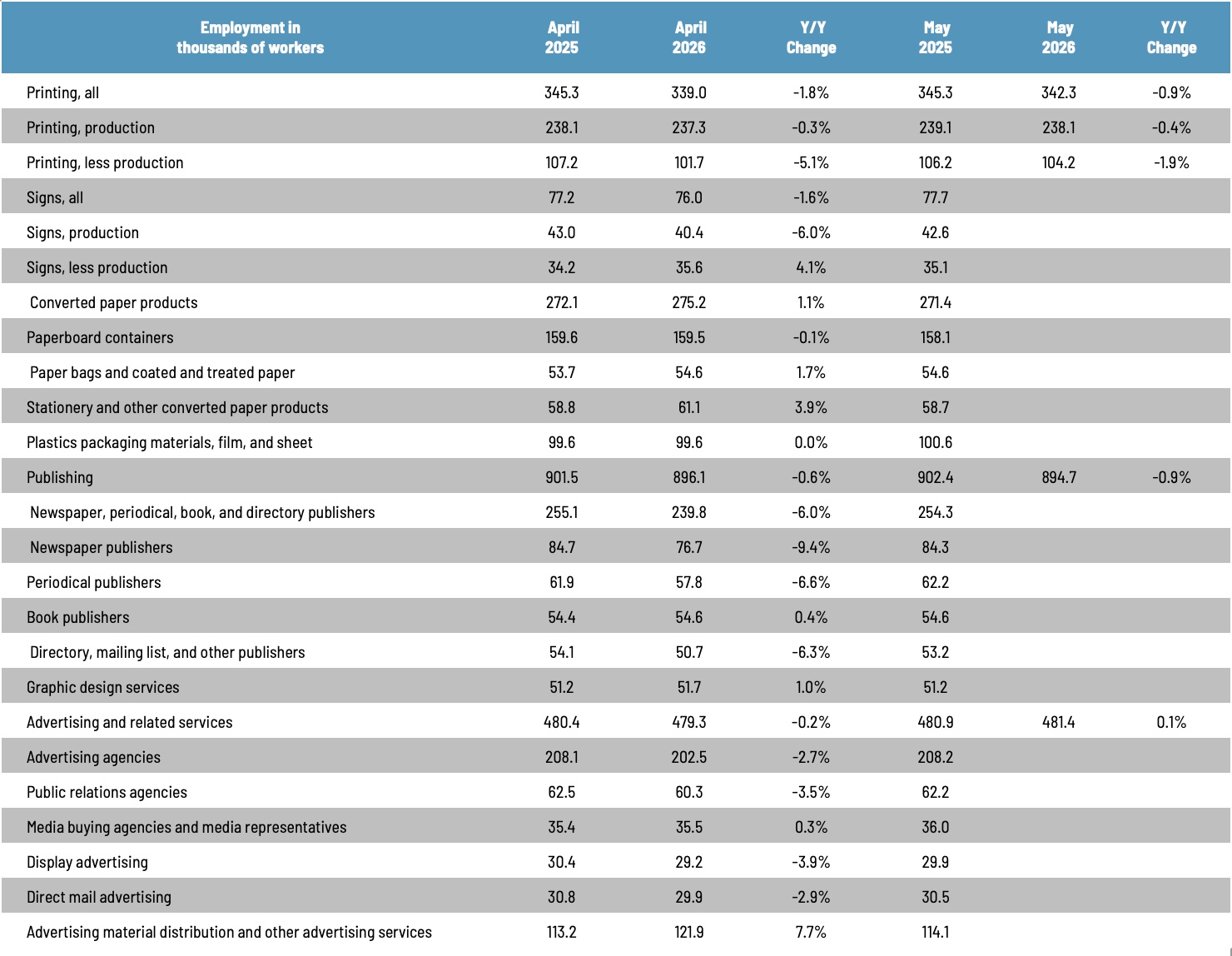
According to the latest, recently released edition of County Business Patterns, in 2023 there were 32,332 establishments in NAICS 511 (Publishing Industries [except Internet]). This represents an increase of 15% since 2010. In macro news, the University of Michigan’s Consumer Sentiment Index is at record lows. Read More

Finishing: Production Inkjet's Next Frontier

Finishing: Production Inkjet's Next Frontier

As production inkjet has advanced, a new primary factor limiting productivity has emerged: finishing. How are PSPs adapting their investment and automation strategies? New research shows many can gain a competitive advantage by focusing on finishing. Read More

HanGlobal Launches New LabStar 330mini at Flexo & Labels Expo 2026

HanGlobal Launches New LabStar 330mini at Flexo & Labels Expo 2026

Discover HanGlobal's newly launched LabStar 330mini digital label press! Get the full show roundup to see how this ultra-integrated, high-performance inkjet solution captured the crowd's attention and redefined narrow-web printing. Read More

Around the Web: Of Food and Feynman

Around the Web: Of Food and Feynman

A book designer who specializes in spine design. The Chinese postal service is using humanoid robots to sort packages. An amusingly overproduced Day Display. Allen Ginsberg’s spoken-word poetry recitation album is being reissued. The winners of this year’s World Food Photography Awards. A retired geneticist launched the online Museum of Plugs & Sockets. A viral warning about a new gas station scam is actually a hoax. What is the world’s longest domestic flight? Aw, et tu, graphene: Skeleton Technologies launches graphene-based GrapheneUPS for AI data centers. What is the quietest spot in the U.S.? Researchers finally cracked Richard Feynman’s “Restaurant Problem.” Malaysia’s kek lapis Sarawak is perhaps the world’s most complex cake. Welcome to WhatTheyThink’s weekly miscellany. Read More