WhatTheyThink

Premium Commentary & Analysis

High Noon for Trade Shows and Industry Conferences: 30% decrease expected by 2004

Is it my imagination or are there too many trade shows and conferences?

Tuesday, June 11, 2002

Is it my imagination or are there too many trade shows and conferences? John Werner, publisher of Graphic Communications World (a.k.a. the "Green Sheets"), prints the most comprehensive list of Official Industry Meetings and Events available today. His publication listed over 500 trade shows and conferences in 2001 and this number has not changed significantly for 2002. Yet, the last trade show I attended was down 70% in both exhibitors and attendees. Everyone at the show blamed it on a bad economy or the residual of 9/11 events.

Do we really believe the trade show business as we know it will eventually return to prosperity? Or is the trade show model broken?

Raine believes the era of in-person World’s Fairs are over. Payoffs are skeptical when you fully load the time, travel, and marketing expenses for attendees and exhibitors. These circuits, which have been the gravy trains for trade Associations and consulting companies for decades, are headed for trouble. Ironically, this tough economy has turned the trade shows into giant job fairs. I found more people "in transition" at the last trade show than serious procurement or decision-making attendees.

We believe 2003 is the year for a major shakeout when industries, events, and trades shows either consolidate or choose a different venue to attract customers.

Business problems have grown in complexity. Productivity gains are driven by technology. And technology investments are witnessing a capital deepening into businesses today. Selecting and evaluating intellectual property solutions requires solid research, integrated processes, and trusted relationships. Casual browsing of exhibit booths, as if you were shopping at the mall for a pair of pants, seems to be out of step when searching for potential vendors with solutions.

Moreover, the abundance of vendors already sitting on customers’ doorsteps eliminates the need to travel to trade shows and conferences altogether. With the advent of web advertising, Internet product demos, and even 24x7 web casts; customers can choose when to shop for solutions. Buyers are looking for immediate solutions on their company’s timetable versus the conference calendars.

Equipment manufacturers have built magnanimous demo facilities, which customers can visit year-round instead of waiting for a trade show. Exhibitors will increasingly have trouble funding and rationalizing external trade shows versus regional demo centers. Customers are changing they way they buy equipment and services. The location of that purchase is also changing...from the exhibit floor to the customer’s office.

A New Model for Trade Shows and Conferences:

The world of work and communications has changed forever. Database management tools (e.g. CRM) and global Internet connectivity are making it cheaper and easier to target and deliver laser-focused content to the right customer at the right time. The trade shows and industry conferences of tomorrow will resemble in-person workshops or boot camps. These intimate sessions must drive profitability with less than 50 people who share a common business problem and cater to attendees who will travel less than 100 miles to the seminar location.

Attendees will expect the seminar to accelerate their company’s knowledge capital (as well as their own marketability), expand networks, discuss best practices, and ultimately inspire with explicit ideas and actions that can they can engage the next day.

Bottom line: Trade shows and industry conferences will have to find a new distribution model to deliver relevant information about new products, services, and content directly to the attendees. By 2004, expect to see 30% fewer trade shows and industry conferences in this industry. The survivors will be those that offer immediate customer ROI and rich content, while based on new profit models.


Continue reading your article
with a WhatTheyThink membership.

WhatTheyThink Annual Membership

Less than $4/week.

Get unlimited access to in-depth commentary and analysis covering the latest trends, emerging technologies, operational strategies, and key events across every segment of today's printing industry.

Stay informed. Stay competitive. Stay ahead.
WhatTheyThink Day Pass

$5 for 24 hours

Unlimited access to all of WhatTheyThink. Get your Day Pass

Already a member?
Sign In

About WhatTheyThink

WhatTheyThink is the global printing industry's go-to information source with both print and digital offerings, including WhatTheyThink.com, WhatTheyThink Email Newsletters, and the WhatTheyThink magazine. Our mission is to inform, educate, and inspire the industry. We provide cogent news and analysis about trends, technologies, operations, and events in all the markets that comprise today's printing and sign industries including commercial, in-plant, mailing, finishing, sign, display, textile, industrial, finishing, labels, packaging, marketing technology, software and workflow.

Recent Articles from WhatTheyThink

Around the Web: Of Books and Bots

Around the Web: Of Books and Bots

New book “Empire of Ink” is a look at the history and mythology of the American newspaper. A hacked smart lightbulb provides access to banned books. A digital archive reassembles Leonardo da Vinci’s long-cut-apart notebooks. Michelangelo’s secret underground hiding place—complete with the artist’s graffiti. Marie Antoinette may have been history’s first influencer. A worn copy of a 1912 pulp magazine featuring Tarzan sold at auction for $58,560. New book, “The Graphene Handbook - Making Sense of Graphene at Its Inflection Point.” Visa is integrating its payment network into ChatGPT, which should be fun. A humanoid robot plans to climb Everest. A designer who specializes in chairs without legs. Did a flying monk see Halley’s Comet…twice? The British geologist whose goal was to eat as many different animals as he possibly could. Welcome to WhatTheyThink’s weekly miscellany. Read More
Publishing Establishments—2010–2023

Publishing Establishments—2010–2023

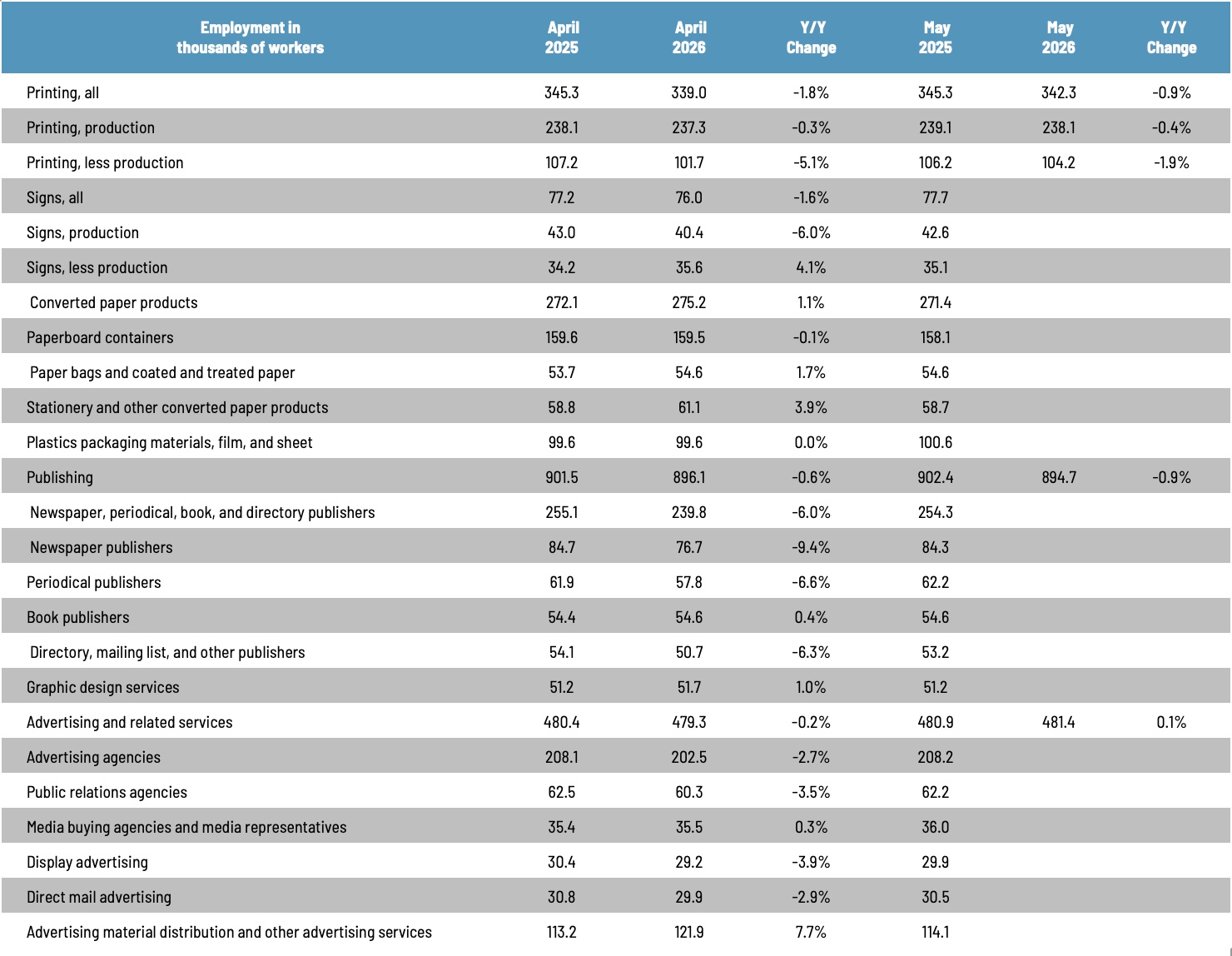
According to the latest, recently released edition of County Business Patterns, in 2023 there were 32,332 establishments in NAICS 511 (Publishing Industries [except Internet]). This represents an increase of 15% since 2010. In macro news, the University of Michigan’s Consumer Sentiment Index is at record lows. Read More

Finishing: Production Inkjet's Next Frontier

Finishing: Production Inkjet's Next Frontier

As production inkjet has advanced, a new primary factor limiting productivity has emerged: finishing. How are PSPs adapting their investment and automation strategies? New research shows many can gain a competitive advantage by focusing on finishing. Read More

HanGlobal Launches New LabStar 330mini at Flexo & Labels Expo 2026

HanGlobal Launches New LabStar 330mini at Flexo & Labels Expo 2026

Discover HanGlobal's newly launched LabStar 330mini digital label press! Get the full show roundup to see how this ultra-integrated, high-performance inkjet solution captured the crowd's attention and redefined narrow-web printing. Read More

Around the Web: Of Food and Feynman

Around the Web: Of Food and Feynman

A book designer who specializes in spine design. The Chinese postal service is using humanoid robots to sort packages. An amusingly overproduced Day Display. Allen Ginsberg’s spoken-word poetry recitation album is being reissued. The winners of this year’s World Food Photography Awards. A retired geneticist launched the online Museum of Plugs & Sockets. A viral warning about a new gas station scam is actually a hoax. What is the world’s longest domestic flight? Aw, et tu, graphene: Skeleton Technologies launches graphene-based GrapheneUPS for AI data centers. What is the quietest spot in the U.S.? Researchers finally cracked Richard Feynman’s “Restaurant Problem.” Malaysia’s kek lapis Sarawak is perhaps the world’s most complex cake. Welcome to WhatTheyThink’s weekly miscellany. Read More