WhatTheyThink

Premium Commentary & Analysis

Inside SkinnyScript Technology, The Real Deal?

There has been considerable interest of late on this SkinnyScript technology.

Sunday, September 30, 2001

There has been considerable interest of late on this SkinnyScript technology. When you say that file sizes were reduced 45 times smaller, that will usually get a little attention. When you speak as if it smoothly goes into any workflow, that gets even more attention. What is it? Does it really work? Who are these people? Canada based Consolidated Magna Ventures and PODbook.com, Magna’s wholly owned subsidiary announced on September 25 the launch of their proprietary technology, SkinnyScript. SkinnyScript is an encoding process that significantly reduces the size of graphic image files used in publishing, “without compromising image quality.” How much smaller? Company executives say publishers and printers can expect much smaller file sizes, which in turn create increased throughput, lower storage requirements and faster communication. Moreover, this is all based on Adobe's PDF file format. Case Study #1: PODbook formed an alliance with Copydot Prepress, a color service bureau that specializes in preparing publications for print. Testing was extensive and took many months to complete. Upon completion, CopyDot and PODbook.com convinced the San Jose Magazine to utilize the technology for their October issue. Apparently, all went well. The October issue of San Jose Magazine, "the Magazine for Silicon Valley", is a four-color, 180 page city and regional magazine and is on stands now. Gilbert Sangari, Publisher of the magazine said this about SkinnyScript. "Imagine someone coming to you with what sounds like a publisher’s dream and wants you to be the guinea pig. Well, this wasn’t a dream but a dream come true. It took us literally half the normal time to do our October issue. Not to mention handling the files back and forth between the magazine and pre-press via e-mail, not jazz disks. You can now have your cake and eat it too." Specifically, the 180 pages of the magazine originally comprised 18 gigabytes of data, all of which were processed using SkinnyScript to yield a final product totaling only 400 megabytes, roughly 45 times smaller. The files were delivered on a single CD to the printers for Computer-to-Plate printing. The bulk of the magazine was printed at Quebecor World Vancouver. The covers were printed at Teldon International of Richmond, B.C. A True Revolutionary Product? Magna certainly is acting like they have something no one else does. The company announced a week later that they would acquire their partner, Copydot Prepress. The company signed a Letter of Intent to purchase 100% of the issued and outstanding shares of Copydot. The President of Copydot, Rick Gagner, will be appointed to Magna's Board of Directors and both he and Peter Field, V.P. Marketing for Copydot will be offered management contracts. Both companies now conclude that SkinnyScript technology is a significant advancement in this industry, making the production and delivery cycles quicker and less costly than any other competitor can offer at this time. Magna President, Robert Archer stated "The events of the last few weeks have ushered in a new era for Magna. Our CTO, Daniel Walters has done an exemplary job in developing SkinnyScript for the prepress market and the team at Copydot has demonstrated a great deal of technical ability, professionalism and business acumen throughout the testing period. Through the last few months of our relationship we came to realize that we shared a common vision for the implementation of SkinnyScript in the prepress market and we are extremely pleased to join forces with them to build a significant presence in the printing industry.'' Case Study #2 Last week, the companies announced that another publication had successfully gone to press with SkinnyScript technology. "AIRLINES'', the in-flight magazine for Westjet Airlines, is published by Zulu Publications. Quebecor World again produced most of the publication. Rick Gagner, President of Copydot stated, "this is further support for the technology and workflow, and indicates that publishers can rely on this workflow to improve their productivity and costs. As a first time client, Zulu was quick to understand the importance of this process and is reaping the rewards immediately.'' The Companies are already working on the next issue of San Jose Magazine and contracts are being pursued with other publishers. The Skinny on SkinnyScript Executives have been very “tight lipped” about the process and understandably so. Here’s what we have learned so far. The SkinnyScript name was developed by Daniel Walters, but was originally supposed to be called Skinny Postscript. However, Adobe didn't allow this because Postscript is one of their trademarks. Rick Gagner said that Adobe is fully aware of the technology and supports it’s use. Apparently, SkinnyScript is a method of filtering the PostScript stream from applications and en-coding the PostScript before it is distilled by a standard PDF distiller to reduce file size. It reduces prepress quality PDF files small enough to be e-mailed by the pages or easily download a full 8up imposition in minutes. This process would normally “take hours and eat up the bandwidth.” Executives at Copydot and PODbook.com say after the November issue of the San Jose Magazine is completed, “it will show that SkinnyScript is a viable workflow.” The companies do not really see viable competitors to their product on the horizon. Says Daniel Walters, “With this amount of size reduction and quality level I don't of any others that would compete here.” Fractal algorithms are being used by others to further reduce file size. Is SkinnyScript simply more aggressive with the process? Walters says, “Fractals and mandibles use big words. Encoding means a reduction of verbosity. No fractals please, the programming for that stuff gives me a headache. Seamless yes, as simple as any other PostScript device or software application. Remember Postscript is device independent. SkinnyScript is still the same PostScript just encoded. It's Skinny, get it?” Got it. More to come!


Continue reading your article
with a WhatTheyThink membership.

WhatTheyThink Annual Membership

Less than $4/week.

Get unlimited access to in-depth commentary and analysis covering the latest trends, emerging technologies, operational strategies, and key events across every segment of today's printing industry.

Stay informed. Stay competitive. Stay ahead.
WhatTheyThink Day Pass

$5 for 24 hours

Unlimited access to all of WhatTheyThink. Get your Day Pass

Already a member?
Sign In

About WhatTheyThink

WhatTheyThink is the global printing industry's go-to information source with both print and digital offerings, including WhatTheyThink.com, WhatTheyThink Email Newsletters, and the WhatTheyThink magazine. Our mission is to inform, educate, and inspire the industry. We provide cogent news and analysis about trends, technologies, operations, and events in all the markets that comprise today's printing and sign industries including commercial, in-plant, mailing, finishing, sign, display, textile, industrial, finishing, labels, packaging, marketing technology, software and workflow.

Recent Articles from WhatTheyThink

Around the Web: Of Books and Bots

Around the Web: Of Books and Bots

New book “Empire of Ink” is a look at the history and mythology of the American newspaper. A hacked smart lightbulb provides access to banned books. A digital archive reassembles Leonardo da Vinci’s long-cut-apart notebooks. Michelangelo’s secret underground hiding place—complete with the artist’s graffiti. Marie Antoinette may have been history’s first influencer. A worn copy of a 1912 pulp magazine featuring Tarzan sold at auction for $58,560. New book, “The Graphene Handbook - Making Sense of Graphene at Its Inflection Point.” Visa is integrating its payment network into ChatGPT, which should be fun. A humanoid robot plans to climb Everest. A designer who specializes in chairs without legs. Did a flying monk see Halley’s Comet…twice? The British geologist whose goal was to eat as many different animals as he possibly could. Welcome to WhatTheyThink’s weekly miscellany. Read More
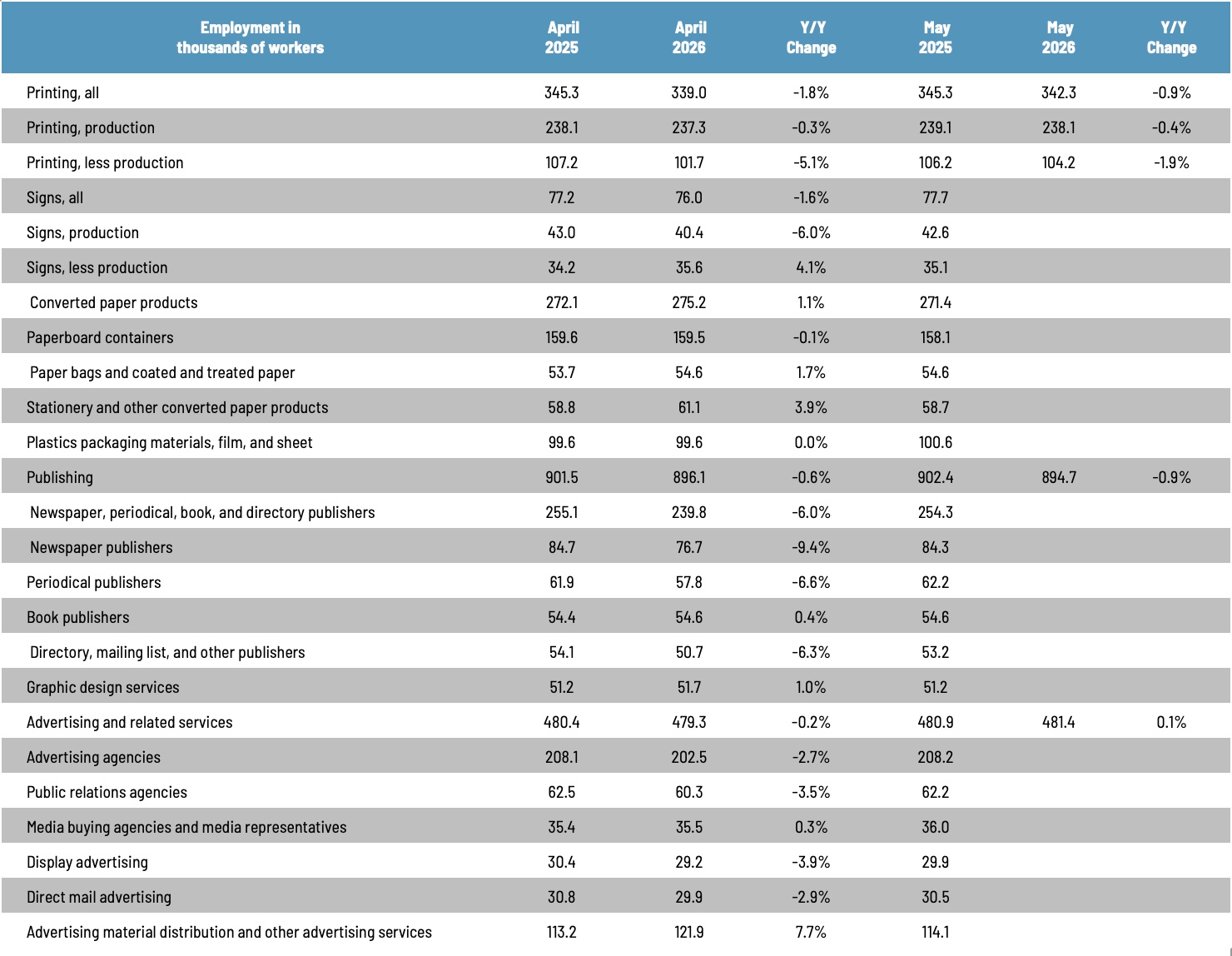
Publishing Establishments—2010–2023

Publishing Establishments—2010–2023

According to the latest, recently released edition of County Business Patterns, in 2023 there were 32,332 establishments in NAICS 511 (Publishing Industries [except Internet]). This represents an increase of 15% since 2010. In macro news, the University of Michigan’s Consumer Sentiment Index is at record lows. Read More

Finishing: Production Inkjet's Next Frontier

Finishing: Production Inkjet's Next Frontier

As production inkjet has advanced, a new primary factor limiting productivity has emerged: finishing. How are PSPs adapting their investment and automation strategies? New research shows many can gain a competitive advantage by focusing on finishing. Read More

HanGlobal Launches New LabStar 330mini at Flexo & Labels Expo 2026

HanGlobal Launches New LabStar 330mini at Flexo & Labels Expo 2026

Discover HanGlobal's newly launched LabStar 330mini digital label press! Get the full show roundup to see how this ultra-integrated, high-performance inkjet solution captured the crowd's attention and redefined narrow-web printing. Read More

Around the Web: Of Food and Feynman

Around the Web: Of Food and Feynman

A book designer who specializes in spine design. The Chinese postal service is using humanoid robots to sort packages. An amusingly overproduced Day Display. Allen Ginsberg’s spoken-word poetry recitation album is being reissued. The winners of this year’s World Food Photography Awards. A retired geneticist launched the online Museum of Plugs & Sockets. A viral warning about a new gas station scam is actually a hoax. What is the world’s longest domestic flight? Aw, et tu, graphene: Skeleton Technologies launches graphene-based GrapheneUPS for AI data centers. What is the quietest spot in the U.S.? Researchers finally cracked Richard Feynman’s “Restaurant Problem.” Malaysia’s kek lapis Sarawak is perhaps the world’s most complex cake. Welcome to WhatTheyThink’s weekly miscellany. Read More