WhatTheyThink

Premium Commentary & Analysis

Perspective: Price Wars & Eroding Margins: Don't Blame the Client

As the 20th century drew to a close,

Thursday, June 27, 2002

As the 20th century drew to a close, we could not have asked for a better picture of our economy. The business climate was the best it had been in many of our lifetimes, and the state of the printing industry was, to say the least, as good as it gets.

Looking back, among many economic influences there were two key phenomena occurring, the magnitude of which will most likely not be seen any time soon: Y2K and the dot com craze. For a solid three years before the new millennium, we were warned of impending computer collapse, because back in the infancy of the PC, no one thought about the universal impact of millions of computers not being able to tell the difference between the years 2000 and 1900.

So what happened? Every company from General Electric to the corner drugstore went out and started to buy new computers, new software, and just about anything else deemed to be "Y2K compliant." Consumers followed suit in fear that come January 1, 2000, cars wouldn’t start, crushed ice wouldn’t come out of the freezer, and maybe for the first time, the clock on the VCR would stop flashing 12:00. Microsoft took off. Intel flourished. Dell became a household word. As for dot com, what more needs to be said.

But, as the saying goes, "All good things must come to an end," and by the second quarter of 2000 the train began to slide downhill. Manufacturing that was expanding exponentially, started to face the problem of high inventories with reduced demand. This of course began the domino effect of decreased sales, lower profits, reduced workforces, and most significantly, the stock market reaction of wiping out shareowner value. Oh yes, and don’t forget, dot gone.

So what did we in the printing business do? Well, in our eagerness to keep up our record sales pace of the end of the most prosperous decade of the century, we knee-jerked to a market that was desperately searching for any lifeline to save corporate profits. But just like our corporate clients, much of our previous success was the result, not just of the high demand we were fortunate to enjoy, but also because we did a good job of reducing our overhead, trimming fat, and becoming as productive and efficient as possible.

So when Joe Buyer all of sudden was given the mandate by his CFO to "beat down the price" from the supplier, we went to war with each other for what small fragments of the profit pie that remained. The strategy turned to: cut the price to keep the volume, and sacrifice a bit of margin to keep moving forward. Not the best strategy when your dealing with serious over capacity in the printing industry and two new and significant forces that seemed to have born with the sole purpose of driving as many printing companies into submission as possible: E-COMMERCE and The RATE CARD.

Don’t get me wrong, I am not a total opponent of e-commerce, however, the manner in which it is currently being utilized is a far cry from the new efficient work flow that it has been sold on. First, the landscape of e-commerce providers has dwindled from a plethora, to a paltry few. Second, from a supplier’s standpoint, the time, effort and expense of e-commerce has actually caused an increase in costs, not a decrease. And on top of all this, many of the e-commerce providers are demanding 2% of the value of the job as a transaction fee. Hardly seems like a way to become more productive and efficient. But for the time being it is here, and it has given us another opportunity to give away some more of the minuscule profit margin, leaving, dot none.

And now for one of my favorites: The Rate Card. Also masquerading as the Supplier Questionnaire, RFI, RFP, or RFQ. I wish it would just RIP. Give credit to the consultant who came up with the idea to convince corporate management that he could deliver overall savings of 20% - 70% of the company’s print purchasing expenditures in an industry where the average margin is in the low single digits. And give this consultant even more credit for making the sale without having any legitimate way to verify any of these promised savings (which I defy anyone who knows anything about what we do, to prove!)

But once again, being the magnanimous types that we are, we just kept lowering and lowering our prices each time the email came back with a new "target price" that was already about 10% lower than just the cost of the paper. I know one senior executive at a well known printing company who told me that to stay in one of the latest rate card competitions, he would have needed to sell his work with absolutely no value added in the price!

So now we keep hearing about the, slow all be it, but impending economic recovery. We are being told that maybe there never really was a recession. We’re supposed to be on the heals of an upswing. But the marketing support levels in corporate America haven’t returned just yet. And the reduced level of work that exists, continues to be fought after by too many suppliers with too much excess capacity. So the only way to get it is, you guessed, let’s lower our price.

I do believe that the recovery will be here soon... I just hope that when it does arrive, we don’t give it away to the first guy who asks for it.


Continue reading your article
with a WhatTheyThink membership.

WhatTheyThink Annual Membership

Less than $4/week.

Get unlimited access to in-depth commentary and analysis covering the latest trends, emerging technologies, operational strategies, and key events across every segment of today's printing industry.

Stay informed. Stay competitive. Stay ahead.
WhatTheyThink Day Pass

$5 for 24 hours

Unlimited access to all of WhatTheyThink. Get your Day Pass

Already a member?
Sign In

About WhatTheyThink

WhatTheyThink is the global printing industry's go-to information source with both print and digital offerings, including WhatTheyThink.com, WhatTheyThink Email Newsletters, and the WhatTheyThink magazine. Our mission is to inform, educate, and inspire the industry. We provide cogent news and analysis about trends, technologies, operations, and events in all the markets that comprise today's printing and sign industries including commercial, in-plant, mailing, finishing, sign, display, textile, industrial, finishing, labels, packaging, marketing technology, software and workflow.

Recent Articles from WhatTheyThink

Around the Web: Of Books and Bots

Around the Web: Of Books and Bots

New book “Empire of Ink” is a look at the history and mythology of the American newspaper. A hacked smart lightbulb provides access to banned books. A digital archive reassembles Leonardo da Vinci’s long-cut-apart notebooks. Michelangelo’s secret underground hiding place—complete with the artist’s graffiti. Marie Antoinette may have been history’s first influencer. A worn copy of a 1912 pulp magazine featuring Tarzan sold at auction for $58,560. New book, “The Graphene Handbook - Making Sense of Graphene at Its Inflection Point.” Visa is integrating its payment network into ChatGPT, which should be fun. A humanoid robot plans to climb Everest. A designer who specializes in chairs without legs. Did a flying monk see Halley’s Comet…twice? The British geologist whose goal was to eat as many different animals as he possibly could. Welcome to WhatTheyThink’s weekly miscellany. Read More
Publishing Establishments—2010–2023

Publishing Establishments—2010–2023

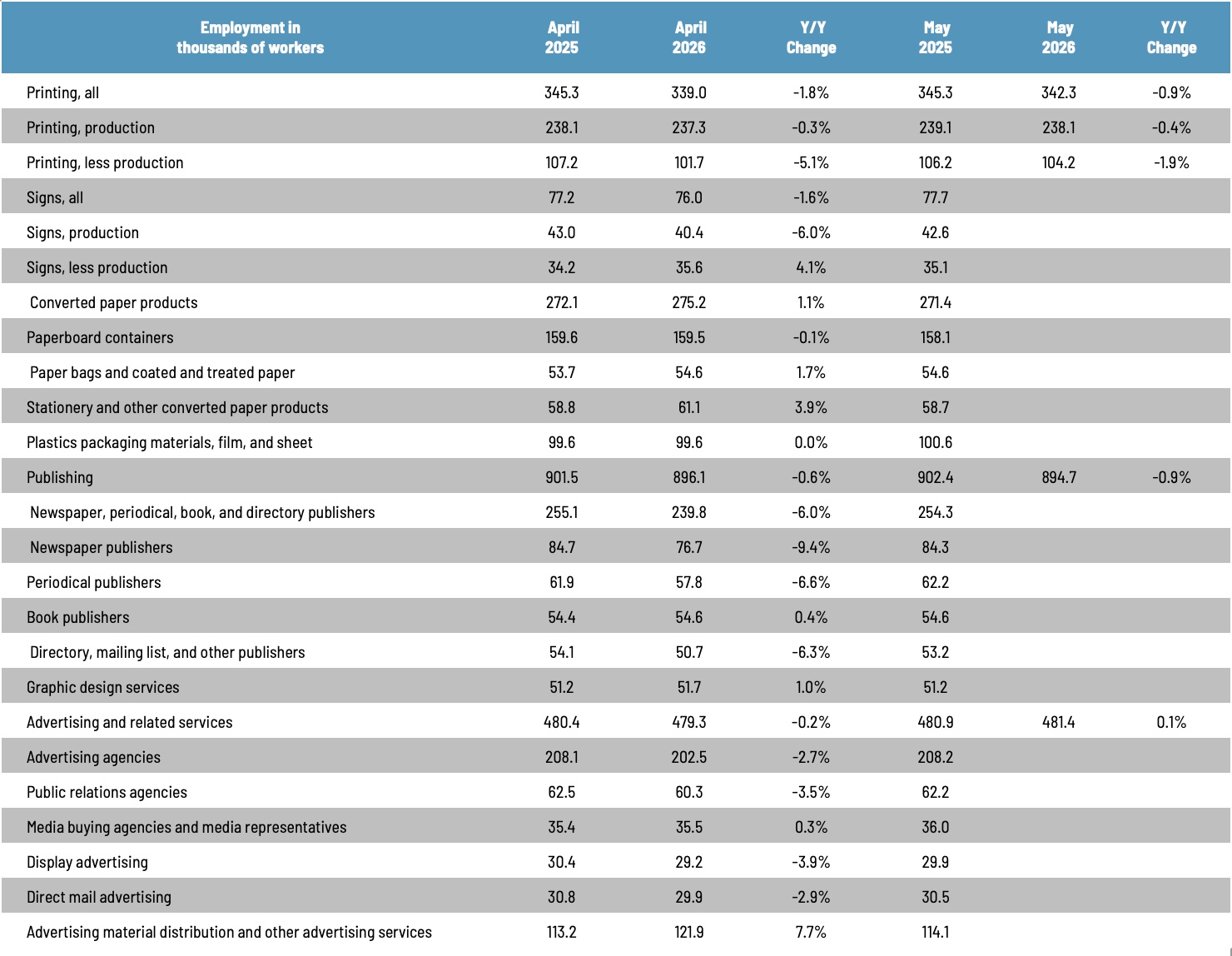
According to the latest, recently released edition of County Business Patterns, in 2023 there were 32,332 establishments in NAICS 511 (Publishing Industries [except Internet]). This represents an increase of 15% since 2010. In macro news, the University of Michigan’s Consumer Sentiment Index is at record lows. Read More

Finishing: Production Inkjet's Next Frontier

Finishing: Production Inkjet's Next Frontier

As production inkjet has advanced, a new primary factor limiting productivity has emerged: finishing. How are PSPs adapting their investment and automation strategies? New research shows many can gain a competitive advantage by focusing on finishing. Read More

HanGlobal Launches New LabStar 330mini at Flexo & Labels Expo 2026

HanGlobal Launches New LabStar 330mini at Flexo & Labels Expo 2026

Discover HanGlobal's newly launched LabStar 330mini digital label press! Get the full show roundup to see how this ultra-integrated, high-performance inkjet solution captured the crowd's attention and redefined narrow-web printing. Read More

Around the Web: Of Food and Feynman

Around the Web: Of Food and Feynman

A book designer who specializes in spine design. The Chinese postal service is using humanoid robots to sort packages. An amusingly overproduced Day Display. Allen Ginsberg’s spoken-word poetry recitation album is being reissued. The winners of this year’s World Food Photography Awards. A retired geneticist launched the online Museum of Plugs & Sockets. A viral warning about a new gas station scam is actually a hoax. What is the world’s longest domestic flight? Aw, et tu, graphene: Skeleton Technologies launches graphene-based GrapheneUPS for AI data centers. What is the quietest spot in the U.S.? Researchers finally cracked Richard Feynman’s “Restaurant Problem.” Malaysia’s kek lapis Sarawak is perhaps the world’s most complex cake. Welcome to WhatTheyThink’s weekly miscellany. Read More