WhatTheyThink

Premium Commentary & Analysis

PART TWO: Clearly Ready: Joe Truncale, Executive Vice President and future leader of NAPL

In February,

Monday, June 24, 2002

In February, NAPL - the National Association for Printing Leadership, formalized the intentions of I. Gregg Van Wert to step down as president and CEO of the 69-year-old association at the end of this year. His decision was planned and follows a career with the Association that spans almost 30 years of industry service. He has served as NAPL’s President and CEO since January, 1992.

NAPL simultaneously announced that a management transition had commenced which would elevate Joseph P. Truncale to the position of NAPL President on January 1, 2003. Truncale has served as NAPL’s Executive Vice President since 1992.

Joseph P. Truncale joined the staff of NAPL in 1984 as Director of Member Relations. In 1988 he was given the added title of Senior Staff Director. He was named Executive Vice President in 1992.

In part one, Gregg Van Wert offered his perspective on the industry and changes over the years at NAPL. Today, Joe Truncale shares his thoughts going forward and what the future holds for NAPL and the printing industry.


WTT: Joe, you have served as NAPL’s Executive Vice President since 1992, and in other positions dating back to 1984. What did you learn from Mr. Van Wert during his tenure?

Joe Truncale:
I’ve had the privilege of working with Gregg since 1984, and during those 18 years I have learned many important things from him. First and foremost, I’ve learned that our industry is truly unique, and that, despite the technological and structural changes it has undergone in recent years, it always has been and it continues to be people-centered. We may now be able to communicate and conduct business with great speed, but the value of the quality relationships we form during the course of business are what really counts, and those relationships will always carry considerable meaning. If you’re in business for the long haul, you will find that there is simply no substitute for building and maintaining quality relationships.


WTT: What’s the number one item on your to-do list once you become president of NAPL?

Joe Truncale:
My first goal is to put in place a system for reaching out on a regular basis to all NAPL members and key stakeholders so that we can garner feedback on our current offerings while, at the same time, gain insights into the industry’s operating environment in order to assess its future needs. Change happens at a incredibly rapid pace, one that only promises to quicken over the coming years. If we want NAPL to be the resource our members turn to FIRST for quality insights and dependable advice, we need to be out front listening to them on a number of levels—not only through formal surveys, but through thoughtful one-on-one dialogue and other personal feedback processes.


WTT: What do you see as the greatest challenges facing printers today?

Joe Truncale:
The single greatest challenge printers now face is finding a way to understand and maximize the many opportunities that will undoubtedly present themselves, but will do so only to those who are the most astute and best prepared. We at NAPL are very optimistic about the opportunities that are opening up in the graphic arts and about what they will mean to the success of our members, but we also know that, in the future, success in our industry is going to look and feel very different than it has in the past.

Our most successful members are already diversifying their products and services so that they may provide a broader range of assistance to their customers. In so doing, they are developing an even deeper understanding of the business communication objectives those customers have, and they are learning that those objectives include, but certainly are not limited to, print.


WTT: How will NAPL help printers meet those challenges?

Joe Truncale:
It has always been NAPL’s role to create an environment where members can talk with, and learn from, each other, where they are free to engage in the kind of industry networking that is valuable at many levels and in many ways. The Association was founded in 1933 for that very reason—so that forward-thinking printers could have a forum for sharing the ideas, information, and insights that would benefit all who participated and our industry as a whole. That objective is as sound today as it was nearly 70 years ago, and NAPL is as firmly committed to making it happen as it was then, although we are doing so now in ways our founders would never have dreamed possible.

True to our mission of "Enabling the printing community to profit from change," NAPL continues to be at the forefront of our industry in facilitating and encouraging the interchange of ideas, and in providing our members with dependable information, insights, and advice both through traditional methods, such as on-site consulting, newsletters, and seminars, and through the new opportunities technology affords us, such as videoconferencing, distance learning, and periodicals delivered electronically.


WTT: How can printers best educate and train employees, including sales and technical personnel?

Joe Truncale:
There are many effective ways for printers to train and develop their employees’ skills, and I am proud of the fact that NAPL provides some of the finest sales training available anywhere through its seminars, books, periodicals, consulting services, and, of course, the distinctive Sales & Marketing Course that is offered as part of our annual NAPL Management Institute at Northwestern University.

Our recently introduced Professional Membership program offers job-specific educational materials such as newsletters, books, tapes, and seminars for printing professionals in human resources, finance, production management, and sales and marketing. These individual professional memberships are included at no additional cost to our NAPL corporate members, and they are available on an individual basis to anyone in the industry at a very affordable rate. This is just one example of how the Association continues to tailor its offerings to meet the specific management development needs of our industry.


Thank you Joe. We look forward to your tenure and wish you the very best.


Continue reading your article
with a WhatTheyThink membership.

WhatTheyThink Annual Membership

Less than $4/week.

Get unlimited access to in-depth commentary and analysis covering the latest trends, emerging technologies, operational strategies, and key events across every segment of today's printing industry.

Stay informed. Stay competitive. Stay ahead.
WhatTheyThink Day Pass

$5 for 24 hours

Unlimited access to all of WhatTheyThink. Get your Day Pass

Already a member?
Sign In

About WhatTheyThink

WhatTheyThink is the global printing industry's go-to information source with both print and digital offerings, including WhatTheyThink.com, WhatTheyThink Email Newsletters, and the WhatTheyThink magazine. Our mission is to inform, educate, and inspire the industry. We provide cogent news and analysis about trends, technologies, operations, and events in all the markets that comprise today's printing and sign industries including commercial, in-plant, mailing, finishing, sign, display, textile, industrial, finishing, labels, packaging, marketing technology, software and workflow.

Recent Articles from WhatTheyThink

Around the Web: Of Books and Bots

Around the Web: Of Books and Bots

New book “Empire of Ink” is a look at the history and mythology of the American newspaper. A hacked smart lightbulb provides access to banned books. A digital archive reassembles Leonardo da Vinci’s long-cut-apart notebooks. Michelangelo’s secret underground hiding place—complete with the artist’s graffiti. Marie Antoinette may have been history’s first influencer. A worn copy of a 1912 pulp magazine featuring Tarzan sold at auction for $58,560. New book, “The Graphene Handbook - Making Sense of Graphene at Its Inflection Point.” Visa is integrating its payment network into ChatGPT, which should be fun. A humanoid robot plans to climb Everest. A designer who specializes in chairs without legs. Did a flying monk see Halley’s Comet…twice? The British geologist whose goal was to eat as many different animals as he possibly could. Welcome to WhatTheyThink’s weekly miscellany. Read More
Publishing Establishments—2010–2023

Publishing Establishments—2010–2023

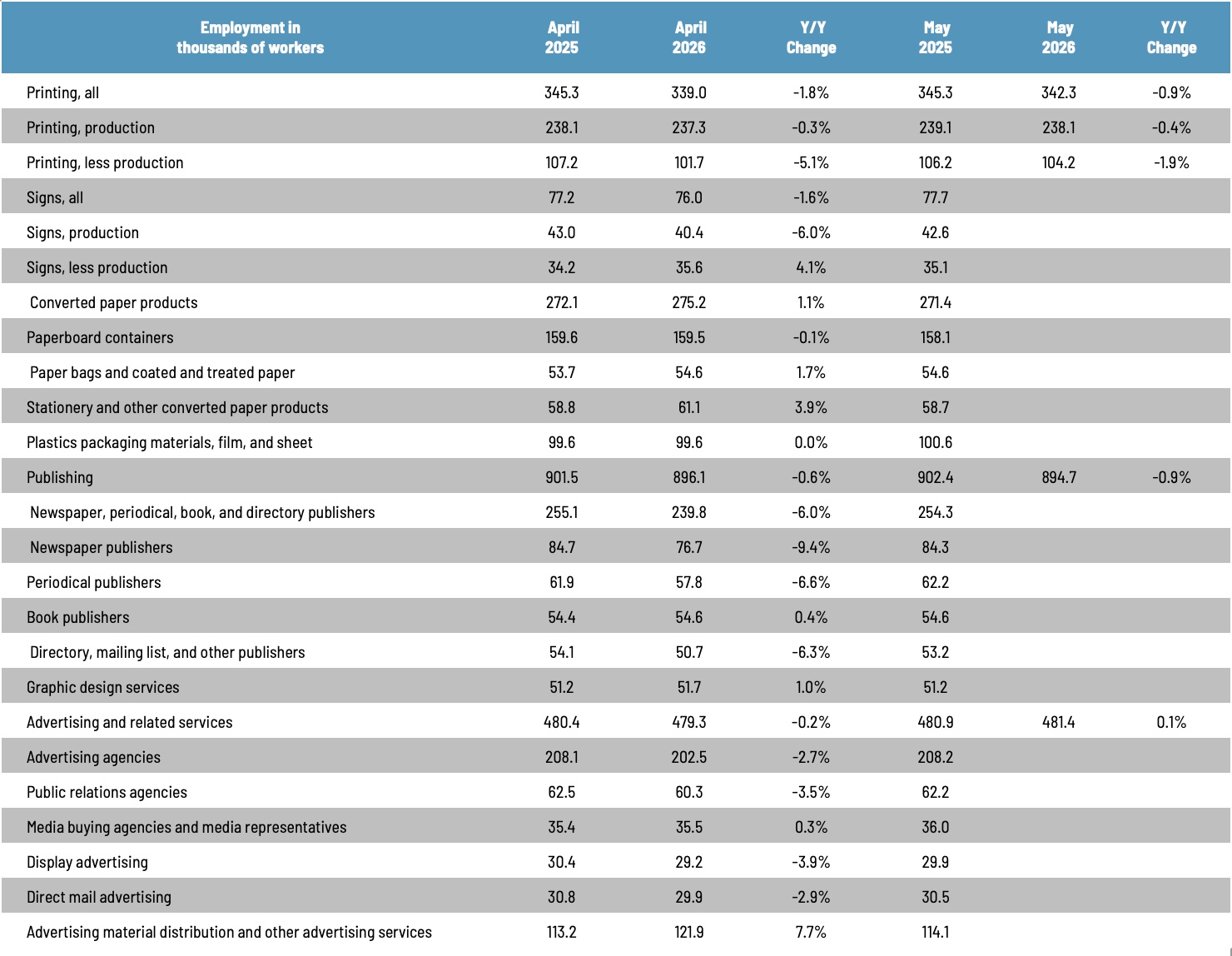
According to the latest, recently released edition of County Business Patterns, in 2023 there were 32,332 establishments in NAICS 511 (Publishing Industries [except Internet]). This represents an increase of 15% since 2010. In macro news, the University of Michigan’s Consumer Sentiment Index is at record lows. Read More

Finishing: Production Inkjet's Next Frontier

Finishing: Production Inkjet's Next Frontier

As production inkjet has advanced, a new primary factor limiting productivity has emerged: finishing. How are PSPs adapting their investment and automation strategies? New research shows many can gain a competitive advantage by focusing on finishing. Read More

HanGlobal Launches New LabStar 330mini at Flexo & Labels Expo 2026

HanGlobal Launches New LabStar 330mini at Flexo & Labels Expo 2026

Discover HanGlobal's newly launched LabStar 330mini digital label press! Get the full show roundup to see how this ultra-integrated, high-performance inkjet solution captured the crowd's attention and redefined narrow-web printing. Read More

Around the Web: Of Food and Feynman

Around the Web: Of Food and Feynman

A book designer who specializes in spine design. The Chinese postal service is using humanoid robots to sort packages. An amusingly overproduced Day Display. Allen Ginsberg’s spoken-word poetry recitation album is being reissued. The winners of this year’s World Food Photography Awards. A retired geneticist launched the online Museum of Plugs & Sockets. A viral warning about a new gas station scam is actually a hoax. What is the world’s longest domestic flight? Aw, et tu, graphene: Skeleton Technologies launches graphene-based GrapheneUPS for AI data centers. What is the quietest spot in the U.S.? Researchers finally cracked Richard Feynman’s “Restaurant Problem.” Malaysia’s kek lapis Sarawak is perhaps the world’s most complex cake. Welcome to WhatTheyThink’s weekly miscellany. Read More