WhatTheyThink

Premium Commentary & Analysis

The Path to Profitable Diversification - Part 2

By David Dodd April 15,

Thursday, April 15, 2004

By David Dodd April 15, 2004 -- This is the second of two articles that are describing the steps that printing company managers should take to improve the odds of achieving real success when diversifying their business operations through the addition of one or more value added services. In Part 1 , we made the point that printers should first develop a sound diversification strategy, and we explained how to decide which value added service or services to offer. We also contended that printing company managers must think in terms of “value added solutions” rather than individual value added services in order to avoid the growing commoditization of value added services. And finally, we observed that printers must design and implement an operating model that embodies and supports the strategy of providing true value added solutions. This article will discuss one of the core business processes that value added solution providers must be able to perform effectively and efficiently if they want to be successful—the process of selling solutions. The first and most important key to success in selling value added solutions is recognizing that solution selling differs in fundamental ways from selling traditional printing services. Some industry pundits contend that the secret to increasing value added services sales is simply to identify the right “customer.” While identifying the right buyer is clearly important, the reality is that successfully selling value added services requires more than simply finding the right person to “pitch.” And, successfully selling value added solutions demands an even greater change in printers' sales methodology than selling individual value added services. What printing company managers must recognize is that successfully selling value added solutions requires an entirely different sales strategy and process from the one used for selling traditional printing services. A sound value added solution sales strategy contains five key elements—buyer identification, seller strengths and weaknesses, business results and personal victories, need analysis, and value justification. The first three of these strategy elements exist because of the underlying structure of value added solutions sales. The last two elements are made necessary because of the inherent characteristics of value added solutions—a focus on broad customer outcomes, the requirement for a high level of customization and integration, and the necessity of gaining in-depth knowledge regarding the customer's business operations. In our book, Making Value Added Services Work , we describe all five key elements of an effective value added solution sales strategy in detail. In this article, we will focus on the structure of value added solution sales and explain how that structure differs from the structure of traditional printing sales. Sales structure is one of the major differences between a traditional commercial printing business and a value added solutions business. Sales of conventional print jobs are, for the most part, simple sales from a structural perspective. By simple, we mean that the print salesperson typically deals with one individual “buyer” throughout the sales process and that individual makes the ultimate purchase decision. In contrast, sales of value added solutions will almost always be complex sales. A complex sale can be defined as a sale in which two or more individuals must give their approval or input before the purchase decision can be made. Because of their breadth and scope, value added solutions will usually involve several areas of the customer's business. It is not uncommon, for example, for a value added solution to affect a customer's marketing department, sales department, and IT department. In this situation, individuals from all three of these departments are likely to be involved in the purchase decision. And, because of the costs involved, it is not unusual for the purchase of a value added solution to require the approval of the customer's finance department and perhaps its legal department as well. The number and variety of individuals involved in sales of value added solutions and the necessity of obtaining multiple approvals before a sale can be closed mean that a salesperson involved in such sales must use a selling process that is more strategic and more analytical than the process used for selling conventional print jobs. By “strategic,” we mean that the sales process must place at least as much importance on what occurs before the sales call as what occurs during the sales call. The sale of a value added solution requires the salesperson to gather and digest a huge volume of information. The salesperson is facing multiple “buyers” who have different personalities, different interests, and different (and perhaps conflicting) objectives and agendas. When you add the formal approval process that exists in many corporate environments, it's easy to understand why selling value added solutions is a complicated job. In a complex sale environment, the salesperson needs a strategy and a system for organizing and analyzing the huge amount of information that is involved in value added solution selling. Successfully managing a complex sale involves identifying all of the individuals who will be participating in the approval process, understanding the specific role that each person is playing, and establishing a position with each of these buyers. Then the salesperson must demonstrate why the proposed value added solution will benefit not only the “customer”—the business enterprise as a whole—but also each of the individual buyers. Mastering the art of making complex sales is not the only selling skill that is needed for success with value added solutions, but it is a necessary element of success.


Continue reading your article
with a WhatTheyThink membership.

WhatTheyThink Annual Membership

Less than $4/week.

Get unlimited access to in-depth commentary and analysis covering the latest trends, emerging technologies, operational strategies, and key events across every segment of today's printing industry.

Stay informed. Stay competitive. Stay ahead.
WhatTheyThink Day Pass

$5 for 24 hours

Unlimited access to all of WhatTheyThink. Get your Day Pass

Already a member?
Sign In

About WhatTheyThink

WhatTheyThink is the global printing industry's go-to information source with both print and digital offerings, including WhatTheyThink.com, WhatTheyThink Email Newsletters, and the WhatTheyThink magazine. Our mission is to inform, educate, and inspire the industry. We provide cogent news and analysis about trends, technologies, operations, and events in all the markets that comprise today's printing and sign industries including commercial, in-plant, mailing, finishing, sign, display, textile, industrial, finishing, labels, packaging, marketing technology, software and workflow.

Recent Articles from WhatTheyThink

Print ERP Built Natively Inside Microsoft Dynamics 365

Print ERP Built Natively Inside Microsoft Dynamics 365

No third-party integrations. No disconnected systems. DynamicsPrint® extends Microsoft Dynamics 365 F&SCM with print-specific ERP designed to scale globally with your business. Read More

Around the Web: Of Moons and Mother Roads

Around the Web: Of Moons and Mother Roads

The 1835 “Moon Hoax” made ridiculous news stories credible. The USPS is issuing the 2026 Route 66 Centennial Stamp Collection. Highlights from the recent Sustainable Brands Conference. Researchers have created what might be the most accurate mathematical representation of color perception ever. When in North Dakota, visit the Theodore Roosevelt Presidential Library, which opens tomorrow, July 4. An Etsy gardening scam features AI-generated plant images and fake seeds.  Good grief: corneal tattooing is a thing. Graphene radar-absorbing coatings for defense use. If you missed Monday’s Strawberry Moon, more moons are coming. Answering the burning question: “do bug zappers still exist?” Turn any water bottle into a water vessel for dogs. Is there any advantage to “alkaline water”? Welcome to WhatTheyThink’s weekly miscellany. Read More
Graphic Arts Employment in May Up Overall—Substantially Among Non-Production

Graphic Arts Employment in May Up Overall—Substantially Among Non-Production

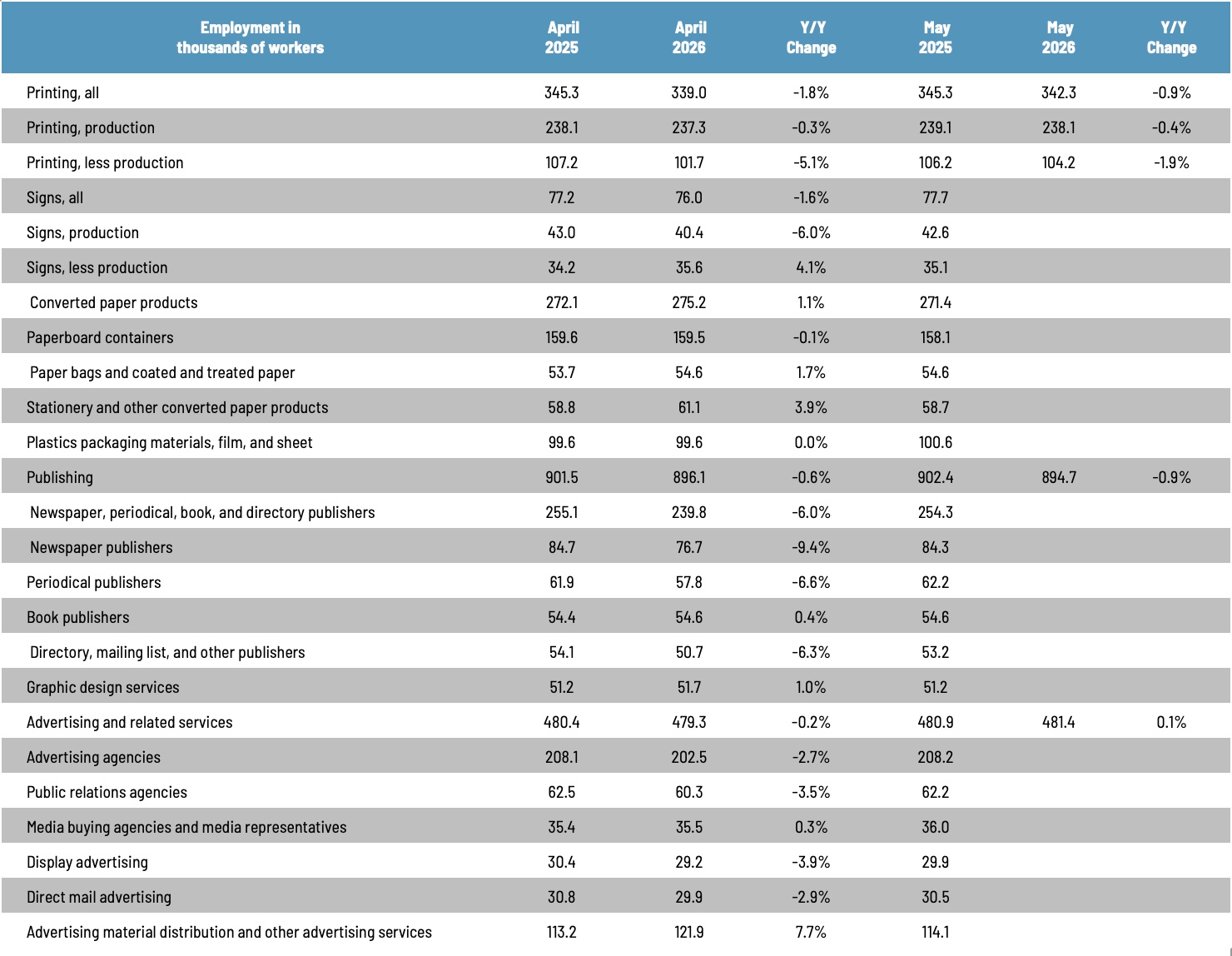
After a sluggish four months, the employment situation picked up in May, with overall printing industry employment up 1.0% from April, production employment up 0.3%, and non-production employment up 2.5%. Read More

Explore Mohawk's new paper options for all your digital printing needs

Explore Mohawk's new paper options for all your digital printing needs

Digital printing is the answer to the agility of modern work?ow. Mohawk Digital offers a diverse collection of fine and production papers for Inkjet, Dry Toner and HP Indigo presses. Read More

Around the Web: Of Botticelli and Beef

Around the Web: Of Botticelli and Beef

Newspaper Club has partnered with type foundry abcD8 to create a custom typeface inspired by the visual history of newspapers. MAD magazine has published its 600th issue. “Wordhord: Old English Word of the Day.” New evidence for the cause of death of the model for Botticelli’s “Birth of Venus.” Attending a Zoom meeting while on a roller coaster. Graphene-enabled PFAS-free firefighting foam. A jacket that can harvest moisture from the atmosphere. The iPhone’s Vehicle Motion Cues are surprisingly effective at reducing car sickness. An e-bike designed specifically to carry children. “Do fitness trackers still work if you have tattoos?” Rouser Lab’s “Earth’s black box” attempts to track humanity’s spiral into environmental destruction. “Beef tea” was a thing in the 19th century. Welcome to WhatTheyThink’s weekly miscellany. Read More