WhatTheyThink

Premium Commentary & Analysis

Mail-Well reports their Sixth Consecutive Quarter of year over year improvement: Summary of Q4 Earnings Call

By Ann Levine February 11,

Wednesday, February 11, 2004

By Ann Levine February 11, 2004 – Mail-Well, Inc. (NYSE: MWL) today announced fourth quarter net income of $5.7 million or $0.12 per diluted share compared to a net loss of $2.6 million or $0.05 per diluted share for the same period last year. For the full year, Mail-Well reported net income of $8.4 million of $0.17 per diluted share. Full year 2002 figures were a net loss of $202 million or $4.24 per diluted share. Fourth quarter EBITDA was $39.5 million with full year EBITDA at $131.6 million representing a 9% improvement over 2002 EBITDA of $121 million. Topics of this summary: Commercial Segment Results Resale Segment Results 2003 Achievements 2004 Strategy and Guidance Q & A Commercial Segment Results The Commercial Segment, serving the needs of direct customers, makes up approximately 75% of Mail-Well's sales. This segment is made up of the commercial printing operation and envelope operation serving commercial direct and transactional customers. The fourth quarter resulted in improved performance with an increase in EBITDA margins of 8.5%. Sales on a same-store basis were flat during the quarter compared with last year. For the full year, sales were up 2.2%. Mail-Well has increased activity in fulfillment type services and has expanded market share with local businesses. Resale Segment Results The Resale segment is made up of printed office products and resale envelope operations. Sales were down 6.2% from $103.9 to $97.5 million. The Office Products sector continues to demand lower pricing leading to a decrease in sales to $19 million of 4.5%. EBITA increased by $2.1 million to $14.8 million. 2003 Achievements Mail-Well reported the sixth consecutive quarter of year over year improvement during today's earnings call. The pricing pressures faced during the year cost the company $40 million. Company President and CEO, Paul Reilly, stated that the company achieved 1.7% real sales growth while the composite market declined by 3.6%. Mail-Well reported on progress in changing its culture through the implementation of significant employee training in supervisory skills, quality and sales. Additionally the company has implemented a mobilization program to achieve a higher level of productivity with processes. This program includes employee and customer surveys to determine a greater level of responsiveness customer needs. Last quarter's reorganization along customer-centric lines, as opposed to product lines, has shown results with recent wins of three clients with multi-year contracts. 2004 Strategy and Guidance As part of its 2004 strategy, Mail-Well will follow the tenants of its SOAR program and its related mobilization and investment of employees. The company will also focus on customer communication needs and apply solutions for customized messages and solutions. The company expects sustained growth due to positive economic indicators. At the same time, CEO Reilly stated negative indicators include overcapacity in the envelope industry with capacity utilization at 52%, soft pricing and “irrational” paper pricing increases. Among the positive and negative indicators, Mail-Well expected EBITDA in the $135-$142 million range for 2004. The recent announcement on subnotes will result in $18 million in charges in the first quarter and will impact EPS by about $0.22 per share. Q & A Although the envelope division has been a tough area for Mail-Well, fourth quarter results were strong and the expectation is for continued strength and sustainability. Mail-Well's capacity utilization is in the plus or minus 60% range across each of the lines. Sales are getting a bit better in units, but the 1.7% real growth is not making a dent in utilization. Capital expenditures for 2004 are expected in the $20-25 million range. When advantageous, the company takes on additional capital expenditures financed through operating leases. The actual capital expenditures will be in the mid $30 million range. Capital expenditures allow the company to acquire new equipment and allow the shut down of older equipment. The benefits of the national “Do Not Call List” has seen an increase in direct mail that was stronger during the fourth quarter than the previous quarter. Mail-Well was non-committal on an increase in M & A activity in the printing sector. The corporate expense at $3 million is not a reasonable run rate going forward. $20-25 million a year is more normalized. In order to regain a hold on pricing, Mail-Well's capacity utilization rate would need to increase 5 points. Volume increases of 10% would have a significant impact. Volume increases have been across the board in both lines, with real growth in the commercial segment. Given the company's current plans, the last 6 months of 2004 is expected to generate the numbers to reach the company's growth target. Assumptions underlying Mail-Well's future growth is 0-1% market growth or $18-20 million in market share growth on top of that is $100 million in additional sales. Mail-Well's experience with customer trends cited in today's conference call were a) a reduction in the number of venders and b) customers seeking more services from one vendor. Mail-Well does not disclose its customer churn rate but admitted today customer churn is an important part of the company's business. With larger customers there is less churn. Churn is typically in the medium to small customers. With the recently announced direct mail wins, Mail-Well's contracts include fixed pricing in the first year with an opener after that. Margins on the contracts are dependent upon company performance. In the pricing arena and the ability to pass on costs to the customer, in the commercial segment, new pricing is part of every quote. In the transactional arena, pricing is negotiable. Within the resale segment, Mail-Well typically commits to a price one year out due to products appearance in a customer's catalog. Increases in raw materials have been roughly 10%. Mail-Well's Reilly stated that trends indicate television ads will decrease due to trends of marketers using a combination of direct mail and cable and with the onset of TIVO, more ad dollars will be spent on direct mail.


Continue reading your article
with a WhatTheyThink membership.

WhatTheyThink Annual Membership

Less than $4/week.

Get unlimited access to in-depth commentary and analysis covering the latest trends, emerging technologies, operational strategies, and key events across every segment of today's printing industry.

Stay informed. Stay competitive. Stay ahead.
WhatTheyThink Day Pass

$5 for 24 hours

Unlimited access to all of WhatTheyThink. Get your Day Pass

Already a member?
Sign In

About WhatTheyThink

WhatTheyThink is the global printing industry's go-to information source with both print and digital offerings, including WhatTheyThink.com, WhatTheyThink Email Newsletters, and the WhatTheyThink magazine. Our mission is to inform, educate, and inspire the industry. We provide cogent news and analysis about trends, technologies, operations, and events in all the markets that comprise today's printing and sign industries including commercial, in-plant, mailing, finishing, sign, display, textile, industrial, finishing, labels, packaging, marketing technology, software and workflow.

Recent Articles from WhatTheyThink

Print ERP Built Natively Inside Microsoft Dynamics 365

Print ERP Built Natively Inside Microsoft Dynamics 365

No third-party integrations. No disconnected systems. DynamicsPrint® extends Microsoft Dynamics 365 F&SCM with print-specific ERP designed to scale globally with your business. Read More

Around the Web: Of Moons and Mother Roads

Around the Web: Of Moons and Mother Roads

The 1835 “Moon Hoax” made ridiculous news stories credible. The USPS is issuing the 2026 Route 66 Centennial Stamp Collection. Highlights from the recent Sustainable Brands Conference. Researchers have created what might be the most accurate mathematical representation of color perception ever. When in North Dakota, visit the Theodore Roosevelt Presidential Library, which opens tomorrow, July 4. An Etsy gardening scam features AI-generated plant images and fake seeds.  Good grief: corneal tattooing is a thing. Graphene radar-absorbing coatings for defense use. If you missed Monday’s Strawberry Moon, more moons are coming. Answering the burning question: “do bug zappers still exist?” Turn any water bottle into a water vessel for dogs. Is there any advantage to “alkaline water”? Welcome to WhatTheyThink’s weekly miscellany. Read More
Graphic Arts Employment in May Up Overall—Substantially Among Non-Production

Graphic Arts Employment in May Up Overall—Substantially Among Non-Production

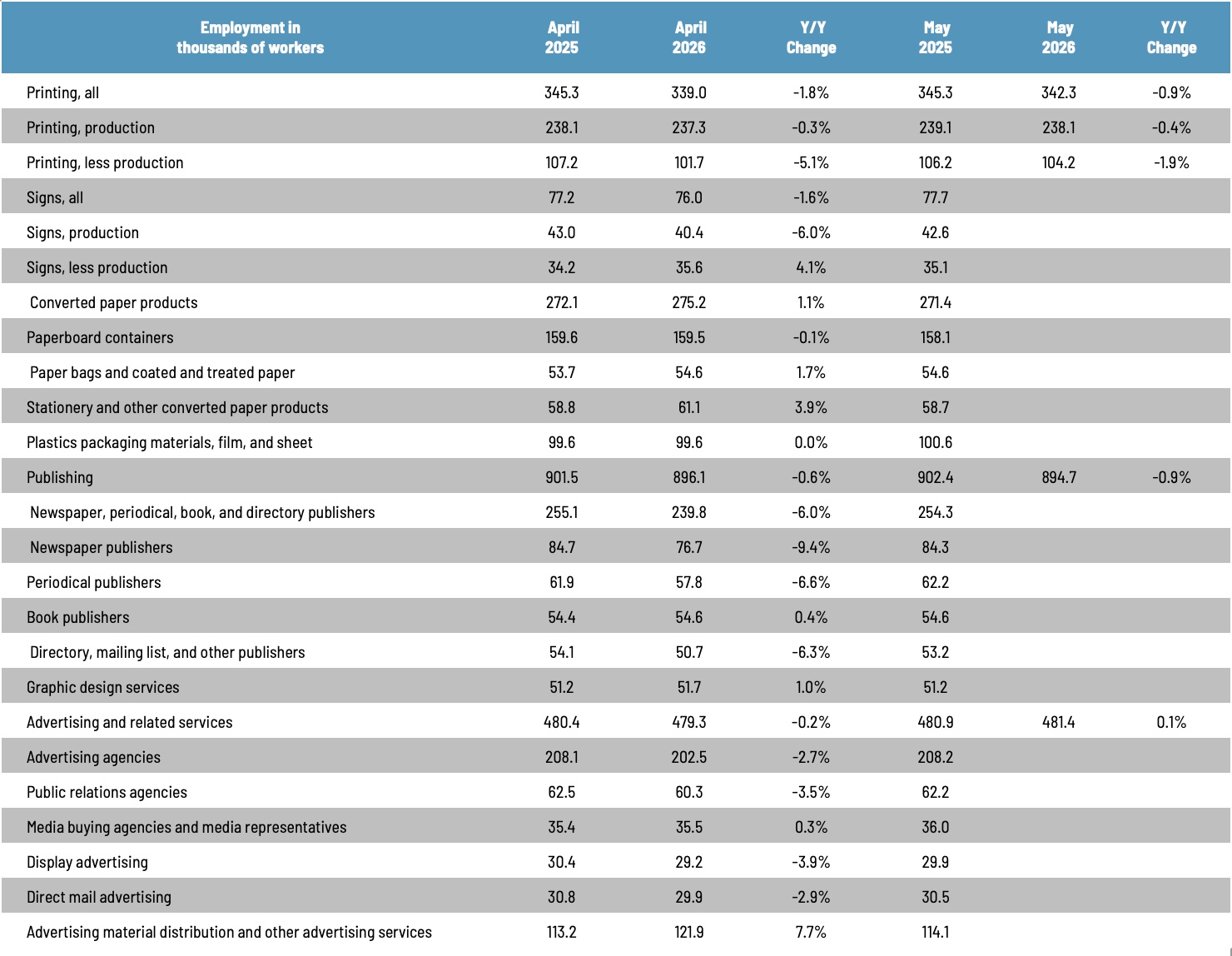
After a sluggish four months, the employment situation picked up in May, with overall printing industry employment up 1.0% from April, production employment up 0.3%, and non-production employment up 2.5%. Read More

Explore Mohawk's new paper options for all your digital printing needs

Explore Mohawk's new paper options for all your digital printing needs

Digital printing is the answer to the agility of modern work?ow. Mohawk Digital offers a diverse collection of fine and production papers for Inkjet, Dry Toner and HP Indigo presses. Read More

Around the Web: Of Botticelli and Beef

Around the Web: Of Botticelli and Beef

Newspaper Club has partnered with type foundry abcD8 to create a custom typeface inspired by the visual history of newspapers. MAD magazine has published its 600th issue. “Wordhord: Old English Word of the Day.” New evidence for the cause of death of the model for Botticelli’s “Birth of Venus.” Attending a Zoom meeting while on a roller coaster. Graphene-enabled PFAS-free firefighting foam. A jacket that can harvest moisture from the atmosphere. The iPhone’s Vehicle Motion Cues are surprisingly effective at reducing car sickness. An e-bike designed specifically to carry children. “Do fitness trackers still work if you have tattoos?” Rouser Lab’s “Earth’s black box” attempts to track humanity’s spiral into environmental destruction. “Beef tea” was a thing in the 19th century. Welcome to WhatTheyThink’s weekly miscellany. Read More