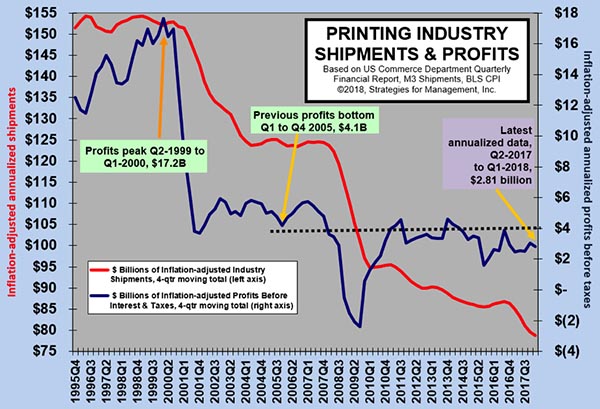
The April and May U.S. commercial printing shipments underscore that the media shifts that were expected to start this Fall are starting earlier than anticipated. The Commerce Department revised April's shipments down almost -1% from the initial report, making April the worst one in our inflation-adjusted data series which starts in 1993. May's shipments were no better, down -2.7% compared to last year; this made it the worst May in our data series as well. In fact, April and May are likely the worst in decades based on other data we can piece together from those earlier times.
This means the urgency of acting to realign and re-cast print businesses for yet another new marketplace is growing. For those who have already started, it's a reminder that the realignment and re-casting will be a constant process. These next years will present great opportunities but also great risks that require wise navigation.
In part one of this column, we reviewed some comments made in a trade association publication last year by a supplier CEO in response to an article in Barron's. This discussion is completed in this column, but that is by no means the end of this dialogue. Print's role, and more importantly, the role of the evolving print business, will be explored by our entrepreneurs and by clients and competitors in their strategic planning and in the daily decisions they make. There is no single right answer in a dynamic marketplace, but all answers require an urge to act creatively and proactively.
“Large populations in developed countries and even larger ones in developing countries that are unable or unwilling to keep pace with constantly evolving electronic technology would be left out.”
In the prior column, research was cited about how even the world's poor are purchasing digital technologies. The adoption rate for wireless communications around the world is rather staggering.
The International Telecommunications Union reports the data. In the developed world, there are more than 630 million mobile broadband subscriptions, and more than 300 million elsewhere. There are 1.4 billion mobile cellular subscriptions in the developed world, and more than 3.8 billion in developing countries. The latter have been growing at a rate of more than 25% per year since 2005, well beyond population growth, and well beyond GDP growth in those countries.
One of the reasons for this rapid adoption is the fact that the old tech landlines never made their way through developing countries. There were no customers to attract them, and often, the terrains made the costs of installing them too high. Where they were installed, they were often unaffordable for average citizens. Therefore, cellular and wireless technologies are making their way rapidly through these countries. Physical lines are not required, and in most of these countries, there are a multiplicity of affordable plans that make mobile communications much more attractive than landlines—in addition to the obvious convenience of the mobile factor. The ubiquity of these devices ensures that there will be a market for text and video communications that will develop rapidly.
Another factor spurring the adoption of digital communications and digital media in these countries is that there are few legacy media businesses of significant clout that have franchises they must protect. One of the reasons we see the effects of digital media play out so vividly in the U.S. is that we see the displacement effects on legacy media. In developing countries, many did not have legacy media to displace, nor did they have a free press, and perhaps more significantly, they did not have a flood of goods and services competing for their incomes that would necessitate advertising and marketing communications supported publications to get their attention.
Yet another issue is the continuing declining price of technologies. The Producer Price Index of the Bureau of Labor Statistics shows this well. Since 2005, computer prices are down -48%, wireless communication prices are down -21%, cellular service prices are down -21%, and Internet service prices are down -28%. Compare this with rising paper and postal costs. Well, they don't compare, and that's part of the problem. Even if paper and postal costs were flat, the comparative costs of new technologies would make them more expensive.
“Advertisers who have historically paid a good portion of the bill for journalism would likely take their money elsewhere in response to this segmentation and a net decline in audience.”
They already are. This is why employment in newspaper publishing has dropped so much, and shows no sign of leveling off. Other formats for journalism have taken the newspaper's place, as discussed in the prior column. The fact that advertiser money would go elsewhere is not a surprise, of course, because digital media are often providing a better deal–they do not have the same embedded production and distribution costs. Digital media require different strategies to accomplish the same market coverage, such as increased frequency of messaging and use of multiple media when one would have filled the advertiser's objectives in the past. Digital media have made the media planning, selection, and deployment task much harder, and not easier.
The assumption was, by this supplier CEO, that we are being deprived of journalism because of shrinking advertising expenditures. Advertising agency revenues are increasing as seen in the chart below. Advertising revenues are now larger than commercial printing revenues, something that has never happened before. Within two or three years, if not sooner, there will be more people working in advertising agency establishments than in commercial printing. Fifteen years ago, the printing industry had about 50% more workers than agencies did.
That advertising revenue now includes rising public relations, social media, search engine marketing, events, promotions, and production of digital media, at the expense of traditional advertising. It's probably not that we are being deprived of journalism, it's that the journalists have deprived us of venues for their content. That vacuum has been filled in quite handily by many news and opinion sources that were once limited to newspapers. There is no shortage of content, that's for sure.
Audiences are growing, and marketers, and journalists, have greater capabilities to customize messages and content to narrower segments, and they also have the ability to engage in mass marketing at lower unit costs in more forms of media than ever before. There is no net decline in audience. This is a misinterpretation of what is happening in media markets.
There are only 168 hours in a week. Media users, whether at work or at home, have only a certain amount of time to engage in media for whatever reasons they need to. We live in a time where the publishers have lost control of their channels, and must finally cater to the whims, preferences, and demands of their audiences. That audience can choose when, where, how, why, at what time, in what format, on what device, they will consume media content. It's up to the journalists to find ways to survive and ensure that their content is worth paying for or worth attracting advertiser investment. That task belongs to no one else.
Now What?
Technological forces are shaping media markets in ways that could not always be foreseen in terms of their timing, but could be foreseen in terms of their impacts. Over this last decade, there has been no excuse for being blindsided by the impacts of digital media on print. Yet, we know that there were businesses that acted that way.
By now, however, we should know that any assertion of the status quo is an invitation to irrelevance.
Continue reading your article
with a WhatTheyThink membership.