WhatTheyThink

Premium Commentary & Analysis

Tim Dowling, ImageX

Yesterday,

Thursday, November 15, 2001

Yesterday, ImageX named Tim Dowling as Chief Operating Officer. He was previously Vice President of Marketing. Dowling was an essential part of ImageX’s recent repositioning and increased focus on providing branded printed materials to corporate customers. The company has shed several efforts in the last 18 months closing Printbid.com and Paperdeals.com and this week - selling Creativepro.com to PrintingForLess.com.

Dowling's background includes 13 years at Intel Corporation in key management positions leading the company's e-commerce efforts. Immediately prior to joining ImageX, he was vice president of marketing for PcOrder Corporation. In this role, he built and managed the company's profitability strategy, which ultimately led to the successful acquisition of PcOrder by Trilogy Software. Dowling has a solid background in B2B technology marketing, sales, and operations. As COO, he will be responsible for sales, marketing, engineering, operations, and customer management.


Interview Archive

As a former executive at highly regarded Intel and PCorder, what impressed you most when you decided to join ImageX 6 months ago?

I thought ImageX had a valuable service to offer, and that there was significant demand in the market for the type of solution that ImageX provides. The commercial printing industry in the United States is about a $334 billion a year industry. So, the company clearly has a lot of room to grow, and that interested me. I joined Intel at a time when it was developing as a leader in its field, and I think the same is true for ImageX.

The announcement in early October indicated a new, clear message for ImageX going forward. Tell us about this repositioning.

We have done significant internal and external market research and have realized that in order to have a successful business we need to clearly tell our prospects, customers and ourselves what it is that we do best. As part of that, we have increased our focus on performing the service that we do best -- which is leveraging our technology to provide branded printed materials for our corporate customers. We have determined that the majority of our customers use us for one of two reasons: 1)they have e-procurement initiatives and appreciate the value that our e-procurement for print solution provides or 2) they are undergoing corporate brand changes or need brand control across their enterprise. Our Print System provides a way for customers with multiple office locations and divisions to control their print spend, control their brand and save hard and soft dollars due to the efficiencies of e-procurement.

Specifically, is the focus still the Fortune 1000?

We target medium to large sized companies with about 3% of their annual revenues spent on printing. So, yes, that typically is within the Fortune 1000.

The online print center was for the smaller customers and was a partnership with iPrint. Does iPrint fit into the new ImageX going forward?

You'll notice on our Web site that we no longer market the iPrint partnership. Part of our increased focus on growing our business included concentrating on the customers that fit into our two sweet spots - e-procurement for print and printing for corporate brand changes. And so, with that focus, it no longer made since to continue with iPrint.

Does ImageX ever actually print for clients on-site or can most of your work (being mostly brand, corporate identity work) be done offsite?

Generally, we will do a full-color sample of all of our customers' printed materials at the beginning of the relationship. After that sample is approved, the brand standards of the customer are locked in and all future runs of those printed materials are matched to the original proof. This eliminates the need for "press checks" every time something is printed, and thus saves the customer a significant amount of time and money and makes our process much more efficient.

Many of our print buying members follow the e-solution providers, but it is hard to evaluate from releases and brochures. Tell them how the technology that you have is best in terms of implementation and some of the key features of that technology.

Basically, our technology runs our back-end to ensure that once a customer has proofed an online sample of an order and then submits it, that order goes straight to the output location (or into an approval queue and then to the output location) and is converted directly into a press-ready plate. This efficiency helps our customers save time and money, and is directly relational to our extremely low error rate. ImageX has an industry-low error rate of less than 0.5% compared to typical error rates in the print industry of 7-20%. Much of this low error rate can be attributed to the robustness of our technology and our ability to digitally lock in brand standards, including colors, fonts and papers.

Additionally, our technology is seamless to integrate. Because our delivery vehicle is the Internet, customers are not faced with having to integrate software into their computer systems. They simply place orders through their secure Web site. No more faxing proofs back and forth to the printer. No more waiting months for business cards. Our technology allows for decentralized ordering through the Web, but centralized control of what is being ordered.

Side by side, How does ImageX compare to an e-enabled printer using another front end system like printCafe?

You really can't do a side-by-side comparison of the ImageX Print System and the printCafe service. ImageX is a commercial printer that sells printed goods directly to the corporate customer whereas printCafe sells its software to printers. The ImageX Print System is a customized Web site that catalogs the customer's branded printed materials so that employees of that company may procure their printed materials in an efficient and near-error free way. As far as we know, ImageX offers the most advanced and robust solution for selling print via e-procurement.


Continue reading your article
with a WhatTheyThink membership.

WhatTheyThink Annual Membership

Less than $4/week.

Get unlimited access to in-depth commentary and analysis covering the latest trends, emerging technologies, operational strategies, and key events across every segment of today's printing industry.

Stay informed. Stay competitive. Stay ahead.
WhatTheyThink Day Pass

$5 for 24 hours

Unlimited access to all of WhatTheyThink. Get your Day Pass

Already a member?
Sign In

About WhatTheyThink

WhatTheyThink is the global printing industry's go-to information source with both print and digital offerings, including WhatTheyThink.com, WhatTheyThink Email Newsletters, and the WhatTheyThink magazine. Our mission is to inform, educate, and inspire the industry. We provide cogent news and analysis about trends, technologies, operations, and events in all the markets that comprise today's printing and sign industries including commercial, in-plant, mailing, finishing, sign, display, textile, industrial, finishing, labels, packaging, marketing technology, software and workflow.

Recent Articles from WhatTheyThink

Around the Web: Of Books and Bots

Around the Web: Of Books and Bots

New book “Empire of Ink” is a look at the history and mythology of the American newspaper. A hacked smart lightbulb provides access to banned books. A digital archive reassembles Leonardo da Vinci’s long-cut-apart notebooks. Michelangelo’s secret underground hiding place—complete with the artist’s graffiti. Marie Antoinette may have been history’s first influencer. A worn copy of a 1912 pulp magazine featuring Tarzan sold at auction for $58,560. New book, “The Graphene Handbook - Making Sense of Graphene at Its Inflection Point.” Visa is integrating its payment network into ChatGPT, which should be fun. A humanoid robot plans to climb Everest. A designer who specializes in chairs without legs. Did a flying monk see Halley’s Comet…twice? The British geologist whose goal was to eat as many different animals as he possibly could. Welcome to WhatTheyThink’s weekly miscellany. Read More
Publishing Establishments—2010–2023

Publishing Establishments—2010–2023

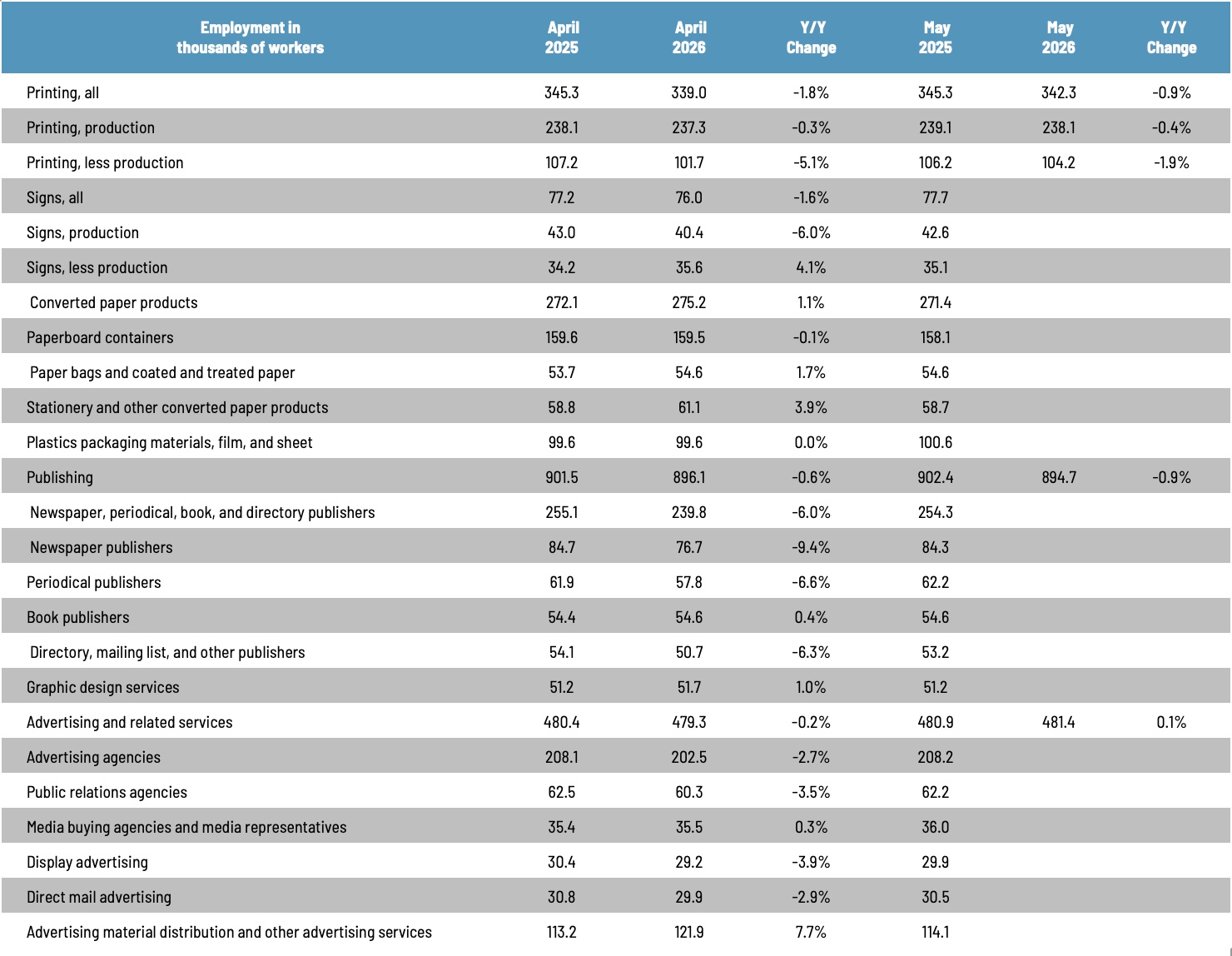
According to the latest, recently released edition of County Business Patterns, in 2023 there were 32,332 establishments in NAICS 511 (Publishing Industries [except Internet]). This represents an increase of 15% since 2010. In macro news, the University of Michigan’s Consumer Sentiment Index is at record lows. Read More

Finishing: Production Inkjet's Next Frontier

Finishing: Production Inkjet's Next Frontier

As production inkjet has advanced, a new primary factor limiting productivity has emerged: finishing. How are PSPs adapting their investment and automation strategies? New research shows many can gain a competitive advantage by focusing on finishing. Read More

HanGlobal Launches New LabStar 330mini at Flexo & Labels Expo 2026

HanGlobal Launches New LabStar 330mini at Flexo & Labels Expo 2026

Discover HanGlobal's newly launched LabStar 330mini digital label press! Get the full show roundup to see how this ultra-integrated, high-performance inkjet solution captured the crowd's attention and redefined narrow-web printing. Read More

Around the Web: Of Food and Feynman

Around the Web: Of Food and Feynman

A book designer who specializes in spine design. The Chinese postal service is using humanoid robots to sort packages. An amusingly overproduced Day Display. Allen Ginsberg’s spoken-word poetry recitation album is being reissued. The winners of this year’s World Food Photography Awards. A retired geneticist launched the online Museum of Plugs & Sockets. A viral warning about a new gas station scam is actually a hoax. What is the world’s longest domestic flight? Aw, et tu, graphene: Skeleton Technologies launches graphene-based GrapheneUPS for AI data centers. What is the quietest spot in the U.S.? Researchers finally cracked Richard Feynman’s “Restaurant Problem.” Malaysia’s kek lapis Sarawak is perhaps the world’s most complex cake. Welcome to WhatTheyThink’s weekly miscellany. Read More