WhatTheyThink

Premium Commentary & Analysis

Success with Creative Suite leads Adobe’s 39% earnings increase

:

Wednesday, December 17, 2003

: Summary of Adobe’s Q4 Earnings Call By Ann Levine December 17, 2003 – Adobe Systems announced fourth quarter and year-end results for the fiscal year ending November 28, 2003. Fourth quarter revenue was $358.6 million, exceeding the company’s target range of $330 - $350 million, compared to $294.7 million for the fourth quarter of 2002. On a year over year basis, fourth quarter revenue increased 22%. Fourth quarter GAAP diluted earnings per share were reported at $0.34, the same figure as pro forma diluted earnings per share. GAAP net income during the fourth quarter was $83.3 million as compared to $40.1 million for the fourth quarter of 2002. On a fiscal year basis, revenue in 2003 was $1.295 billion, an 11% increase over revenue of $1.165 billion in 2002. GAAP net income for the year was $266.3 million over $191.4 million in 2002. For 2003 GAAP diluted earnings per share were $1.10. Pro forma diluted earnings per share were $1.14. Topics of this summary: * Segment Financial Performance * Overall Segment Highlights * Guidance * Q & A Segment Financial Performance Adobe reported revenue by segment of:   Q4 2003 Q4 2002 Q3 2003 Creative Professional $107 million $86.9 million $82 million Digital Imaging $112.6 million $101.6 million $88.3 million OEM $20.8 million $21.8 million $21.8 million E-paper $118.1 million $84.4 million $127 million Revenue by geographic segment during the quarter was the America’s at 50%, Europe at 31% and Asia at 19%. Adobe continues to experience stable demand across all geographic segments. Expenses as a percent of revenue during the quarter were: Research and Development 20.4 %, Sales and Marketing, 31.7% and G & A 8.8%. Overall Segment Highlights The recently released Creative Suite has had a positive response as have the stand-alone Creative Suite products. Initial revenue has been strong. Foreign language shipments began during the first quarter. In Digital Imaging, fourth quarter revenues in video products grew 24% year over year. E-paper desktop licensing was 40% in the fourth quarter. Recent wins in the server-based business include the State of Illinois, Federal Reserve Bank of Richmond, Italian Chamber of Commerce and the Norwegian Public Roads Administration in the government sector. In the commercial sector, recent wins include the Consumer Retail Banking Division of JP Morgan/Chase, Texas Medicare/Healthcare Partnership and the Spanish Bank BPVA. Adobe announced the recent acquisition of the technological assets of Yellow Dragon Software, a leading developer of XML messaging and metadata. The acquisition will create a technology that allows enhanced presentation and security capabilities of PDF. Guidance for Q1 2004 Adobe’s guidance for the first quarter includes a revenue target of $360-$380 million with gross margin at a 93%. GAAP and pro forma earnings per share are targeted at $0.33-0.36 per share. The company expects a lower tax rate of 28%. For fiscal year 2004, Adobe provided guidance of $1.425 billion in revenue for 2004 with an operating margin of 30%. Because the company operates on a 52-53 week year, with the year ending the week closest to December 30th, Adobe will have an extra week of revenue and expenses in 2004. Q & A 1. Revenue with Apple is up 34% sequentially primarily due to Apple customer’s upgrade to Adobe’s Creative Suite. As customers continue to migrate to Apple’s GS product, Adobe anticipates continued upgrades with the Creative Suite. 2. Business in Japan has shown some improvement. Adobe has not yet shipped the Japanese language version of Creative Suite which may have additional impact on revenues. 3. The operating margin target in the first quarter is 31-32% and will be impacted by a number of issues such as an extra week of business, growth-oriented investments, new business, and a new office in San Jose coming on line. 4. Adobe is assuming a relatively stable economy in 2004. 5. Officials stated the company is not becoming overly dependent on one product, as the company strategy is to ensure a complete platform of products that will appeal to a diversity of people, professional and non-professional. 6. Aside from the international versions of the Creative Suite and point products shipped in the first quarter and a new version of Framemaker, there are no additional anticipated announcements of new products for the next several quarters. 7. Adobe did not repurchase any shares during the fourth quarter because the company was seeking a higher level of cash. That level was not disclosed, however, officials stated the company came closer to its cash target. 8. Cash could be used for acquisitions; however, the company wants to maintain flexibility. 9. There was no marked upturn in overall demand in international sales. There was a seasonal upturn in demand in Europe but it was expected. 10. The initial revenue for the Creative Suite has been strong and Adobe expects to see the revenue stream extend further as compared to other products due to more consumers standardizing and deeper penetration with the product. 11. Adobe sees a large opportunity with the E-paper paper business, as there is more awareness of the benefits of PDF. The company has seen an initial payoff through the increased focus on licensing. A decline in upgrade revenues is expected in the first quarter. 12. Design houses have indicated a cautious optimism with regard to the economy. Although there have been published articles on an increase in advertising revenues, executives stress the published numbers are not necessarily being paid for. Adobe officials have not seen additional hiring by Design firms. 13. Adobe has not seen any correlation between PC shipment and Adobe revenue. 14. Adobe did not comment on the performance of the Album and Elements products for the week following Thanksgiving except to say the company is offering a bundled product to consumers for the holiday. 15. Adobe is targeting headcount growth throughout the entire organization in 2004 and as such there will be a headcount growth in the company’s sales force. 16. The foreign exchange benefit in 2002-2003 was $59 million, primarily due to the Euro.  


Continue reading your article
with a WhatTheyThink membership.

WhatTheyThink Annual Membership

Less than $4/week.

Get unlimited access to in-depth commentary and analysis covering the latest trends, emerging technologies, operational strategies, and key events across every segment of today's printing industry.

Stay informed. Stay competitive. Stay ahead.
WhatTheyThink Day Pass

$5 for 24 hours

Unlimited access to all of WhatTheyThink. Get your Day Pass

Already a member?
Sign In

About WhatTheyThink

WhatTheyThink is the global printing industry's go-to information source with both print and digital offerings, including WhatTheyThink.com, WhatTheyThink Email Newsletters, and the WhatTheyThink magazine. Our mission is to inform, educate, and inspire the industry. We provide cogent news and analysis about trends, technologies, operations, and events in all the markets that comprise today's printing and sign industries including commercial, in-plant, mailing, finishing, sign, display, textile, industrial, finishing, labels, packaging, marketing technology, software and workflow.

Recent Articles from WhatTheyThink

Around the Web: Of Books and Bots

Around the Web: Of Books and Bots

New book “Empire of Ink” is a look at the history and mythology of the American newspaper. A hacked smart lightbulb provides access to banned books. A digital archive reassembles Leonardo da Vinci’s long-cut-apart notebooks. Michelangelo’s secret underground hiding place—complete with the artist’s graffiti. Marie Antoinette may have been history’s first influencer. A worn copy of a 1912 pulp magazine featuring Tarzan sold at auction for $58,560. New book, “The Graphene Handbook - Making Sense of Graphene at Its Inflection Point.” Visa is integrating its payment network into ChatGPT, which should be fun. A humanoid robot plans to climb Everest. A designer who specializes in chairs without legs. Did a flying monk see Halley’s Comet…twice? The British geologist whose goal was to eat as many different animals as he possibly could. Welcome to WhatTheyThink’s weekly miscellany. Read More
Publishing Establishments—2010–2023

Publishing Establishments—2010–2023

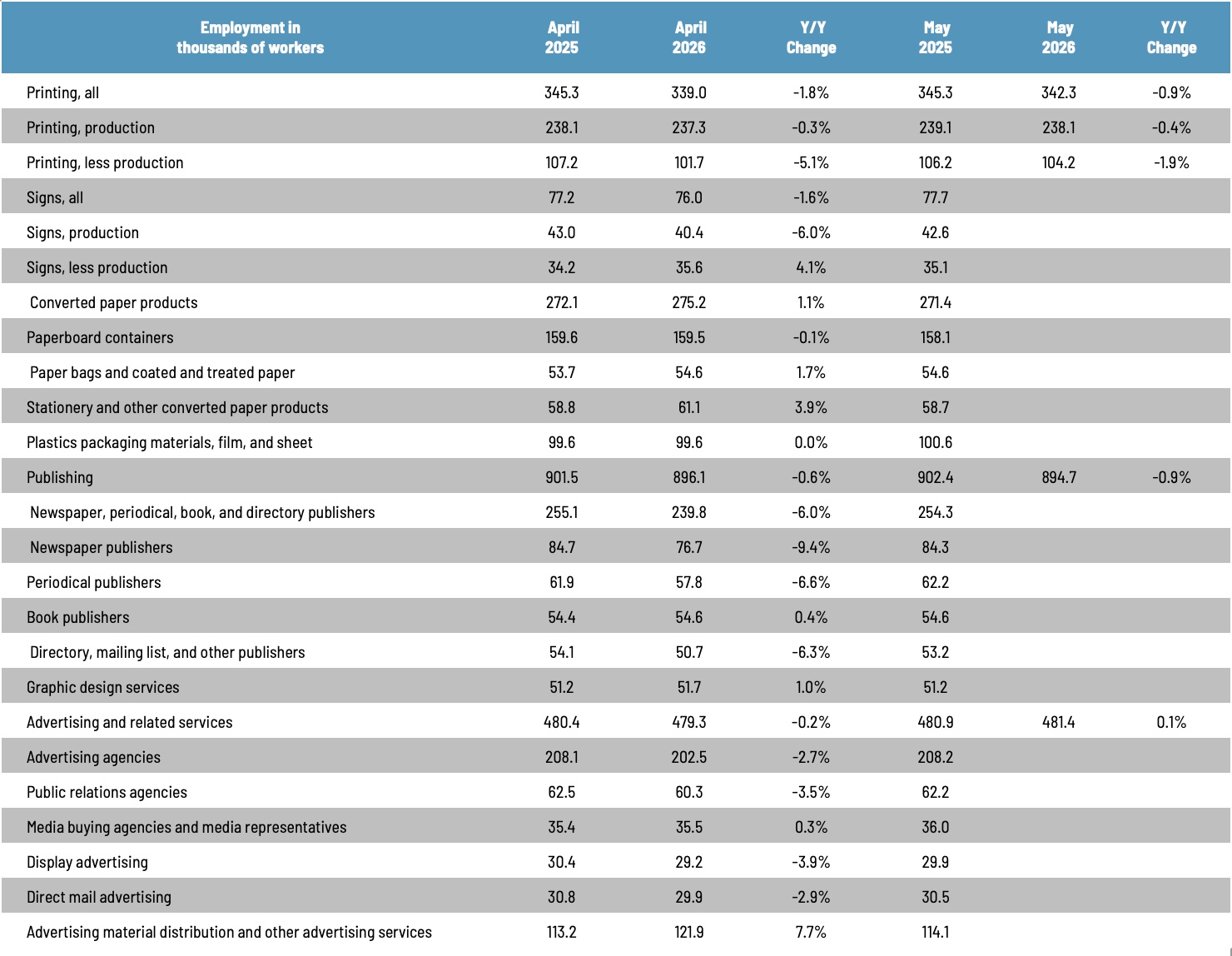
According to the latest, recently released edition of County Business Patterns, in 2023 there were 32,332 establishments in NAICS 511 (Publishing Industries [except Internet]). This represents an increase of 15% since 2010. In macro news, the University of Michigan’s Consumer Sentiment Index is at record lows. Read More

Finishing: Production Inkjet's Next Frontier

Finishing: Production Inkjet's Next Frontier

As production inkjet has advanced, a new primary factor limiting productivity has emerged: finishing. How are PSPs adapting their investment and automation strategies? New research shows many can gain a competitive advantage by focusing on finishing. Read More

HanGlobal Launches New LabStar 330mini at Flexo & Labels Expo 2026

HanGlobal Launches New LabStar 330mini at Flexo & Labels Expo 2026

Discover HanGlobal's newly launched LabStar 330mini digital label press! Get the full show roundup to see how this ultra-integrated, high-performance inkjet solution captured the crowd's attention and redefined narrow-web printing. Read More

Around the Web: Of Food and Feynman

Around the Web: Of Food and Feynman

A book designer who specializes in spine design. The Chinese postal service is using humanoid robots to sort packages. An amusingly overproduced Day Display. Allen Ginsberg’s spoken-word poetry recitation album is being reissued. The winners of this year’s World Food Photography Awards. A retired geneticist launched the online Museum of Plugs & Sockets. A viral warning about a new gas station scam is actually a hoax. What is the world’s longest domestic flight? Aw, et tu, graphene: Skeleton Technologies launches graphene-based GrapheneUPS for AI data centers. What is the quietest spot in the U.S.? Researchers finally cracked Richard Feynman’s “Restaurant Problem.” Malaysia’s kek lapis Sarawak is perhaps the world’s most complex cake. Welcome to WhatTheyThink’s weekly miscellany. Read More