WhatTheyThink

Premium Commentary & Analysis

Part Two: Digital Printing, Channels and the Future

If digital printing is now so well entrenched and growing,

Friday, February 28, 2003

If digital printing is now so well entrenched and growing, why weren’t Indigo and Xeikon, the first entries into the digital press offering, able to succeed on their own? And, why didn’t the traditional graphic arts channel embrace these new products?

The EAGLE believes that the initial drive by Xeikon and Indigo to sell either direct or through large OEM partners had a direct bearing on the results that ensued. They also over sold product maturity (when initially it took two units to keep one operating), based profitability on per page selling prices that were higher than the market could bear, and their projections relied on expected, not actual demand for short run color output. This marketing situation, from a channel standpoint, was further compounded by a series of bad dealer implementations of what should have been more salable smaller format digital printing solutions. These new dealers to the short run world tried to sell for a price, and rapidly ran into trouble against the "click" (page printed) charge mentality of a copier market supplier and their customers. Given the choice of paying up front, or paying through the monthly click charge that comes out of the operating budget, not the capital budget, which one do you think most printers/buyers would choose?

So, Graphic Arts Dealers became gun shy about small format digital printing and lost an opportunity to shine in this emerging market. It is also important to note that there are virtually no traditional graphic arts dealers among the 500 or so key VARS that sell HP Wide format printers to the domestic market – a market that is growing more rapidly than any other part of the digital print market.

In the larger format arena, Xeikon did belatedly try to sell through dealers after they began to lose Xerox and Agfa OEM sales of their products. They chose to develop an Advocating Dealership and later a Joint Venture with the then largest U.S. GA Dealer, PrimeSource. To try to meet its commitments to Xeikon through advocacy, PrimeSource had to separate out this activity from their normal dealership activity, and lost an important level of synergy between their two divisions. In the end, the JV, Canopy, had a larger overhead than could be supported by sales, and wasn’t profitable. When Enovation Graphic Systems purchased PrimeSource, the terms of the deal did not include Canopy. A year later, after going through bankruptcy and being purchased by Punch, Xeikon/Strobbe is still selling direct.

Channel Strategies

Today, the digital press companies appear healthier through their newfound parent companies (Xeikon and Punch, Indigo and Hewlett Packard) and are learning how to promote full workflow solutions that their buyers can use to compete with more traditional analog printers on mid sized print runs. As print buyers are learning about the utility and versatility of shorter runs of digital print for just about every purpose (both digital press and wide format output capabilities), the Graphic Arts Dealer community has still virtually opted out of participation in this very heart of the growth market for printing.

That’s not to say that the channel isn’t investing in ways to become healthy in a declining analog supply market. Because the retail world is based upon large volume sales, most package printing still tends to be necessary in higher quantities than traditional commercial offset printing. For this reason, it is still able to defend its turf against digital print. And the type of printing now most used for both cardboard boxes and the more flexible and growing cardboard packaging market is Flexographic printing. So "flexo" is one hot new field that every graphic arts distribution company is looking to get into. A move into the flexo market also helps to cover the bleeding losses in volume that are occurring in the larger offset press/printing market.

In the U.S., Pitman has been the most successful major dealer in the flexo market with its sales of DuPont "flexo" plates. Recently, Enovation Graphic Systems, the largest U.S. Dealer, has teamed with MacDermid Graphic Arts to enter and focus on this market. Giving more focus to a market that is arguably 1/10th the size of the offset market and growing (in overall volume) less than the offset market is declining (in overall volume) is a step in the right direction, but isn’t going to make all the graphic arts distribution companies whole. While there are real opportunities for some companies to make money in the Flexo marketplace, it can’t replace all of the lost business in the traditional graphic arts channel.

The second place we hear dealers talk about growth opportunity is through the use of private label brands. Incrementally, manufacturers can offer these "brandless" products at lower prices, allowing higher margin to the dealer. But, if prepress supplies are still declining by double-digit rates, The EAGLE believes it’s only possible for some to succeed and to make up for some of their overall decline in business with the lower priced/higher margin sales by the channel.

There are also some opportunities to succeed through a well-managed business plan to sell less broadly distributed products and services at lower volumes and higher margins, or combined with other products by advocacy, rather than price. Overall, this opportunity is only available to a small number of companies. Across the printing market The EAGLE still believes that there is too much distribution capacity for existing supply products – and too much capacity in the factories that manufacture them. So far, we know of only one manufacturer taking plants off line to "right size" its business to the new market realities.

Finding the right mix of products and services from manufacture through distribution to the printer is still a work in progress.


Continue reading your article
with a WhatTheyThink membership.

WhatTheyThink Annual Membership

Less than $4/week.

Get unlimited access to in-depth commentary and analysis covering the latest trends, emerging technologies, operational strategies, and key events across every segment of today's printing industry.

Stay informed. Stay competitive. Stay ahead.
WhatTheyThink Day Pass

$5 for 24 hours

Unlimited access to all of WhatTheyThink. Get your Day Pass

Already a member?
Sign In

About WhatTheyThink

WhatTheyThink is the global printing industry's go-to information source with both print and digital offerings, including WhatTheyThink.com, WhatTheyThink Email Newsletters, and the WhatTheyThink magazine. Our mission is to inform, educate, and inspire the industry. We provide cogent news and analysis about trends, technologies, operations, and events in all the markets that comprise today's printing and sign industries including commercial, in-plant, mailing, finishing, sign, display, textile, industrial, finishing, labels, packaging, marketing technology, software and workflow.

Recent Articles from WhatTheyThink

Around the Web: Of Books and Bots

Around the Web: Of Books and Bots

New book “Empire of Ink” is a look at the history and mythology of the American newspaper. A hacked smart lightbulb provides access to banned books. A digital archive reassembles Leonardo da Vinci’s long-cut-apart notebooks. Michelangelo’s secret underground hiding place—complete with the artist’s graffiti. Marie Antoinette may have been history’s first influencer. A worn copy of a 1912 pulp magazine featuring Tarzan sold at auction for $58,560. New book, “The Graphene Handbook - Making Sense of Graphene at Its Inflection Point.” Visa is integrating its payment network into ChatGPT, which should be fun. A humanoid robot plans to climb Everest. A designer who specializes in chairs without legs. Did a flying monk see Halley’s Comet…twice? The British geologist whose goal was to eat as many different animals as he possibly could. Welcome to WhatTheyThink’s weekly miscellany. Read More
Publishing Establishments—2010–2023

Publishing Establishments—2010–2023

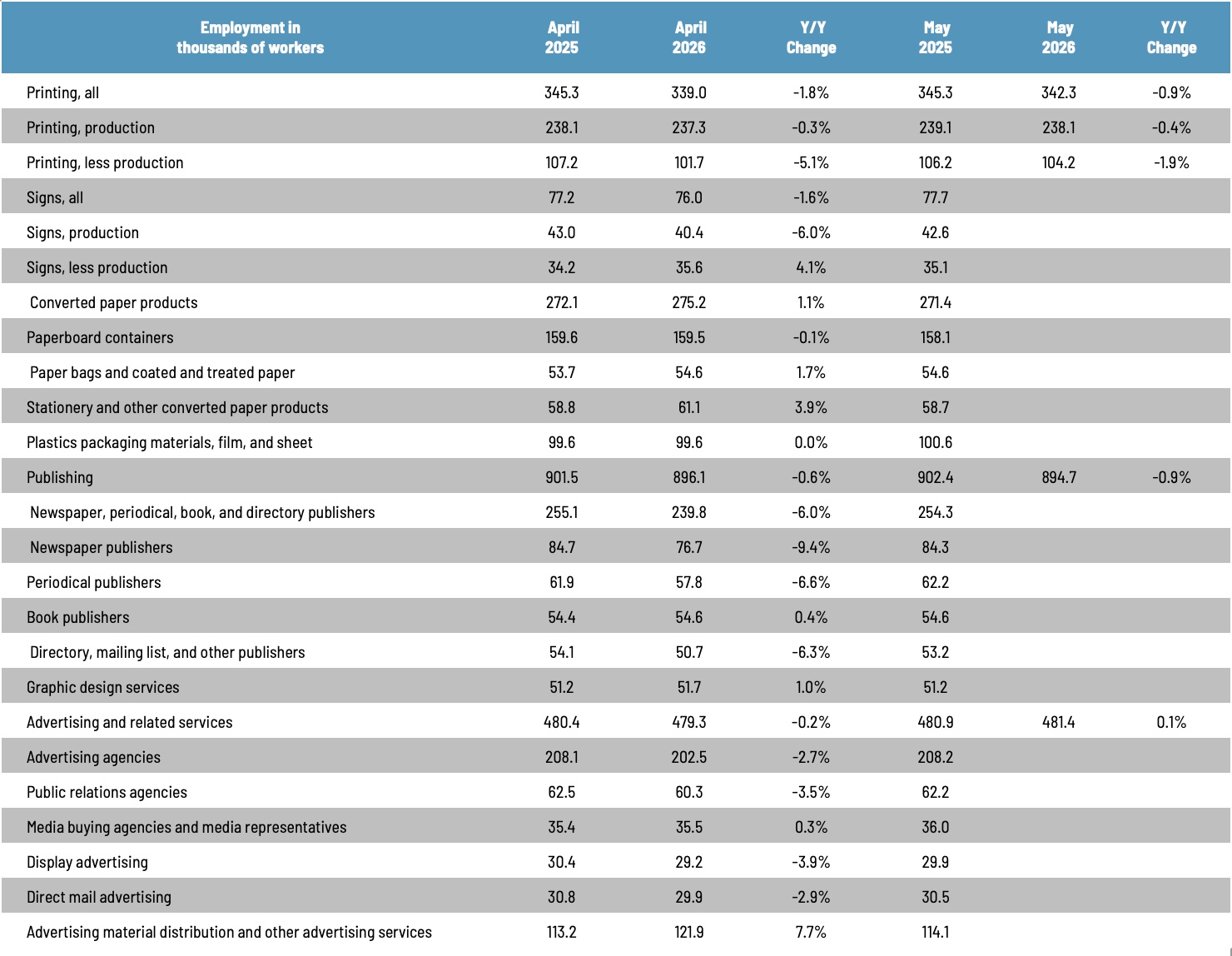
According to the latest, recently released edition of County Business Patterns, in 2023 there were 32,332 establishments in NAICS 511 (Publishing Industries [except Internet]). This represents an increase of 15% since 2010. In macro news, the University of Michigan’s Consumer Sentiment Index is at record lows. Read More

Finishing: Production Inkjet's Next Frontier

Finishing: Production Inkjet's Next Frontier

As production inkjet has advanced, a new primary factor limiting productivity has emerged: finishing. How are PSPs adapting their investment and automation strategies? New research shows many can gain a competitive advantage by focusing on finishing. Read More

HanGlobal Launches New LabStar 330mini at Flexo & Labels Expo 2026

HanGlobal Launches New LabStar 330mini at Flexo & Labels Expo 2026

Discover HanGlobal's newly launched LabStar 330mini digital label press! Get the full show roundup to see how this ultra-integrated, high-performance inkjet solution captured the crowd's attention and redefined narrow-web printing. Read More

Around the Web: Of Food and Feynman

Around the Web: Of Food and Feynman

A book designer who specializes in spine design. The Chinese postal service is using humanoid robots to sort packages. An amusingly overproduced Day Display. Allen Ginsberg’s spoken-word poetry recitation album is being reissued. The winners of this year’s World Food Photography Awards. A retired geneticist launched the online Museum of Plugs & Sockets. A viral warning about a new gas station scam is actually a hoax. What is the world’s longest domestic flight? Aw, et tu, graphene: Skeleton Technologies launches graphene-based GrapheneUPS for AI data centers. What is the quietest spot in the U.S.? Researchers finally cracked Richard Feynman’s “Restaurant Problem.” Malaysia’s kek lapis Sarawak is perhaps the world’s most complex cake. Welcome to WhatTheyThink’s weekly miscellany. Read More