WhatTheyThink

Premium Commentary & Analysis

February Printer Confidence Index: Sales Track Down From Same Period in 2002

February 28,

Friday, February 28, 2003

February 28, 2003 --Market Conditions for Print During fall 2002 the percentage of printers indicating declining local market was trending down. However, since December there has been a rise in negative market sentiment. This rise may be partly related to seasonal issues (slower activity during the December/January time frame), but also may be a reflection of broader economic and political issues. Fourth quarter 2002 GDP grew only at 0.7% while the growing specter of war has created uncertainty about future economic growth. The concern is that print customers may start to hold off or reduce their print spending, which would lead to print providers delaying capital equipment purchases. Six-Month Outlook Printers’ six-month outlook for their local market has tracked down from its peak in November to low points in January and February. Essentially, printers are saying they expect business to be up in the May time frame and down in the June and July periods. Part of the decline in six-month sentiment is surely influenced by current economic conditions and concern about future threats to the economy. Despite the increasingly dour outlook for their local markets, printers remain optimistic about the growth for their business. Printers have consistently indicated they expect their business to grow by 2.5 to 4.5 percent over the next six months vs. an expectation that their local market for print will grow between 0.5 and 2.0 percent. Change in Business Year-Over-Year For 2003 CAP Ventures has added a question asking printers to indicate by what percentage did their revenue change compared with the same month last year. Printers indicated that their revenues have declined for two consecutive months compared with their revenue levels from last year. CAP Ventures believes that printers may have had a slight rebound in revenue during the first quarter of 2002 after the economy started to improve from the shock in September 2001. With the sluggish economy and uncertain future, printers may be experiencing slightly lower revenues in early 2003 compared with last year. This lower revenue figures for the first two months also helps explain why many printers are citing negative market conditions and reduced expectations for the next six months. Capital Equipment Purchases The percentage of printers not purchasing capital equipment last month (69.7%) grew for the second straight month. Interestingly, this number is identical to February 2002’s percentage for not purchasing equipment. There may a seasonal relationship in capital equipment purchases (lowest in the January/February and September/October time frames). Printers generally report lower sales in the late winter and summer periods that could lead to tighter financial conditions and a desire to see how much business rebounds before making a significant capital investment. However, in thinking about the economic and political developments in 2002 there are some similarities for 2003. Last year at this time the country was still in shock from the 9/11 terrorist attacks. The economy was stable, but people were concerned about a recession. Conditions generally improved through most of 2002. However, later in the year and into 2003 the economy appears to have cooled slightly and war/terror concerns are increasing again. If annual trends continue to hold true, we should stable conditions in equipment purchasing and then a substantial increase in the spring and summer. If the broader economic and political developments are impacting capital equipment purchases, we will have to wait and see how things play out in the domestic economy and global theater. Prepress and bindery equipment continue to be the most commonly purchased capital equipment, though both categories were down during the last two months. Press equipment and print management software have been stable for the last several months. The percentage of companies purchasing digital equipment has been relatively stable over the last four months. Large format printer purchases have ticked down, but are within the typical range of three to seven percent. To receive all the charts for the different segments, please contact Jeff Hayes at CAP Ventures. His contact information is below. Respondent Profile Sample size: Between 150 to 200 print providers respond every month. Primary business: Approximately 55% of the respondents characterize themselves as general commercial printers primarily offering offset printing services. The other 45% included a mix of digital print specialists (mostly digital), quick printers, prepress services and other graphic service providers. Size of company: The sample is weighted towards medium to large print providers compared with the overall population of companies in the printing industry. Approximately 33% of the printers have annual revenues in excess of $10 million; another 25% have revenues under $1 million. We have slightly more companies with revenues in excess of $20 million. Geographic region: There is excellent representation from all major regions in the United States but slightly smaller sample sizes from the Mountain and Pacific regions. Title: The respondents are consistently from senior management levels within their company. Approximately 65% of the respondents are a VP, general manager, President/CEO or owner of their company. Equipment profile: The respondents have a variety of printing equipment including traditional presses, digital production printers, color copiers and wide format printing equipment. The most common device is two-color offset presses owned by just about 60% of print providers. Other common devices include 5+ color offset presses (50%), production black & white digital printers like (45%), and color copier/printers (45%), 4-color presses (40%), digital large format printers (40%), digital production color printers (26%). The mix of respondents by type of print providers, size of company, mix of equipment, geography and title has been very consistent throughout the year. This consistent sample profile is important when comparing results over time. Request more data about this survey by contacting Jeff Hayes, Research Director at CAP Ventures. [email protected]


Continue reading your article
with a WhatTheyThink membership.

WhatTheyThink Annual Membership

Less than $4/week.

Get unlimited access to in-depth commentary and analysis covering the latest trends, emerging technologies, operational strategies, and key events across every segment of today's printing industry.

Stay informed. Stay competitive. Stay ahead.
WhatTheyThink Day Pass

$5 for 24 hours

Unlimited access to all of WhatTheyThink. Get your Day Pass

Already a member?
Sign In

About WhatTheyThink

WhatTheyThink is the global printing industry's go-to information source with both print and digital offerings, including WhatTheyThink.com, WhatTheyThink Email Newsletters, and the WhatTheyThink magazine. Our mission is to inform, educate, and inspire the industry. We provide cogent news and analysis about trends, technologies, operations, and events in all the markets that comprise today's printing and sign industries including commercial, in-plant, mailing, finishing, sign, display, textile, industrial, finishing, labels, packaging, marketing technology, software and workflow.

Recent Articles from WhatTheyThink

Print ERP Built Natively Inside Microsoft Dynamics 365

Print ERP Built Natively Inside Microsoft Dynamics 365

No third-party integrations. No disconnected systems. DynamicsPrint® extends Microsoft Dynamics 365 F&SCM with print-specific ERP designed to scale globally with your business. Read More
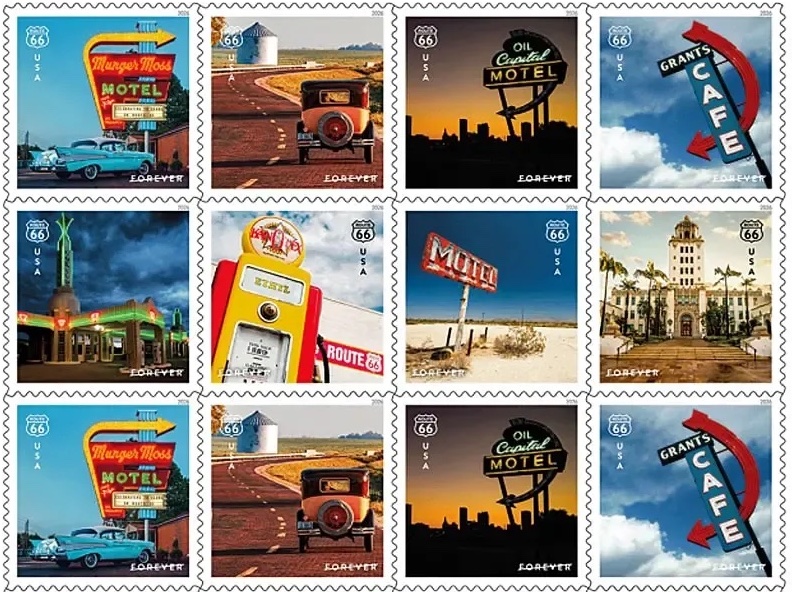
Around the Web: Of Moons and Mother Roads

Around the Web: Of Moons and Mother Roads

The 1835 “Moon Hoax” made ridiculous news stories credible. The USPS is issuing the 2026 Route 66 Centennial Stamp Collection. Highlights from the recent Sustainable Brands Conference. Researchers have created what might be the most accurate mathematical representation of color perception ever. When in North Dakota, visit the Theodore Roosevelt Presidential Library, which opens tomorrow, July 4. An Etsy gardening scam features AI-generated plant images and fake seeds.  Good grief: corneal tattooing is a thing. Graphene radar-absorbing coatings for defense use. If you missed Monday’s Strawberry Moon, more moons are coming. Answering the burning question: “do bug zappers still exist?” Turn any water bottle into a water vessel for dogs. Is there any advantage to “alkaline water”? Welcome to WhatTheyThink’s weekly miscellany. Read More
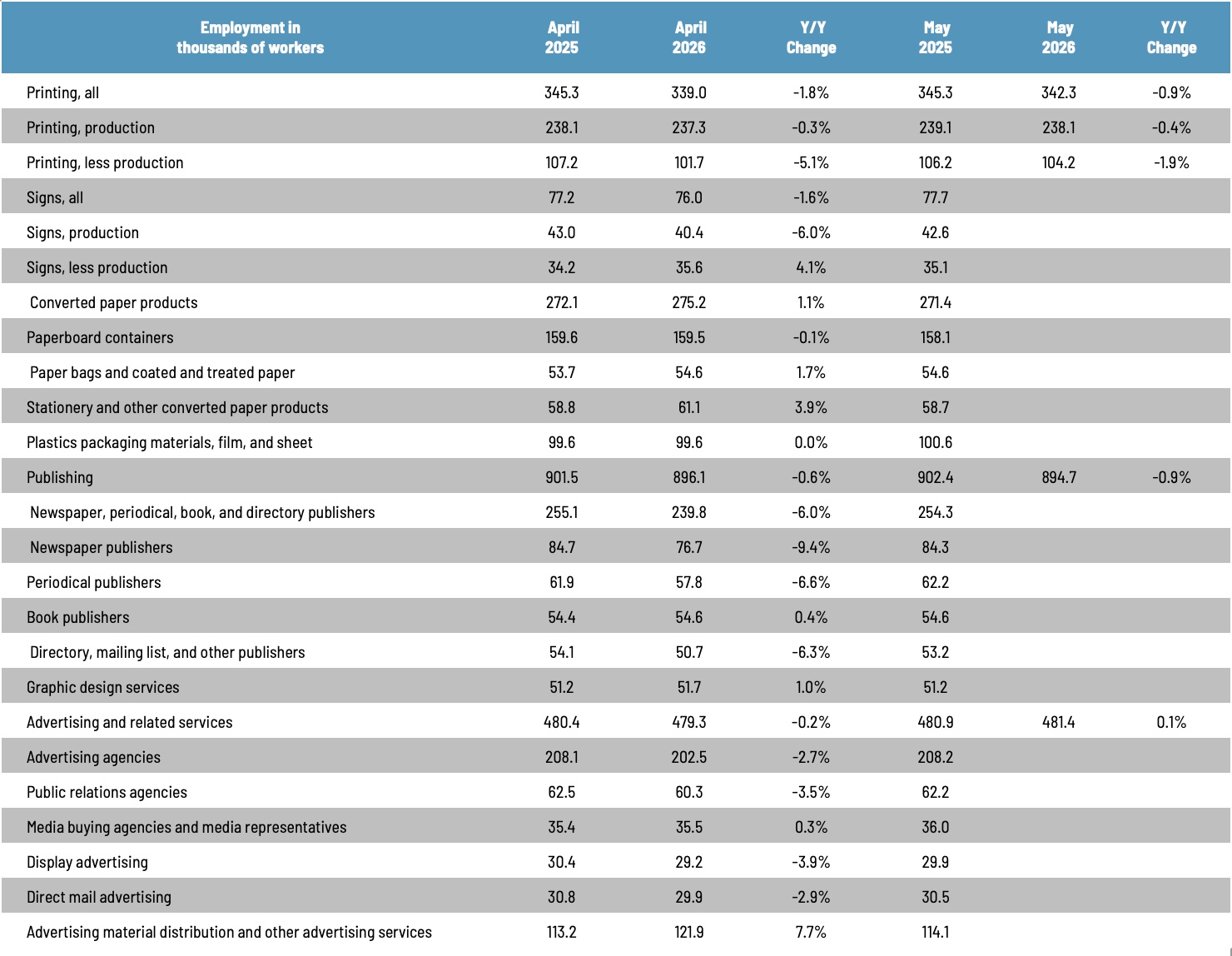
Graphic Arts Employment in May Up Overall—Substantially Among Non-Production

Graphic Arts Employment in May Up Overall—Substantially Among Non-Production

After a sluggish four months, the employment situation picked up in May, with overall printing industry employment up 1.0% from April, production employment up 0.3%, and non-production employment up 2.5%. Read More

Explore Mohawk's new paper options for all your digital printing needs

Explore Mohawk's new paper options for all your digital printing needs

Digital printing is the answer to the agility of modern work?ow. Mohawk Digital offers a diverse collection of fine and production papers for Inkjet, Dry Toner and HP Indigo presses. Read More

Around the Web: Of Botticelli and Beef

Around the Web: Of Botticelli and Beef

Newspaper Club has partnered with type foundry abcD8 to create a custom typeface inspired by the visual history of newspapers. MAD magazine has published its 600th issue. “Wordhord: Old English Word of the Day.” New evidence for the cause of death of the model for Botticelli’s “Birth of Venus.” Attending a Zoom meeting while on a roller coaster. Graphene-enabled PFAS-free firefighting foam. A jacket that can harvest moisture from the atmosphere. The iPhone’s Vehicle Motion Cues are surprisingly effective at reducing car sickness. An e-bike designed specifically to carry children. “Do fitness trackers still work if you have tattoos?” Rouser Lab’s “Earth’s black box” attempts to track humanity’s spiral into environmental destruction. “Beef tea” was a thing in the 19th century. Welcome to WhatTheyThink’s weekly miscellany. Read More