WhatTheyThink

Premium Commentary & Analysis

Part 2: Who is Successful through Change?

The pundits and economists discussed in Part 1 aren&

Friday, February 07, 2003

The pundits and economists discussed in Part 1 aren’t the ones that make it happen; they can only tell us with surety what happened before. But when we talk to the marketplace, we also hear that print is declining, and/or no longer growing as fast as the increase in the GDP. Offset print supplies, the bellwether of the supply chain for many years, has been declining in use by 20% per year for the last two years. To some, this means that the printing business as they know it can no longer support the kind of job opportunities and growth that has been true for most of our careers. To others, the changes in technology and their impact on print have caused pain, but out of that pain has been born new and exciting opportunities.

In 1991 Frank Bruno (RIT) suggested that Flexographic printing would grow from 17% of the print market to 23% by 2005. According to the Flexographic Trade Association (FTA) it was already 24% of the North American market in 2002. By these numbers, "flexo" has grown faster than had been predicted just 10 years ago, while the traditional "offset" lithography market share has declined. This trend is caused by changes in technology and marketing models. Those who pioneered in the flexo world, or have migrated there, are seeing growth, not doom and gloom.

And, while the technology for digital printing really began in the early 80’s the quality, format, throughput and price necessary to compete against offset print for pay didn’t become available until very recently. Short runs, fewer than 3,000 impressions, which are the main stay of the digital world, now make up 66% of all color jobs. And printers are being asked more and more frequently to deliver product with turn around times less than 24 hours. Wide format in particular is in its infancy, however sales are expected to grow from 60,000 units in 2001 to over 125,000 units in 2006. Media sales for these units is expected to grow similarly, from 2.9 MM square feet in 2000 to 6.8 MM square feet in 2005, again a doubling over a five year period.

Between the two markets, flexo and digital, we see much growth still left and terrific opportunities for those who take advantage of it.

The Print Outlook2003 Conference ended with presentations and a panel discussion with three printers. These three printers, Digital Print Impressions (~$5 MM Sales), Metzgers Printing (~$14 MM Sales), and Consolidated Graphics represent a wide spectrum of the market from moderately small to the very largest.

It is important to note that they are all profitable and growing strongly.

The smaller two clearly showed that growth and profitability could be achieved through a focused business plan, taking on digital technologies and broadening their services while keeping a keen eye toward the bottom line. Some may not be able to achieve this measure of security with change; yet their successes indicate that the future is poor only if you let it be that way.

Consolidated Graphics has become successful because they have shunned the old consolidation model that focused upon central control and central purchasing, trying to profit by squeezing the suppliers, and moving business around the country to the most profitable presses for their own benefit. Instead, Consolidated gives its printing locations local P&L control and prefers an emphasis on close customer service to keep the accounts happy, while approving the large capital expenditures each plant needs to prosper. Their foray into national printing is yet to occur, and they see such an effort as a way to do a better job of providing print on demand, where needed, to/for the customer, rather than as a tool for their own advantage.

From small to large, each of these three companies has taken huge risks including expenditure of capital to make the changes that allow them to grow. Purchase of new kinds of presses and other capital equipment are what has fuelled Metzgers. Digital Print Impressions is now more than 80% of the total business of their parent company that for many years had been a typical offset printer. And, Consolidated, unlike most of the aggregators over the past years has suffered because of industry problems with valuations and growth, but has emerged as a strong competitor while most of its competitors are still challenged at best.

Print is Dead – Long Live Print

The future is still bright for those who innovate and change with the times.

See Part 1.


Continue reading your article
with a WhatTheyThink membership.

WhatTheyThink Annual Membership

Less than $4/week.

Get unlimited access to in-depth commentary and analysis covering the latest trends, emerging technologies, operational strategies, and key events across every segment of today's printing industry.

Stay informed. Stay competitive. Stay ahead.
WhatTheyThink Day Pass

$5 for 24 hours

Unlimited access to all of WhatTheyThink. Get your Day Pass

Already a member?
Sign In

About WhatTheyThink

WhatTheyThink is the global printing industry's go-to information source with both print and digital offerings, including WhatTheyThink.com, WhatTheyThink Email Newsletters, and the WhatTheyThink magazine. Our mission is to inform, educate, and inspire the industry. We provide cogent news and analysis about trends, technologies, operations, and events in all the markets that comprise today's printing and sign industries including commercial, in-plant, mailing, finishing, sign, display, textile, industrial, finishing, labels, packaging, marketing technology, software and workflow.

Recent Articles from WhatTheyThink

Around the Web: Of Books and Bots

Around the Web: Of Books and Bots

New book “Empire of Ink” is a look at the history and mythology of the American newspaper. A hacked smart lightbulb provides access to banned books. A digital archive reassembles Leonardo da Vinci’s long-cut-apart notebooks. Michelangelo’s secret underground hiding place—complete with the artist’s graffiti. Marie Antoinette may have been history’s first influencer. A worn copy of a 1912 pulp magazine featuring Tarzan sold at auction for $58,560. New book, “The Graphene Handbook - Making Sense of Graphene at Its Inflection Point.” Visa is integrating its payment network into ChatGPT, which should be fun. A humanoid robot plans to climb Everest. A designer who specializes in chairs without legs. Did a flying monk see Halley’s Comet…twice? The British geologist whose goal was to eat as many different animals as he possibly could. Welcome to WhatTheyThink’s weekly miscellany. Read More
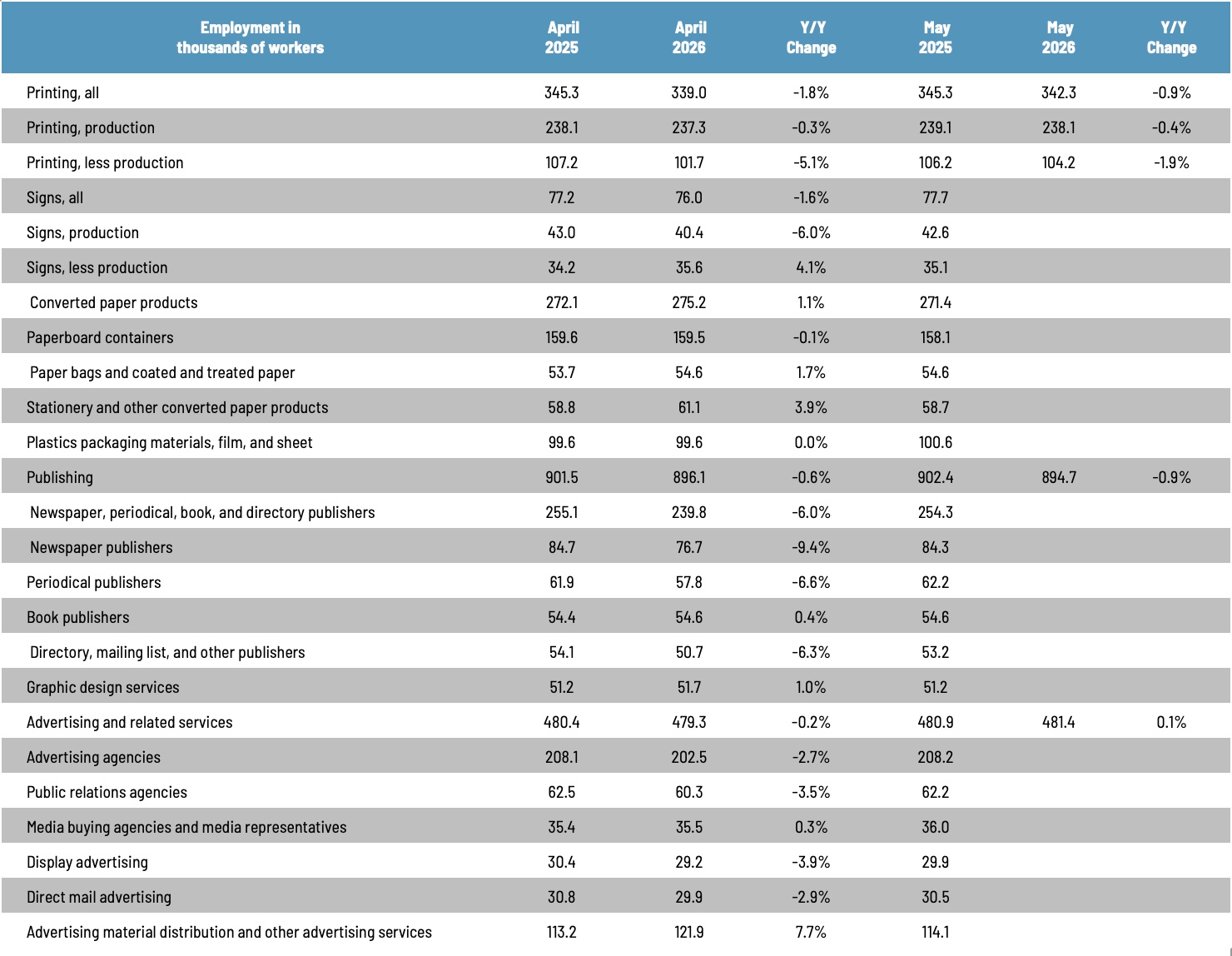
Publishing Establishments—2010–2023

Publishing Establishments—2010–2023

According to the latest, recently released edition of County Business Patterns, in 2023 there were 32,332 establishments in NAICS 511 (Publishing Industries [except Internet]). This represents an increase of 15% since 2010. In macro news, the University of Michigan’s Consumer Sentiment Index is at record lows. Read More

Finishing: Production Inkjet's Next Frontier

Finishing: Production Inkjet's Next Frontier

As production inkjet has advanced, a new primary factor limiting productivity has emerged: finishing. How are PSPs adapting their investment and automation strategies? New research shows many can gain a competitive advantage by focusing on finishing. Read More

HanGlobal Launches New LabStar 330mini at Flexo & Labels Expo 2026

HanGlobal Launches New LabStar 330mini at Flexo & Labels Expo 2026

Discover HanGlobal's newly launched LabStar 330mini digital label press! Get the full show roundup to see how this ultra-integrated, high-performance inkjet solution captured the crowd's attention and redefined narrow-web printing. Read More

Around the Web: Of Food and Feynman

Around the Web: Of Food and Feynman

A book designer who specializes in spine design. The Chinese postal service is using humanoid robots to sort packages. An amusingly overproduced Day Display. Allen Ginsberg’s spoken-word poetry recitation album is being reissued. The winners of this year’s World Food Photography Awards. A retired geneticist launched the online Museum of Plugs & Sockets. A viral warning about a new gas station scam is actually a hoax. What is the world’s longest domestic flight? Aw, et tu, graphene: Skeleton Technologies launches graphene-based GrapheneUPS for AI data centers. What is the quietest spot in the U.S.? Researchers finally cracked Richard Feynman’s “Restaurant Problem.” Malaysia’s kek lapis Sarawak is perhaps the world’s most complex cake. Welcome to WhatTheyThink’s weekly miscellany. Read More