WhatTheyThink

Premium Commentary & Analysis

Inventory vs. Print On Demand: How Print Buyers Use Print

February 20,

Thursday, February 20, 2003

February 20, 2003 -- In January, we asked print customers about how they inventory and use print. Inventory vs. Print On Demand These print buyers indicated that approximately 39.4% of the print they purchased is used immediately with no inventory. The remaining 60% is either partly or completely stored in inventory. The research suggests there may be an opportunity for print customers to implement print on demand solutions to minimize inventory and waste. Of those jobs that print customers put some or most into inventory, customers inventory approximately 54% of the job. In other words, roughly half is used immediately and half is stored. The average run length of jobs that are partly or mostly stored in inventory is 10,920 pieces. This means that customers typically store around 5,900 pieces of a job that has some or all in inventory. Customers also indicated they keep a job in storage for an average of 15 months before it is either discarded or reprinted. However, nearly 70% of print customers indicated they keep jobs in storage for 12 months or less. Print customers appear to be doing a decent job at using printed material from inventory, but there clearly is room for improvement. Customers indicated that of the material in inventory 64.3% of it is ultimately used up with no excess pieces. However, 20.8% is somewhat out of date but still used, and another 14.9% is completely out of date and must be thrown away. CAP Ventures believes there are opportunities for print customers to be more efficient with their printed material by reducing inventory and waste. Print customers can have an initial run done on offset (depending on the run length) for material that will be used within a couple months. The customer could then have subsequent runs done on digital printing systems (again depending on run length) that could be updated or simply done less expensively than traditional offset printing. It appears print customers are starting to employ this strategy. Over 60% of print customers indicated they produce some or all of their printed material with digital print on demand. Only 26.6% indicated they virtually always use offset. Another 15.6% indicated the mostly use offset. The use of print on demand may be overstated compared with the entire universe of print customers since the source of our sample (WhatTheyThink.com) is weighted towards people interested in digital printing. However, other CAP Ventures research suggests that the use of print on demand continues to grow and is widespread. Printers and print customers need to think through the life cycle of a document and determine what is the optimal print/inventory strategy. Cost saving, reduction in inventory space, and improvements in content may be achieved by using the right print technologies. Respondent Profile * Sample size: Between 75 and 100 print customers respond every month. * Primary business: Distributed across key industries including advertising, financial, government, professional services, manufacturing, retail and other. * Size of company: The sample is weighted towards medium to large print customers compared with the overall population of companies. Approximately 25% of the companies have annual print budgets in excess of $1 million; another 20% have revenues under $50,000. * Geographic region: There is representation from all major regions in the United States but slightly smaller sample sizes from the Northeast and South regions relative to the overall business population. * Title: The respondents are consistently from purchasing, creative, marketing and administration. * The mix of respondents by industry, size of company, geography and title has been very consistent throughout the year. This consistent sample profile is important when comparing results over time. Request more data about this survey by contacting Jeff Hayes, Research Director at CAP Ventures. [email protected] CAP Ventures is a strategic consulting firm for providers and users of business communication technologies and services. They deliver key research, analysis, forecasting, benchmarking, and strategy recommendations to make a competitive difference in their clients’ businesses. Send your comments about this report or request further information from CAP Ventures or WhatTheyThink.com by clicking here.


Continue reading your article
with a WhatTheyThink membership.

WhatTheyThink Annual Membership

Less than $4/week.

Get unlimited access to in-depth commentary and analysis covering the latest trends, emerging technologies, operational strategies, and key events across every segment of today's printing industry.

Stay informed. Stay competitive. Stay ahead.
WhatTheyThink Day Pass

$5 for 24 hours

Unlimited access to all of WhatTheyThink. Get your Day Pass

Already a member?
Sign In

About WhatTheyThink

WhatTheyThink is the global printing industry's go-to information source with both print and digital offerings, including WhatTheyThink.com, WhatTheyThink Email Newsletters, and the WhatTheyThink magazine. Our mission is to inform, educate, and inspire the industry. We provide cogent news and analysis about trends, technologies, operations, and events in all the markets that comprise today's printing and sign industries including commercial, in-plant, mailing, finishing, sign, display, textile, industrial, finishing, labels, packaging, marketing technology, software and workflow.

Recent Articles from WhatTheyThink

Around the Web: Of Books and Bots

Around the Web: Of Books and Bots

New book “Empire of Ink” is a look at the history and mythology of the American newspaper. A hacked smart lightbulb provides access to banned books. A digital archive reassembles Leonardo da Vinci’s long-cut-apart notebooks. Michelangelo’s secret underground hiding place—complete with the artist’s graffiti. Marie Antoinette may have been history’s first influencer. A worn copy of a 1912 pulp magazine featuring Tarzan sold at auction for $58,560. New book, “The Graphene Handbook - Making Sense of Graphene at Its Inflection Point.” Visa is integrating its payment network into ChatGPT, which should be fun. A humanoid robot plans to climb Everest. A designer who specializes in chairs without legs. Did a flying monk see Halley’s Comet…twice? The British geologist whose goal was to eat as many different animals as he possibly could. Welcome to WhatTheyThink’s weekly miscellany. Read More
Publishing Establishments—2010–2023

Publishing Establishments—2010–2023

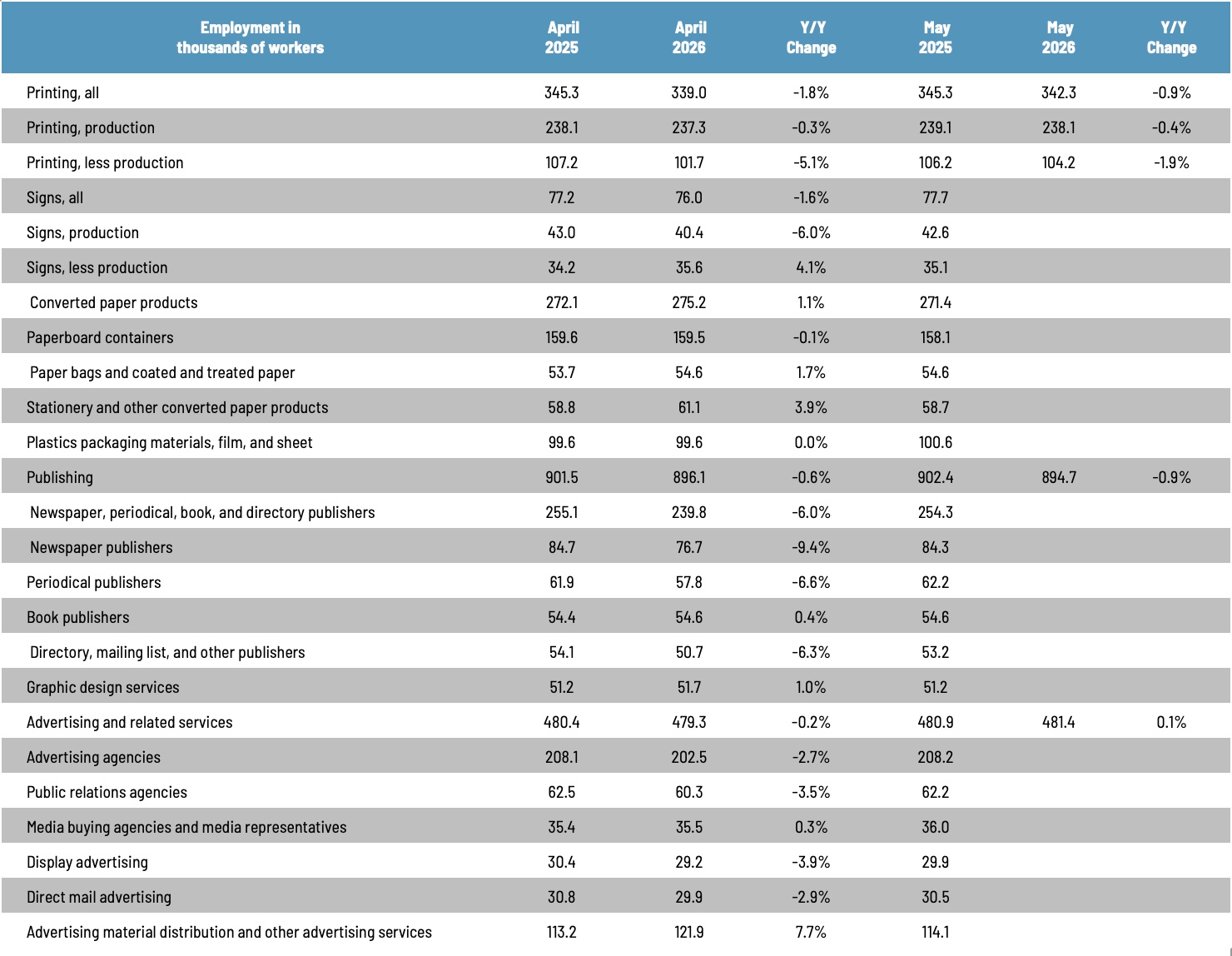
According to the latest, recently released edition of County Business Patterns, in 2023 there were 32,332 establishments in NAICS 511 (Publishing Industries [except Internet]). This represents an increase of 15% since 2010. In macro news, the University of Michigan’s Consumer Sentiment Index is at record lows. Read More

Finishing: Production Inkjet's Next Frontier

Finishing: Production Inkjet's Next Frontier

As production inkjet has advanced, a new primary factor limiting productivity has emerged: finishing. How are PSPs adapting their investment and automation strategies? New research shows many can gain a competitive advantage by focusing on finishing. Read More

HanGlobal Launches New LabStar 330mini at Flexo & Labels Expo 2026

HanGlobal Launches New LabStar 330mini at Flexo & Labels Expo 2026

Discover HanGlobal's newly launched LabStar 330mini digital label press! Get the full show roundup to see how this ultra-integrated, high-performance inkjet solution captured the crowd's attention and redefined narrow-web printing. Read More

Around the Web: Of Food and Feynman

Around the Web: Of Food and Feynman

A book designer who specializes in spine design. The Chinese postal service is using humanoid robots to sort packages. An amusingly overproduced Day Display. Allen Ginsberg’s spoken-word poetry recitation album is being reissued. The winners of this year’s World Food Photography Awards. A retired geneticist launched the online Museum of Plugs & Sockets. A viral warning about a new gas station scam is actually a hoax. What is the world’s longest domestic flight? Aw, et tu, graphene: Skeleton Technologies launches graphene-based GrapheneUPS for AI data centers. What is the quietest spot in the U.S.? Researchers finally cracked Richard Feynman’s “Restaurant Problem.” Malaysia’s kek lapis Sarawak is perhaps the world’s most complex cake. Welcome to WhatTheyThink’s weekly miscellany. Read More