WhatTheyThink

Premium Commentary & Analysis

Is CIM the latest thing in manufacturing? Why all this sudden interest?

By WTT Contributing Columnist Gail Kailing What is CIM?

Friday, December 06, 2002

By WTT Contributing Columnist Gail Kailing What is CIM? A Couple of Definitions According to Mikell Groover (Automation, Production Systems, and Computer Integrated Manufacturing, Prentice-Hall, Inc., Englewood Cliffs, NJ, 1987). CIM is an "informational marriage between customer desires, corporate goals, ease of production, and whatever else makes the company more profitable." A second, equally useful definition is from Joe Mize (Guide to Systems Integration, IIE, 1991) that says CIM is "an open system that combines planning, sales, purchasing, production planning & control, computer aided design, computer aided manufacturing, and computer aided quality control through a centralized database so all data can be accessed and used for control purposes." A Little CIM History Computer Integrated Manufacturing (CIM) is NOT new in the general manufacturing industry. In fact, it’s been around more than 30 years! In 1989 after 20 years of research, and two years of model development, the CIM Reference Model Committee, International Purdue Workshop on Industrial Computer Systems at Purdue University, produced a document called "A Reference Model for Computer Integrated Manufacturing (CIM)." The committee, while researching the tasks an integrated manufacturing system had to be able to carry out, noted that "it has only been since the advent of the modern digital computer that it has been possible to handle the enormous computational load involved in carrying out these functions in real time and thus hoping to compensate for all of the factors affecting plant productivity and economic return." The document analyzed trends in trends in electronics, computer science and control system technology that provided the technical capability to support the development of integrated industrial control systems, including: - Distributed, digital, microcomputer-based, first level dynamic control systems - Standard real-time programming languages such as Real-Time FORTRAN and ADA; (remember this is 1989!) - Standardized high speed serial data links such as MAP and PROWAY; (again, consider the date of publication…), and - Corresponding major developments in database management techniques. We have come a long way, baby! CIM in the Graphic Arts Industry In February 2000, at Seybold Boston, Eddy Hagen of the VIGC (Flemish Innovationcentre for Graphic Communication) presented Computer Integrated Manufacturing and the Path to Profitability. In his presentation he defined the "new" CIM: - CIM will become CIIM (Computer and Internet Integrated Manufacturing) - CIIM is not limited to linking prepress / press / postpressLink with MIS will become more important and will be bi-directional Adobe, Creo, Heidelberg, MAN Roland, Printcafe, et al – Hit the Road Again Just this fall, two groups – yes, all major players in the Graphic Arts Industry – have separately launched initiatives to educate printers about the advantages of JDF (Job Definition Format) and the productivity benefits of CIM. Heidelberg and Adobe formed a partnership to promote JDF and Prinect as solutions to achieve greater efficiency in printers' business processes, end-to-end networking, and associated software applications. Heidelberg’s seminars highlight the Prinect portfolio, a CIM system using JDF as a common data exchange format and comprising a network of integrated workflow components including estimating, quotation, ticketing, tracking and delivery. The Creo, Printcafe and MAN Roland seminars cover all print production, prepress, MIS and post-press processes, and include a look at the current state of the JDF standards and the value of a shared data network. Presentations from the three sponsors highlighting their integration efforts cover specific applications. For example, Creo focuses on Synapse InSite and Synapse Link to collect and share production information, particularly with a printer’s management system. MAN Roland emphasizes two PECOM modules: JobPilot and PressMonitor. Printcafe looks at the role of an integrated management system in a CIM environment, and reviews PrintFlow, a dynamic scheduling system. Internet-enabled Players… There are certainly other vendors providing a wide range of products of interest for commercial and digital print services providers who are considering CIM for their manufacturing operations. While these companies offer "Internet-enabled" applications, some of the modules and applications are further along in the integration of XML/JDF and other file formats and protocols for sharing data. - Avanti Systems - Blanchard Systems - CRC Information Systems - Creo Inc. - DataFlow Systems - DiMS! Organizing Print - Heidelberg - Printable Technologies - Printcafe Software - Prism-USA - Profit Control Systems - Radius Solutions - Tailored Solutions - unit inc. (with SAP) (See E-Business at Graph Expo, WhatTheyThink, October 18, for the vendors reviewed.) So What Does This All Really Mean? The Graphic Arts Industry is evolving away from a "craft-based, custom production" orientation toward more formal manufacturing processes, and at the same time maintains the "mass customization" processes that result in the mass production of individually customized products. The sun, moon, and all the stars have aligned correctly…actually technology has reached a point where the applications, the equipment, and the communications networks are now able to share real-time data. The goal expressed more than a decade ago in the report from Purdue’s CIM Reference Model Committee is finally a goal that can be achieved. The "informational marriage" described in the opening paragraph above will make graphic arts companies more efficient and more profitable!


Continue reading your article
with a WhatTheyThink membership.

WhatTheyThink Annual Membership

Less than $4/week.

Get unlimited access to in-depth commentary and analysis covering the latest trends, emerging technologies, operational strategies, and key events across every segment of today's printing industry.

Stay informed. Stay competitive. Stay ahead.
WhatTheyThink Day Pass

$5 for 24 hours

Unlimited access to all of WhatTheyThink. Get your Day Pass

Already a member?
Sign In

About WhatTheyThink

WhatTheyThink is the global printing industry's go-to information source with both print and digital offerings, including WhatTheyThink.com, WhatTheyThink Email Newsletters, and the WhatTheyThink magazine. Our mission is to inform, educate, and inspire the industry. We provide cogent news and analysis about trends, technologies, operations, and events in all the markets that comprise today's printing and sign industries including commercial, in-plant, mailing, finishing, sign, display, textile, industrial, finishing, labels, packaging, marketing technology, software and workflow.

Recent Articles from WhatTheyThink

Around the Web: Of Books and Bots

Around the Web: Of Books and Bots

New book “Empire of Ink” is a look at the history and mythology of the American newspaper. A hacked smart lightbulb provides access to banned books. A digital archive reassembles Leonardo da Vinci’s long-cut-apart notebooks. Michelangelo’s secret underground hiding place—complete with the artist’s graffiti. Marie Antoinette may have been history’s first influencer. A worn copy of a 1912 pulp magazine featuring Tarzan sold at auction for $58,560. New book, “The Graphene Handbook - Making Sense of Graphene at Its Inflection Point.” Visa is integrating its payment network into ChatGPT, which should be fun. A humanoid robot plans to climb Everest. A designer who specializes in chairs without legs. Did a flying monk see Halley’s Comet…twice? The British geologist whose goal was to eat as many different animals as he possibly could. Welcome to WhatTheyThink’s weekly miscellany. Read More
Publishing Establishments—2010–2023

Publishing Establishments—2010–2023

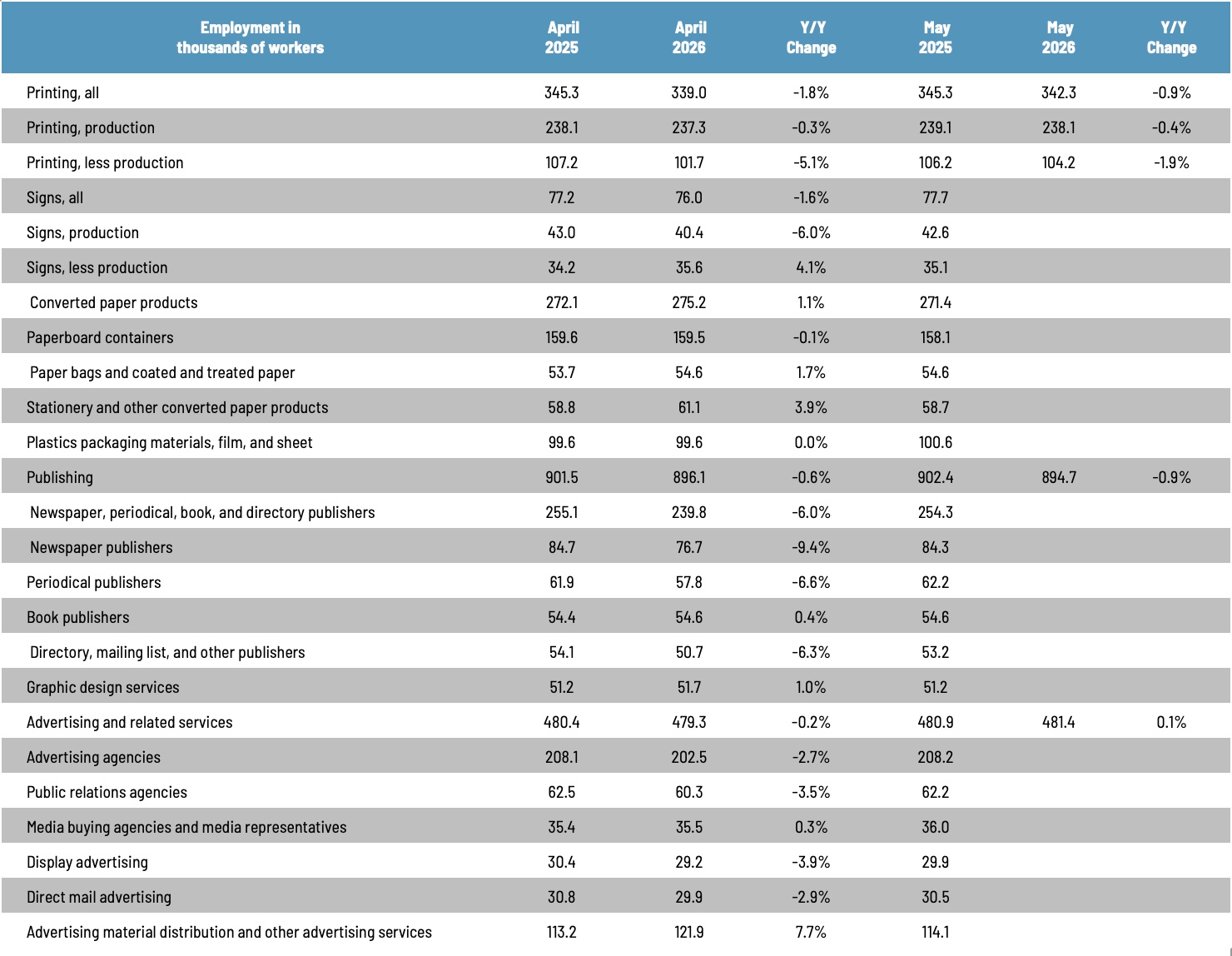
According to the latest, recently released edition of County Business Patterns, in 2023 there were 32,332 establishments in NAICS 511 (Publishing Industries [except Internet]). This represents an increase of 15% since 2010. In macro news, the University of Michigan’s Consumer Sentiment Index is at record lows. Read More

Finishing: Production Inkjet's Next Frontier

Finishing: Production Inkjet's Next Frontier

As production inkjet has advanced, a new primary factor limiting productivity has emerged: finishing. How are PSPs adapting their investment and automation strategies? New research shows many can gain a competitive advantage by focusing on finishing. Read More

HanGlobal Launches New LabStar 330mini at Flexo & Labels Expo 2026

HanGlobal Launches New LabStar 330mini at Flexo & Labels Expo 2026

Discover HanGlobal's newly launched LabStar 330mini digital label press! Get the full show roundup to see how this ultra-integrated, high-performance inkjet solution captured the crowd's attention and redefined narrow-web printing. Read More

Around the Web: Of Food and Feynman

Around the Web: Of Food and Feynman

A book designer who specializes in spine design. The Chinese postal service is using humanoid robots to sort packages. An amusingly overproduced Day Display. Allen Ginsberg’s spoken-word poetry recitation album is being reissued. The winners of this year’s World Food Photography Awards. A retired geneticist launched the online Museum of Plugs & Sockets. A viral warning about a new gas station scam is actually a hoax. What is the world’s longest domestic flight? Aw, et tu, graphene: Skeleton Technologies launches graphene-based GrapheneUPS for AI data centers. What is the quietest spot in the U.S.? Researchers finally cracked Richard Feynman’s “Restaurant Problem.” Malaysia’s kek lapis Sarawak is perhaps the world’s most complex cake. Welcome to WhatTheyThink’s weekly miscellany. Read More