WhatTheyThink

Premium Commentary & Analysis

A Tough Sell: Bringing Digital Document Workflow to the Enterprise - Part II

Not only is it difficult to implement enterprise-

Tuesday, March 26, 2002

Not only is it difficult to implement enterprise-level digital workflow, it's also hard to sell, both as a vendor and an internal champion. "People want to know about the whole process, but what I have seen is that different companies sell on different things, and no one has an overall umbrella view of the total value of going digital," says Chris Ahearn, vice president of sales and marketing for nowdocs.com. "In some cases, vendors even sell a solution that becomes part of the problem. When pieces don't work together, people get frustrated."

It's not easy on vendors either. If an application touches multiple areas, it becomes a more complex sale, and there are more people to reach and educate. "Enterprise workflow vendors often have to sell to inherited platforms and applications," says Ahearn. "They have to persuade multiple people and departments in a company."

The Genetics of Digital Workflow
The genetics of digital workflow contribute to the current dilemma. The evolution of today's digital document processes started with centralized mainframe environments, and then moved to decentralized desktop PCs. Now we see the rise of the networked data center hosting everything. Along the way, divisions and departments came up with their own way of doing things, and these applications are being brought back into the network.

"When you read Gartner and CAPV research, you see that one thing that is missing is a common hardware and software platform," Ahearn notes. "Many departments still use particular software or hardware within the scope of their processes. People need to start seeing what is the best way to do something, but you may not be able to convince them to change."

Under these fragmented conditions, how can companies to get anything to work together across the enterprise? "I think the Internet will allow some of this to get strung together because of its environment and platform independence," Ahearn says. "The new centralized data center supports this approach. For the most part, IT does not want to do anything but a thin client environment, and with good reason. They don't want to download applications to desktops, and if workflow can run in a browser-based environment independent of the desktop, they will have greater success."

Implementation Catch 22
Linking document workflow to the enterprise -- It's not easy, but it's not hopeless. Initially, a company would not build solutions around every single aspect of the business, just certain configurations. Start with integrating functionality specific to basic business applications, Ahearn recommends. Understand how it works, and then branch out and apply the knowledge to other common applications across the enterprise.

For example, when someone joins a company, they fill out employment forms. This enterprise application is very simple, and can easily be done in a digital environment to eliminate paperwork. Basic applications like this are good places to start building enterprise digital document workflow, but here's the catch. That kind of application is not going to give the big, flashy ROI, even though over time, companies may save hundreds of hours in reduced labor and mistakes. Management has to take into consideration the value of eliminating manual clerical labor for paper-based purchase orders, claims, employment forms and other basic applications. Through small wins, the organization needs to prove this works, but it still can be a tough sell.

By starting small, you will be more prepared for larger changes and incur less risk in the learning process. "Critical applications may be the ones with the big workflow ROI, but non-critical tasks provide the best ways to learn," says Ahearn. "I encourage companies to start small and learn mistakes to avoid as they apply digital document workflow to their most critical business applications."


Continue reading your article
with a WhatTheyThink membership.

WhatTheyThink Annual Membership

Less than $4/week.

Get unlimited access to in-depth commentary and analysis covering the latest trends, emerging technologies, operational strategies, and key events across every segment of today's printing industry.

Stay informed. Stay competitive. Stay ahead.
WhatTheyThink Day Pass

$5 for 24 hours

Unlimited access to all of WhatTheyThink. Get your Day Pass

Already a member?
Sign In

About WhatTheyThink

WhatTheyThink is the global printing industry's go-to information source with both print and digital offerings, including WhatTheyThink.com, WhatTheyThink Email Newsletters, and the WhatTheyThink magazine. Our mission is to inform, educate, and inspire the industry. We provide cogent news and analysis about trends, technologies, operations, and events in all the markets that comprise today's printing and sign industries including commercial, in-plant, mailing, finishing, sign, display, textile, industrial, finishing, labels, packaging, marketing technology, software and workflow.

Recent Articles from WhatTheyThink

Around the Web: Of Books and Bots

Around the Web: Of Books and Bots

New book “Empire of Ink” is a look at the history and mythology of the American newspaper. A hacked smart lightbulb provides access to banned books. A digital archive reassembles Leonardo da Vinci’s long-cut-apart notebooks. Michelangelo’s secret underground hiding place—complete with the artist’s graffiti. Marie Antoinette may have been history’s first influencer. A worn copy of a 1912 pulp magazine featuring Tarzan sold at auction for $58,560. New book, “The Graphene Handbook - Making Sense of Graphene at Its Inflection Point.” Visa is integrating its payment network into ChatGPT, which should be fun. A humanoid robot plans to climb Everest. A designer who specializes in chairs without legs. Did a flying monk see Halley’s Comet…twice? The British geologist whose goal was to eat as many different animals as he possibly could. Welcome to WhatTheyThink’s weekly miscellany. Read More
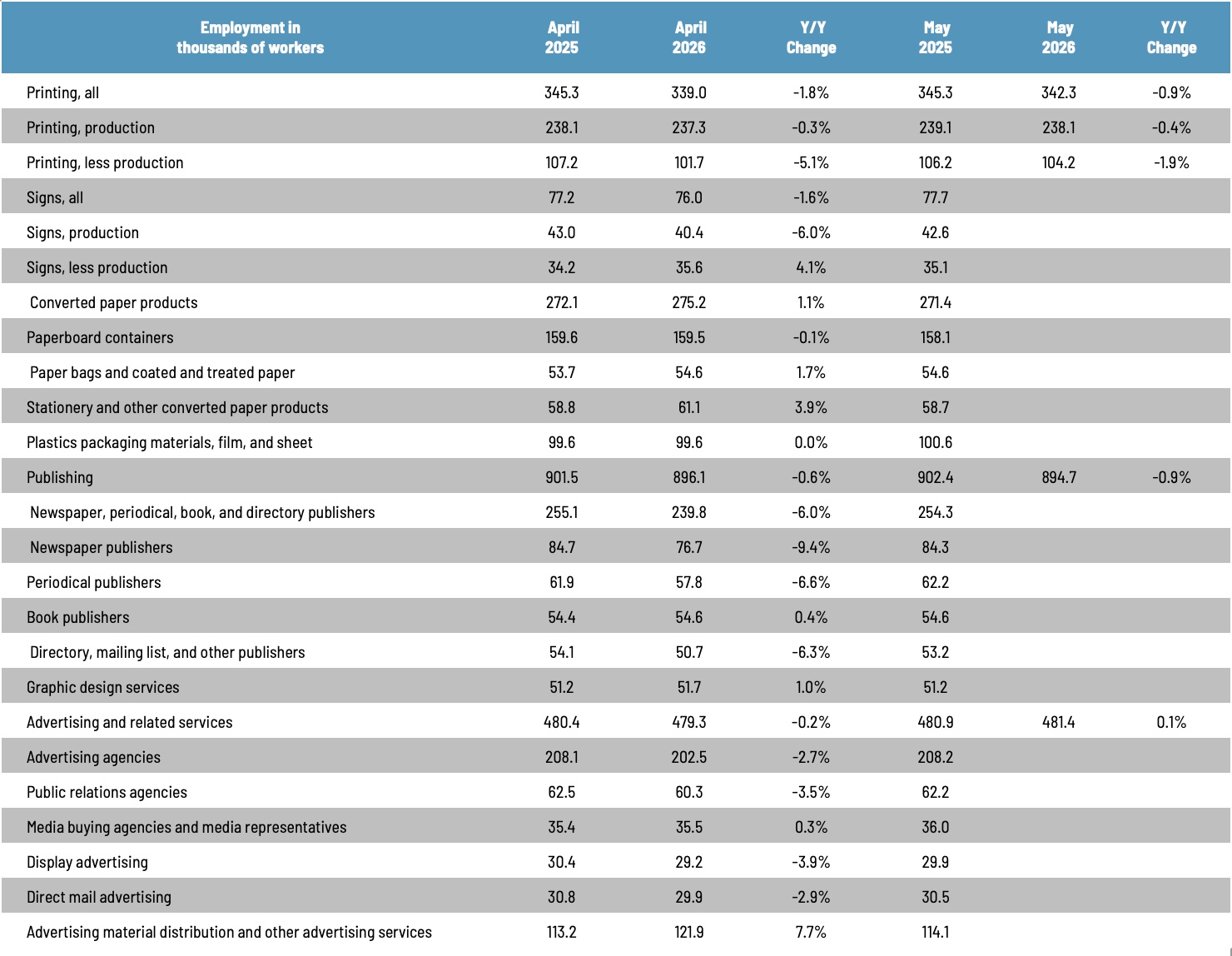
Publishing Establishments—2010–2023

Publishing Establishments—2010–2023

According to the latest, recently released edition of County Business Patterns, in 2023 there were 32,332 establishments in NAICS 511 (Publishing Industries [except Internet]). This represents an increase of 15% since 2010. In macro news, the University of Michigan’s Consumer Sentiment Index is at record lows. Read More

Finishing: Production Inkjet's Next Frontier

Finishing: Production Inkjet's Next Frontier

As production inkjet has advanced, a new primary factor limiting productivity has emerged: finishing. How are PSPs adapting their investment and automation strategies? New research shows many can gain a competitive advantage by focusing on finishing. Read More

HanGlobal Launches New LabStar 330mini at Flexo & Labels Expo 2026

HanGlobal Launches New LabStar 330mini at Flexo & Labels Expo 2026

Discover HanGlobal's newly launched LabStar 330mini digital label press! Get the full show roundup to see how this ultra-integrated, high-performance inkjet solution captured the crowd's attention and redefined narrow-web printing. Read More

Around the Web: Of Food and Feynman

Around the Web: Of Food and Feynman

A book designer who specializes in spine design. The Chinese postal service is using humanoid robots to sort packages. An amusingly overproduced Day Display. Allen Ginsberg’s spoken-word poetry recitation album is being reissued. The winners of this year’s World Food Photography Awards. A retired geneticist launched the online Museum of Plugs & Sockets. A viral warning about a new gas station scam is actually a hoax. What is the world’s longest domestic flight? Aw, et tu, graphene: Skeleton Technologies launches graphene-based GrapheneUPS for AI data centers. What is the quietest spot in the U.S.? Researchers finally cracked Richard Feynman’s “Restaurant Problem.” Malaysia’s kek lapis Sarawak is perhaps the world’s most complex cake. Welcome to WhatTheyThink’s weekly miscellany. Read More