WhatTheyThink

Premium Commentary & Analysis

Communication: The Formula For Success

What if twenty five percent of your business walked out the door,

Wednesday, March 20, 2002

What if twenty five percent of your business walked out the door, today? Would you know why? Could this exodus have been stopped? Did you see the warning signs? Do you have a plan to replace a loss? These are all good questions that a concerned business owner should ask. But, the timing of when to ask is crucial. This disaster can be avoided by having a clear strategy for relating to your customers and developing your business. If your company doesn't have a business development and customer retention strategy, then you need one.

We have all heard the term CRM, but what does it really mean? It certainly isn’t new, as companies have been catering to client needs for decades, but it is receiving considerable attention these days. CRM is the process of learning customer preferences and integrating customer satisfaction into all customer dealings for the purpose of building a corporate philosophy based on customer loyalty. Take special note of the word process. It doesn’t require the purchase of any special software, only the application of a corporate wide customer-centric attitude. The benefits of a clear CRM strategy are well worth your efforts. A clear strategy develops a mutually beneficial relationship between company and customer, fosters a mutual learning environment and focuses on the customer’s lifetime value. This is what business development is all about.

Your customer view must extend beyond the next print job. Your focus must be long-term and consider the amount of business a client brings throughout the lifetime of the relationship. Long relationships bring profit, while short relationships require you to look for new customers often. This is more costly than cultivating your existing clients. While most executives give lip service to having a cohesive company strategy, odds are that a poll of key individuals within an organization will yield divergent opinions about what is important and what is not. I have personally witnessed this lack of consensus in a wide range of companies and worked with management to develop a clear path forward. When management doesn't agree on the details, the strategy is "fuzzy". In sales, clear always beats fuzzy!

Getting your customer's mind share can be a significant challenge. The need to cut through information clutter is shared by most businesses. An excellent way to achieve this is through one-to-one communications. Nevertheless, in order to implement your plan, you must first capture customer-specific information. If your goals are cost-effective sales and JIT delivery, then you need to know if these objectives are shared by your clients. In order to know this, you need to have an interactive and on-going relationship with your customers. Post the following formula on the wall and encourage all employees to live by it:

Dialogue = Information
Information = Knowledge
Knowledge = Loyalty
Loyalty = Profit
Therefore: Dialogue = Profit.

Managing your customers requires capturing customer intelligence. Although this knowledge can be harnessed with enterprise software, a pencil and piece of paper works too. Whatever method you choose, the following steps will assist in managing this process. Group customers into categories, which are made up of customers with similar needs, and assign customer support personnel as category managers who view the lifetime value of each customer as a managed asset. Once this has been done you need to set a strategy for each customer and category, effectively manage communications for a continuation of dialogue and offer an expanding menu of new products and services. By implementing ongoing dialog and catering to customer needs, your surprises will be confined to birthday gifts, and the dual objectives of nurturing happy customers and generating a healthy bottom line will be met. This is the essence of business development.

Seven Steps To Business Development
1. Know what the customer needs.
2. Determine what s/he likes dislikes.
3. Assign internal personnel who are responsible for customer care feeding.
4. Create new benefits, services and/or products based on customer input.
5. Foster company-wide attitude: "If it wasn’t for this customer, I wouldn’t have my job".
6. Maintain customer dialogue, which has value for the customer (not just lame mailings and calls).
7. Maintain an on-going feedback loop to preclude neglected relationships.


Continue reading your article
with a WhatTheyThink membership.

WhatTheyThink Annual Membership

Less than $4/week.

Get unlimited access to in-depth commentary and analysis covering the latest trends, emerging technologies, operational strategies, and key events across every segment of today's printing industry.

Stay informed. Stay competitive. Stay ahead.
WhatTheyThink Day Pass

$5 for 24 hours

Unlimited access to all of WhatTheyThink. Get your Day Pass

Already a member?
Sign In

About WhatTheyThink

WhatTheyThink is the global printing industry's go-to information source with both print and digital offerings, including WhatTheyThink.com, WhatTheyThink Email Newsletters, and the WhatTheyThink magazine. Our mission is to inform, educate, and inspire the industry. We provide cogent news and analysis about trends, technologies, operations, and events in all the markets that comprise today's printing and sign industries including commercial, in-plant, mailing, finishing, sign, display, textile, industrial, finishing, labels, packaging, marketing technology, software and workflow.

Recent Articles from WhatTheyThink

Around the Web: Of Books and Bots

Around the Web: Of Books and Bots

New book “Empire of Ink” is a look at the history and mythology of the American newspaper. A hacked smart lightbulb provides access to banned books. A digital archive reassembles Leonardo da Vinci’s long-cut-apart notebooks. Michelangelo’s secret underground hiding place—complete with the artist’s graffiti. Marie Antoinette may have been history’s first influencer. A worn copy of a 1912 pulp magazine featuring Tarzan sold at auction for $58,560. New book, “The Graphene Handbook - Making Sense of Graphene at Its Inflection Point.” Visa is integrating its payment network into ChatGPT, which should be fun. A humanoid robot plans to climb Everest. A designer who specializes in chairs without legs. Did a flying monk see Halley’s Comet…twice? The British geologist whose goal was to eat as many different animals as he possibly could. Welcome to WhatTheyThink’s weekly miscellany. Read More
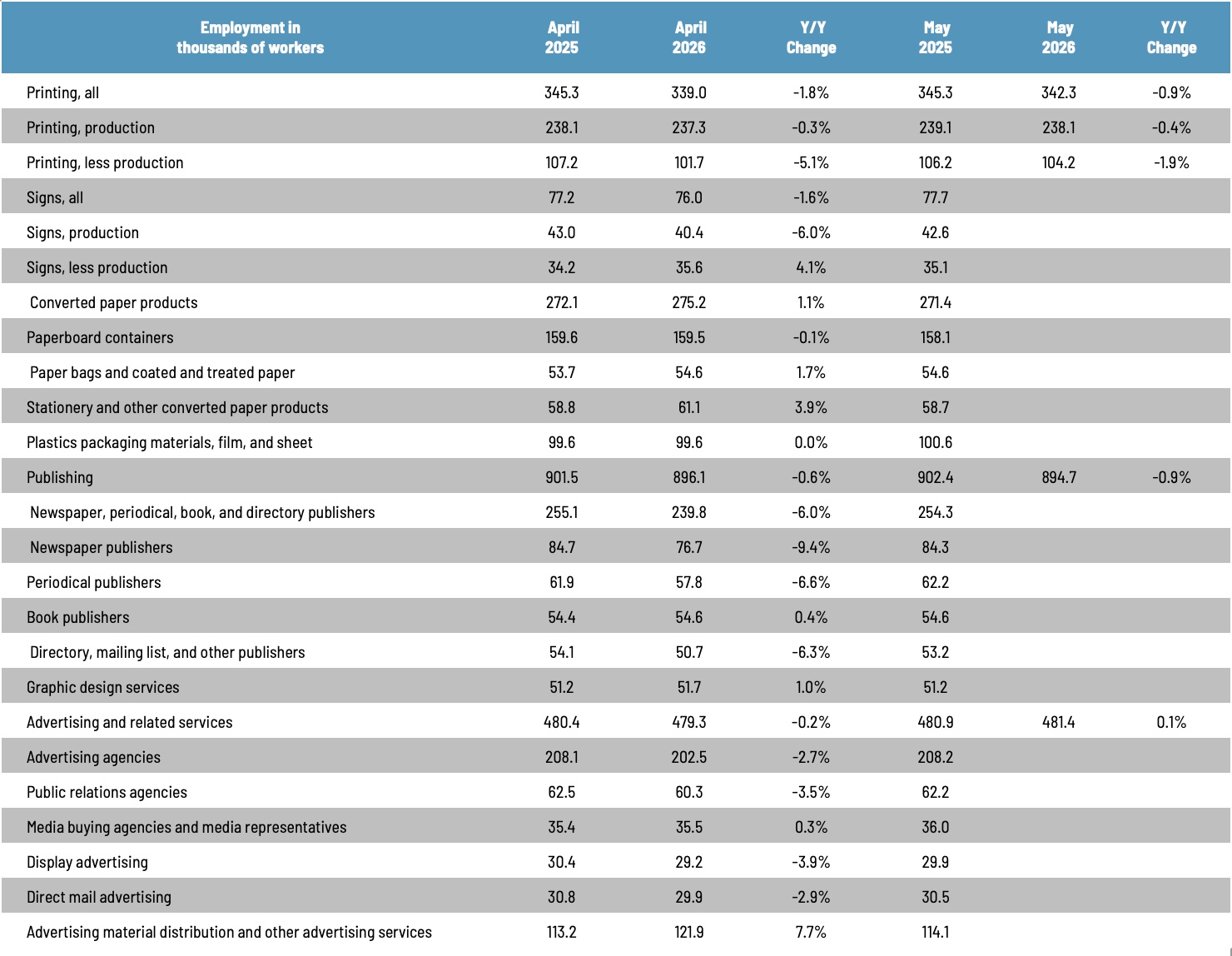
Publishing Establishments—2010–2023

Publishing Establishments—2010–2023

According to the latest, recently released edition of County Business Patterns, in 2023 there were 32,332 establishments in NAICS 511 (Publishing Industries [except Internet]). This represents an increase of 15% since 2010. In macro news, the University of Michigan’s Consumer Sentiment Index is at record lows. Read More

Finishing: Production Inkjet's Next Frontier

Finishing: Production Inkjet's Next Frontier

As production inkjet has advanced, a new primary factor limiting productivity has emerged: finishing. How are PSPs adapting their investment and automation strategies? New research shows many can gain a competitive advantage by focusing on finishing. Read More

HanGlobal Launches New LabStar 330mini at Flexo & Labels Expo 2026

HanGlobal Launches New LabStar 330mini at Flexo & Labels Expo 2026

Discover HanGlobal's newly launched LabStar 330mini digital label press! Get the full show roundup to see how this ultra-integrated, high-performance inkjet solution captured the crowd's attention and redefined narrow-web printing. Read More

Around the Web: Of Food and Feynman

Around the Web: Of Food and Feynman

A book designer who specializes in spine design. The Chinese postal service is using humanoid robots to sort packages. An amusingly overproduced Day Display. Allen Ginsberg’s spoken-word poetry recitation album is being reissued. The winners of this year’s World Food Photography Awards. A retired geneticist launched the online Museum of Plugs & Sockets. A viral warning about a new gas station scam is actually a hoax. What is the world’s longest domestic flight? Aw, et tu, graphene: Skeleton Technologies launches graphene-based GrapheneUPS for AI data centers. What is the quietest spot in the U.S.? Researchers finally cracked Richard Feynman’s “Restaurant Problem.” Malaysia’s kek lapis Sarawak is perhaps the world’s most complex cake. Welcome to WhatTheyThink’s weekly miscellany. Read More