WhatTheyThink

Premium Commentary & Analysis

Components of Digital Workflow: Getting From Point A to Point B

The benefits of digital workflow,

Monday, February 25, 2002

The benefits of digital workflow, as covered in the last column, are fairly easy to understand. Most of us can readily grasp them in the context of business strategy and return on investment. However, the actual process of generating documents in the digital domain can be intimidating. The beauty of digital workflow is that software automatically does most of the work. Still, you might find it helpful to have a basic idea of what is involved.

The stages of document production workflow are concept, creation, data integration, production, finishing and distribution, or more simply -- creation, production and output. "Concepts are usually born of a marketing need, and creation describes the application of graphic design to drive the marketing requirement," says Dave Squires, vice president of Sefas Innovation, Inc. (sefas.com). Some might contend that design is outside the actual workflow process. That is arguably true, but understanding what design must do can improve the efficiency of digital throughput.

"Data integration is where document content, whether static or highly personalized, is brought into the design," Squires explains. "Production involves the application of business logic, design rules, content objects and printing instructions to the actual process of assembling, formatting, rendering, and then physically preparing the documents according to their specification, whether they will be delivered on paper or electronically." Business logic or rules are the "if x, then y" scripting that underlies the appearance of a computer-generated document. Some document composition software makes this layer largely transparent to designers and novice programmers.

Take and Transform
MAIL 2000 (mail2000.com) is a good example of a print/mail operation automating all stages of digital workflow, starting with the ability to receive data in any form, whether digital or as traditional print. "First we receive and 'recognize' data into the system with a lights off process," explains MAIL 2000 COO John Kuiper, "then we distribute and print it."

Information and images printed on personalized documents can come from all kinds of databases. Composition software -- which automatically grabs information from other systems and pulls all the pieces together into a digital document -- is designed to accept data in a specific way. However, the format of the database extract may not match the intake needs of the composition tool. A preprocessing step corrects this, resorting and validating data from the extract and adding information or calculations as needed. "The purpose is to strip complexity away from the extract," says Tim West, vice president of development for Art Plus Technology (artplustechnology.com).

Counting Pages
Validation is the sorting of data to the point where it can be sent to the print/mail process as a print-ready file, but before that happens, validation has another important role. "In order to do page composition, the system has to know the number of pages in each document," West explains. "The first pass of the composition process is the same as print processing, but it's done to determine how many pages per set will be generated after the variable content flows in."

This information is also useful for resource and mail planning, such as determining how many documents will be five pages or less for envelope inserting, six or more pages for flats, or how many pages require special handling. Understanding the demands on print capacity can help maximize throughput and get jobs to the right facility, whether for a certain type of output such as highlight color, or to achieve a specific postmark or mailing location.

Where the Savings Are
"Postal is where the savings are," declares West, and in digital workflow, presort software organizes document order to get the best postal rates. A postal optimization process identifies address changes or updates. The next composition pass determines the order in which the job will print. The resulting resorted print-ready file goes to the appropriate printers and facilities for production and mailing or some other delivery method.

The MAIL 2000 workflow system automatically verifies addresses, and presorts and barcodes customers' documents. The data is segmented to the point of end delivery for local printing at any of MAIL 2000's six production facilities. "We automatically segment one file into six for the production sites, checking for completeness and creating a print file for routing. We save time on distribution because work gets into the mail stream faster," says Kuiper.

It's the Software, Stupid
You're probably not going to find one software package to handle all the steps of digital document workflow. Some offerings are specialized to certain functions, and many companies offer modular capabilities. "One category of workflow products automates validation and sorting of data and making a print-ready file," West explains. "Other products are designed to handle just print output."

Some operations find everything comes down to customization of existing software. Others end up with a mix of proprietary and off-the-shelf packages. West says Art Plus Technology uses third party postal sorting software, but also writes software to do sorting, validation and composition. You can even outsource some steps, like postal sorting, and not be bothered by software at all.

A Step-Saving System
MAIL 2000 has built an automated document workflow system with proprietary software to route data from receipt through certification, design and distribution without any manual intervention. "Our process eliminates 17 out of 20 steps in getting a letter to mail," declares Kuiper, "and that creates a speed and quality advantage."

The company uses the same composition tool for letters to also do output for the web and send electronic notices to customers. "We can mix one print file from a client into 20 percent email and 80 percent print output, for example, and change this on the fly next month if the company wants to send more email. We just flag it in the data because we use the same composition tool," Kuiper explains. Putting software to work to drive the stages of digital workflow helps companies like MAIL 2000 achieve maximum flexibility and efficiency.


Continue reading your article
with a WhatTheyThink membership.

WhatTheyThink Annual Membership

Less than $4/week.

Get unlimited access to in-depth commentary and analysis covering the latest trends, emerging technologies, operational strategies, and key events across every segment of today's printing industry.

Stay informed. Stay competitive. Stay ahead.
WhatTheyThink Day Pass

$5 for 24 hours

Unlimited access to all of WhatTheyThink. Get your Day Pass

Already a member?
Sign In

About WhatTheyThink

WhatTheyThink is the global printing industry's go-to information source with both print and digital offerings, including WhatTheyThink.com, WhatTheyThink Email Newsletters, and the WhatTheyThink magazine. Our mission is to inform, educate, and inspire the industry. We provide cogent news and analysis about trends, technologies, operations, and events in all the markets that comprise today's printing and sign industries including commercial, in-plant, mailing, finishing, sign, display, textile, industrial, finishing, labels, packaging, marketing technology, software and workflow.

Recent Articles from WhatTheyThink

Around the Web: Of Books and Bots

Around the Web: Of Books and Bots

New book “Empire of Ink” is a look at the history and mythology of the American newspaper. A hacked smart lightbulb provides access to banned books. A digital archive reassembles Leonardo da Vinci’s long-cut-apart notebooks. Michelangelo’s secret underground hiding place—complete with the artist’s graffiti. Marie Antoinette may have been history’s first influencer. A worn copy of a 1912 pulp magazine featuring Tarzan sold at auction for $58,560. New book, “The Graphene Handbook - Making Sense of Graphene at Its Inflection Point.” Visa is integrating its payment network into ChatGPT, which should be fun. A humanoid robot plans to climb Everest. A designer who specializes in chairs without legs. Did a flying monk see Halley’s Comet…twice? The British geologist whose goal was to eat as many different animals as he possibly could. Welcome to WhatTheyThink’s weekly miscellany. Read More
Publishing Establishments—2010–2023

Publishing Establishments—2010–2023

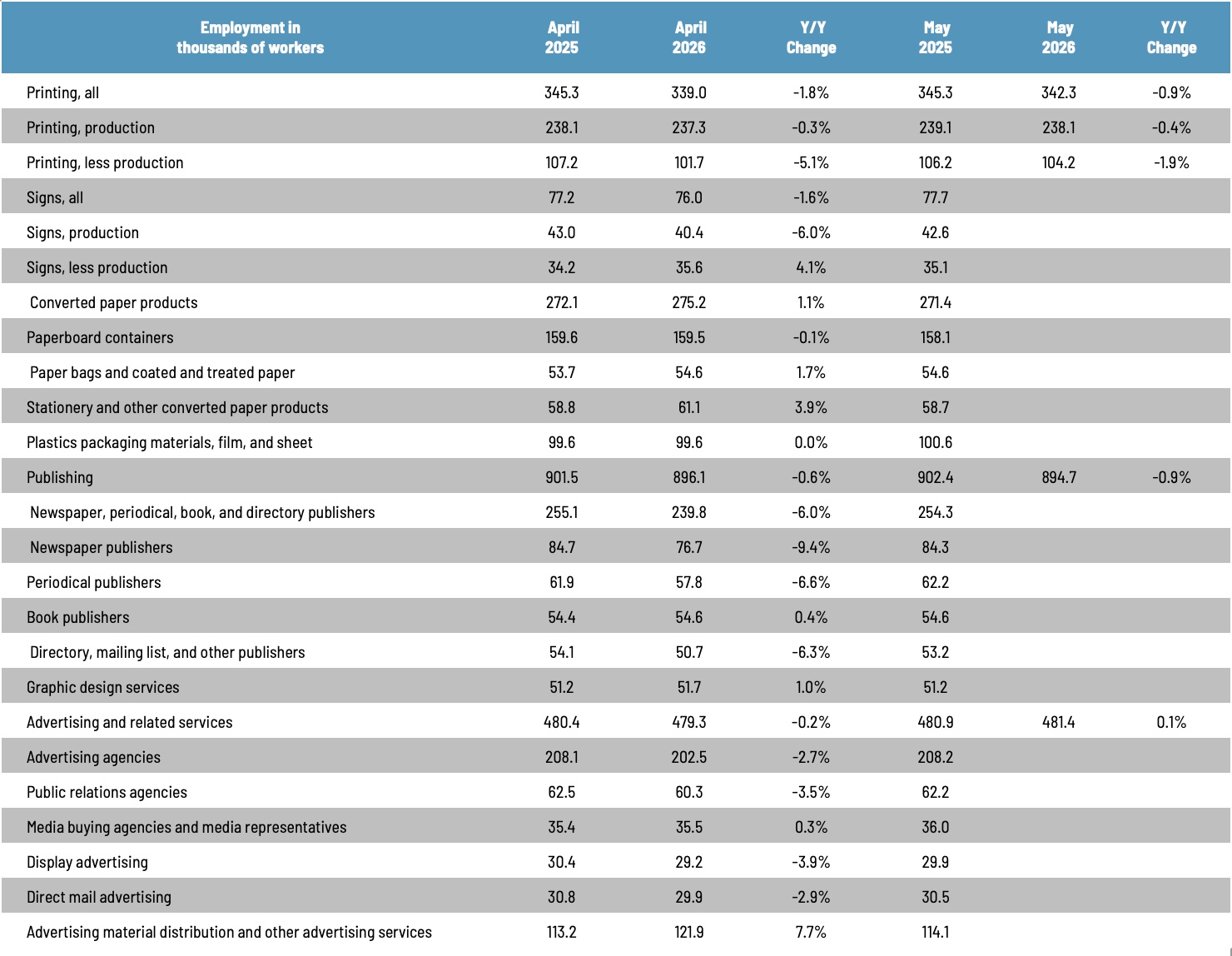
According to the latest, recently released edition of County Business Patterns, in 2023 there were 32,332 establishments in NAICS 511 (Publishing Industries [except Internet]). This represents an increase of 15% since 2010. In macro news, the University of Michigan’s Consumer Sentiment Index is at record lows. Read More

Finishing: Production Inkjet's Next Frontier

Finishing: Production Inkjet's Next Frontier

As production inkjet has advanced, a new primary factor limiting productivity has emerged: finishing. How are PSPs adapting their investment and automation strategies? New research shows many can gain a competitive advantage by focusing on finishing. Read More

HanGlobal Launches New LabStar 330mini at Flexo & Labels Expo 2026

HanGlobal Launches New LabStar 330mini at Flexo & Labels Expo 2026

Discover HanGlobal's newly launched LabStar 330mini digital label press! Get the full show roundup to see how this ultra-integrated, high-performance inkjet solution captured the crowd's attention and redefined narrow-web printing. Read More

Around the Web: Of Food and Feynman

Around the Web: Of Food and Feynman

A book designer who specializes in spine design. The Chinese postal service is using humanoid robots to sort packages. An amusingly overproduced Day Display. Allen Ginsberg’s spoken-word poetry recitation album is being reissued. The winners of this year’s World Food Photography Awards. A retired geneticist launched the online Museum of Plugs & Sockets. A viral warning about a new gas station scam is actually a hoax. What is the world’s longest domestic flight? Aw, et tu, graphene: Skeleton Technologies launches graphene-based GrapheneUPS for AI data centers. What is the quietest spot in the U.S.? Researchers finally cracked Richard Feynman’s “Restaurant Problem.” Malaysia’s kek lapis Sarawak is perhaps the world’s most complex cake. Welcome to WhatTheyThink’s weekly miscellany. Read More