Image Credit: Marimekko
Few fashion and design brands carry their heritage as confidently as Marimekko. Since its founding in Helsinki in 1951, the Finnish label has built an identity so distinctive that its prints are instantly recognizable: bold, geometric, unapologetically colorful.
But what makes Marimekko’s story compelling is not just its aesthetic legacy. It’s the way the company has used that legacy as a springboard for growth, innovation, and responsible production, without ever diluting what makes it unique.
With a Paris flagship now open in Le Marais, continued expansion across Asia-Pacific, and a Helsinki printing mill producing one million meters of fabric per year, Marimekko offers a masterclass in scaling a design-led brand with purpose and precision.
A Factory at the Heart of Everything
Start with the source. Marimekko’s Helsinki printing mill is the beating heart of the brand—the place where its iconic fabrics come to life. Producing approximately one million meters of printed textiles each year, the factory is central to both the brand's identity and its quality control.
This level of in-house production is rare. Most fashion and lifestyle brands have outsourced manufacturing to reduce costs. Marimekko’s decision to maintain a domestic printing facility speaks to a deeper philosophy: that the integrity of a print, from design to finished fabric, cannot be fully preserved at arm’s length.
The mill also serves as an architectural reference point. When Marimekko opened its first Paris flagship in October 2025, the store’s interior drew direct inspiration from the Helsinki printing mill, combining bold hues with industrial materials to create a space that feels alive and distinctly Marimekko. The result is a retail environment where the brand’s manufacturing roots are made visible, turning the shop floor into a kind of homage to the craft behind the product.
Sustainability as Strategy, Not Afterthought
Marimekko’s sustainability objectives are woven into its broader business strategy rather than treated as a separate initiative. For a brand built on textiles—one of the most resource-intensive industries in the world—this matters enormously.
The company’s commitment to eco-conscious production is reflected in both materials and methods. One of the most striking examples is its use of laser-marked denim. Traditional denim finishing processes, particularly stone-washing and sandblasting, are water-heavy and often involve harmful chemicals. Laser marking replaces these processes with precision technology that uses no water and significantly reduces chemical waste. The result? Denim that achieves the same worn, textured finish through a cleaner, more controlled method.
This kind of innovation demonstrates that sustainability and quality are not competing priorities. Laser technology allows for greater design precision, which aligns directly with Marimekko’s commitment to craftsmanship. It is a case study in how the right technological investment can simultaneously reduce environmental impact and improve the product.
Home Furnishings: Where the Prints Live Longest
Marimekko’s product portfolio spans clothing, bags, accessories, and home décor; and it is in the home furnishings category that the brand's prints often make their most lasting impression. Tableware, textiles, and soft furnishings carry Marimekko’s visual language into everyday domestic spaces, turning the morning coffee ritual or the dining table into a small act of design appreciation.
At the Paris Le Marais store, this dimension of the brand is given prominent space. Marimekko mugs, plates, tumblers, and gift-wrapping sit alongside curtains in signature prints, bags, and apparel. The store functions less like a conventional retail outlet and more like a curated environment—a total design world that customers can step into and, piece by piece, take home.
This approach to home furnishings is significant commercially, too. Unlike fashion, which turns over seasonally, well-made homeware has a longer purchase lifecycle and tends to attract customers who are investing in the brand rather than simply buying a trend. For Marimekko, whose prints are genuinely timeless, this is a natural and profitable positioning.
Fashion With a Design Identity
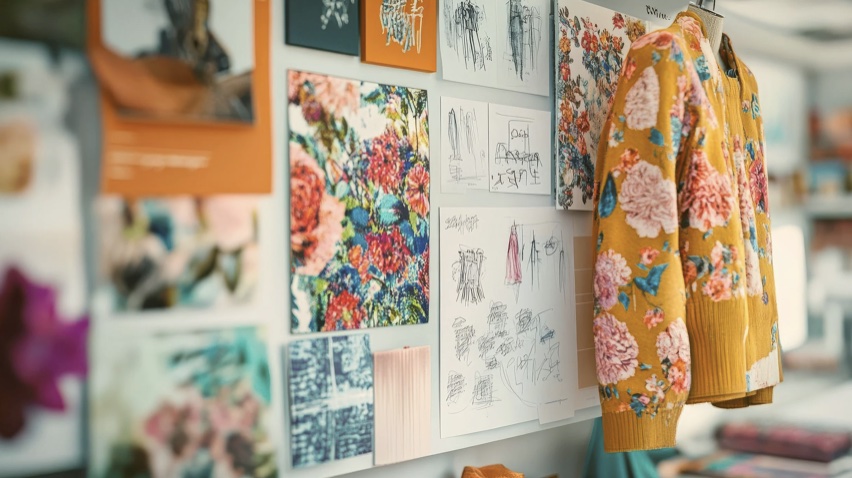
On the fashion side, Marimekko’s clothing range maintains the same visual confidence as its homeware. The brand’s dresses, in particular, have served as a canvas since 1951—and the archive is rich with decades of design evolution.
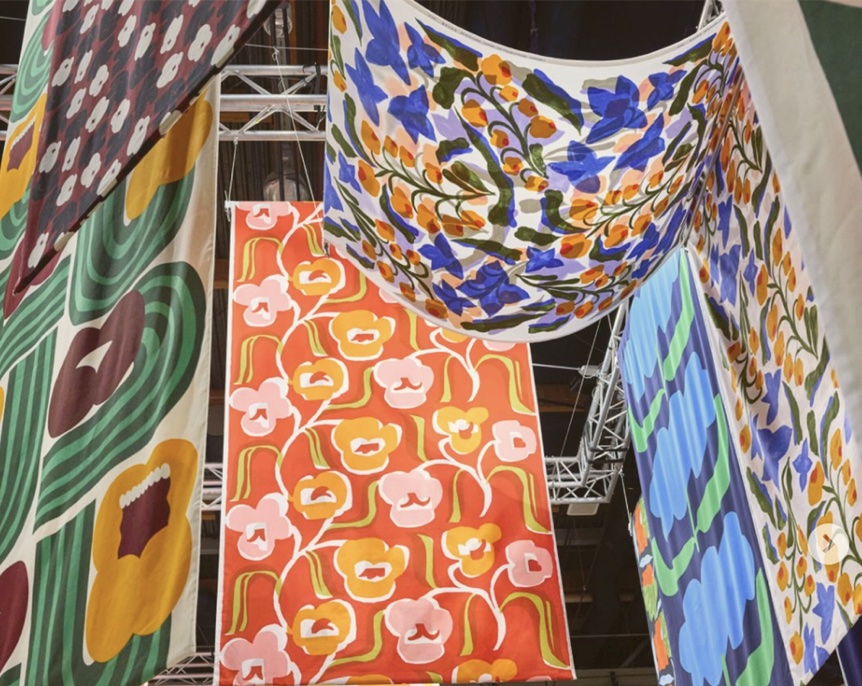
In March 2025, Marimekko brought that archive to Paris in an especially compelling way. The brand participated for the first time in Matter and Shape, a design salon held in the Jardin des Tuileries. The installation presented a conceptual reinterpretation of Marimekko’s print archive, with original fabric swatches spanning multiple decades on display for visitors to engage with directly. Simultaneously, the Le Marais flagship hosted a pop-up of rare archive dresses, curated by Creative Director Rebekka Bay, available to vintage enthusiasts from 6–9 March.
Together, these two activations told a coherent story: that Marimekko’s fashion output is not ephemeral trend-chasing, but the product of a living design archive. The brand’s prints endure precisely because they were never designed to be of the moment—they were designed to be themselves.
Paris and the Logic of Western Expansion
The decision to open a Paris flagship makes cultural and commercial sense. Paris is a city where design literacy runs deep, where consumers are attuned to the difference between surface-level aesthetics and genuine craft. Marimekko’s prints—bold, architectural, instantly recognizable—translate well into that context.
Located at 120 Rue Vieille du Temple in Le Marais, the store sits in one of Paris’s most design-forward neighborhoods. The opening weekend was a neighborhood event in the truest sense, spilling into the streets with music, festivities, and a collaboration with local florist Castor Fleuriste, whose bouquets were wrapped in Marimekko fabrics during the launch week. It was a confident, joyful market entry, precisely the tone a brand with Marimekko’s heritage should strike.
With over 170 stores globally and an online presence serving customers in 39 countries, the Paris store is part of a considered retail expansion, not a speculative one.
Asia-Pacific: The Growth Engine
While the Paris opening drew attention, Marimekko’s most commercially significant growth market is Asia-Pacific. The brand identifies the region as one of its key markets alongside Northern Europe and North America—and for good reason.
Consumer appetite for design-led lifestyle brands in markets such as Japan, South Korea, and Australia has created fertile ground for Marimekko’s proposition. The brand’s emphasis on originality, craftsmanship, and longevity resonates strongly in markets where quality is prized and brand identity matters. Asia-Pacific is not a secondary market for Marimekko - it is central to the company's long-term growth ambitions.
In 2025, the company’s net sales totaled €190 million, with a comparable operating profit margin of 17.1%. These figures reflect a business that has found a sustainable growth model, one that does not depend on volume alone, but on the enduring value of a strong design identity.
What Marimekko’s Model Actually Proves
The Marimekko case is instructive for anyone watching how design-led brands navigate scale. The company has grown its revenue and global footprint without chasing mass-market accessibility. Its Helsinki factory continues to produce fabric domestically. Its sustainability work is embedded in production processes, not bolted on as marketing. Its retail environments are extensions of the brand's design world, not just points of sale.
Most strikingly, the archive is treated as an asset, not a museum piece. The Matter and Shape installation and the Paris pop-up are examples of a brand that understands its history is commercially relevant, that customers want to engage with where a brand comes from, not just where it is now.
Bold prints and a clear sense of purpose have carried Marimekko from a small Helsinki textile company to a €190 million global business. The next chapter, from the banks of the Seine to the markets of Asia-Pacific, looks equally vivid.