 Now that the very successful Dscoop Rockies is behind us, I wanted to capture and share some thoughts from Noam Zilbershtain, VP & GM, HP Indigo, on what he sees as the new demands of the industry and how HP is poised to support it.
For anyone who has ever been to a Dscoop event, you know it has always been a good place to see new products and share ideas. But this year felt different. The attendee and partner conversations weren’t just about a single press or a single feature, they were about what printers now expect from digital, and what they will no longer tolerate. Ultimately it was about outcomes.
The printing industry is shifting from selling products to delivering business outcomes. More sellable output, stronger economics, with the confidence to commit and scale. All powered by predictability and uptime that customers can rely on. That shift isn’t a slogan. It’s forcing all of us, HP Indigo included, to rethink how look at production and how we build, we sell and how we support the value chain.
Zilbershtiain provided some clarity to how HP is looking at the industry and future development. “I’ve used the phrase ‘Nonstop Digital Printing’ for a while. This is HP Indigo’s vision, and a clear statement of where we believe the industry is heading. It is what digital printing must deliver and, increasingly, what customers now expect it to deliver. What’s changed is that this vision is no longer aspirational. It has become a measurable operational requirement, one that shows up in how customers evaluate investments, plan capacity, and manage risk on their production floors.”
The New KPI: Sellable Output
“For years, much of print equipment marketing revolved around speed specs and theoretical capacity,” continued Zilbershtiain. “Today, customers are asking a different question: How much sellable output can I reliably produce, week after week with the predictability and cost structure that allow me to commit, plan, and grow with confidence? That’s a higher bar, and it’s the right one to aspire to.
“It also changes the meaning of innovation. It’s not only about the next technology node. It’s about leveraging intelligence to stabilize performance, accelerate decisions, and relieve the burden from skilled operators, because labor is constrained everywhere, and complexity keeps rising, “and focusing on the KPI and sellable output, is what we are focusing on at HP Indigo.”
AI-First, Not AI-as-a-Feature
This is where AI transforms from a buzzword to infrastructure. “At HP Indigo, we’ve made a deliberate shift toward becoming an AI?first company, embedding artificial intelligence across the solutions and value chain, and not treating it as an accessory.” For customers and partners, that matters for one reason: practical value. AI should help teams run more production with fewer people, less downtime, fewer errors and faster recovery. Today, not someday. In other words, AI that works on your production floor, not just in presentations.”
The implication is broader for analysts and industry observers. When AI is production?proven and embedded into the platform, it expands software, automation, and attach?rate revenue over time. It also helps shift the business away from purely cyclical hardware dynamics toward platform economics. Put simply: “HP Indigo monetizes AI benefits where others absorb them.
“That’s not a theoretical statement,” said Zilbershtiain. “We’re applying AI where it can materially enable outcomes: by reducing interruptions, accelerating recovery, and stabilizing execution through automated press failure recovery, AI?powered diagnostics and troubleshooting, AI?driven print mode decisions, and automated defect detection with reprint.”
Dscoop Edge Rockies: What Was Launched and Why
At Dscoop Edge Rockies 2026, HP introduced several tangible steps tied directly to that “outcomes shift.” The common thread across them is straightforward: make digital production more predictable, easier to run, and better economically, especially as production environments become harder to manage and scale.
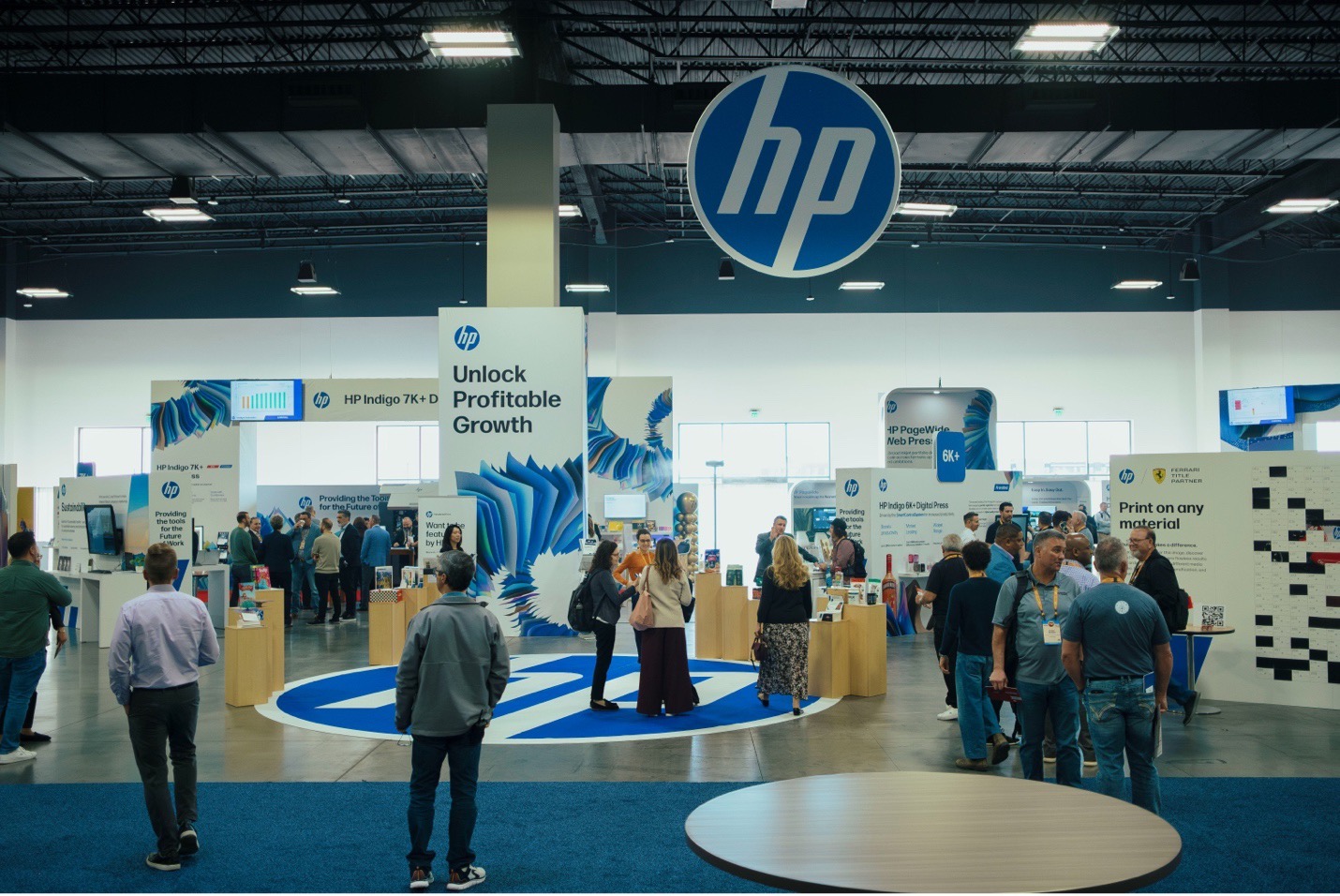
A3 with Improved Economics and Automation: HP Indigo 7K+
“We remain deeply committed to A3, because a lot of real production lives there, and because customers need a combination of versatility and cost efficiency they can count on,” said Zilbershtiain. “At Dscoop, we introduced the HP Indigo 7K+ Digital Press, bringing a more economical 4?color ECO Print Mode alongside expanded automation capabilities.” This isn’t innovation for its own sake. It’s a response to the realities customers are confronting—higher operating costs, tighter availability of skilled expertise, and pressure to deliver consistent output with simpler operation. The goal is to make operation and economics more attractive without compromising on Indigo quality and flexibility.
Consistent, Sellable B2 Output Every Day: The HP Indigo 120K Value Pack
In commercial printing, B2 continues to be where customers push hardest for nonstop business outcomes, because the economics of the floor depend on stable throughput and predictable output. “At Dscoop, we introduced the HP Indigo 120K Value Pack, designed to let existing customers upgrade productivity, efficiency, and stability without replacing the press,” added Zilbershtiain. That’s a good example of the outcome mindset, since customers don’t always want a forklift upgrade they want a clear pathway to better performance and economics on the assets they already own.
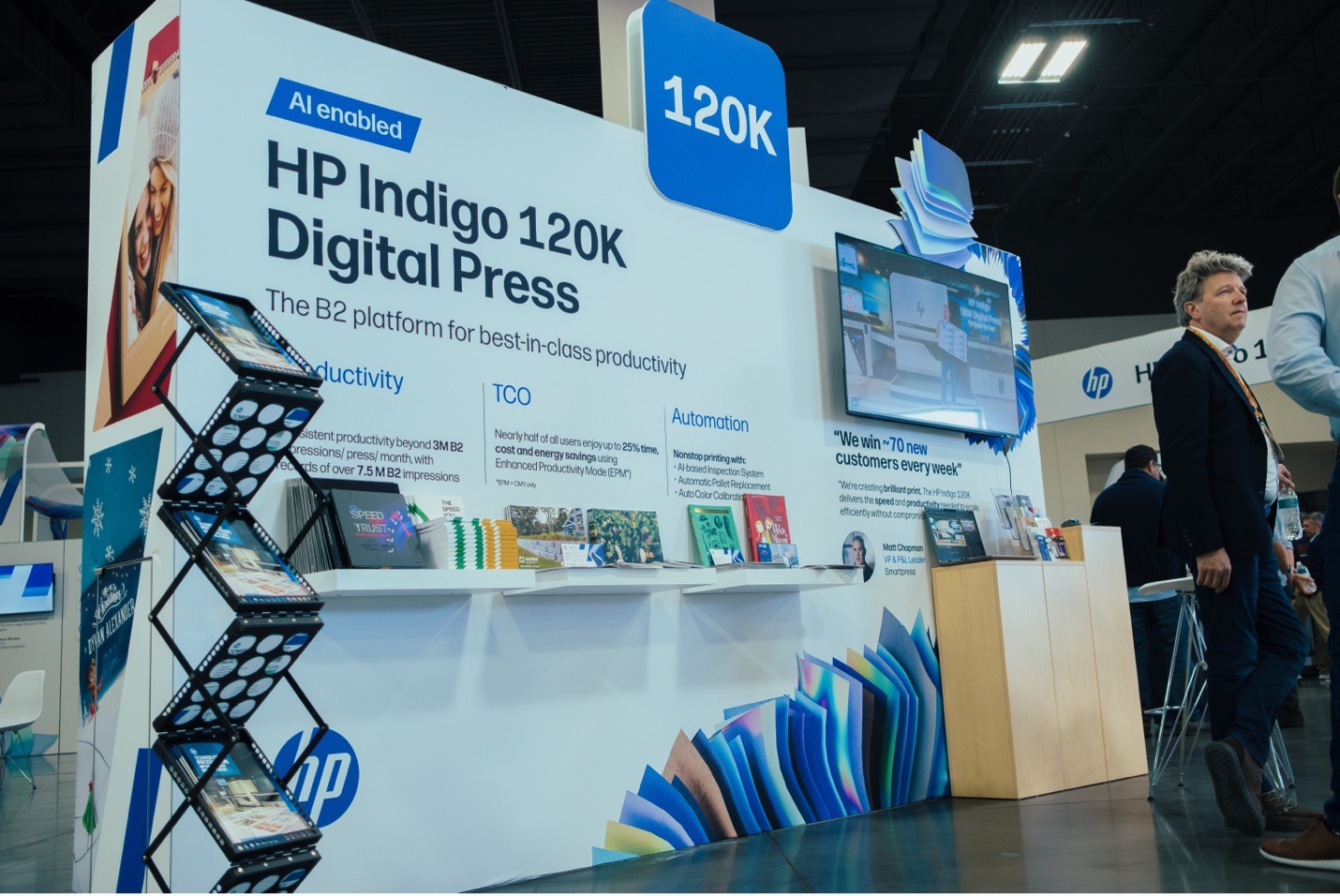
“The Value Pack was validated through a five?month beta period, across dozens of presses, covering hundreds of millions of B2 impressions, with improvements focused on the KPIs that matter most to production: stability and uptime as the foundation for higher, more consistent throughput and sellable output.”
Automation Beyond the Press: Print?Focused AMRs Through MoviGo
If you talk to printers running high?mix production, they will tell you that the bottlenecks are often not only in print. They’re in the movement of materials, including pallet handling, roll transport, and the orchestration of the floor.
“That’s why we announced an expanded partnership with MoviGo Robotics, where HP will sell and fully support print?focused AMRs directly,” said Zilbershtiain. “This will enable true end?to?end automation across the production floor for B2 pallets for HP Indigo commercial sheetfed presses, and for the roll transport supporting both HP Indigo and HP PageWide presses with the Sharko 5 RT.”
One of the strongest signals is when customers describe this not as cool tech, but as an important tool to unlock to operational efficiency. As Adam Carnell, CEO of Bluetree Group, put it, “Adopting robotics fundamentally changed how movement works inside the factory. It allows us to redesign processes, scale smarter, improve flow, and stay ahead as a modern, data?driven print business.” That’s exactly the point: outcomes require a systematic approach.
Labels & Packaging: Momentum That’s Visible in the Field
In labels, “nonstop” is becoming tangible through platforms like the HP Indigo V12, where performance improvements translate into real capacity and cost impact, and where we continue to invest in upgrades that improve availability, utilization, and scalability.
“At the same time, we’re seeing strong momentum in the platform that sits at the heart of the segment: the HP Indigo 6K+,” said Zilbershtiain. “Since its introduction at Labelexpo, only six months ago, we’ve already seen that pace matters because it reflects customer demand for reliability and productivity improvements that show up immediately on the floor.
“And in flexible packaging, we marked a milestone at Dscoop that signals something bigger than a number: 100 HP Indigo 200K presses installed worldwide to date.
“Milestones matter when they reflect confidence—confidence that digital can deliver not only differentiation, but scale.”
What Gives Me Confidence Right Now
“When industries mature,” added Zilbershtiain, “the conversation shifts. In print, we’re seeing that shift clearly. Customers are pushing all of us: vendors, partners, and internal teams to deliver business outcomes that hold up as complexity grows: consistent sellable capacity, reliable economics, and the confidence to scale without adding friction.
“What gives me confidence is that we’re moving decisively in that direction. Not by talking about AI as a feature, but by embedding intelligence into the operating system of digital printing, including; press, workflow, and factory automation, so customers can run with less variability and more control. At the same time, this shift is changing the conversation with customers from what the press can do, to what the business can reliably deliver, day after day.
“At Dscoop Edge Rockies, we didn’t just launch products,” concluded Zilbershtiain. “We reinforced a commitment: digital printing should be judged by what customers can count on—every shift, every day, Nonstop.”
More to Come…
2026 offers many new opportunities. I would like to address your interests and concerns in future articles as it relates to the manufacturing of Print, Packaging, and Labels, and how, if at all, it drives future workflows including Industry 4.0 and 5.0. If you have any interesting examples of hybrid and bespoke manufacturing, I am very anxious to hear about them. Please feel free to contact me at [email protected] with any questions, suggestions, or examples of interesting applications.