- Printed communications remain a preferred option for record-keeping, sensitive information, financial matters, and official documentation.
- Digital continues to expand in areas where immediacy and convenience matter.
- With artificial intelligence, accuracy matters more than speed.
By Anne Valaitis
(Watch a video interview with Anne Valaitis on customer communication trends here.)
Introduction
There’s no question that customer communications are evolving quickly, but the change is organized rather than chaotic. In late 2025, Keypoint Intelligence conducted a survey of 291 business respondents that send transactional communications to customers. Based on this research, a consistent picture is emerging: Organizations are modernizing their techniques as consumers become more discerning about the communications they receive. In addition, the balance between digital and print is stabilizing into something far more strategic than the “digital takeover” predictions of the past would dictate. This article provides a brief overview of our 2025 survey results and explores how businesses will likely build their communication strategies throughout 2026.
Key Research Findings
Carefully Measured Investments
Across all of the surveyed industries, organizations expect their transactional communication budgets to rise modestly over the next two years. The signal is clear: Investment continues, but it’s measured carefully. The things that organizations are prioritizing—automation, workflow efficiency, personalization, stronger data practices—show that they are improving their communication ecosystems step by step rather than through dramatic reinvention.
Despite steady progress, most organizations still describe themselves as only partially modernized. In many businesses, integrations are inconsistent. Data is connected in some areas but fragmented in others. Personalization works well during certain journeys but not at all in others. The result is a landscape where modernization is occurring, but not uniformly—and this inconsistency directly affects how customers experience their communications. It also places a growing importance on understanding what customers value.
It's About Clarity, Not Complexity
Whether it’s email, print, SMS, mobile apps, web portals, or automated assistants, today’s consumers increasingly navigate a multi-channel communication environment. This diversity influences their expectations in meaningful ways. Based on our research among consumers, one theme stands out above the rest: clarity consistently wins. People want straightforward language, clean layouts, easy-to-spot next steps, a clear sense of what communication means, and an understanding of what (if anything) they need to do.
Just as notable is the role of print. Rather than fading into the background, printed communications remain a preferred option for record-keeping, sensitive information, financial matters, and official documentation. Trust plays a significant role in this preference. Print still conveys seriousness and permanence in ways that digital sometimes does not. Digital, however, is indispensable for quick updates, reminders, confirmations, and alerts. Apps and portals are no longer optional for many consumers; they are expected parts of account management and information retrieval.
Taken together, these behaviors reveal a simple truth: Consumers aren’t rejecting digital and they aren’t clinging to print. The shift toward digital is undeniable, yet consumers are consistently choosing whatever channel fits the moment. They expect the organizations that they do business with to adapt accordingly.
AI is Under Scrutiny
In marketing communications, generative artificial intelligence (AI) has been embraced for creative lift. When it comes to transactional communications, though, AI is under much sharper scrutiny. People notice when an interaction is automated, and accuracy matters more than speed. Respondents to our consumer research report appreciating fast answers, automated confirmations, and well-timed alerts as long as the information is correct. When an AI-enabled interaction feels generic, incomplete, or inaccurate, trust declines quickly. The tolerance for mistakes is low.
Figure 1: Concerns About AI
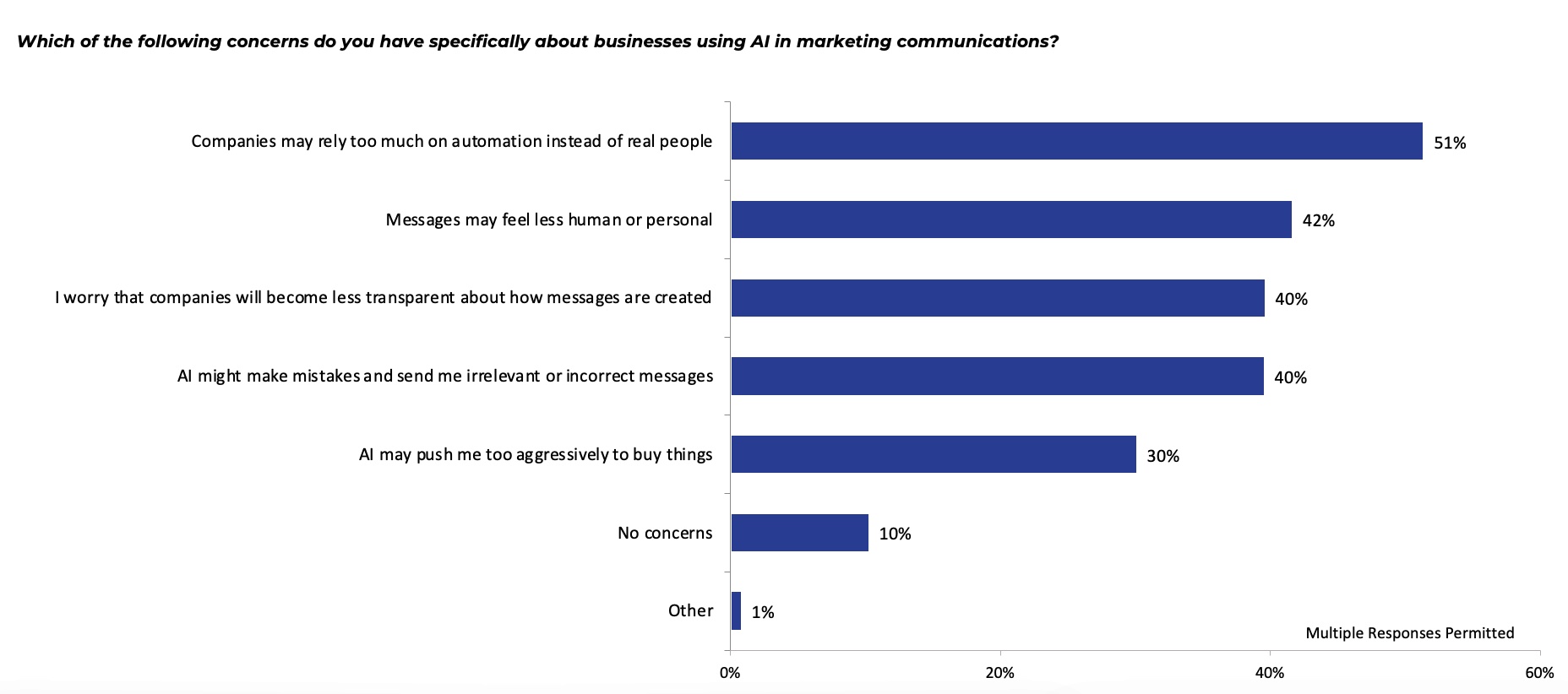
N = 1,481 Total Respondents
Source: Customer Communications Consumer Survey; Keypoint Intelligence 2025
For their part, organizations are exploring AI for workflow improvements, routing, and content generation. At the same time, however, businesses and consumers alike are aligned on one requirement: the underlying data, rules, and content must be strong before AI enters the picture. AI does not mask weak communication systems; it exposes them.
Print and Digital Are Coexisting
In our business research, a key takeaway across industries is that print and digital are coexisting more intentionally than ever. Today, nearly 9 out of 10 organizations deliver transactional communications through a combination of print and digital. Over the next two years, digital-only delivery is expected to rise slightly, while print-only delivery will increase in a few compliance-heavy sectors.
Figure 2: Delivery Format of Transactional Communications
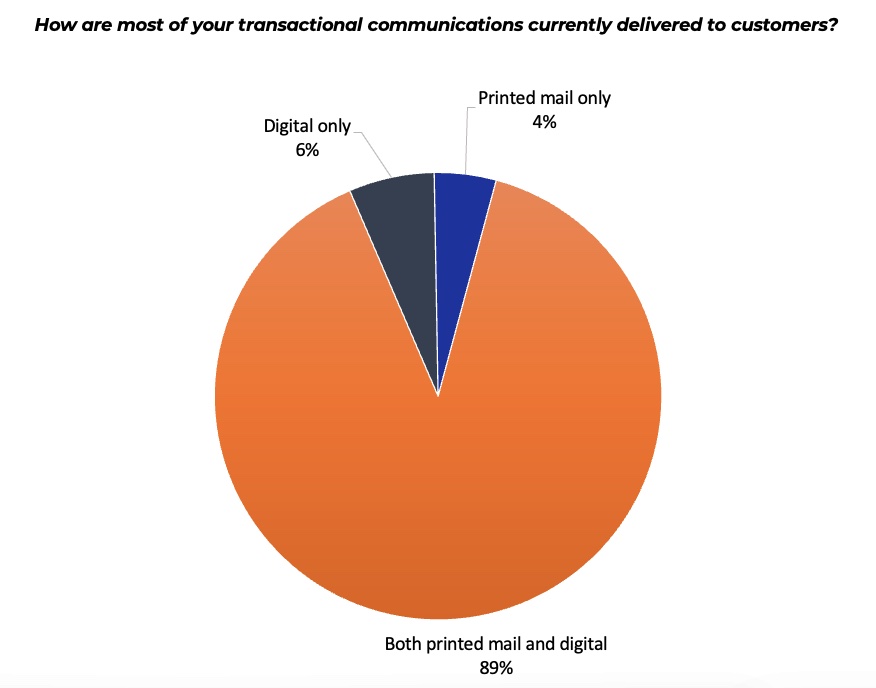
N = 291 Total Respondents
Source: Customer Communications Direct Marketing Business Survey; Keypoint Intelligence 2025
Print is becoming more specific in purpose—it is more commonly used for high-value, high-trust, or regulatory communications. Digital continues to expand in areas where immediacy and convenience matter. This trend points toward channel orchestration rather than channel elimination.
What Does the Future Hold?
Based on our collective research, three forces are likely to define customer communication strategies in the coming year:
- Channel elasticity will become the norm. People choose channels situationally, so organizations that adapt by offering the right message through the right channel at the right moment will earn the strongest engagement and trust.
- Data discipline will distinguish leaders from laggards. Personalization is only as strong as the correctness and consistency of the data that drives it. As consumers become more sensitive to errors and irrelevance, organizations must elevate data hygiene, governance, and integration.
- Operational precision will matter more than ever. From stopping messages once a customer completes an action to aligning updates across e-mail, apps, print, and portals, customers expect their communications to match real-time behaviors.
These forces suggest a future where communication strategy depends less on channel decisions and more on reliability, accuracy, and coordination.
The Bottom Line
Customer communications are changing in subtle yet meaningful ways. Our research shows that customers want clear information, seamless experiences, and communication that meets them in the right place at the right time. Organizations want to modernize, but they face uneven systems, aging workflows, and a rising expectation to personalize responsibly.
The opportunity ahead lies between these two realities. As we move through 2026, the organizations that succeed will be the ones that modernize steadily, strengthen their data foundations, and approach communication as an ecosystem rather than a set of disconnected channels.
As Principal Analyst for Keypoint Intelligence’s AI Service, Anne Valaitis draws on her document management and artificial intelligence expertise to help clients identify opportunities where AI can streamline operations, reduce costs, and shape new offerings that drive market demand and generate revenue. She has led numerous research projects that have influenced the document solutions landscape.