By APTEC, HK
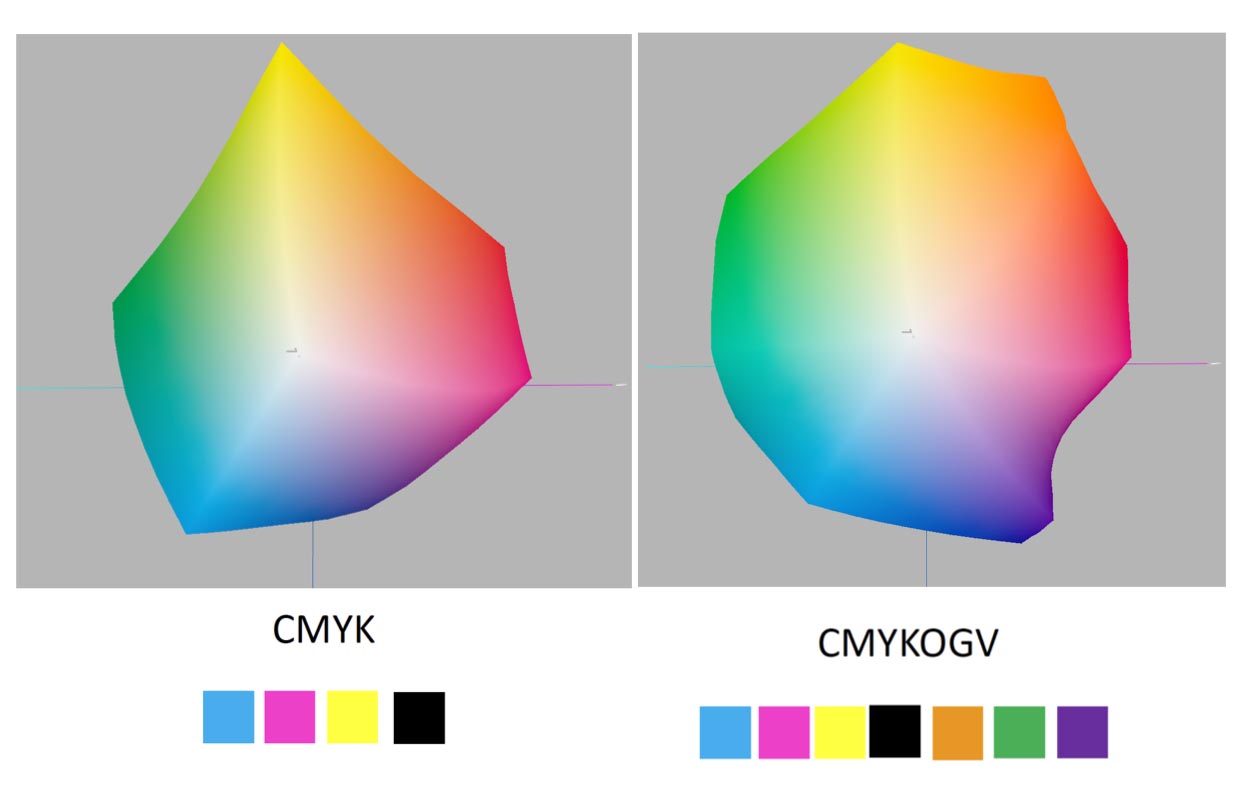
With advancements in printing technology, customers increasingly demand more vibrant and rich colors in printed materials. Wide gamut printing, or Extended Gamut Printing (ECG), was developed to address this, adding additional spot colors to the traditional CMYK color model, commonly incorporating Orange (O), Green (G), and Violet (V), or high-fidelity formats using Red (R), Green (G), and Blue (B) to expand the color gamut and produce more realistic colors. At the same time, if certain printed materials require multiple spot colors, wide gamut printing is expected to reduce costs.
High fidelity (Hifi color) was introduced to the market in the 1990s. However, its technical requirements and cost were high—such as the need for more press machine units and inks, additional color separation software, and higher control standards for press machines—resulting in limited widespread use of high fidelity technology.
In recent years, advancements in printing technology have sparked various suppliers to introduce multicolor solutions, which are conceptually similar to wide gamut printing, and involve the addition of color beyond CMYK, with common configurations of five, six (O, G), or seven colors (e.g., OGV, RGB) to expand the color gamut. Seven-color printing is particularly popular in the market, although challenges remain in separation, calibration, soft proofing, and printing control.
Key Considerations for 7C Printing:
- Ink
- Ink overprint, especially the overprint effects between O, G, V, and CMYK.
- Solids targets for different substrates; currently, ISO provides data only for coated paper.
- Print sequence
- Different sequences affect color performance; generally, the sequence KVCGMOY is used.
- There may be a need to adjust the sequence or modify ink formulations based on ink overprint concerns.
- Screen ruling
- Generation of screen ruling: using AM (Amplitude Modulation), FM (Frequency Modulation), or hybrid (AM + FM).
- Output screen angles for O, G, V.
- Calibration methods
- Related to screen ruling
- Previewing print effect
- Effective previewing of wide gamut printing: soft proofs and digital proofs.
- Separation and file modification software
- Requires color separation software to perform wide gamut color separation.
- Requires modification software to revise files after wide gamut separation.
Basic Techniques for 7C Printing:
- You can use FM, AM, or AM + FM.
- Output screen angles should align with the relative angles of the CMYK
- K and V: 45°
- C and O: 15°
- M and G: 75°
- Y: 90°
- Total Ink Coverage (TAC) should be set between 300% and 330%.
Calibration for 7C printing is also a significant focus. Currently, the most commonly used calibration methods in the industry are Tone Value Increase (TVI) and gray balance, but both primarily address 4C calibration. OGV calibration can only be performed using ISO 20654’s Spot Color Tone Value control (SCTV) since TVI and gray balance cannot calibrate all plates simultaneously, necessitating two separate calibration processes:
- TVI calibration for CMYK + ISO 20654 SCTV calibration for other colors
- Region: Europe
- Printing dataset: FOGRA55
- G7 calibration for CMYK + ISO 20654 SCTV calibration for other colors
- Region: North America
- Printing dataset: Idealliance ECG
This undoubtedly affects operational efficiency by using two calibration methods. Since 2019, APTEC has innovatively integrated SCTV into 4C printing, showing effective results, leading to the current CTV (Color Tone Value). CTV is different concept of calibration. CTV can be applied across various printing methods, including 4C printing, extended gamut printing, offset printing, digital printing, and flexographic printing. CTV does not require dot target curves, just as linearization concept—meaning 50% in file corresponds printed dot value of 50%, followed by software calculations for CTV across all colors and calibration curves.
Steps for CTV Calibration
Before proceeding with linear printing output for CTP, parameters such as focus and exposure must be adjusted according to the manufacturer’s specifications. There is no need for any press machine compensation curves in the initial phase; instead, the linearization curve of the plate should be employed to ensure that the input dot value of 50% results in an output dot value of 50% approximately.
Subsequently, through the combination of the press machine, ink, and paper, tests must be conducted to meet the required CIELab values for the solids, starting with the first set of linear plate printing, which is crucial for users to understand the performance between the press machine, ink, and paper, making necessary adjustments to achieve optimal printing results.
Target substrate data (the following dataset is created by APTEC, with its ICC and color dataset submitted to ICC):
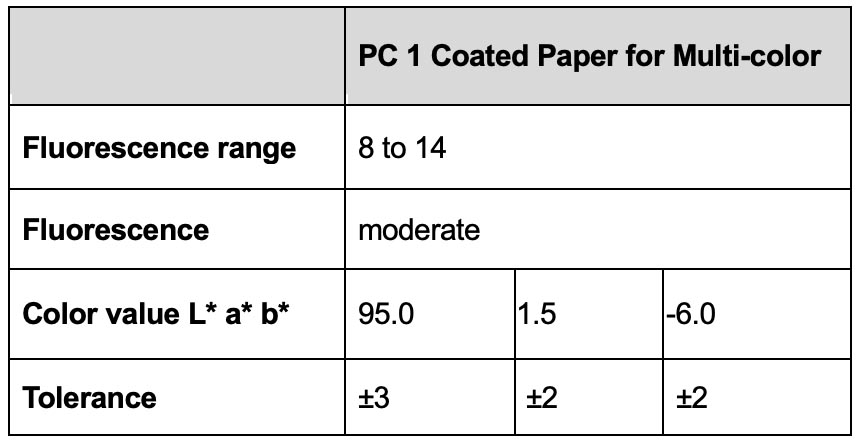
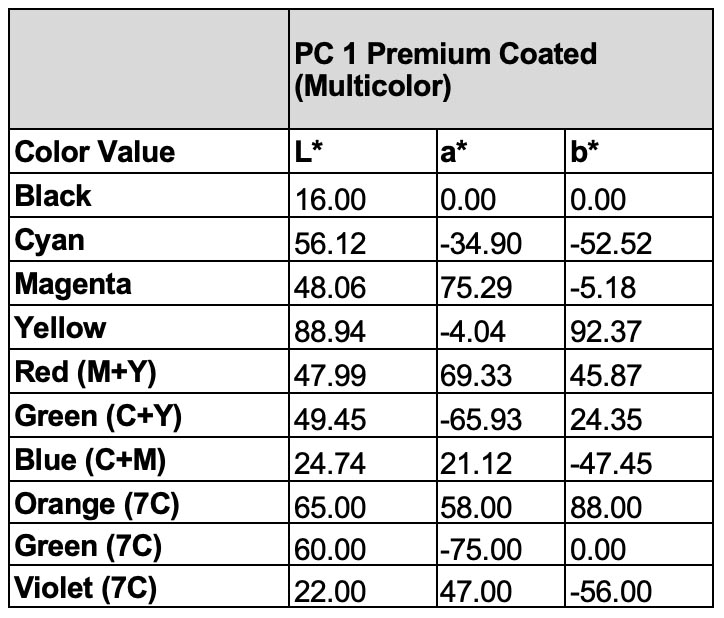
The control aims during printing is to meet the following CIELab color values—not density values—and check data across all areas. Under ideal field density conditions, the color tolerance across the printed sheet should be best within ±0.05 to maintain uniformity.
Target color values:
After achieving target values, the entire CTV test chart should be measured by spectrophotometer, with software like GMG's OpenColor, CGS’s CxF ToolBox, Heidelberg’s Prinect Calibration Manager, Chromix’s Curve, etc., for calculating CTV/SCTV calibration curves.
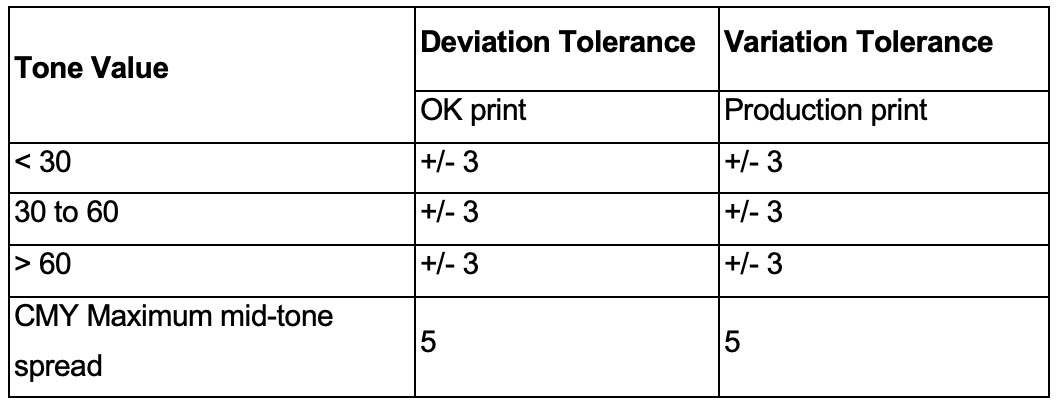
Following linear printing, the next step involves CTV calibration printing. The setup for this printing process mirrors that of linear plates, using the same ink key settings for the test run, followed by normal production methods. The calibration requirements for CTV tones of 25%, 50%, and 75% aim at a ΔCTV target of 0, with a tolerance of ±3. That means, the printed 25% dot should be between 22% and 28%.
During the printing process, spectrodensitometer, like X-Rite or Techkon, can be used to check if the print dots are approaching 50% (thus traditional dot gain does not need to be considered) and within the following tolerance.
Tolerance for CTV (according to Greater Bay Area Standard):
Regardless of using ECG or 4C, CTV employs the same calibration steps, allowing for direct calibration of all color plates without separating 4C from other plates. Therefore, using CTV can deliver significant benefits to ECG. In fact, whether in 4C or ECG, the calibration steps remain the same, leading to greater advantages for wide gamut applications.
Mr. Yang Weifeng, Printing Manager of Ningbo Sinso Printing Co., the CTV Certified Printing Company, expressed: “The combination of CTV + CMYKOGV surprised us. During the 7C printing process, CTV can utilize the control of tones to achieve more accurate seven colors. In the past, it is very challenging to reproduce the special colors, but now even gradation becomes smoothly, breaking through the technical bottlenecks of ECG.”
7C ICC Profile by Using CTV
APTEC has created CTV characterization dataset with ICC profile for 7C together with other seven datasets, which have been uploaded to the International Color Consortium (ICC) for public use (https://www.color.org/registry/index.xalter).
For more information about CTV, please visit https://www.ctv-aptec.org/en/.
Next up: CTV in digital printing