By APTEC, HK
CTV (Color Tone Value) was initiated by Mr. William B. Birkett and Prof. Chuck Spontelli in 2005.
CTV is a printing calibration and color control method based on the colorimetric values obtained from spectral data. CTV compensates the limitation of near neutral and density control. The key is to use color values (LAB), instead of density, to obtain a consistent and reliable visual result, such as a result where 50% of the dots have the same color appearance as 50% of the printed color, and effectively monitor the dot and dot color changes. It makes CTV a visually uniform measure. CTV’s linearization concept makes it an effective tool for smoothness and consistency in gradients.
ISO published “ISO 20654: Graphic technology—Measurement and calculation of spot color tone value” in 2017, which is mainly used for spot color control. Advanced Printing Technology Centre (APTEC), under The Hong Kong Printers Association (HKPA), researched and innovatively applied it to process color with ideal results. CTV is able to monitor both color and tonal values, and can be applied to different printing methods, spot color printing, four-color printing and multicolor printing. It can bring better print performance as compared with other calibration methods. Consistent colors can be achieved in the design and print production process, and printing quality can be improved. CTV is also a recognized method stated in ISO/10128 published in 2023.
In order to further expand CTV’s application, HKPA obtained the funding from the Cultural and Creative Industries Development Agency (CCIDA), appointed APTEC as the implementation organization for this project. One of the objectives for this project is to expand the application of CTV. APTEC applied CTV in flexography and created different colorimetric dataset of four color and seven color by using CTV, including PVC, adhesive sticker, and coated paper.
Key to Success
Flexographic printing is a popular printing method widely used for packaging, labels, plastic bags, and other materials. The anilox roller is the heart of the flexographic printing machine, as it plays a crucial role in determining the printing results. It directly affects the thickness of the ink layer, registration accuracy, and consequently influences printing speed, the stability and overall print quality. The key of the application of CTV includes screening ruling of anilox roller, whether the RIP can support CTV curves, and the stability of the printing process.
In the past, flexographic printing was normally perceived as only suitable for spot colors and solid color printing due to difficulty in producing halftones, particularly those below 5% tone. APTEC has conducted print test in flexographic printing by using CTV. After applying CTV, even 2% tone can also be produced, and with a very smooth tone. Even multi-color can apply CTV.

Procedure for CTV calibration field test in flexography.
1 Press machines to be used: 12C and 7C
2 Check-up: check the operating system, output system and press machine.
2.1 Anilox roller: suggest to use 800lpi to 1200lpi
2.2 Color sequence:
2.2.1 7C printing: Y-O-M-G-C-V-K
2.2.2 4C printing: Y-M-C-K
2.3 Record the data of Billions of Cubic Microns (BCM). Good condition of anilox roller, without blockage (it is recommended to clean it thoroughly with ultrasonic cleaning or specialized cleaning agent before testing).
3 Calibration: calibrate and output linear plate
3.1 The hardness of the flexographic plate should be moderate, measured with a Shore A durometer.
3.2 The flexographic plate dot can be measured and monitored, with tolerance of 1%.
3.3 After developed the flexographic plate, the overall thickness and base thickness ratio is moderate, approximately 50% or more.
4 Printing: print the test form, calibrate the CMYK solid ink values, meet the required LAB values
4.1 Color requirements for solids: CIE Lab values based on ISO12647-6
4.2 Color difference for solids: DE76 ≤3
4.3 Hue difference for solids: DEH 2 to 6
5 Measurement: Measure the LAB value for the tone chart
6 Calculation: Calculate the CTV compensation curve by using software or RIP
7 Application: Apply new CTV compensation curve for plate output and press run
8 Control the solids color and deltaE values
9 Verify: Measure the tone of the test form and verify the calibration result
9.1 Check the tone of 25%, 50% and 75%, if the dot is within the tolerance +/-3
10 Random check the print stability
During the process control, data measurement is necessary by using like spectrodensitometer, spectrophotometer, flexo plate reader, durometer and thickness gauge.
Color aims (CMYK is based on ISO 12647-6; OGV is based on ISO/TS 21328, all color values are calculated and adjusted according to SCCA)
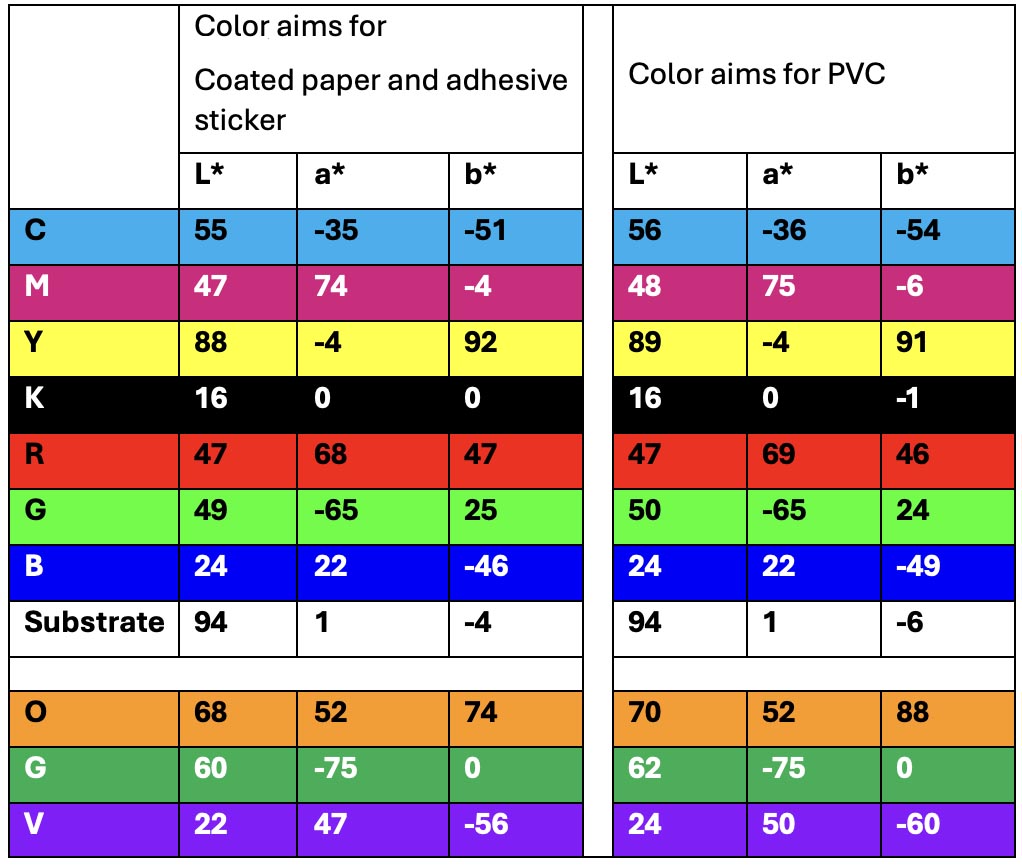
SCCA stands for Substrate-Corrected Colorimetric Aims. It is based on the human visual phenomenon of chromatic adaptation – that simulates how CIELAB aim values (or a whole characterization dataset, or a printed image) would appear on a substrate different from that on which it was originally printed.
Benefits of CTV:
- Can be applied to different printing methods, like offset, flexography, digital printing and gravure
- Can be applied to spot color, 4C color and multi-color printing
- Can be used with any printing ink and on any printing materials
- Can be used with any screen ruling and screening methods (AM screen, FM screen, hybrid screen, continuous tone)
- Easy to master because it is the same as traditional printing control of printing dots, but simultaneously monitors the dots color
- Ideal for packaging printing, with the 4C and spot dot curves calculated and used in the same way
- Smoother gradation, more detailed and better color contrast
Conclusion
CTV is an effective and practical printing color control method based on the massive field tests in over 30 printing companies by APTEC. Most importance is that it is easy to understand and operate. APTEC will continue to explore the applications of CTV.
To learn more about the application of CTV, please contact APTEC at [email protected] or visit www.ctv-aptec.org.
Next up: CTV in Multicolor