By APTEC, HK
Background
Press calibration is an important means for controlling print quality. ISO/TS 10128 which was published by ISO/TC130, describes various press calibration methods. Another important indicator document for print quality control, ISO 12647-2 uses LAB color values as the main control parameter. However, in actual production, printing operators usually use density as the color control, applying the Murray-Davies formula to calculate Tone Value Increase (TVI).
Ultimately, customers often use color appearance as their acceptance standard, leading to some discrepancies. It is because the same density can result in different colors, and different colors have different TVI values. Additionally, different paper types apply different TVI curves which will be difficult to manage. While density is an effective indicator for monitoring the status of printing machine, it is not the best method for monitoring color.
In 2005, William B. Birkett and Charles Spontelli introduced the concept of CTV. The original name is Colorimetric Tone Value. In 2017, ISO published a standard, ISO 20654 (Graphic technology—Measurement and calculation of spot color tone value) which proposed that Spot Color Tone Value (SCTV) was to control spot color halftone, i.e. the name of Colorimetric Tone Value changed to Color Tone Value. However, it has not gained widespread adoption in the industry over the years.
Advanced Printing Technology Centre (APTEC) located in Hong Kong (hereinafter referred to as APTEC) has strived to promote printing standardization since 2007. In 2019, APTEC has tested and applied SCTV in four-color printing and conducted what is believed to be an unprecedented large-scale test in the industry. After multiple tests, it has been proven that SCTV is good to apply in four-color printing and is considered a very practical method for color control in printing. The characterization datasets (ICC profile) generated by using CTV methodology on two kinds of printing materials, namely CCNB (Clay Coated News Back) and white board, have been recognized by International Color Consortium (ICC) (www.color.org). Not only are they the first submission from China, but also the first globally recognized datasets for CCNB and white board.
In 2023, ISO released a new version of ISO/TS 10128 and planned to publish an updated version of ISO 12647-2, stating that Color Tone Value (CTV) is one of the recognized methods for press calibration.
Characteristics of CTV:
- Controls the output curve of the RIP, similar to the TVI calibration curve
- Measures the color values of tones
- Calculates dot values using Lab/XYZ color data
- Does not measure density and does not require the use of RGB filters for measuring and calculating dots
- Use linear curve to calculate color values
- Measures the LAB color values of tone graduation of each plate in CMYK 4C printing
Benefits of CTV:
- Can be applied to different printing methods (offset, flexo, digital, gravure)
- Can be applied to spot color, four-color, and multi-color printing
- Can be used with any printing ink and on any printing substrate
- Can be used with any screening ruling or screening methods (AM screen, FM screen, hybrid screen, continuous tone)
- Easy to master because it is the same as traditional printing control of printing dots, but simultaneously monitors the dot color
- Ideal for packaging printing, with the 4C and spot dot curves calculated and used in the same way
- Smoother gradation, more detailed and better color contrast

(Left) Use CTV color control method. (Right) Use other color control method.
The Steps for CTV Press Calibration
The first step is to perform linear printing, i.e. no compensation curves are used to ensure that an input dot value of 50% outputs as 50%. It is best to measure the dot on the plate at each 10%, and checking the uniformity across the left and right of the printed sheet. It is recommended that the tolerance for dot controlled within +/-1%. If the output result for the 50% dot is not 50%, no worry! Relevant data for the plate can be recorded as a reference for subsequent quality control.
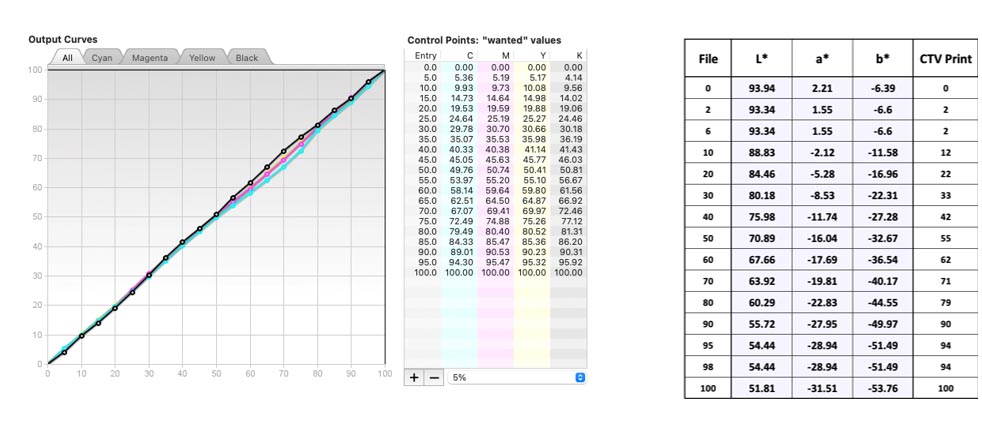
Calculate CTV compensation curve.
Next is the preparation for press run. Check all the physical and chemical variable factors for the press machine, such as water, rubber blankets, pressure, etc. The press machine must remain stable and repeatability, and various variable factors should be recorded. Conduct the press run based on the following CIELab values requirements for the solid colors. The first set of linear plate printing is crucial as it helps us to understand the performance between the press machine, ink and paper, allowing for adjustments as needed to achieve the best printing results.
Table 1. Target Paper Data (Based on the target values submitted to ISO/TC130 and ICC by APTEC)
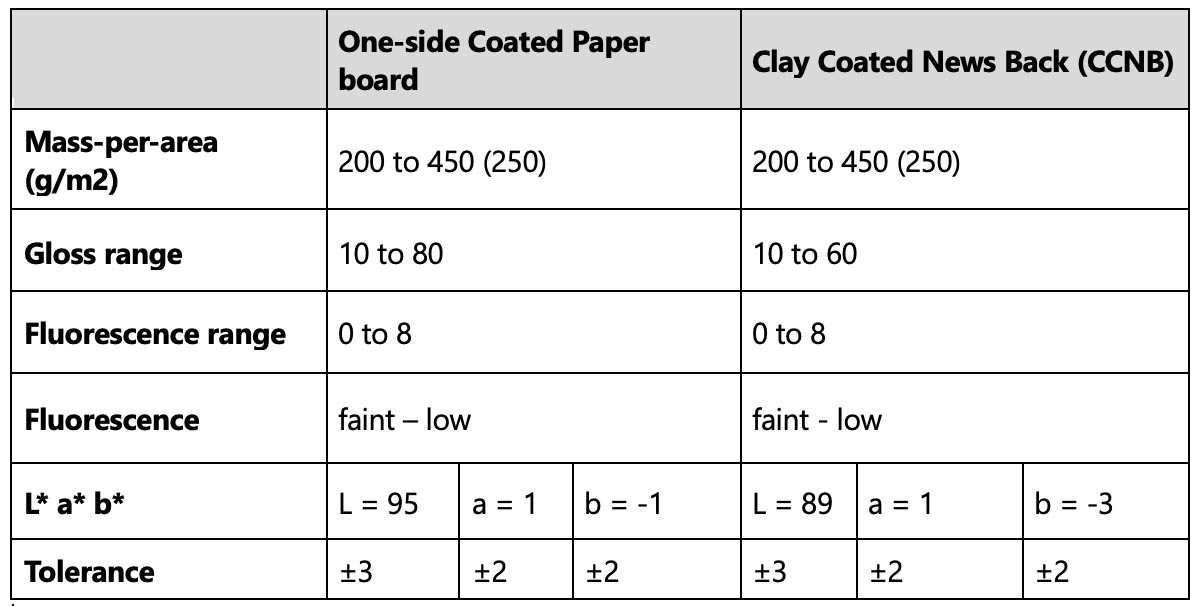
The target is to achieve the following CIELab color values, not density, and to check the uniformity of the press form. Under ideal density of solids, the tolerance between the top and bottom of the press form should be within +/-0.05 to maintain uniformity.
Table 2. Target Color Data (Based on the target value submitted to ISO/TC130 and ICC by APTEC)?
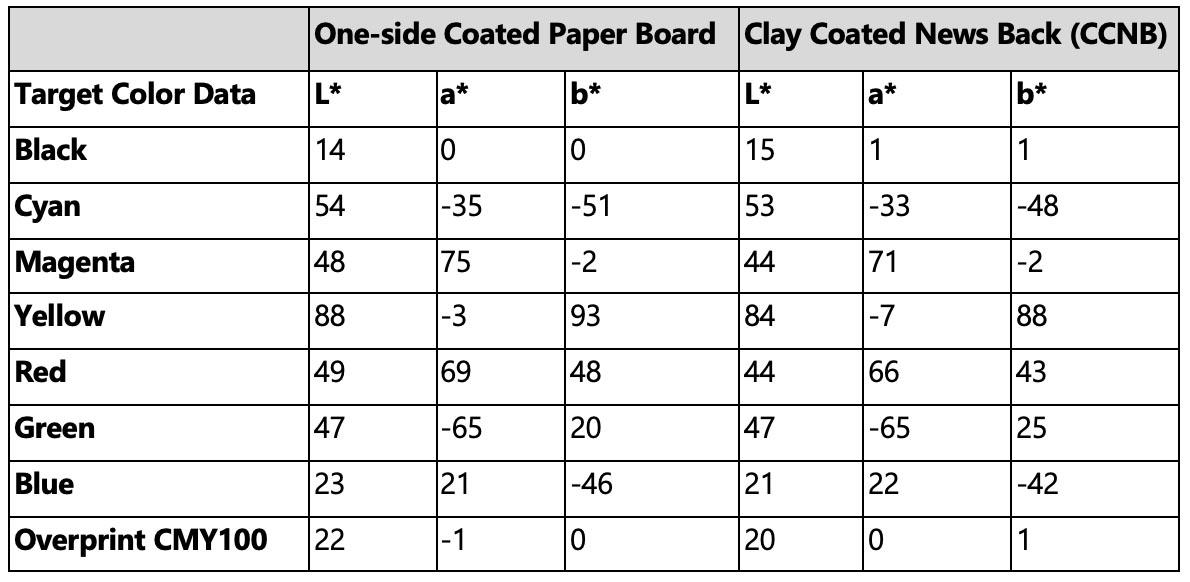
** White backing is applied for the measurement
After achieving the target values, measure the entire CTV tone targets and use software to calculate the CTV/SCTV calibration curve, then inputting the control points into the RIP.
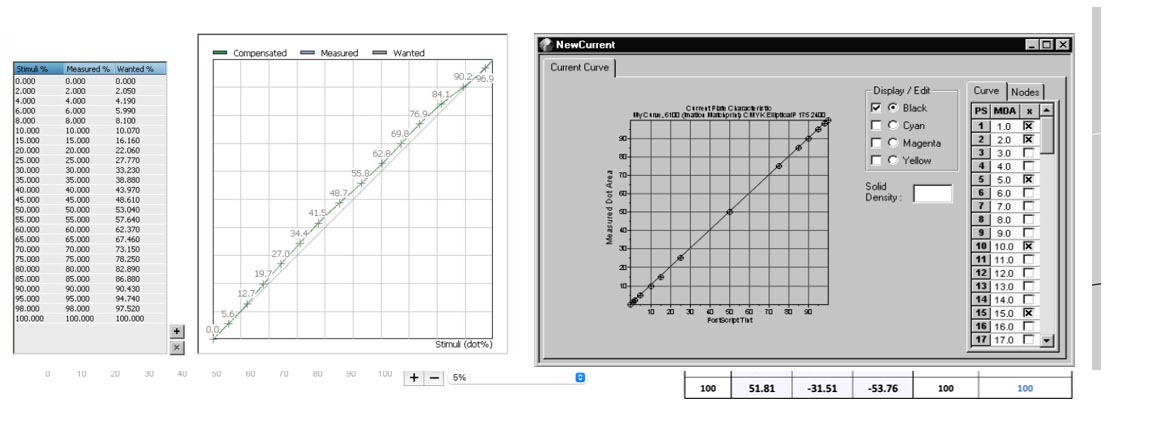
Apply CTV compensation curve.
After completing linear print, the next step is CTV calibration print, with the same ink key settings for proceeding normal print. The idea requirement for CTV calibration is that the ?CTV targets for 25%, 50%, and 75% are 0, with a tolerance of +/-3. For example, the printed 25% dot should fall between 22% and 28%. The calculation for the CTV can refer to “ISO 20654:2017 Graphic technology—Measurement and calculation of spot color tone value.”
During this process, tools and software provided by X-Rite or Techkon can be used to monitor print dots, such as eXact spectrophotometer and SpectroDens. For using CTV, dot gain does not need to be considered. At the same time, check the tone tolerance values for OK print and production run.
Requirements for CTV Production Tolerances
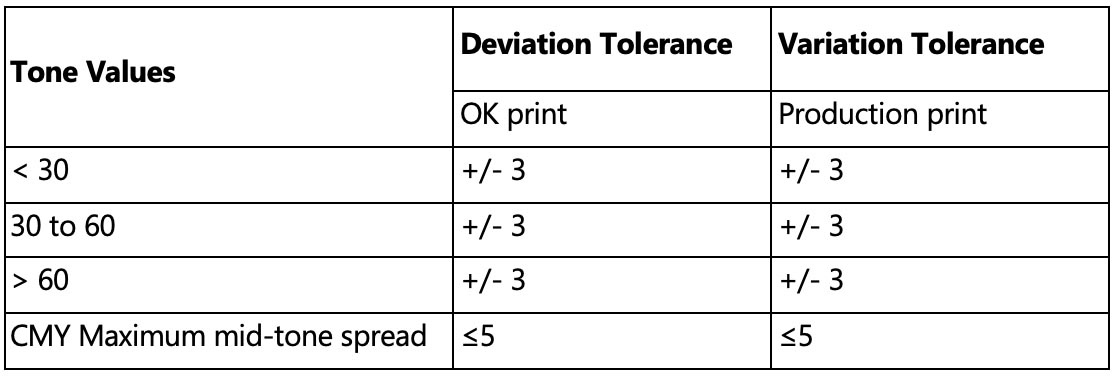
Monitoring Print Production
To control print quality effectively, it is necessary to measure the color bar and record the four-color solid ink density and LAB values, including wet and dry density, as well as the LAB values for overprint RGB, CTV tonal dot and gray balance. These are all key parameters for quality control.
At the same time, attention must be paid to the paper color, as different papers can directly affect the printed colors, particularly noticeable in highlight area. Another factor is the optical brightening agents (OBA), which can also affect visual perception and measurement values. There are two methods to evaluate OBA content, i.e. ?B and ?CIE Lab b*.
For non-standard paper, paper relative calculation is used, called Substrate Corrected Color Aim (SCCA), which was proposed by Mr. David McDowell from the United States in 2004 and is a linear correction technique based on tristimulus values. The basic concept is to adjust the ink’s CIELab target values according to the actual paper color, using the corrected solid ink values as the printing targets.
After completing the CTV calibration, a compensation curve is generated, which will be used in the subsequent printing production process. By continuously monitoring whether the 50% dot prints at 50%, printing stability can be ensured. If the output of the 50% dot deviates from the target, it may indicate a change in the press machine's condition. Additionally, if printing in different types of paper, the existing compensation curve may no longer be applicable, then recalibration may be required.
Supported by HKSAR Government: “Color • Method • Master: GBA ReCreates the World’s Color”
In order to promote the effective use of CTV, The Hong Kong Printers Association (HKPA) has successfully applied funding from Cultural and Creative Industries Development Agency of the Government of the Hong Kong Special Administrative Region to organise the project “Color. Method. Master: GBA ReCreates the World’s Color” (“Color. Method. Master”), with APTEC as the implementation organization.
“CTV Pilot Scheme” and “Production of CTV Characterization Dataset” are two important schemes, so as to enlarge the application of CTV.
Testimonials from CTV Users:
Mr. Ngan, Prepress Manager of Safe Power Printing & Box (Dong Guan) Mfg. Co., Ltd. stated that CTV calibration applying in seven-color multi-color can easily result in smooth gradation and much detailed images. We will apply CTV in our real job production.
Ms. Helena Ho, Operation Manager of Kinta Press Packaging Sdn Bhd stated, “CTV allows us to complete output much faster and is a very simplified method, of which it has given us less failure and frustration when we are on it.”
To know more about the application of CTV, please contact APTEC at [email protected] or visit www.ctv-aptec.org.
Next in this series: CTV in flexo.