Signs of the Times, Part the Ongoing—AI-Yi-Yi: With Friends Like These…
Ever heard of an AI startup called Friend? No, nor have we, until we discovered that it’s making no friends in New York City. Ostensibly some kind of AI chatbot for lonely people, it launched a massive ad campaign in the NYC subway system and, according to Futurism, it may go down as one of the most extensive sign defacements in ad history.

And, according to the company CEO, this was not unanticipated.
“I know people in New York hate AI, and things like AI companionship and wearables, probably more than anywhere else in the country,” he told Adweek. “So I bought more ads than anyone has ever done with a lot of white space so that they would socially comment on the topic.”
We remain somewhat confused by what this actually is.
And, it’s worth pointing out, a CEO who would troll the city of New York doesn’t seem aligned with a product that’s supposed to “care” about its users, especially because Friend’s flagship product is a $129 wearable gadget that sits around your neck and listens to your every word, sparking substantial privacy concerns.
Ah. So…if you’re talking to other people, you don’t really need it, and if you’re talking to yourself, well, maybe there are other issues involved.
Anyway, just one more way that life is getting more surreal by the day. Whoops…looks like the clocks have melted again…
They’ll Need a Crane
Well, this doesn’t bode well for the future of automated delivery. Again from Futurism (we like them!):
On Wednesday, [Amazon] temporarily suspended drone deliveries in the West Valley area near Phoenix, Arizona after two of its MK30 drones collided with a construction crane just miles away from an Amazon warehouse.
The 80-lb. drones apparently smashed into the crane while it was lowering an AC unit onto the roof of a building. Thankfully, no one was injured. Is this the first such drone crash? Of course not.
In 2021, a drone crash in an Amazon testing range in Oregon sparked an acres-wide blaze. And last December, two MK30 drones plummeted hundreds of feet to their doom after their propellers suddenly stopped spinning mid-flight. (An investigation by Bloomberg implicated Amazon’s decision to remove sensors that were present on its older drones in the crash.)
Ah, removing sensors. Always a brilliant idea.
Pushkin Too Hard
Our Mount Monadnock Media Maven points us to this Guardian article about an unlikely 21st century caper: an international rare books heist. The university library of Warsaw, Poland, has discovered that rare editions of classic works of poetry, drama and fiction by two giants of Russian literature, Alexander Pushkin and Nikolai Gogol, had gone missing.
a more thorough investigation of the library’s stocks revealed that a further 74 books of Russian literature had been stolen in the weeks, or even months, leading up to the final swoop. The thieves had managed to avoid detection by replacing the books they had stolen with what one newspaper described as “high-quality facsimiles” of the originals.
Were there not security features?
Most books in the Warsaw library have been fitted with a magnetic strip that raises an alarm at the exit unless deactivated. But older books went without this, as an expert had advised that the glue on the magnetic strip could damage the paper.
Doh! Although Frank Norris’ The Octopus was not involved, the conspiracy’s tentacles stretched throughout Europe.
The Warsaw book heist was not an isolated incident but one of the final stops on an unprecedented grand tour of bibliophilic crime, which snaked its way from north-east to south-west Europe between spring 2022 and winter 2023. As many as 170 rare Russian books, valued at more than £2.5m, vanished from the shelves of the National Library of Latvia in Riga, two university libraries in Estonia, Vilnius University Library in Lithuania, the National Library of Finland in Helsinki, the National Library of the Czech Republic in Prague, Bibliothèque Diderot in Lyon, the Bibliothèque nationale de France and the University Library of Languages and Civilisations in Paris, the Bibliothèque de Genève in Switzerland, the State Library in Berlin and the Bavarian State Library in Munich.
It’s a long, convoluted story, but the thefts ultimately centered around Pushkin for a number of reasons.
From a collector’s point of view, what makes the stolen Pushkins so alluring is less the ideology contained within their covers than the fact that they were published before the author’s death at the age of 37. (In an echo of his verse novel Eugene Onegin, Pushkin died in a duel with a French officer rumoured to have had an affair with his wife.) The two other authors whose books were second and third on the list of stolen works in 2022 and 2023 were Mikhail Lermontov and Gogol, who lived until just 26 and 42 respectively. Tolstoy, by contrast, died aged 82. “It’s the same logic you have with rock stars: the younger they die, the more valuable they become,” says Guillemet, the bookseller.
The trail ultimately led to Litfund, a Russian auction house that specializes in books.
In July 2023, Litfund set a new Russian record for the sale of antique books, when a copy of Pushkin’s Eugene Onegin went under the hammer for 26m rubles (£233,000).
Well, you know those Onegin Offegin relationships... Anyway, was Litfund behind the heists?
Even if these books were indeed sold through Litfund, this does not prove that the auction house commissioned their theft. Meanwhile, the idea that the Kremlin coordinated the repatriation of valuable cultural heritage remains extremely speculative. The apparent unwillingness of Russian authorities or private companies such as Litfund to aid in the European investigation, however, suggests they are at the very least comfortable with the current outcome. Of the approximately 170 books that have gone missing, none of the originals have been recovered.
One silver lining is that it seems, at least in some quarters, books are still a highly valuable commodity. It’d be hard to see a Kindle edition having a similar value.
New Map on Monday
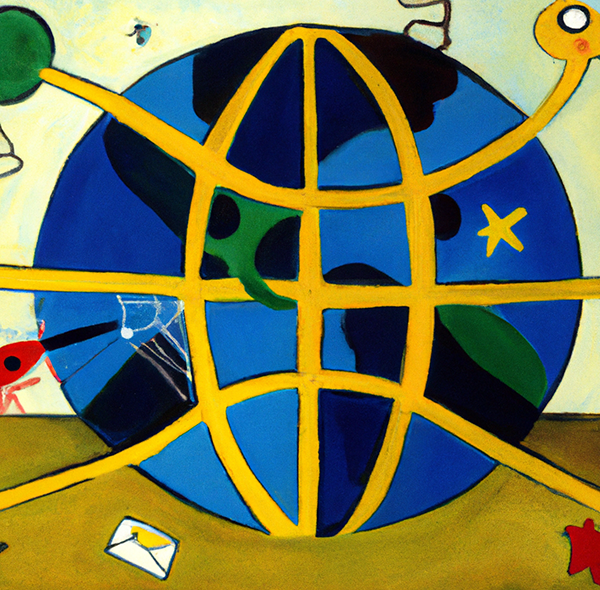
We have no doubt linked in the past to a clip from The West Wing about the “Cartographers for Social Justice,” championing the use of the Peters Projection (aka Gall-Peters Projection) rather than the traditional Mercator Projection for map display and education. The Mercator map, while developed for easier navigation by making longitude and latitude lines perpendicular, it has tended to distort landmasses.
Traditional map projections, of which the Mercator is one example, have tended to show countries incorrectly in proportion to one another, exaggerating the size of high latitude countries such as Canada and making tropical regions such as Africa appear much too small.
This can have political implications. Flash forward and, via Print magazine, three cartographers entered the fray with their concept of an Equal Earth Map, describing their work in a 2019 paper published in the International Journal of Geographical Information Science:
“We searched for alternative equal-area maps… but could not find any that met all our aesthetic criteria. Hence the idea was born to create a new projection that would have more eye appeal compared to existing equal-area projections and to give it the catchy name Equal Earth.”
They explain:
Interestingly, they do not recommend one single design. Yes, the paper includes alternative maps and mathematical equations that attempt to “flatten the sphere,” but the designers wanted to concentrate on what the public would accept. They offer free, downloadable maps and you can specify a language and a central meridian.
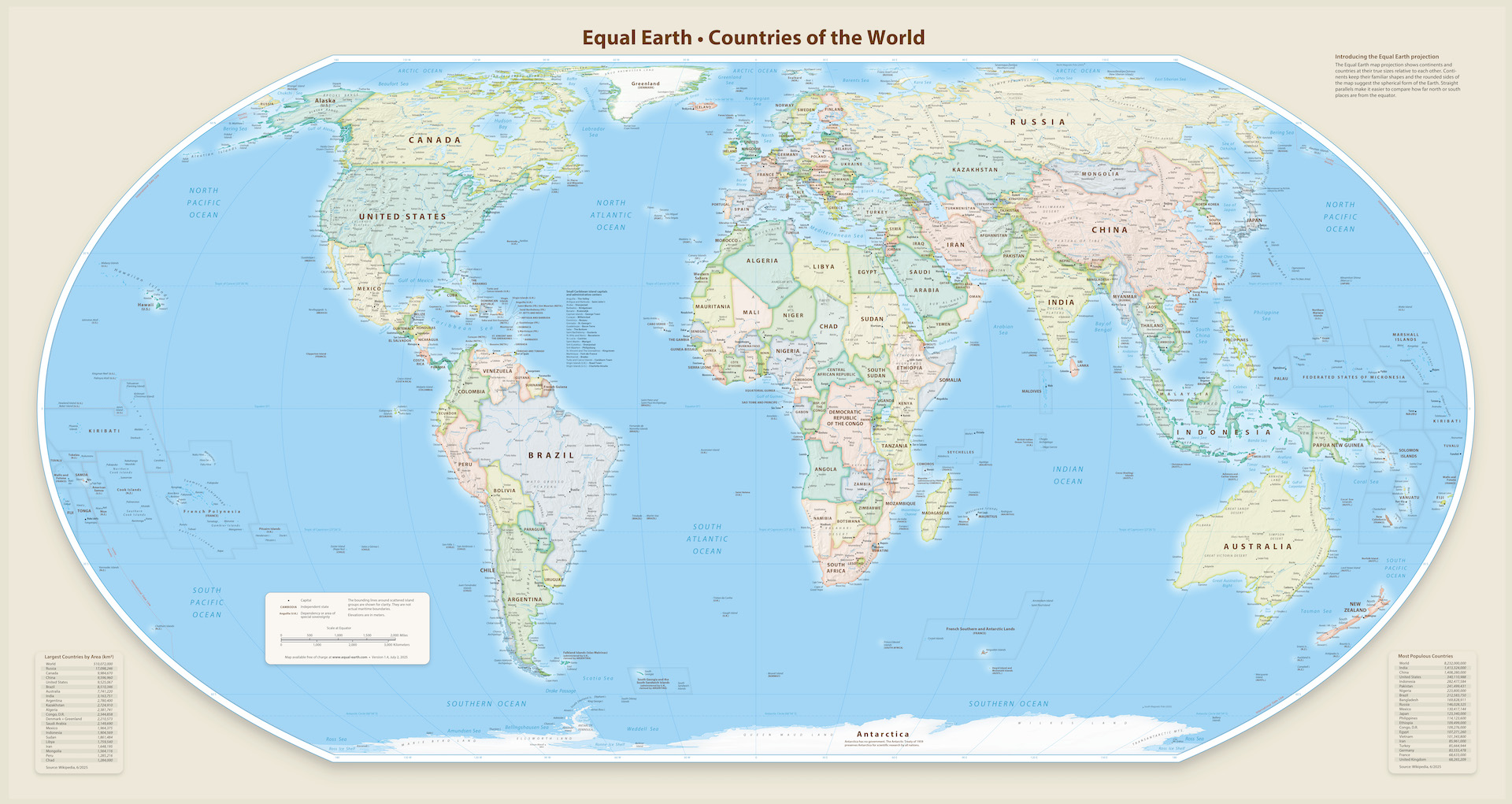
Acceptance is happening. The Correct The Map campaign, led by the organizations Africa No Filter and Speak Up Africa and backed by the African Union, is gathering steam worldwide.
Outlet Store
When building or renovating a home, it’s desirable to try to “futureproof” it in some way. In one early 2000s project involving a townhouse in Boston, that involved adding hardwired Ethernet ports alongside the electrical outlets. That didn’t prove too futureproofy, as WiFi was only a couple of years away. Other attempts we have seen include USB charging ports, which are, at least for now, still useful.
But, via Core 77, Japanese company CIO has really gone all-in on futureproofing with its Polaris power outlet: homeowners can, without the need for rewiring, add sockets for USB-A, USB-C—or whatever comes next.

The detachable socket structure solves the problem of ports evolving with the times after installation. USB ports, Qi2, and other suction structures can be installed and removed in your preferred combination with no maintenance required. The port arrangement is also carefully considered, with a user-friendly design that uses an L-shape to prevent incorrect insertion into AC outlets.
Pretty neat, although there is no indication if this will ever be available in the US.
Torch Song
Do you want to handy way to eliminate plastic waste? Sure, we all do. And, via Gizmodo, it may just be possible using a super-cool-sounding tool: a hydrogen-powered plasma torch. Dear Santa, bring us one of those…
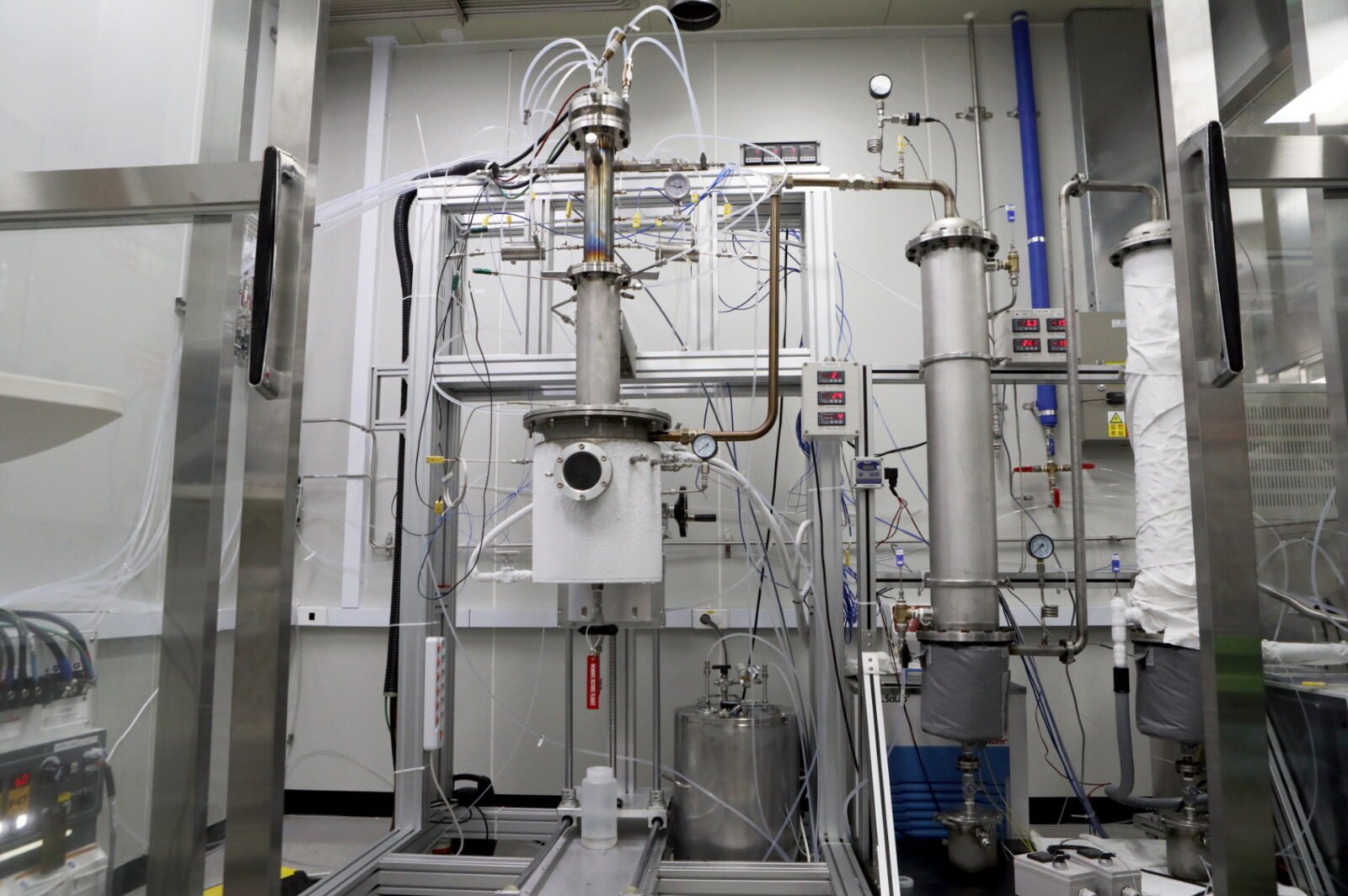
the Korea Institute of Machinery & Materials (KIMMS) announced the development of a plasma torch that annihilates plastic waste in less than 0.01 seconds—about ten times faster than a blink. The torch is entirely powered by hydrogen and converts mixed plastic waste into ethylene and benzene, two primary chemical ingredients for plastic.
Now granted, neither of those substances are things one would want to have around the house, but they can be reused to make more plastic, which is at least better than chucking plastic waste into a landill. (Now, of course, who can think of benzene without being reminded of German chemist August Kekulé’s discovery of the structure of benzene via a dream of a snake eating its own tail? But that just may be us.)
Anyway, there are other reasons you may not want this for home use.
The torch exploits the speedy kinetics and energy transfer efficiency of plasma—hot, ionized gas—to instantly zap plastic into simpler compounds. The plasma used in the torch is extremely hot, between 1,832 and 3,632 degrees Fahrenheit (1,000 and 2,000 degrees Celsius).
And it’s pretty effective.
the team salvaged around 70 to 90% of the chemical compounds they were hoping to extract from the mixed plastic waste, with an ethylene yield of 90%. After some purification, they found that more than 99% of the output was pure enough to be recycled as raw material for plastic manufacturing.
“After some purification” may be doing some heavy lifting there, but it sounds promising.
In addition to creating useful byproducts, the torch is also powered by hydrogen, giving it “significant potential for carbon reduction,” the researchers explained. In addition, “pilot operations have already demonstrated economic feasibility,” they added. The team will officially start demonstrations with an eye to commercialization in 2026.
Wishing Welles
Halloween is approaching, and one of the most infamous Halloween events was Orson Welles’ 1938 Mercury Theater of the Air radio broadcast of “War of the worlds,” which generated something of a panic, although not as much of one as has been exaggerated over the years. Via Laughing Squid, in the 1950s BBC Four aired a series called the Orson Welles’ Sketch Book. In one 1955 episode, Welles looked back at the 1938 brouhaha. Interestingly, Welles said that one of the aims of the broadcast was to stress that people shouldn’t believe everything they hear on the radio.
You can listen to the original broadcast here:
TreeMail
(Optional musical accompaniment to this item.)
When we first heard (weirdly, via the BBC quiz show Richard Osman’s House of Games) that the city of Melbourne, Australia, had issued email addresses to 70,000 of the city’s trees, we were a bit bemused. Back in the 1970s, it was said that talking to your plants was supposed to help them grow. So, maybe vegetation has entered the 21st century and today’s equivalent is that emailing trees (and perhaps other plants) helps them grow?
Well, not exactly. Turns out, it was actually about tree maintenance. In 2013, the city had issued the trees ID numbers and email addresses so that if passersby noticed dangerously hanging or overgrown branches or other issues, they could send an email which would alert the proper authorities to come and effect repair. But, it being Australia, there was a cheeky unintended consequence—although surely someone had anticipated this:
people began writing their favorite trees whimsical letters. “I have exams coming up and I should be busy studying,” reads one. “You do not have exams because you are a tree. I don’t think that there is much more to talk about as we don't have a lot in common, you being a tree and such. But I’m glad we’re in this together.”
The initiative is still going strong and the program’s website includes a map of every tree and its email address, should you wish to write to a tree. (Hell, we think it would be vastly superior to an AI chatbot.)
The responses are actually crafted by employees at the City of Melbourne — and as of 2018, the trees had received more than 4,000 emails from all over the world.
Plant Math
While it’s not clear (actually it’s perfectly clear) if trees can read emails or not, another question that can be asked of our leafy friends is, can plants do math? And, it turns out, yes. While this does not mean that keeping a philodendron on your desk during a math exam will help in any way, via BBC Science Focus, some plants have been found to perform some basic arithmetical functions.
Venus flytraps, for example, famously snap their leaves shut when they sense a bug, or something else, moving on them. But they only do this if whatever it is moves twice within about 15–20 seconds.
…They wait until they’ve sensed at least three electrical pulses before they start producing the chemicals needed to digest their prey, presumably to avoid wasting their energy on lucky escapees.
So…they can count at least to three.
Meanwhile, thale cress (Arabidopsis thaliana), a cabbage relative, has been found to do something akin to division. These guys use sunlight to accumulate food stores (starch) during the day via photosynthesis.
But to keep themselves alive at night, they have to set a sustainable rate of starch consumption (starch divided by time) by gauging how much starch they’re storing in their leaves and combining this information with their circadian sense of time.
This is not to say that plants will evolve the ability to do trigonometry or calculus any time soon, but survival often entails some degree of mathematical ability.
Tale of the Tapeworm
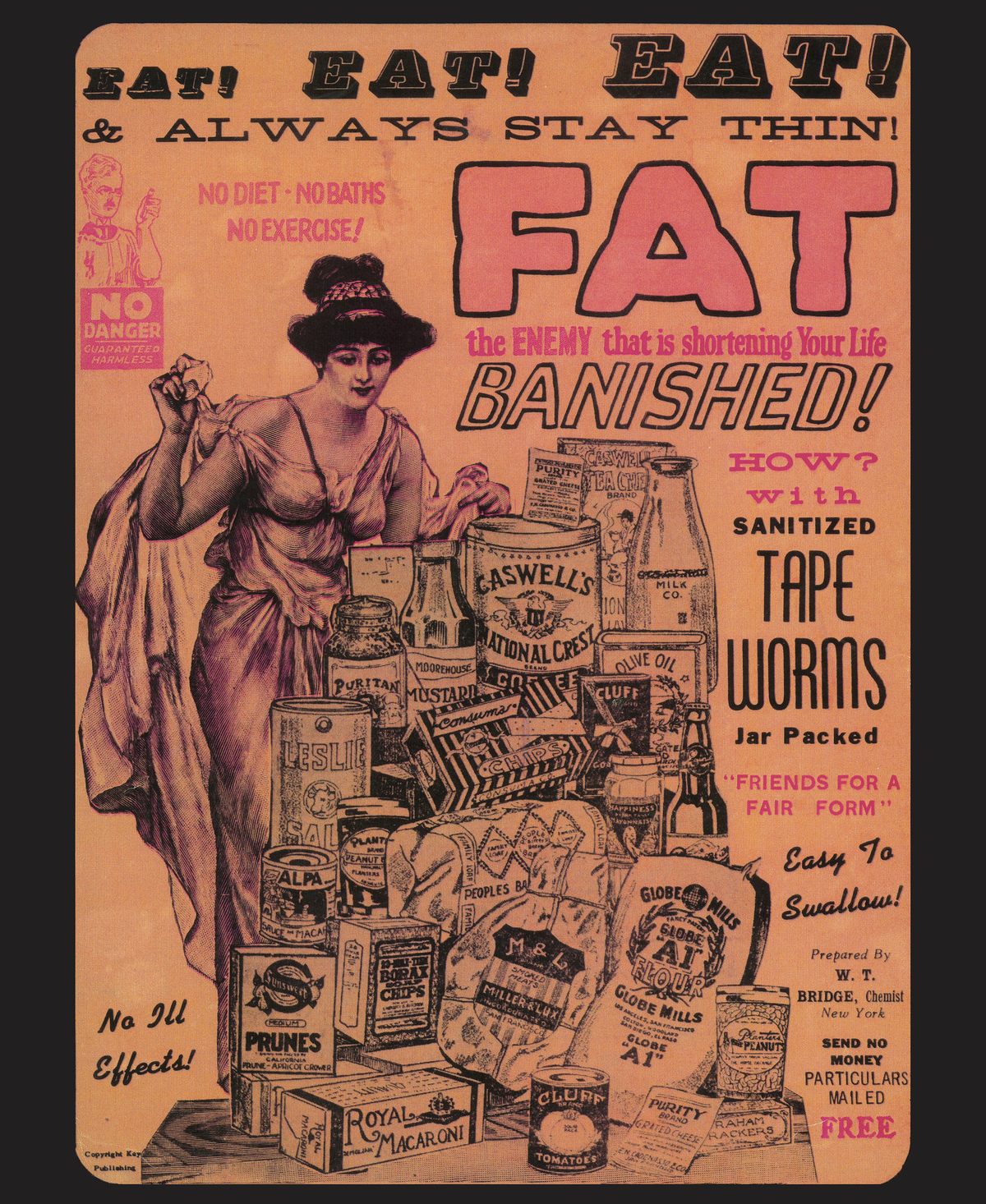
Looking for a fun friend who knows you inside and out? Try the Victorian tapeworm diet. Yes, there may have been such a thing—and it still exists. How does it work? Says Atlas Obscura:
You take a pill containing a tapeworm egg. Once hatched, the parasite grows inside of the host, ingesting part of whatever the host eats. In theory, this enables the dieter to simultaneously lose weight and eat without worrying about calorie intake.
It was pitched specifically to women because of course it was. According to a popular beauty guide at the time (tellingly called The Ugly Girl Papers):
First and foremost, the guide states that “it is a woman’s business to be beautiful.” Beauty takes time and effort and no plain girl could forego the tediousness of beauty regimes if she wanted to find a husband.

Once the suitably fat-shamed tapeworm ingester had reached her (or, more probably, some rando male’s idea of her) ideal weight, how does she then rid herself of the parasite (that is, the tapeworm, not the rando male)?
This included pills or special devices. One such invention, created by Dr. Meyers of Sheffield, attempted to lure the tapeworm by inserting a cylinder with food via the digestive tract. It comes as no surprise that many patients choked to death before the tapeworm was successfully removed. Other folk cures prescribed holding a glass of milk at the end of either orifice and waiting for the tapeworm to come out.
Let’s just…picture this for a moment. Or, better yet, let’s not.
Interestingly, the Victorian version of the diet may have actually been a farce, and that it wasn’t really a thing.
This doesn’t negate, however, that there are people willing to try it. If the “tapeworm pills” of the Victorian era were indeed a farce, it does not change the fact that people bought and swallowed them in the hopes that a gigantic worm would live in their digestive system. Likewise, a simple Google search on the diet will pull up dozens of diet blogs that cover the topic. The comment sections will take you on a sadly humorous trip full of obvious scams and willing participants asking for more information.
Like any comments section…
Around the Webb Gaia: Seeing Stars
We often cite in this space the latest findings from the James Webb Space Telescope, but there is another telescope that is doing some amazing work: the European Space Agency’s (ESA) Gaia Space Telescope, essentially a “star surveyor.” Via LiveScience, scientists have used Gaia images to create a fly-through-able 3D map of “star kindergartens” within the Milky Way. (A “star kindergarten” is not where Hollywood celebrities deposit their kids, but rather areas of the galaxy where new stars are being formed.)
These are reddish-pink nebulas and sparkling stars in the star-forming regions of the Milky Way, made as part of the three-dimensional map of stars up to 4000 light-years from the sun.
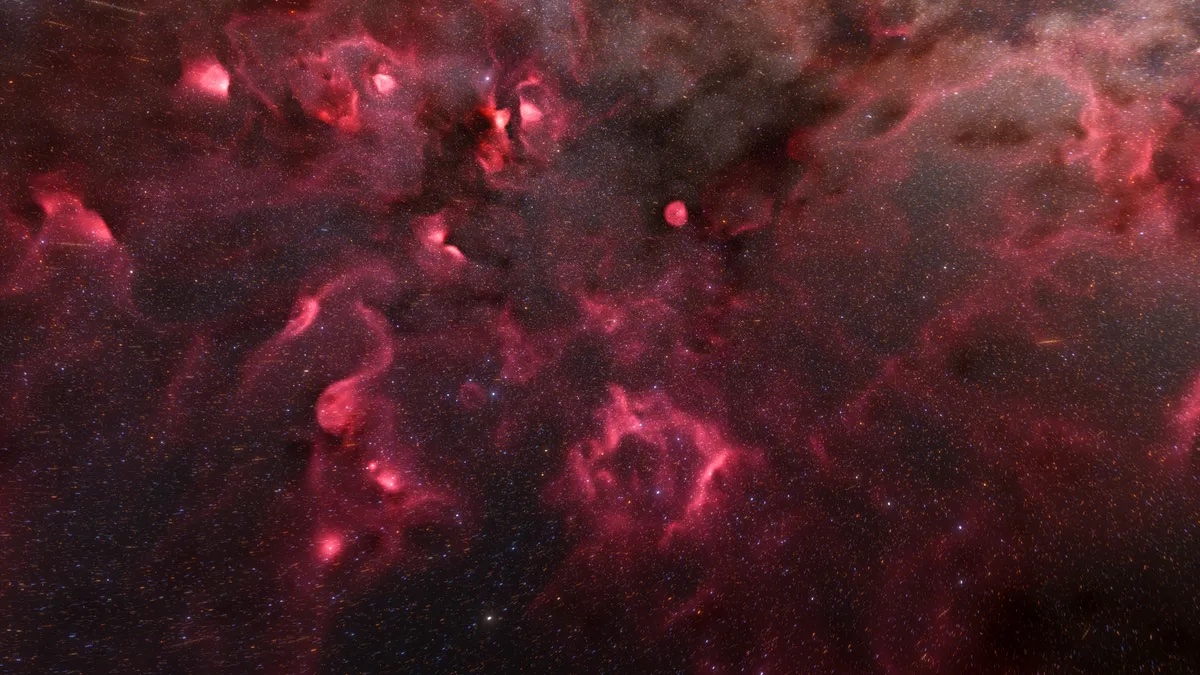
Within the collection of 44 million "ordinary" stars Gaia captured lies 87 O-type stars— rare infant stars, which are both extremely massive and hot. They emit bright ultraviolet light that oozes so much energy that the rays blast electrons off of any hydrogen atoms they hit, ionizing them. This process creates a cloud of charged hydrogen gas around the O stars, called HII regions.
Watch the video here.
The things we can do.
Food Outlook
What are you going to be cooking and—ostensibly—eating in 2026? We like to think it’ll be the same things we have been eating all along, but apparently Whole Foods thinks otherwise. Via (who else?) Food & Wine:
According to Whole Foods Market’s latest trend report, 2026 will be all about incorporating added fiber to pantries, celebrating women in agriculture, frozen food that feels fancy, and the introduction of beef tallow into more home kitchens, to name just a few upcoming trends.
Beef tallow? Don’t know about that one.
The eight potential trends for 2026 were identified by the Whole Foods Market Trends Council, a collective consisting of Whole Foods Market team members, including foragers, buyers, and culinary experts.
And, perhaps, practical jokers. We won’t give away all eight, but what are the few that struck us particularly? In addition to the beef tallow (yeah, no):
“Food products that double as décor.” Huh? “Today’s consumers are drawn to eye-catching artwork that was previously reserved for wine labels but now brings an aesthetic appeal to everyday items and staples.” Uh huh…
A growing number of brands are taking notice and revamping their packaging to meet shoppers’ desires for displaying aesthetic pantry items. Standout examples that Whole Foods will be selling in stores include brightly colored canned seafood.
We’ll go them one further and just slather the seafood on the walls. Sure, it’ll be tough to keep the neighbors’ cats away, but who doesn’t like a design challenge?
“Freezer fine dining.” Putting one’s dining furniture in a large, walk-in freezer? No…
Accepting mediocre frozen meals is a thing of the past, and delicious offerings from the freezer aisle have become something many of us actually look forward to at dinner time. Whole Foods has noticed that customers are increasingly seeking frozen foods that emphasize high-quality ingredients and showcase global cuisines, such as arancini or pupusas.
Pupusas? Isn’t that one of the stages of insect development? Or what Indigenous peoples carried their infants in?
you can now find a wide selection of frozen meals that might excite you, such as Flour + Water Cacio e Pepe Pizza, Laoban Crab Rangoon, or Saiga Foods Pho.
We recently learned the proper pronunciation of “pho” and realized that one would not want to be known as the king of it.
“A vinegar renaissance.” A whole art movement based on vinegar?
shoppers are now ”seeking out premium, small-batch options, bold new flavors, and innovative formats that [upgrade] everything from home-cooked meals to craft cocktails and mocktails on restaurant menus.”
Craft cocktails based on vinegar? Isn’t that what wine decays into?
We’re tempted to identify these trends just so we can actively avoid them.
This Week in Printing, Publishing, and Media History
October 6
1723: Benjamin Franklin arrives in Philadelphia at the age of 17.
1927: Opening of The Jazz Singer, the first significant “talkie” movie.
2010: Instagram is founded by Kevin Systrom and Mike Krieger.
2020: Dutch-American guitarist, songwriter, and producer Eddie Van Halen dies (b. 1955).
October 7
1777: The Americans defeat the British in the Second Battle of Saratoga, also known as the Battle of Bemis Heights.
1849: American short story writer, poet, and critic Edgar Allan Poe dies (b. 1809).
1885: Danish physicist and philosopher and Nobel Prize laureate Niels Bohr born.
1919: KLM, the flag carrier of the Netherlands, is founded. It is the oldest airline still operating under its original name.
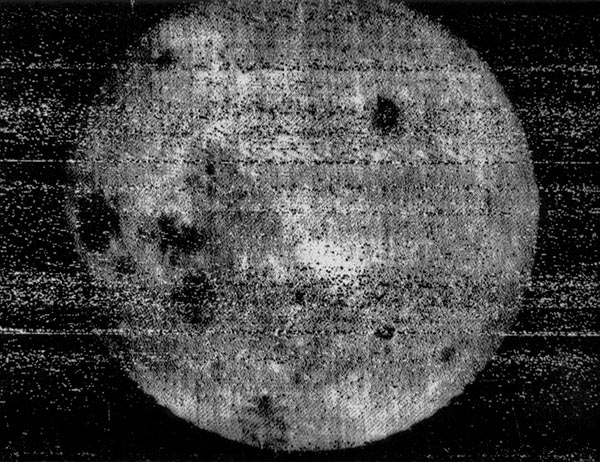
1959: The Soviet probe Luna 3 transmits the first-ever photographs of the far side of the Moon.
October 8
1921: KDKA in Pittsburgh's Forbes Field conducts the first live broadcast of a football game.
1962: Der Spiegel publishes an article disclosing the sorry state of the Bundeswehr, and is soon accused of treason.
1982: Cats opens on Broadway and runs for nearly 18 years before closing on September 10, 2000.
October 9
1446: The hangul alphabet is published in Korea.
1874: The Universal Postal Union is created by the Treaty of Bern.
1907: French actor, director, and screenwriter Jacques Tati born.
1940: John Lennon born.
1986: The Phantom of the Opera, eventually the second longest running musical in London, opens at Her Majesty’s Theatre.
1987: American author, playwright, and diplomat, United States Ambassador to Italy Clare Boothe Luce dies (b. 1903).
2004: Algerian-French philosopher and academic Jacques Derrida dies (b. 1930).
October 10
1813: Italian composer and philanthropist Giuseppe Verdi born.
1924: “Actor,” “director,” and “screenwriter” Ed Wood born.
1985: American actor, director, producer, and screenwriter Orson Welles dies (b. 1915).
October 11
1910: Former President Theodore Roosevelt becomes the first U.S. president to fly in an airplane.
1950: CBS’s mechanical color system is the first to be licensed for broadcast by the U.S. Federal Communications Commission.
1961: American comedian Chico Marx dies (b. 1887).
1967: Typographer, known for work on Times New Roman font, Stanley Morison dies (b. 1889).
October 12
322 BC: Athenian statesman Demosthenes dies (b. 384 BC).
1892: The Pledge of Allegiance is first recited by students in many US public schools, as part of a celebration marking the 400th anniversary of Columbus's voyage.
1924: French journalist, novelist, and poet, Nobel Prize laureate Anatole France dies (b. 1844).
1979: The Hitchhiker’s Guide to the Galaxy, the first of five books in Douglas Adams’ Hitchhiker’s Guide to the Galaxy comedy science-fiction trilogy, is published.