Boxed In
If you follow our PrintStats and our other data series, you know we are always on the lookout for recession indicators. Happily, we have not seen any of those indicators signaling a recession as of yet. GDP growth, the job market, CPI—these are all data series that economists use to “take the pulse” of the economy and warn if trouble’s brewing. But, via Discover magazine, there is one recession indicator with which we are unfamiliar: the cardboard box index. First proposed by former Federal Reserve Chair Alan Greenspan, the idea is that, since more than 75% of non-durable goods are shipped in cardboard boxes, the production of said boxes can reveal something about changes in the demand for consumer products. What does the current CBI (cardboard box index) suggest?
According to [Virginia Tech economist Jadrian] Wooten, box makers have lately been scaling back, with nearly 9 percent of domestic capacity set to shut down. “If they’re cutting back, it’s likely because orders are shrinking,” he said in a statement. Which means: fewer boxes, fewer goods moving, shakier economy.”
(More details at Monday Morning Economist. The Wall Street Journal has a similar story.)
How predictive has the CBI has been in the past? Well:
Jeffrey Kleintop, managing director and chief global investment strategist at Charles Schwab, uses the cardboard-box indicator as a clue to where the stock market may be headed. “Things that we make or ship tend to go in cardboard boxes,” Kleintop said. “I look at demand for corrugated fiberboard, which is what most cardboard boxes are made of. During the last three or four recessions over the last 30 years, demand for cardboard boxes fell by 10 to 15%.”
Hmm…
Interestingly, cardboard boxes have not been the only non-traditional metrics for gauging the health of the economy. Via the Discover article, they have included:
- The Lipstick Index—when consumers are financially pinched, they shift from expensive items to cheaper ones, or skip them entirely, things like nail polish, high heels, or skincare items.
- Men’s Underwear Sales—Another Greenspan metric. “Since underwear is an invisible, replace-only-when-necessary item, a dip suggests men are postponing even the most basic purchases.”
- The Hemline Index—skirt lengths rise with optimism and fall with pessimism. Presumably they mean economic optimism and pessimism…
These are all essentially measures of consumer sentiment (the University of Michigan’s Consumer Sentiment Index is the “official” measure that most economists tend to track) but consumer sentiment isn’t always an accurate reflection of what is happening economically. In 2023–24, according to virtually every economic indicator, the economy was in the best shape it had been in in generations, and yet consumer sentiment—“vibes”—indicated that things were dismal. Go figure.
Still, the box thing may not be wrong…
To a Tee
Consider the graphic T-shirt. One of the most perennially popular fashion items of all time. You are probably wearing one right now or, if not, you probably have a set you wear on weekends or elsewhere at leisure. Graphic tees are top promotional items, and common souvenirs from everything from concerts to vacation destinations. And yet: where did they come from? What was the first graphic T-shirt ever produced?
There is never really a first anything, but via Laughing Squid, the first documented appearance of a printed T-shirt was in a 10-second clip from the 1939 movie The Wizard of Oz, where some T-shirt-bedecked workers are repairing the Scarecrow after a flying monkey attack.
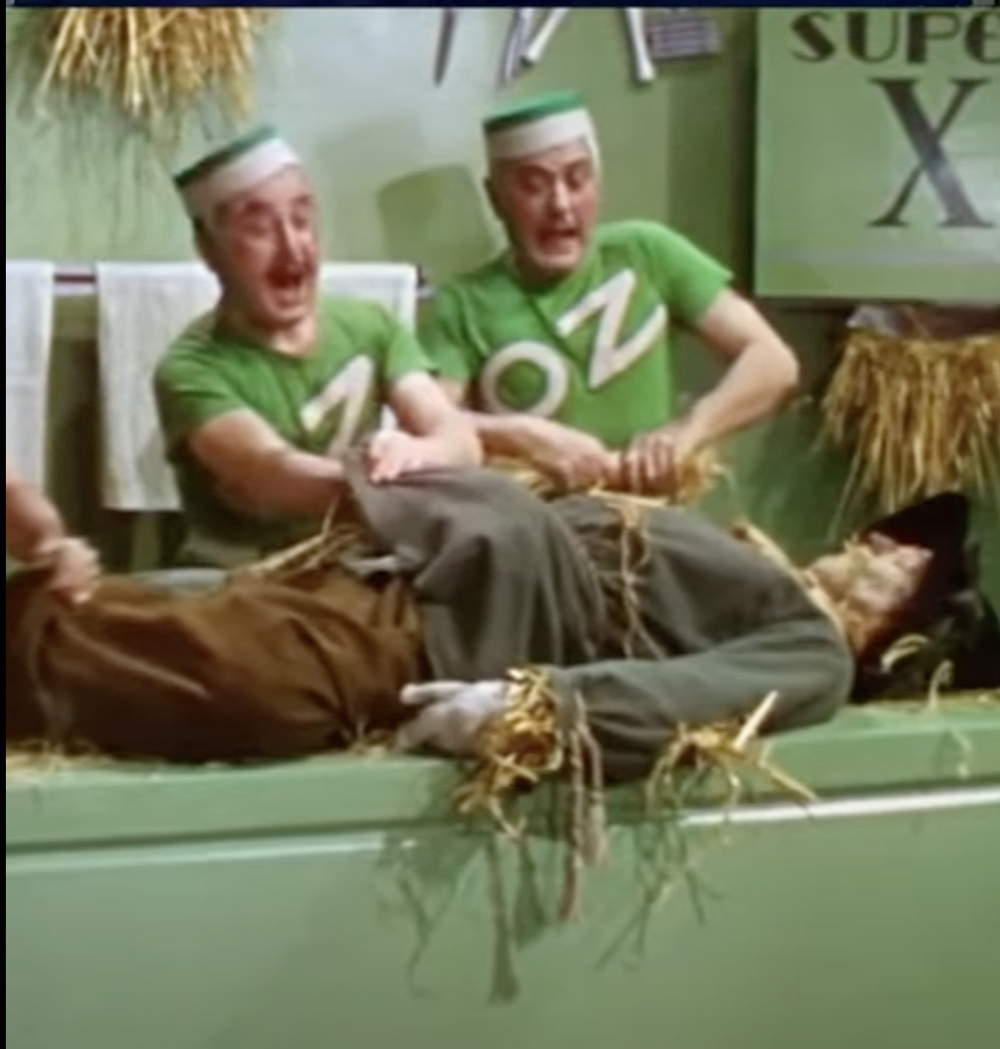
Now, whether it was an original invention of TWoO costume designer Adrian Greenberg or an idea he nicked from somewhere else is unknown, but if it was the latter, no one seems to have documented it before. It would take until the 1950s and 60s for the graphic tee to become popular, at least somewhere beyond the Yellow Brick Road.
Cover Stories
We’ve all heard of novelizations of movies, but what about book coverizations? That is, taking a movie and basing a book cover (and, apparently, just a book cover) on it. Well, via Print magazine’s Steven Heller, that is the M.O. of designer Matt Stevens, who combines various graphic styles to create book covers of films, both popular and obscure.
He began this project in 2023, and published the results in a limited-edition collection dubbed Good Movies as Old Books—and now is back with a trade version from Chronicle.
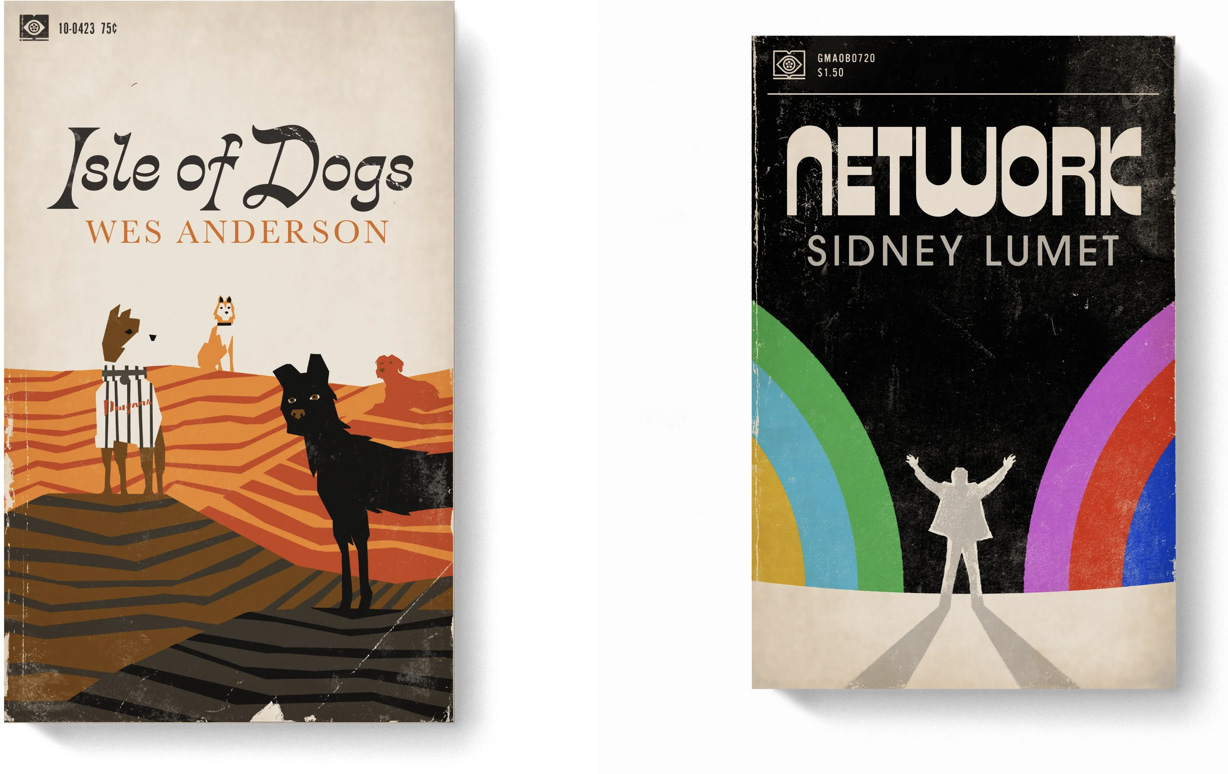
Stevens talks to Heller about his process:
My goal with the style was to try new things and create interesting combinations. Oftentimes, I was trying to do something that had not been done for a particular film. So many of these more known films have so much visual imagery already associated with them, I really focused on doing something that hadn’t been done before, or where the style created a really interesting combination of style and film. I would keep a list of films and a big Pinterest board of styles I liked or wanted to try. Often keeping those things both going at the same time, the combinations would just reveal themselves as I worked.
Blanc Slate
Back in the day, Mad Magazine had a recurring feature called “Snappy Answers to Stupid Questions,”usually written by the late great Al Jaffee. We thought of that when we read the Boing Boing headline, “Will you pay a premium for Montblanc's e-ink notebook?” “Yes, because shelling out a grand for ‘luxury digital paper’ makes perfect sense.” OK, not Jaffeean-level snappy, but still. Montblanc has indeed released a pen-enabled e-ink notebook.
Montblanc Digital Paper – a new chapter in the Maison's tradition of thoughtful innovation. Designed for those who value the quiet clarity of handwriting, Montblanc Digital Paper offers a focused digital space to write, sketch, or annotate with ease. Whether starting from a blank page, marking up documents, or finding and sharing notes, the experience is fluid and refined. Three interchangeable tips allow each stroke to feel just right – distinct, personal and satisfying. Rooted in Montblanc's legacy of craftmanship, Montblanc Digital Paper brings familiar intention into a modern form. A companion for those who write not merely to communicate, but to leave an impression.
Ig Nobel
You’ve heard of the Nobel Prizes, surely, but one science award contest we keep an eye on are the Ig Nobel Prizes. Founded in 1991 by Marc Abrahams, editor of the satirical magazine Annals of Improbable Research(né the Journal of Irreproducible Results), the Ig Nobels celebrate scientific research that is a bit outré—or even kind of silly, or at least to everyone but the researchers conducting the studies. Via Nature, this year’s Ig Nobels included:
a nutrition prize for studying the preferred pizza toppings of rainbow lizards at a seaside resort in Togo1 (their favourite is four-cheese), and a physics award for figuring out how to prepare the perfect cacio e pepe2 — a pasta dish made with grated pecorino romano cheese and black pepper that is surprisingly hard to get right.
Although winning an Ig Nobel was at first deemed insulting, it’s come to be seen as kind of an honor.
“When we first got the phone call about winning an Ig Nobel, we honestly thought it was a prank. Once we realized it was real, we were thrilled and genuinely honored,” says Fritz Renner, a psychologist at the University of Freiburg in Germany and a winner of this year’s peace prize for work showing that drinking alcohol can improve your ability to speak in a foreign language6.
Some other winners:
CHEMISTRY
Rotem Naftalovich, Daniel Naftalovich and Frank Greenway, for experiments to test whether eating Teflon [a form of plastic more formally called ’polytetrafluoroethylene’] is a good way to increase food volume, and hence satiety, without increasing calorie content.
PEACE
Fritz Renner, Inge Kersbergen, Matt Field and Jessica Werthmann, for showing that drinking alcohol sometimes improves a person’s ability to speak in a foreign language.
BIOLOGY
Tomoki Kojima, Kazato Oishi, Yasushi Matsubara, Yuki Uchiyama, Yoshihiko Fukushima, Naoto Aoki, Say Sato, Tatsuaki Masuda, Junichi Ueda, Hiroyuki Hirooka and Katsutoshi Kino, for their experiments to learn whether cows painted with zebra-like stripes can avoid fly bites.
At any rate, click through for the full list of winners.
Third Time’s the Charmera
Some of you may remember those old disposable cameras, an ecological nightmare of an idea wherein you bought a cardboard-housed camera at a CVS or wherever and when the roll of film was used up you brought it back for developing and bought a new one. (We moved house a few years ago and came across an old undeveloped one from sometime in the mid-90s—we have no idea where we could even get it developed.)
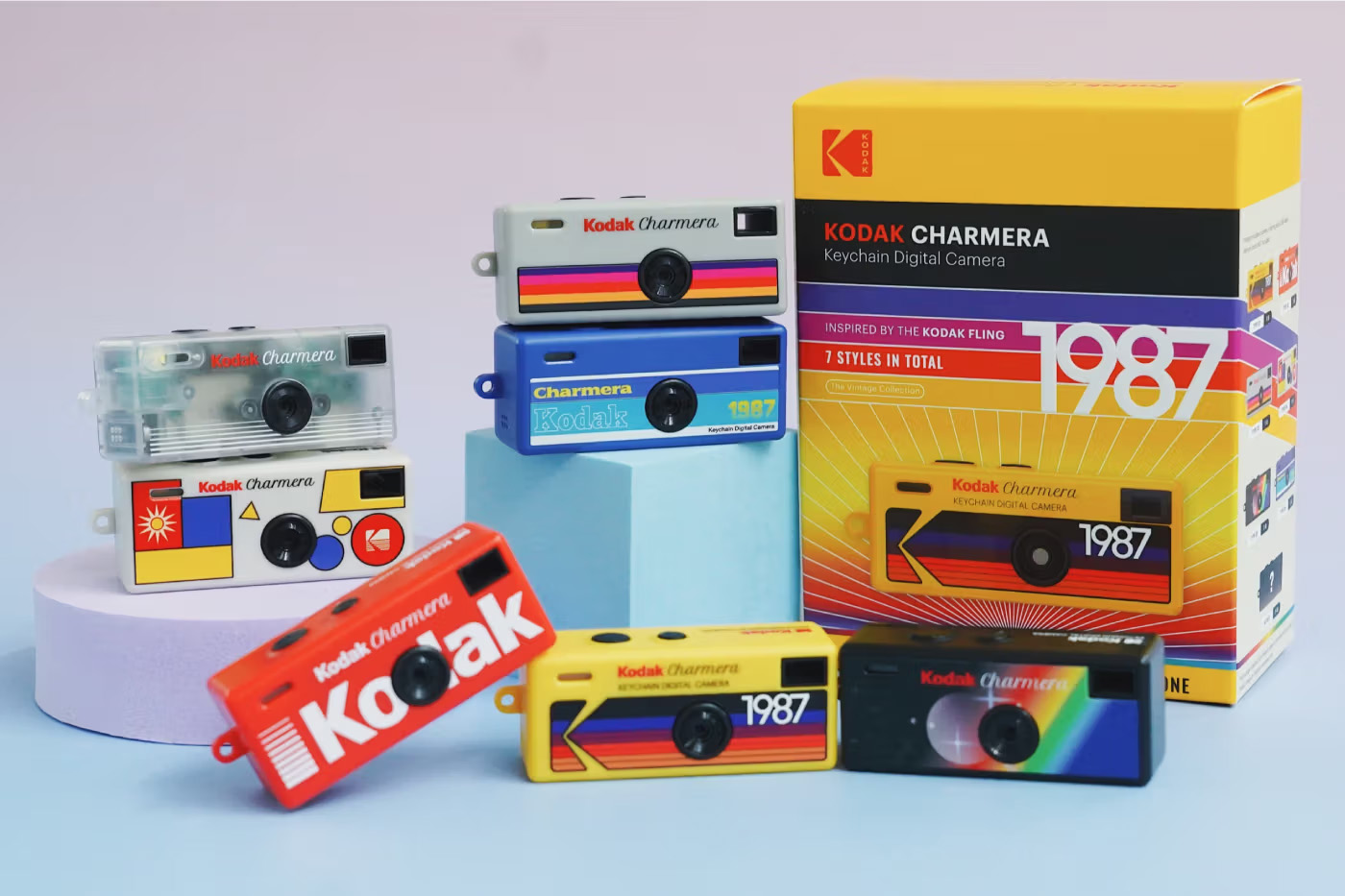
Anyway, we mention this as Kodak was recently inspired by these old cameras (which they produced at the time) and has introduced the Charmera, a mini digital keychain camera. Via Hypebeast:
the Charmera weighs in at about 30 grams and measures 2.2 inches across. It’s capable of taking both photo and video and features seven vintage-style filters, date stamps for photos and customized KODAK frames. Built in is a mini screen for photo and video review, while the images and videos can be saved and transferred to other devices via USB-C. A micro SD card is also required.
We’re not sure we understand this:
Released via the blind box model, customers have the chance to get either the six regular editions or the one secret edition. The secret edition features a transparent shell that shows the camera’s inner workings.
Who needs seven cameras? You can get the set for $29.99, although it is actually sold out.
Ad Nauseam
Do you like ads? Are you in the market for a new refrigerator? If yes to both, good news! Samsung is unleashing its new line of refrigerators complete with video screens that play ads. Via The Verge, Samsung’s “screens everywhere” initiative is now turning into “ads everywhere.” As Samsung wrote in a statement to Android Authority:
Samsung is committed to innovation and enhancing every day value for our home appliance customers. As part of our ongoing efforts to strengthen that value, we are conducting a pilot program to offer promotions and curated advertisements on certain Samsung Family Hub refrigerator models in the U.S. market.
Wait…“Android Authority”!?
Advertisements can be dismissed on the Cover Screens where ads are shown, meaning that specific ads will not appear again during the campaign period.
Uh huh. Anyway, sounds horrifying.
Here’s what we suspect the next step will: the fridge will be unable to be opened until you watch an ad. Could be good for dieters…
Round and Round
Here’s a line one rarely comes across: “Turkish designer/architect Müge Kahraman, however, sees beauty in baggage carousels.” All we really want to see in baggage carousels is our baggage, but chacun à son goût. Anyway, via Core77, Kahraman has parlayed her love of baggage retrieval carousels into a line of mirrors. And, well, why not?

The two full-sized mirrors are called Baggage Claim O and Baggage Claim I, for obvious reasons. The tabletop unit is called Baggage Claim M, either for “medium” or “makeup.”
Or “missing” as baggage occasionally is. So does that loud klaxon sound just before you look in the mirror? Does your face go round and round? Is your own reflection the last one to appear in the mirror? Anyway, they are available in four colors, although no prices are mentioned.
We can’t wait for her design for a TSA body scanner-inspired walk-in shower.
Heart of Glass?
(Optional musical accompaniment to this item.)
When we read this Discover article, “Breakthrough for Organ Transplants May Be Realized by Turning Organs into Glass,” we were bemused, and thought that it was something surely deserving of an Ig Nobel Prize. But it is something designed to solve a very real problem concerning organ transplant logistics: transplantable organs are viable for only a short window of time and sometimes they don’t make it to the intended recipient before they become unusable.
Today, transplant organs are typically kept cool, essentially in a high-tech version of a refrigerator. But this method preserves them for less than 48 hours, drastically limiting the logistics of delivering organs to patients in need.
Researchers are looking into freezing organs via cryopreservation, a long-term storage solution that could boost the number of available viable organs and better match the organ to the recipient. And this is where the glass comes in.
To bring this closer to reality, researchers from Texas A&M University recently published a study in Nature Scientific Reports outlining an improved method called vitrification. The technique turns organs into a glass-like state while avoiding the cracking that plagues current approaches. If perfected, it could transform not just medicine but also wildlife conservation and even food preservation.
If you have ever thawed frozen food that experienced freezer burn, you know the basic problem with freezing organs.
Organic material is highly sensitive to freeze damage. When water inside cells freezes slowly, it forms sharp ice crystals that rupture cell membranes. That’s why we can’t toss an apple into the freezer and expect it to thaw in perfect condition.
Enter vitrification.
Vitrification (from the Latin vitrum, meaning glass) solves this problem by preventing ice crystal formation altogether. The process turns the cell’s contents and surrounding solution into a uniform, glass-like state that can be revived through rapid thawing.
Vitrification is already used to preserve things such as eggs and sperm in fertility treatments, but thus far has proven challenging for scaling up to things like more complex organs, which can crack when vitrified, which is not a good thing. So researchers are working on vitrification options—such as varying temperature—that will eliminate cracking.
The promise of vitrification extends far beyond organ transplantation. Because it can technically be applied to any organic material, it could reshape the global “bio–cold chain.” The researchers see applications in biodiversity conservation, pharmaceutical storage, and even food waste reduction.
Or even entire human bodies, allowing us all to potentially become Walt Disney.
Around the Webb, Part the Occasional: Saturnalia
We have not checked in with the James Webb Space Telescope in a while, but we note that it has trained its eye not on the most distant objects in the universe, but rather on one of our Solar System neighbors, Saturn. It found “strange dark beads” in Saturn’s atmosphere, and scientists have no idea what they are. Via LiveScience:
The astronomers expected to see emissions across broad bands of the infrared spectrum in the atmospheric layers above the vortex. Yet what they noticed instead were dark, bead-like features — separated by vast distances yet possibly interconnected — drifting slowly in the charged plasma of the planet's ionosphere, and a lopsided star-shape structure in the stratosphere beneath. They published their findings Aug. 28 in the journal Geophysical Research Letters.
Any ideas?
“We think that the dark beads may result from complex interactions between Saturn's magnetosphere and its rotating atmosphere, potentially providing new insights into the energy exchange that drives Saturn's aurora,” Stallard said.
To get a better idea of what’s going on, researchers hope to conduct follow up observations.
Saturn is currently at its equinox, meaning the patterns could change drastically as the sun shifts across the planet's face.
The things we can do.
Tyrannosaurus Wrecks
We have never quite understood trends in popular entertainment (or, most recently, even been aware of them), but one late 19th-century, early 20th-century fad boggles the mind: train wrecks. Says Atlas Obscura:
From 1896 until the 1930s, staged train wrecks were a popular—albeit destructive—event at fairs and festivals across the U.S., long before anyone ever thought of wrecking old automobiles at a demolition derby or monster truck rally.
One of the first was staged by railroad equipment salesman A.L. Streeter in 1895 in Ohio. How it worked was that the stager of the wreck laid a length of track— anywhere from 1,800 feet to a mile-long—and placed two old steam locomotives at either end of the track, facing each other. Here’s where it becomes a health and safety nightmare: they hired two locomotive engineers who, when given the signal to go, started the trains and got them up to speed. Then—get this—they had to jump off the trains before they crashed. And it was a hit, in more ways than one
According to the historian James J. Reisdorff’s book The Man Who Wrecked 146 Locomotives, Streeter’s wreck was so successful that there were at least six staged train collisions the following year, including the most infamous one north of Waco, Texas, known as the “Crash at Crush.”
This was where they realized that crashing locomotives into each other was not the safest thing in the world.
The locomotives reached 50 miles per hour before they collided, crunching into a mass of bent steel and shattered wood before exploding. One witness described the terror: “There was a swift instance of silence, and then, as if controlled by a single impulse, both boilers exploded simultaneously and the air was filled with flying missiles of iron and steel varying in size from a postage stamp to half a driving wheel.” A Civil War veteran who was there said it was more terrifying than the Battle of Gettysburg.
The fad lasted until 1935, but locomotive crashing was still occasionally done.
In 1951, two steam locomotives were wrecked in Colorado in front of the cameras for the movie Denver and Rio Grande, a western-themed film about the construction of the railroad of the same name.
Not a movie to see right before an Amtrak trip.
The Trolly Problem
If you have been to a supermarket lately, you may have noticed that shopping carts are getting more high tech, with wheel locks, coin-operation, and other smart-cart features. (Ooh, “Personalized, location-based and real-time contextual advertising.” Awesome.)
Anyway, lost shopping trolleys not only cost supermarkets money to replace—according to a new report, more than 520,000 of them are lost across the UK every year (probably even more in the US)—but it turns out that lost shopping carts have a very high carbon footprint as well. From what? Well, via Food & Wine, the efforts to recover them.
“Thousands of shopping trolleys are reported as abandoned in the UK every year,” Neill Raath, lead author of the study and assistant professor at WMG at the University of Warwick, shared in a statement. “When you multiply the carbon impact of retrieving each one, it becomes both significant and concerning.”
How significant is significant?
According to the researchers, it would amount to the “equivalent of flying from London to New York and back twice.”
And hopefully not in a shopping cart.
As for where all those added carbon emissions come from, the researchers explained that supermarkets rely on commercial collection services, which use “diesel vans to survey suburban areas, to collect and return the trolleys.”
And they are not only collected and returned, some may need to be refurbished (i.e., regalvanization using a zinc coating). The researchers estimated that collection made up 1% of a trolley's environmental impact, while refurbishment contributed another 8%.
They then calculated the environmental cost of the 520,000 abandoned trolleys in the UK, based on whether they were collected in a van, which would emit the equivalent of 343 metric tons of CO?, a figure the team stated in their press release as being “the annual equivalent of driving eighty petrol cars.” The researchers also explained that if just 10% of the trolleys are refurbished, it would “almost double those emissions.”
And they also hastened to add that as big as these impacts seem, manufacturing brand-new shopping carts has an even bigger environmental impact.
So always return your shopping cart to the designated cart corral, unless you plan to live out of it.
This Week in Printing, Publishing, and Media History
September 22
1789: The office of United States Postmaster General is established.
1791: English physicist and chemist Michael Faraday born.
1888: The first issue of National Geographic magazine is published.
1991: The Dead Sea Scrolls are made available to the public for the first time by the Huntington Library.
September 23
1911: Pilot Earle Ovington makes the first official airmail delivery in America under the authority of the United States Post Office Department.
1889: American journalist, publisher, and co-founder of The New Republic Walter Lippmann born.
1889: English novelist, short story writer, and playwright Wilkie Collins dies (b. 1824).
1889: Nintendo Koppai (later Nintendo Company, Limited) is founded by Fusajiro Yamauchi to produce and market the playing card game Hanafuda.
1909: The novel Le Fantôme de l'Opéra (The Phantom of the Opera), by Gaston Leroux, is published as a serialization in Le Gaulois.
1926: American saxophonist and composer John Coltrane born.
1930: American singer-songwriter, pianist, and actor Ray Charles born.
1949: American singer-songwriter and guitarist Bruce Springsteen born.
Wow—what a day for musical births!
1962: The Lincoln Center for the Performing Arts opens in New York City.
2002: The first public version of the web browser Mozilla Firefox ("Phoenix 0.1") is released.
September 24
1852: The first airship powered by (a steam) engine, created by Henri Giffard, travels 17 miles (27 km) from Paris to Trappes.
1896: American novelist and short story writer F. Scott Fitzgerald born.
1906: U.S. President Theodore Roosevelt proclaims Devils Tower in Wyoming as the nation's first National Monument. (The aliens would arrive 71 years later.)
1936: Muppet creator Jim Henson born.
1991: American children's book writer, poet, and illustrator Dr. Seuss (né Theodor Seuss Geisel) dies (b. 1904).
September 25
1690: Publick Occurrences Both Forreign and Domestick, the first newspaper to appear in the Americas, is published for the first and only time.
1897: American novelist, short story writer, and Nobel Prize laureate William Faulkner born.
1906: Leonardo Torres y Quevedo demonstrates the Telekino, guiding a boat from the shore, in what is considered to be the first use of a remote control.
1912: Columbia University Graduate School of Journalism is founded in New York City.
1929: English actor and screenwriter Ronnie Barker born.
1951: American actor and producer Mark Hamill born.
1956: TAT-1, the first submarine transatlantic telephone cable system, is inaugurated.
September 26
1888: Poet, playwright, critic, and Nobel Prize laureate T. S. Eliot born, not with a bang, but a whimper.
1905: Albert Einstein publishes the third of his Annus Mirabilis papers, introducing the special theory of relativity.
1910: Indian journalist Swadeshabhimani Ramakrishna Pillai is arrested after publishing criticism of the government of Travancore and is exiled.
1969: Abbey Road, the last recorded album by The Beatles, is released.
1973: Concorde makes its first non-stop crossing of the Atlantic in record-breaking time.
September 27
1825: The world’s first public railway to use steam locomotives, the Stockton and Darlington Railway, is ceremonially opened.
1840: Iconic cartoonist Thomas Nast born.
1891: Russian author and critic Ivan Goncharov dies (b. 1812).
1962: Rachel Carson’s Silent Spring is published, inspiring an environmental movement and the creation of the U.S. Environmental Protection Agency.
1998: The Google internet search engine retroactively claims this date as its birthday.
September 28
1891: American author and poet Herman Melville dies (b. 1819).
1909: American author and illustrator Al Capp born.
1935: French-Scottish actor, director, and producer, inventor of the Kinetoscope William Kennedy Dickson dies (b. 1860).
1951: CBS makes the first color televisions available for sale to the general public, but the product is discontinued less than a month later.
1952: American satirical novelist Christopher Buckley born.
1964: American comedian, actor, and singer Harpo Marx dies (b. 1888).
1966: French author and poet André Breton dies (b. 1896).
1970: American novelist, poet, essayist, and playwright John Dos Passos dies (b. 1896).