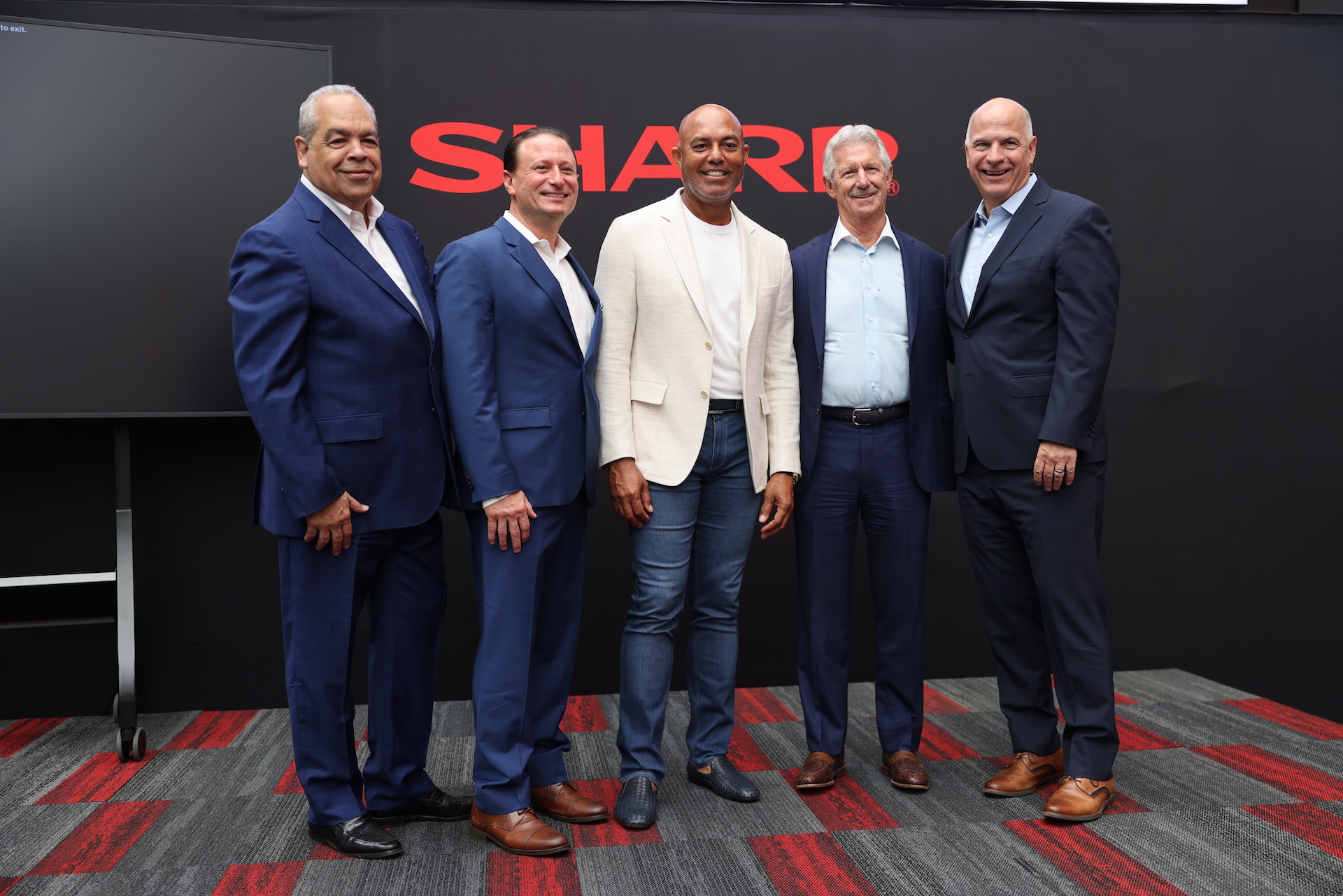
Attending a program graduation ceremony at Sharp headquarters, from left: Luis Villa, Dino Pagliarello, Mariano Rivera, Larry Weiss, Mike Marusic.
Sharp Imaging and Information Company of America (Sharp) has teamed with the Mariano Rivera Foundation to launch a specialized training program that can take high school graduates straight to employment as field service technicians for graphic equipment.
The program, developed by Sharp and conducted at the company’s U.S. headquarters in Montvale, N.J., is based on an intensive, hands-on curriculum that qualifies its students for tech support positions in the dealer network. Several who graduated the program this summer have received job offers, and more are expected to enter the workforce by the same route when the training is offered again next year.
Dino Pagliarello, Sharp’s Vice President of Product Management and Production Print, describes the curriculum as a four-week program that enables students to understand monochrome and color MFP (multifunction printer) technology from a technician’s perspective. Beginning with an overview of basic electrical principles, its core competencies span all key aspects of MFP components and operations in highly granular detail.
Combining lectures, hands-on activities, and live demos, each lesson contributes a selected topic to the full body of professional knowledge that the course is designed to impart. The emphasis throughout is on the kinds of maintenance and troubleshooting work that an MFP service technician would be expected to perform on customers’ devices in the field – the very role that the program aims at preparing its graduates to step into.
Full-Time Commitment
Class sessions took place at Montvale five days a week from 9 a.m. to 4 p.m. The first class, consisting of four students, ran from July 7 through July 31; a second group of three students took the course from August 4 through August 28. The students, all graduates of Newark Tech High School in Newark, N.J. were selected for the program by the Foundation.
Pagliarello notes that the instruction the students received wasn’t confined to lectures in the classroom. The hands-on portions introduced them to different parts of the Sharp operation with the goal of giving them the bigger picture of what they were being trained to do.
“We offered the students the opportunity to sit in different divisions within our organization so they can learn how the process works,” he explains. “Being a technician is fine, but understanding how that technician interfaces with the corporate organization is critically important. It's about being a part of an organization that is helping people get things done.”
This was the rationale for having the students interface with Sharp personnel in logistics, customer support, quality assurance, marketing, sales, and product management. This phase of the training “gives them a well-rounded understanding of the part that they play when it comes to being a technician,” Pagliarello observes. “It’s about being part of a company.”
Dress for Success
The program also helped the students with another critical piece of preparation for entering the job market: soft skills. “We had our HR team work with them very closely,” Pagliarello says. This coaching covered answering interview questions, developing a résumé, and dressing for meetings with recruiters. “We wanted to get them organized so that when they did interview for a job, they were ready for it,” Pagliarello says.
The coursework is demanding, but Pagliarello says the students are “like sponges” in their ability to absorb what it has to teach them.
“They’re digital natives,” he points out. “It’s been a breath of fresh air to work with students that are fresh out of high school to be able to pick up this training so quickly.” By completing it, he adds, they become Sharp-certified MFP technicians eligible to be hired by Sharp or by dealers of Sharp products.
In fact, at the time of this writing, two students from the first class of four had been hired by dealers, another was interviewing, and another was a candidate for a position to be created at Sharp.
“If all goes well, they’ll all be gainfully employed by the time the process is over,” says Pagliarello, adding that the same efforts will be made on behalf of the three students in the second group. “The intention is to employ every student that we move through the system.”
“Not a Super Secret Sharp Thing”
Sharp wants other companies to do what it has done on behalf of career development.
“One of our intentions is to offer this curriculum to any dealer in the country that wants to do this themselves,” Pagliarello says. “This is not a super secret Sharp thing. We believe that this is an opportunity for the industry to get young people into the business at a faster pace with the appropriate training. So we’re very happy to share that out.”
Sharp plans to run the program again next year in the summer months, this time with a larger group of students in a single class. Pagliarello credits Mike Marusic, President and CEO of Sharp, with providing the resources needed to build the curriculum and get the right people involved. “Without his support, none of this would’ve happened,” Pagliarello says.
With two graduating classes behind it, the training program that the Foundation inspired and Sharp created stands ready as a model for others to follow. That is what Pagliarello hopes Sharp’s fellow suppliers in the graphic equipment space will step up to do.
“It's a win-win for everybody,” he declares. “I’m assuming that after this story goes out, there’ll be other manufacturers that are going to say, hey, we could do that too. I think it's going to start an awesome trend in the industry to get more young talent into these organizations, and that essentially is what we're trying to get started.”
Big League Matchups
The Sharp program is the latest in a series of print-related educational initiatives supported by the Mariano Rivera Foundation, the personal philanthropy of Major League Baseball great Mariano Rivera. Its aim is to offer vocational training programs that equip underserved young people with sets of certified and highly employable job skills.
About a dozen students from Newark Tech High School have been training for professional certifications at Premium Color Group, which opened a print training center in support of the Foundation’s Print Design Packaging Development Program at its Carlstadt, N.J. plant in 2023. There’s also a Foundation-sponsored career pathway program in graphic communications in progress at the Boys & Girls Club of New Rochelle, N.Y.
The Foundation’s ties to the industry were forged four years ago in a partnership with Atlantic Tomorrow’s Office, a provider of office printing systems, wide-format printers, and managed print services. Luis A. Villa, Vice President, Production & Industrial Print, and Larry Weiss, Chairman, collaborated with the Foundation to launch its Print Design Packaging Development Program, initially presented at its training center in Gainesville, FL. They also enlisted the help of equipment manufacturers.
Villa says that last year, he invited Sharp to become “the only OEM in this industry to actually have a program to train these students and offer these students to your dealer resellers network.” He salutes Sharp for being “very, very hands on” with the students, offering remote sessions whenever transportation was an issue for any of the trainees. The Foundation also provides ride-sharing stipends for students who travel to Sharp headquarters that way.
New Hands at the Helm
Management services for the Foundation are now provided by Do Good: Make Money, a firm launched by Laura Probst, its Principal and Chief Strategist, in 2005. Through social impact consulting, it helps companies, foundations, and high-profile individuals like Mariano Rivera to create “goodness platforms” for advancing their philanthropic causes.
Probst says that during a tour of its headquarters by Foundation members and students, Sharp wanted to know what more it could do to help the students get started in their careers. Told that they would like to find jobs after completing their final year of vocational training, Sharp proposed jointly piloting a program leading to certification and job placement.
While the program was taking place, the Foundation checked in with the students to follow their progress and make sure that the training was working for them.
Probst is encouraged by what she has seen in the Foundation’s training partnership with Sharp.
“To get these kids to the place where they want to be is really proving to be effective,” she says. With the model created for the Foundation by Sharp, “we're going to be able to help hundreds of kids a year going to where they need it and really listening to what they want to do. So we’re excited.”