For decades, studies have shown that brains prefer paper. Whether it’s students in a classroom or shoppers in a retail aisle, brains process information more deeply and accurately in print. But why? A recent study sheds some light.
The study, conducted by Yu-Cin Jian, professor in the Educational Psychology and Counseling Department at the National Taiwan Normal University in Taipei, used eye tracking with 50 undergraduate students to investigate the differences in how people read in print versus digital media.
Specifically, Jian wanted to understand how comprehension fares in print and digital, not just when text is involved, but when readers have to process information that requires a heavier cognitive load, such as representational or explanatory diagrams. To determine which medium wins out, Jian randomly assigned participants to read the same six-page Popular Sciencearticle (complete with complex diagrams) either in print or on a tablet. She then asked participants to answer reading comprehension questions.
Here are the results:
- Participants spent about the same amount of time reading in print and on the tablet.
- Participants’ comprehension was better in print (no surprise).
- How participants consumed the information was different between print and digital.
What We Can Learn from Eye Tracking
How do we know the participants consumed the information differently between print and digital? Eye tracking.
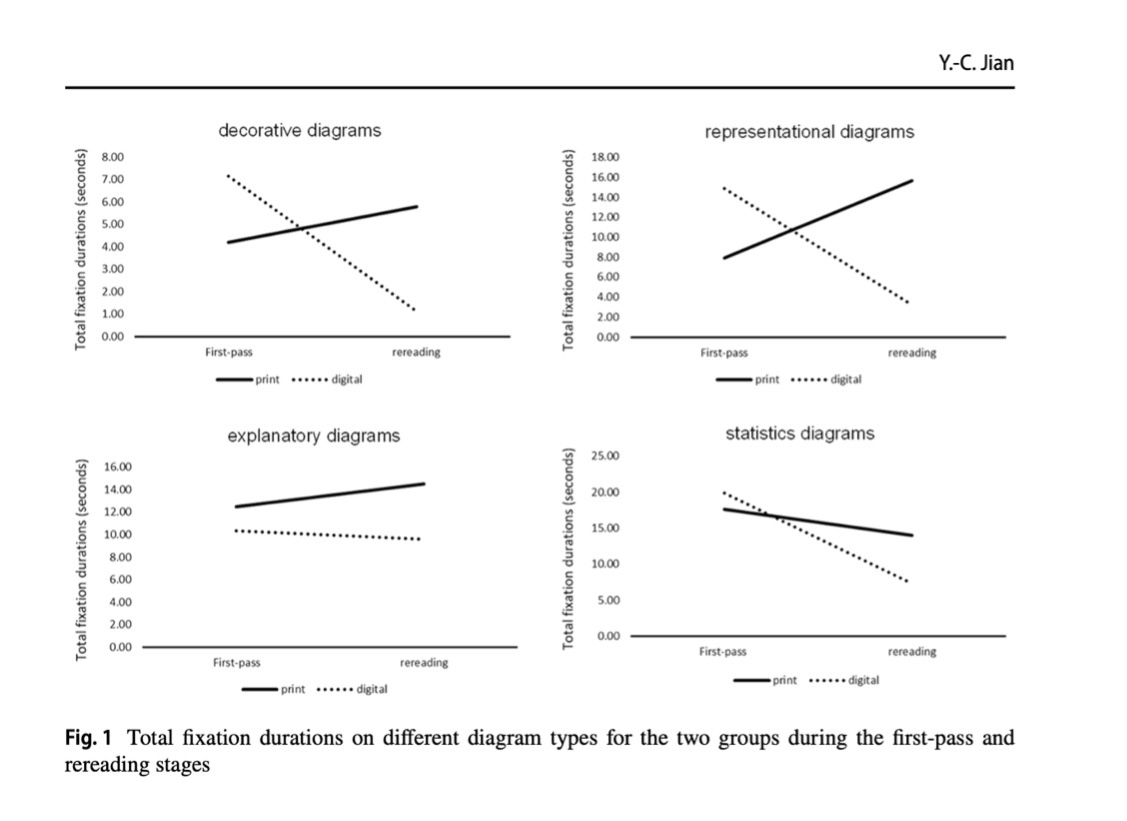
Eye tracking studies ask participants to view a visual stimulus while an eye-tracking device which, using infrared light and cameras, measures their eye movements. In thiscase, eye movement data indicated that, while the print and digital groups spent about the same amount of time reading their assigned content, the time was not divided evenly in how they did it.
The digital group spent more time reading the article initially (called the “first pass reading”), but rarely went back to re-read any portion of it. By contrast, the print group skimmed the article first, then went back and re-read the parts they felt were important.
This is not the first study to show that our brains process information more deeply in print. Other studies have pointed to factors such as spatial/haptic cues (i.e., location on the page and small imperfections on paper) as helping with recall, for example. Jian’s study adds another piece to the puzzle.
Extrapolations for Marketing
Based on Jian’s research, we can also extrapolate that this is a reason why graphics, pull-outs, and bullet points are so effective. They are easier for brains to process anyway. However, by virtue of the fact that our brains identify these sections as set apart, distinct from the main text, the greatest likelihood is that readers go back to re-read them, too.
So not only are the printed graphics, pull-outs, and bullet points easier to process initially, but they likely get read more than once.
The takeaways? When information needs greater processing to be understood and analyzed, put it in print. Use visual elements when possible, but understand their multiplied value when delivered on paper.