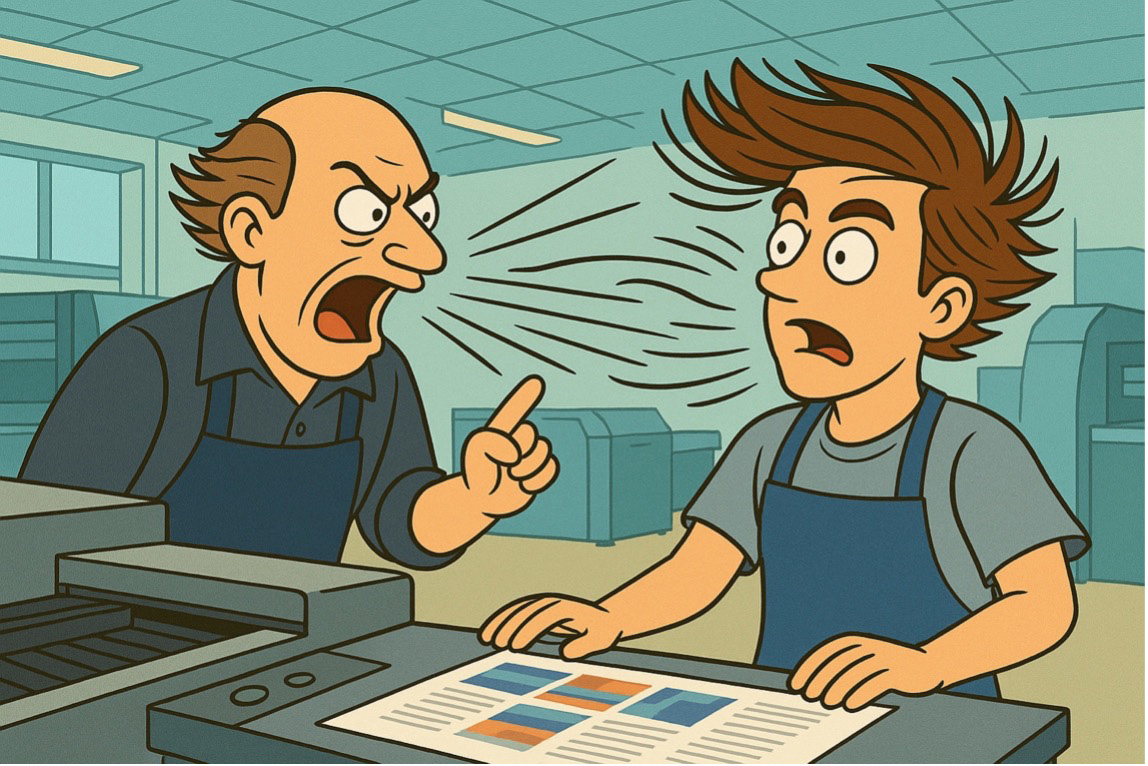
Last week, WhatTheyThink looked at what could be learned about printing industry employees’ dissatisfaction with their jobs by analyzing the negative reviews of their employers on Indeed. One of the common complaints was a “toxic/hostile” workplace environment. Clearly, no print shop wants that, but what does “a toxic/hostile environment” actually look like? How do employees define such things?
As we did in the previous analysis, we turned to ChatGPT. First, we asked the AI platform, which analyzed representative samples of employee reviews of commercial printers with accounts with Indeed, to give us the percentage of reviews with the words “toxic” and “hostile” in them. Then we asked ChatGPT to expand its analysis to include synonyms, as well.
Here is what we found:
Across this broader sample, about one in 10 reviews explicitly uses [the words] “toxic” or “hostile.” When you include closely related language (favoritism/nepotism, cliques/politics, unsafe, abusive/yelling, racist, “dictatorship” management, or mandatory overtime framed as harmful), the share rises to roughly one in five.
That’s a lot. Granted, whether someone is reviewing their print shop employer or their auto mechanic, they are far more likely to post a negative review than a positive one. (ChatGPT found that approximately 50% of all commercial printing employee reviews were negative, with those in production roles far more likely than those in managerial or administrative roles to post negative reviews.) So the point here isn’t that so many reviews are negative, but rather that, when employees do post a negative review, what percentage perceive their work environments as toxic or hostile.
How Do Employees Define “Toxic”?
How do employees define “toxic” and “hostile” in their own words? What follows is ChatGPT’s analysis, along with representative quotes, with company names and plant locations removed:
- Favoritism, politics, and cliques (perceived unfairness).
- “Too much politics with senior management…hard workers not appreciated while slackers get rewarded.”
- “Clique-y, toxic office culture…poor communication between departments.”
- “Owners’ children…destroy any kind of positive work environment.”
- Poor leadership behaviors (blame, lack of support, inconsistency).
- “HORRIBLE management…love to blame and point fingers for mistakes.”
- “No direction. When you try to take initiative… it is stepped all over.”
- Extreme or poorly managed schedules.
- “Mandatory twelve hour shifts seven [days]…turnover is very high.”
- “You work almost every day, and get few days off.”
- Disrespect and dignity violations.
- “People are racist and make racist comments and weird stares.”
- “Racist and exploitive management…a manager said all the temps belong in a correctional facility.”
- Safety and investment concerns.
- “Incompetent management, unsafe work conditions, hostile environment…zero investment in the equipment.”
- “Machines…in poor maintenance…made working with them impossible at times.”
- “Unsafe to work in…hazardous chemicals everywhere.”
- Communication and mentorship gaps.
- “Poor management, no leadership or guidance. No mentorship…poor communication.”
The Pattern Underneath
Stepping back, looking across all shops and job roles surveyed, “toxic/hostile” is usually shorthand for a trust gap driven by the following:
- Unfairness (favoritism/politics).
- Unsupportive management (blame, opacity, no voice).
- Unsustainable scheduling (mandatory or constant OT without relief).
- Feeling unsafe or disrespected (equipment/conditions or interpersonal conduct).
When a company has reviews like those above, does it mean that the culture there is actuallytoxic and hostile? Or could these just be outliers? It could be either one. To find out, the first step (whether your company is on Indeed or not) is finding out what your employees actually think.
What’s Next?
Getting a true and accurate assessment starts with a commitment from the top down that you want people to provide honest input, then committing to them that there will be no consequences for their feedback. It is often helpful to name a neutral lead such as HR or outside facilitator (rather than the management they may be distrustful of) to handle those comments.
Other steps include:
- Pulse surveys
- Listening tours
- Fairness audits of schedules, OT, promotions, pay
- Hotlines
- Exit interviews
There are lots of options. Check online, hire a consultant, or even ask ChatGPT (which would be happy to put together a pretty darn good step-by-step plan for you). Whatever you do, it’s worth doing something. In the best-case scenario, you’ll find that you’re doing great. In a less ideal situation, you’ll find some situations that need correcting. But even that’s a good thing because it’s better to know than not to know, and once you know, you have the opportunity to make it right.