(Adobe Stock)
- AI is revolutionizing routine functions like scanning documents, routing forms, pulling up files, or issuing print jobs.
- IT decision-makers are increasingly embracing AI and embedding it into tools that they already use, including MFPs, cloud systems, and document management platforms.
- Although many firms recognize the potential of AI, they often lack a clear roadmap for integration. This is especially the case in environments with legacy systems or strict compliance demands.
By Lisa Brown
Introduction
Across all industries and within businesses of every size, artificial intelligence (AI) is redefining how information is captured, processed, secured, and shared. Whether it’s reconciling financial statements, managing patient records in healthcare, or sorting legal documents, today’s organizations are leveraging AI to modernize and streamline document-centric processes. AI is no longer a futuristic concept; it’s a practical tool that is being embedded in daily operations. This is particularly the case in the world of print and workflow automation.
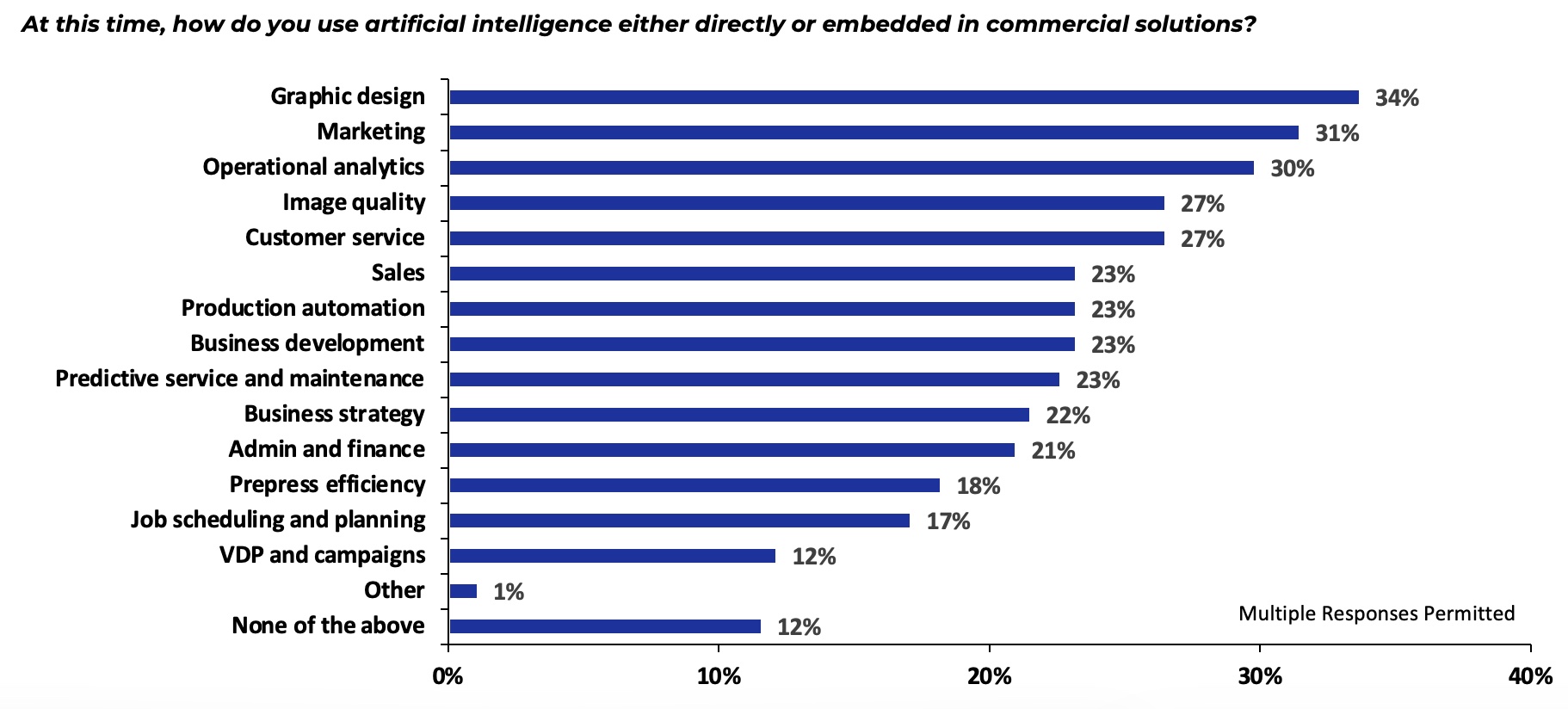
The proof is in how IT decision-makers are investing in and implementing AI. According to an AI readiness end-user survey conducted by Keypoint Intelligence, 95% of businesses in the United States were at least actively exploring—if not already investing in—AI for document workflows. The shift away from manual processes and disconnected systems reflects an increasing need for greater speed, intelligence, and security in everyday work.
For the print and workplace technology channel, this momentum represents a pivotal opportunity to reframe print and imaging solutions as critical enablers of the digital transformation (DX). As AI becomes more integrated into the way work gets done, providers that can pair smart technology with strategic guidance will be best positioned to lead us into the future.
Reimagining Print’s Role in the Workplace
AI is no longer limited to back-office analytics or experimental pilots. In today’s workplace, it is revolutionizing routine functions like scanning documents, routing forms, pulling up files, or issuing print jobs. Technological innovations like machine learning, computer vision, and natural language processing enable multifunctional peripherals (MFPs) and document systems to interpret, classify, and make decisions about content in real time.
Here are just a few examples of AI in action:
- Law firms are using MFPs that distinguish between contracts and depositions, automatically filing documents by case type.
- Healthcare clinics are redacting personal health data before securely transmitting files, reducing the risk of Health Insurance Portability and Accountability Act (HIPAA) violations.
- Insurance providers are leveraging AI to extract and validate data from claims forms. Missing or consistent information can then be flagged for human review.
- Universities are auto-sorting transcripts and student records, accelerating processing times and improving archiving accuracy.
AI is no longer just making workflows faster; it’s making them smarter and more adaptable so they can accommodate complex compliance and content management needs.
Vertical Adoption Gains Ground
Thanks to the desire for efficiency as well as the increased availability of AI features and technologies, AI adoption has accelerated across a wide variety of industries. IT decision-makers are increasingly embracing AI and embedding it into tools that they already use (e.g., MFPs, cloud systems, document management platforms). For example:
- Healthcare providers are using AI to digitize intake forms, detect sensitive data, and feed information into EHR systems with greater accuracy. These improvements help reduce administrative burdens while also enhancing compliance.
- Financial services and banking institutions are automating labor-intensive tasks like loan processing, identity verification, and regulatory reporting. AI ensures that sensitive content is processed quickly and accurately without introducing any additional risks.
- In the insurance vertical, AI is streamlining underwriting and claims processing. By integrating document AI with cloud-connected print and capture devices, insurers can reduce their reliance on manual input to accelerate decision-making.
- Law firms are using AI to auto-classify files, redact confidential content, and apply consistent naming conventions. This reduces administrative time and frees up staff members’ time so they can focus more on client service and analysis.
- With limited staff and growing administrative workloads, schools are using AI to automate record-keeping, manage the use of print, and protect student privacy via secure, cloud-based print management solutions.
- The manufacturing and logistics sectors benefit from AI that can read, classify, and store delivery notes, packing lists, and inspection records. Smart MFPs in the field act as on-ramps to digital workflows, improving visibility and traceability.
Unlocking AI’s Full Potential
Even as interest grows, many organizations remain unsure about how to operationalize AI across their document workflows. Although they may recognize the potential, they often lack a clear roadmap for integration. This is especially the case in environments with legacy systems or strict compliance demands.
Today’s technology providers can add significant value by:
- Delivering tailored AI-powered print and capture solutions that address industry-specific challenges and regulatory concerns.
- Providing consulting and enablement services, from AI education and governance frameworks to ROI evaluation and implementation planning.
- Offering integrated packages that combine intelligent MFP hardware with cloud workflow tools, automation engines, and analytics dashboards.
By becoming a strategic transformation provider rather than just a vendor, today’s providers can build long-term trust and loyalty.
While the benefits are clear, the shift toward increased AI adoption is not without challenges. Some organizations remain cautious, and rightfully so. Reasons for this include:
- Ethical and regulatory concerns, especially in the healthcare, financial, and public service sectors.
- Fears of job displacement and/or resistance to change from management and employees.
- Data quality and integration issues, including inconsistent formats, unstructured inputs, and isolated systems.
To overcome these barriers, AI solutions must do more than just perform… they need to build trust and confidence. This involves building workflows that are auditable, explainable, and transparent about how data is handled and how decisions are made. Providers must be ready to support customers with onboarding, user training, model validation, and proof-of-concept initiatives so teams can make the shift from AI-curious to AI-capable.
The Bottom Line
As AI becomes increasingly embedded in everyday business systems, its influence on DX will only grow deeper. Modern workplaces are evolving toward intelligent automation, and print and document workflows are a key component of that journey.
The takeaway for technology providers is clear: now is the time to reposition print and imaging solutions as integral components of a digital strategy. By coupling advanced technologies with industry expertise and hands-on support, providers can help their customers increase efficiency, improve compliance, and stay ahead of the curve. When it comes to AI, the winners of the future will go beyond selling solutions and instead strive to build partnerships.
As a Principal Analyst at Keypoint Intelligence, Lisa Brown has played a crucial role in enhancing client performance, leading research projects within the consulting group, and contributing to the advisory services team. She is dedicated to understanding and addressing clients' needs, developing strategies that are designed to maximize their potential. With over a decade of experience in the workplace technology sector, Ms. Brown excels in delivering actionable insights that prepare clients for success.