This article is sponsored by Canon as part of WhatTheyThink’s Print Product Spotlight series. In preparing this article, the WhatTheyThink Print Product Section editors conducted original, in-depth research into Canon’s imagePRESS V Digital Presses. This Product Spotlight describes what the editors feel are the products’ strengths in the marketplace. Canon previewed the final article for accuracy but had no editorial control over the content.
(Watch David Zwang’s interview with Matt Poliniak, Sr. Manager Production Print Solutions, Canon USA here.)
Canon’s imagePRESS V Family of production color digital presses have been engineered to provide ease of use, color accuracy, and consistency with minimal operator intervention. Their line of presses, which includes the imagePRESS V900 Series, imagePRESS V1000 press, and imagePRESS V1350 press are designed with state-of-the-art engineering developments that are intended to deliver both high quality and high performance to address the needs of today’s customer.
Background
Canon’s imagePRESS V Family of digital color toner presses are built for production print. Their line of presses, which includes the imagePRESS V900 Series, imagePRESS V1000 press, and imagePRESS V1350 press are designed with state of the art engineering developments that are designed to deliver high quality and high performance to address the needs of today’s customer realities.
Consistent Productivity, Quality, and Ease of Use
Designing a digital press for today’s changing and challenging market requirements can be difficult. In addition to providing high productivity and quality, since labor and media are increasingly hard to come by, a press must be easy to operate and provide inherent repeatability. The imagePRESS V line of digital presses are the result of years of customer feedback and engineering ingenuity. Overall, the imagePRESS V line of presses focuses on productivity, cost control, quality and ease of use. This is accomplished by intuitive engineering and a high level of automation in many of the key operational technologies.
The imagePRESS V900 Series and V1000 press are rated at speeds of up to 90 ipm and 101 ipm respectively based on continuous printing for a letter size page, while the V1350 press is rated up to 135 ipm. However, speed is only good if you don’t have to deal with time consuming setups, or to stop for color and registration adjustments while continuously feeding the media for both simplex and duplex printing. While there are many unique developments in these presses, there are a few key areas that highlight the design benefits. The imagePRESS V presses are designed to look beyond just speed to measure productivity, since there are many other factors involved.
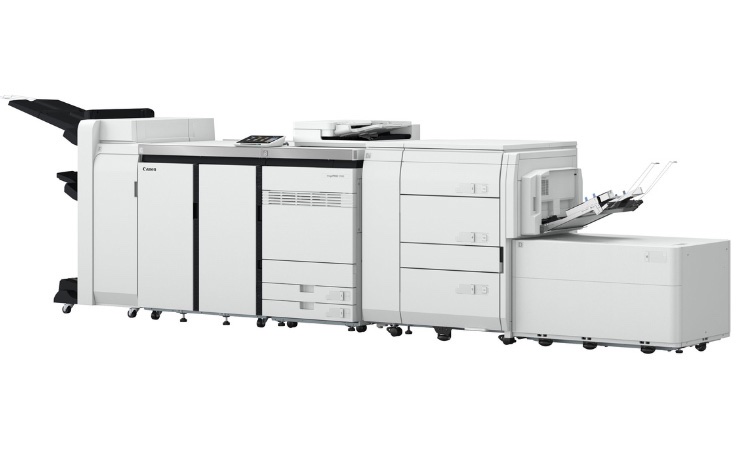
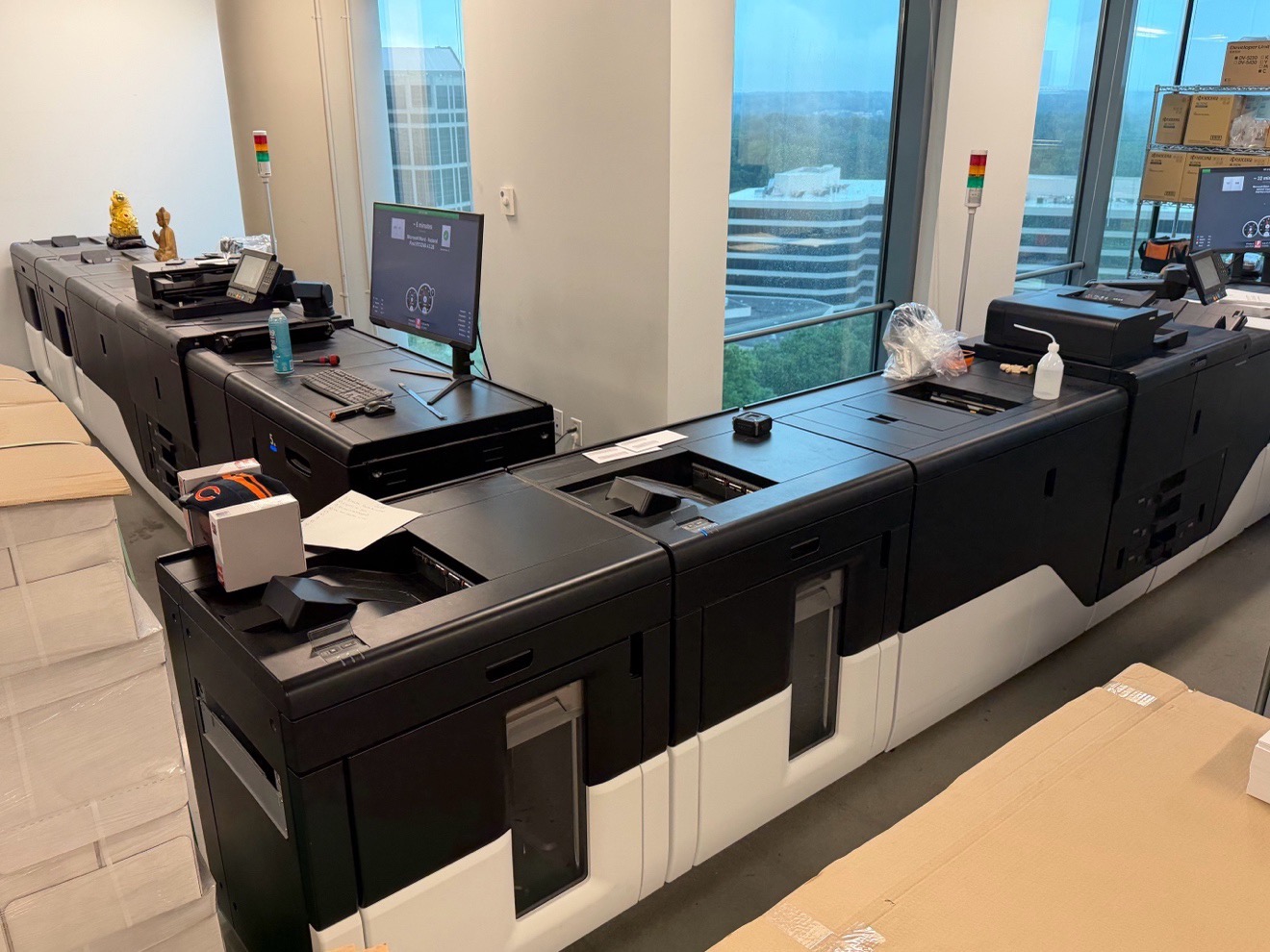
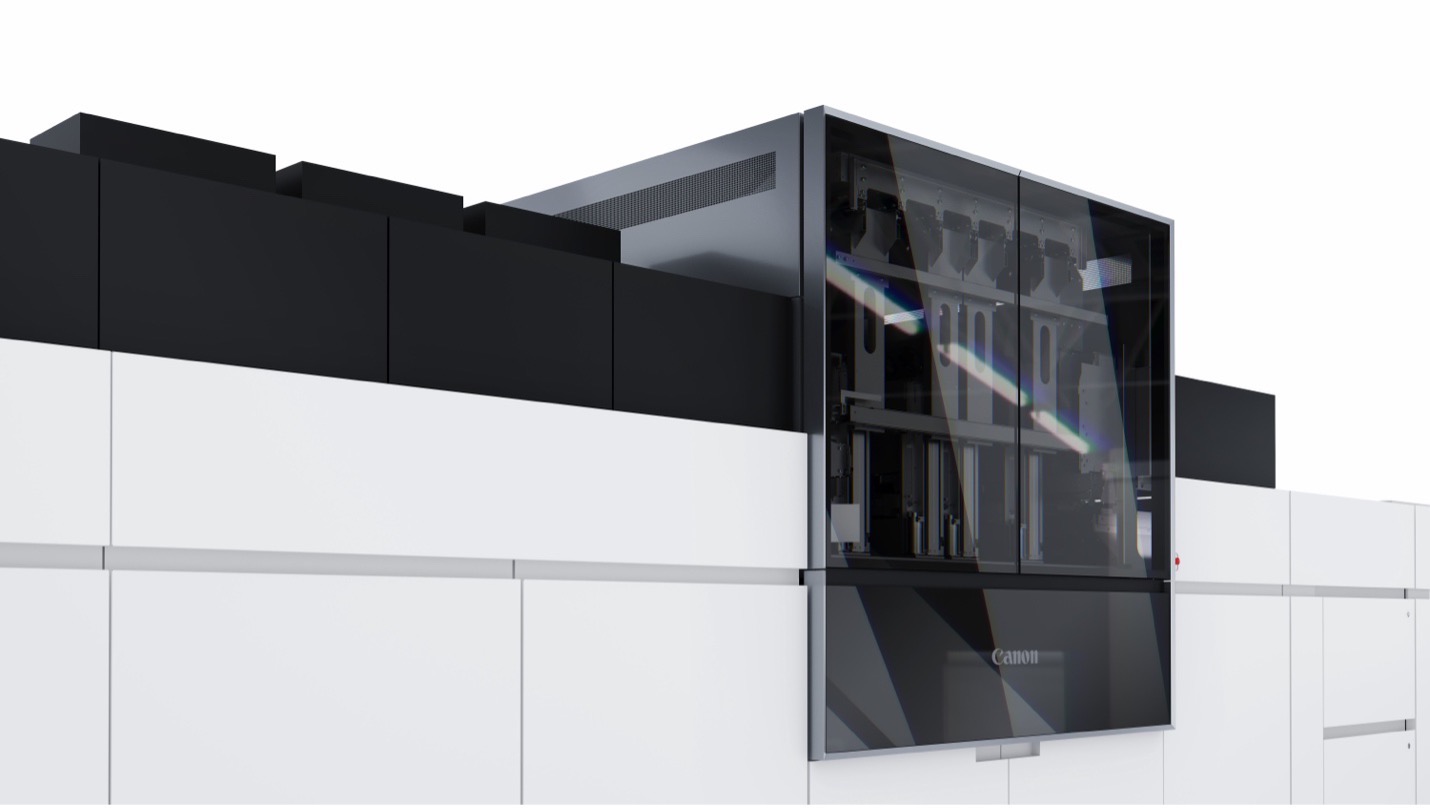
Canon imagePRESS V family of digital toner presses. © Canon
High Performance Feeding
Whether you are feeding a lightweight bond stock or heavy packaging media, envelopes or magnets, each with its own characteristics, the feeding and imaging can be affected. If you are duplexing, it compounds potential issues, especially on long sheets. Canon engineers addressed this with a number of unique developments in the press.
The new POD Deck F1 option was designed to help provide reliable and stable feeding of a wide range of media. Full-air paper feeding enables stable transportation as a result of its high separation performance. Only one sheet is separated from the deck by air, picked up by the suction belt, aligned and then fed into the press. The new design is designed to provide stable paper feeding even when printing a wide range of heavy, synthetic or magnetic paper, which tends to stick to each other and can be difficult to handle with the physical paper pickup roller method.
Each optional POD Deck has three drawers, all drawers support heavy, synthetic, and magnetic paper and can be switched automatically. This enables users to print continuously without frequent paper changes even when handling various media. Frequent paper supply by hand is lessened because the capacity is up to 5,000 sheets in total. Up to 10,000 sheets can be stacked in the POD Deck F1 option with a tandem configuration.
To help with continuous operation with this new system, even if a double feed occurs, the problem media is ejected to purge tray, and printing continues automatically without reprint instructions by the operator.
Color Consistency, Accuracy, and Automation
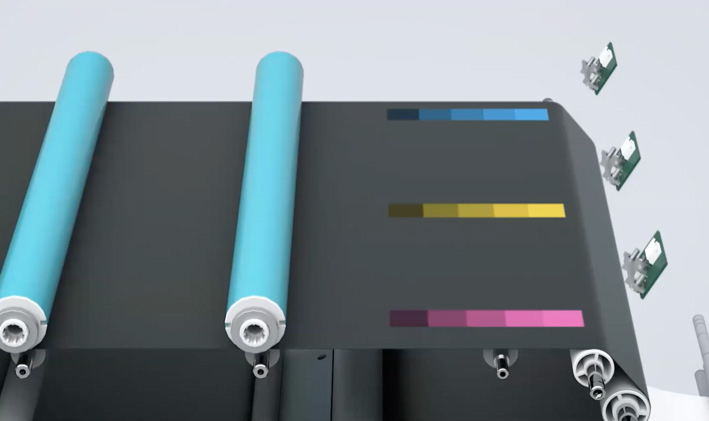
Providing accurate and repeatable color throughout a press run is an imperative. The imagePRESS V series does this through a number of automated technologies. Consistency is provided by their Multi-DAT technology. The imagePRESS V1000 press automatically measures 20 color patches (20%, 40%, 60%, 80%, and 100% densities of each primary) every minute (or 102 pages) with built-in densitometers, while the imagePRESS V1350 press performs this measurement between every image. The CMY patches are measured directly on the transfer belt and K on the drum, all without operator involvement. If it reads outside of tolerance, the press will adjust automatically in real time.
Color accuracy is achieved with the help of ILS (Inline Spectrophotometer) technology. This built-in system, which consists of up to four spectrophotometers, can quickly and accurately perform an engine linearization (calibration) without the need for a handheld i1 spectrophotometer. It can also perform media calibration, create custom media profiles, calibrate to the G7 standard, and even run a verification check to many color standards. Whether you have the PRISMAsync print server or Fiery controller, these critical tasks are completed without the need for operator involvement (other than to initiate). When creating custom output profiles, it automatically prints the patches and measures them in under five minutes. So you no longer need to do an external profiling each time you introduce a new paper, and more importantly you don’t need to have extensive color management skills.
The PRISMAsync print server is equipped with the Automated Color Tasks feature, where it will combine many of the above actions and perform them in just one step. Instead of initiating each task individually, this feature will perform each action. When completed, the press is calibrated and verified, providing the information to the key operator that the press is printing to their standards.
With the Fiery Zero Step calibration, when you start a run, it also looks at the last time you calibrated your selected paper, and if it hasn’t been completed within your preset timeframe, it will pause your job, where ILS will then calibrate automatically for you and then start printing your job. Once completed, your production job automatically begins. The Fiery Spot Pro feature can also use ILS to dial in spot colors. It identifies spot colors in the PDF file and asks the operator what they want to do. You just select iteration, and it knows your paper, it knows your output profile, it knows the LAB values, all automatically. Then using the ILS to measure, it will print those patches on your paper and measure them with spectral measurements, limiting the need to use an external spectrophotometer and color management software.
The PRISMAsync print server now includes a 21.5-in. monitor to help you intuitively manage your jobs, substrates, color, as well as view the Scheduler where an operator can see up to eight hours in advance, how long until production is completed, and if there is something that will interfere with the job finishing (i.e., media quantity or finisher capacity).
Precision Registration
The Precision Registration technology (equipped in the imagePRESS V1000 press) is designed to dramatically improve sheet to sheet and front to back registration and consistency. It does this through a combination of technologies. Canon’s vacuum-fed POD Deck F1 option performs a skew and alignment adjustment before the media enters the press. As the paper enters the press it performs the first of four registration checks within the marking engine itself, where it does another skew adjustment and alignment. As the media enters this area, it creates a small buckle in the media to remove the skew. Instead of releasing the media (and buckle) which can cause additional registration issues on heavy and card stock, the stock is moved forward, releasing its grasp as it enters the section of the engine. This helps to media, regardless of size and weight remained aligned and centered before the image transfer.
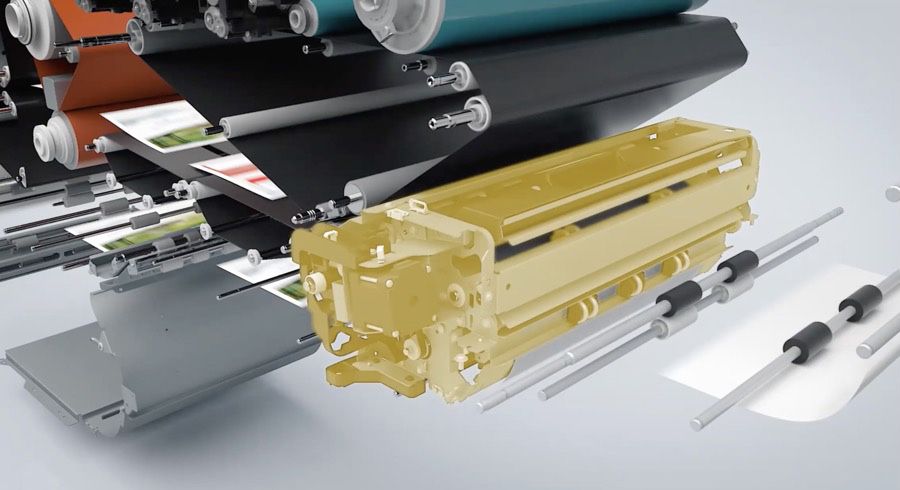
After imaging, it goes through a secondary duplex mechanical alignment where the media is centered once more, helping to provide accurate side to side image placement.
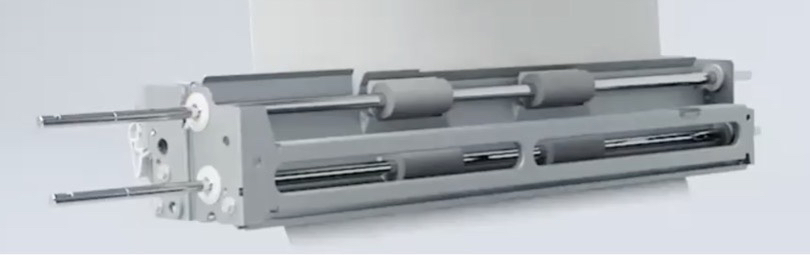
After being fully duplexed, where the media is making its way back to the imaging section, the paper then goes through a third alignment, where a skew adjustment is performed once again, helping to allow the media to stay straight and aligned before making the final turn for the second side imaging.
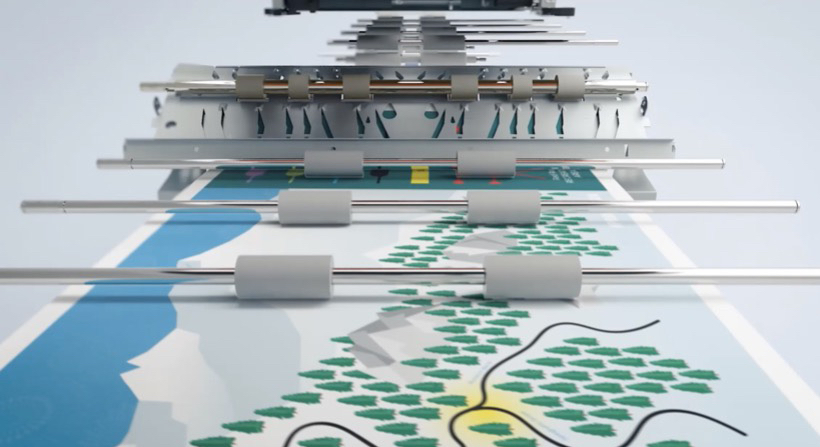
Before imaging, the media is greeted with the same skew, positioning, timing procedure it utilized in the first past, where last-minute adjustments are made for proper image placement of the side of the page. The Precision Registration system is designed to provide sheet-to-sheet and front-to-back alignment and consistency by checking and fixing multiple times.
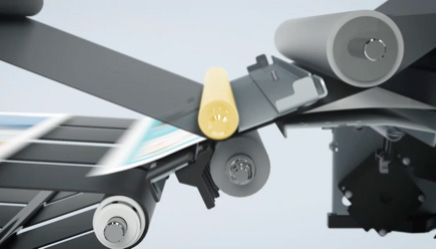
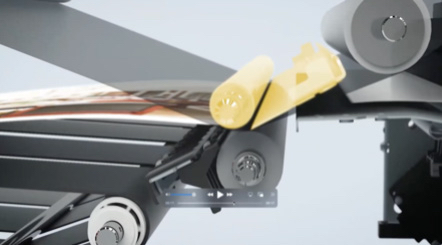
To help optimize imaging, the imagePRESS V family uses Dynamic Transfer technology, where they replicate a transfer roller to support lightweight media and a blade moves down automatically where it can replicate a transfer belt to support heavy weight stocks. This technology is designed to help you get reliability for lightweight papers, and optimal toner transfer on heavyweight papers.
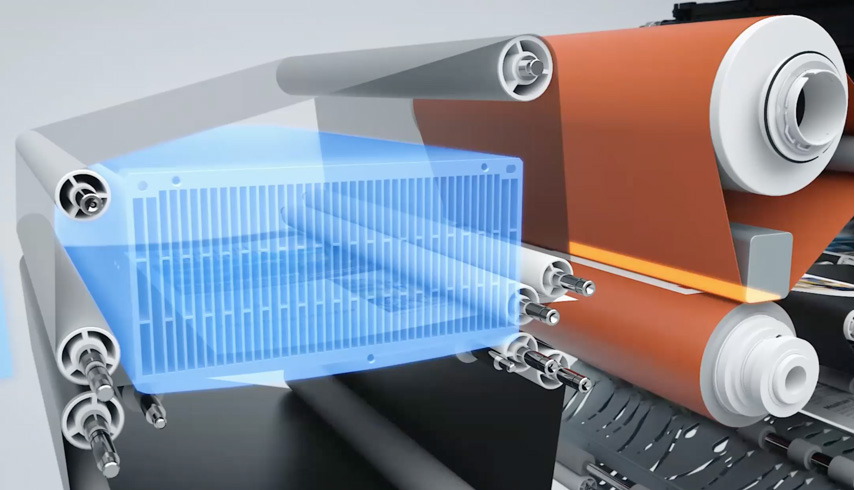
One of the other media control technologies incorporated is the Cooling Unit. Since toner bonding to media is a heat-driven process, digital presses need to cool the media down for subsequent operations, whether that be duplexing or exit and finishing. The imagePRESS V family uses what is in essence a heat sink which absorbs about 30% of the residual heat in the paper without the need for chemicals or additional energy consumption. This helps with minimizing paper curl on thin stocks, and “bricking” when printing on heavy and coated stocks, helping to provide a consistent finishing process.
These registration and media handling technologies are designed to provide consistency throughout the job and from job to job. They also address a wide variety of supported finishing options.
Production Printing for Today and Tomorrow
Canon introduced their first digital color toner presses, the entry-level imagePRESS digital press, in 2006, and they have been developing and manufacturing digital presses with new and innovative features ever since. As a result, they are one of the global leaders in production digital printer manufacturing. The latest imagePRESS models, continue to be built on existing and new engineering developments that make them high-quality and high-performance presses that address customer needs for today and tomorrow.