On Sunday, June 29, Landa Digital Printing filed for a Title 10 reorganization plan in Israel. As part of Landa Digital Printing’s reorganization plan, the company is requesting a stay of proceedings from the court to exhaust the significant negotiations now being conducted with strategic parties.
For a company that excited the crowds at drupa 2012 with the latest venture, Benny Landa focused on a new printing technology called Nanography, offering a glimpse into a new way of producing print, not as just analog or digital. How did they get here?
The anticipation of this new technology was great. However, with the previous experience with the development and introduction of Indigo, prior to selling it to HP, the Landa team realized that this was going to be a much bigger effort than any of the very experienced team expected. Ultimately, there was a big spread between the concept and the execution. They realized that, when you are pushing the envelope on material science, data rates, jetting rates, speed, quality, etc., there are a lot of moving parts that need to be addressed. So instead of shipping product, they went back to the labs in Rehovot, Israel, to address outstanding issues and use the feedback they received at drupa, subsequent visits to printing businesses, and a few beta sites around the world, to refine the functional design.
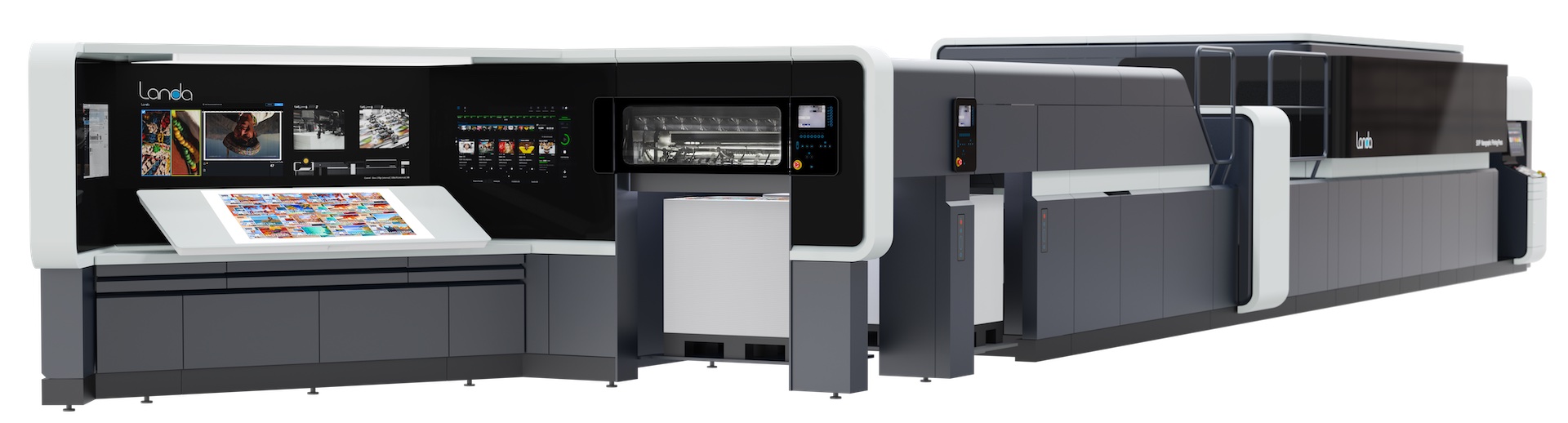
So now, a little over 13 years after the initial introduction of the Landa Digital Print technology, Landa now has a mature and proven technology platform, with more than 51 Landa presses installed in 14 countries around the world. More than 20% of their customers have placed a repeat order for a second or third press.
The Advantages
Landa Nanotechnology is the core of the press technology, so it is the best place to start. If you have been following my writings on production inkjet, you know that there are significant obstacles to overcome in order to reach the ultimate goal of offset replacement. Probably the most challenging is getting ink to adhere to, and sit on the top surface of, the media. Of course, the main problem is that inkjet inks have a liquid carrier component, whether they are water- or solvent-based. To date, we have seen press manufacturers focus on preparing the media, either through treatment at media manufacturing or pre-treatment as a flood or spot coat in line with the print engine. Of late we have seen new developments in components as well to quickly set the ink on the media without drying in the printheads.
In addition to the ink characteristics, Landa uses a unique imaging approach, jetting the ink onto a heated transfer blanket, drying the ink on the blanket, and then transferring the dried image to the media. By jetting the ink onto the specially designed transfer blanket, they are able to overcome the inability of inkjet’s adherence of the ink to a variety of media surfaces. The abrasion-resistant laminated layer is then transferred onto virtually any paper or plastic without penetrating the surface, leaving no residual ink on the blanket. The image instantly bonds with the media and since there is no water at that point, the image can bond to almost any media, and reduces the speed constraints experienced by the other cut sheet production inkjet vendors.
The quality of the print is also affected by this process because there is no surface penetration as in inkjet or spread as in conventional offset. This provides a level of clarity and detail not available in either of those technologies, regardless of resolution.
Software Is Integral
When you look at the DFE (digital front end) of digital and now even offset presses, they perform an increasing number of functions. At a minimum, they process the incoming files and send it to the imaging engine. Today’s DFEs can also offer some additional control of the print hardware, in the case of Landa, this is tightly integrated from the workflow to the press functions. In essence, it is computer-driven.
Landa has partnered with Fiery to develop and supply the DFE for its presses. While Fiery has been developing and integrating its DFEs into digital printers for years, the demands of the Landa presses presented lots of new challenges. The essence of these challenges is that the data storage and RIP processing demands of these presses push the limits of the state of currently available technology.
The Landa Press software can be—and is—updated almost every month, so people don’t need to wait that long to have 20 issues addressed. That includes updating Landa’s Active Quality Management (AQM), an inline, closed-loop quality control system with automatic correction for registration, nozzle failures, etc.
Development Continued
A year ago at drupa 2024, Landa came to the event with the tagline is “Print More,” with the introduction of new “faster and smarter” presses. They introduced the next generation S11 simplex B1 press supporting a wide range of media thickness from 2.4-point to 32-point (60–800 grams). Unlike majority of inkjet presses, the Landa offset inkjet technology advantage is that it can run a wide variety of media, including paper, plastics, etc. The new Landa S11 and S11P models include a new ink drying system that enables transfer of dry ink from the blanket to the media. The new presses offer a PrintAI module which enhances print quality and ensures a perfect fit for even the most demanding folding cartons and commercial print applications requiring micro text and other brand protection features including elevating productivity to 11,200 sph.
In an effort to increase press production and the speed of installs, they moved to a more efficient production model with the imaging engine developed and manufactured in Israel and the transports coming from Komori, shipped directly to the customer site for assembly. This allowed them to decrease costs and increase their manufacturing capacity to keep up with increasing demand.
Built On the Relationships
Sometimes it’s not easy for people to grasp what is it that Landa offers and what makes them different. They may not understand how dramatic the change can be for them having this press installed vs. another type, yet they can be installed right next to each other.
This technology opens new markets and new boundaries all the time. To address this they assigned FSEs (field service engineers) to their customers and assigned an account SM (success manager). While the field service engineers are focused on keeping the press running, making sure that people are trained, they have as the first line of support the account success managers who are basically overseeing the performance of the technology at the site. In other words, they make sure that the customer is successful.
This model for scaling to the growth is based on building a cluster of a service organization in a sub-region. As their customer base grows, it is necessary to scale the staffing, and it seems that the service organizations supporting these increasing installations are growing very nicely as well. As a result, Landa has seen growth in new customers and repeat orders, many potential buyers remain cautious due to the high investment required and ongoing geopolitical and economic uncertainties.
So How Did They Get to a Title 10?
The unit price of Landa’s presses is between $3.5 and $4 million, so even slight fluctuations in customer acquisitions have a significant impact on revenue. While consumable sales have been fairly steady, the print industry as a whole has seen a drop off in capital equipment sales since the beginning of the year. Add to that the global economic uncertainties, tariffs and international shipping costs and delays have also disrupted operations and added to financial strain, compounding operational difficulties.
2025 has been especially challenging for many Israeli companies. The war has put a unique strain on them since more than 25% of the Israeli workforce has been called up for extended reserve duty. So the company’s revenues are not sufficient to cover its substantial operating costs, which were nearly four times higher than its average monthly revenue in the first five months of 2025.
In addition to the costs of the long development cycle and lag to initial sales, each press costs more to build than the price at which it is sold. Like many digital press manufacturers, Landa expects to build revenue and profit on consumables (ink) and recurring maintenance revenues. However, this means that, even before accounting for marketing, research and development, or overhead, every machine sold results in a loss at the gross margin level.
Landa Digital Printing has had more than $1.3 billion invested in the company to date. The $1.3 billion figure is confirmed by recent financial reporting and company statements as the total invested capital, including all rounds and ongoing support from key stakeholders, also including more than $220 million from founder Benny Landa himself, as well as substantial investments from secured creditors and other major investors including the Rausing family who owns Swiss based Tetra Laval (Tetra Pak), and at least $435 million across two major funding rounds (primarily from Altana and Skion, both linked to Susanne Klatten). This figure does not account for the full cumulative investment since the company’s inception. On May 22 of this year, Susanne Klatten turned over the leadership of her companies to her offspring, who decided they no longer wanted to fund Landa Digital Printing growth.
Unlike many new tech startups (think AI), where there is an expected high burn rate to get it off the ground, the market opportunities for press manufacturers may be stable but don’t offer the same upside return on investment. However, they do have unique technology offerings and a book of IP for continued development when things stabilize. In order to increase revenues, while many printers can see the advantages of acquiring a Landa even with lower monthly volumes, Landa is looking at more targeted equipment sales that will have more significant consumable sales.
Conclusion and Futures
At the beginning of the year, Landa Digital Print had about 500 employees working around the world, many of them dedicated to development of technology—software engineers, hardware engineers, mechanical engineers, chemists, etc.—and many in customer-facing positions—field service engineers, experts, account success managers—and all work to ensure and support customers’ growth and success worldwide. They are operating today directly in China, Europe, and North America.
As a part of the reorganization, the employee positions that have been reduced are mainly from headquarters operations and development. They expect that at the end of the reorganization process they will be down to about 250–300.
As for the future, there are two parallel tracks currently in due diligence. One is with a strategic partner that has synergies, and the other is with a financial investor. Oron and Landa Digital Printing are currently pursuing both to ensure that they can make the best decision for the long term ongoing growth of Landa Digital Printing. While these things can take time, he believes that they are a few months away from an exit from the Title 10 reorganization and a new beginning.
More to Come…
2025 is moving at an increased pace. I would like to address your interests and concerns in future articles as it relates to the manufacturing of Print, Packaging and Labels, and how, if at all, it drives future workflows including “Industry 4.0 and 5.0.” If you have any interesting examples of hybrid and bespoke manufacturing, I am very anxious to hear about them. Please feel free to contact me at [email protected] with any questions, suggestions, or examples of interesting applications.