Background
Over the course of the last six articles in this series, I have highlighted the components of an intelligent workflow infrastructure for print and packaging. I have not highlighted any specific equipment since that would be specific to a providers products and markets. In fact, an intelligent workflow infrastructure should be designed to support an almost infinite selection of equipment and processes to ensure a future-proof design.
I intentionally designed this as a series, since I believe it is the best way to present this topic in a way that can be used as a resource as you look at the present and future of your business. Here are the links to the other “chapters” in order of their appearance. If you haven’t been follow the series, it makes sense to start at the beginning.
Intelligent Workflow Infrastructures: Preparing for Today and the Future
Intelligent Workflow Infrastructures: Roll Up Your Sleeves
Intelligent Workflow Infrastructures: Single Source of Truth
Intelligent Workflow Infrastructures: Can’t Ride Until You Board
Intelligent Workflow Infrastructures: It’s All About Data
Intelligent Workflow Infrastructures: Tying It Together
In this last and final article of this Intelligent Workflow Infrastructure series, I will take a forward look at where this all seems to be going.
Ultimately It’s About the Supply Chain
As print and packaging service providers, we tend to look at what we do somewhat myopically. It is totally understandable since delivering on shifting markets and changing expectations while still getting product out the door on time is a huge focus and a challenge unto itself. However, the reality is that print and packaging manufacturing is just a part of a much bigger and wider supply chain.
That may seem more obvious in packaging, since you can probably envision product design and manufacturing through converting, delivering, and, ultimately, purchasing by the consumer. However, even in business communication, display, etc., there is at least a value chain and in many cases a supply chain as well.
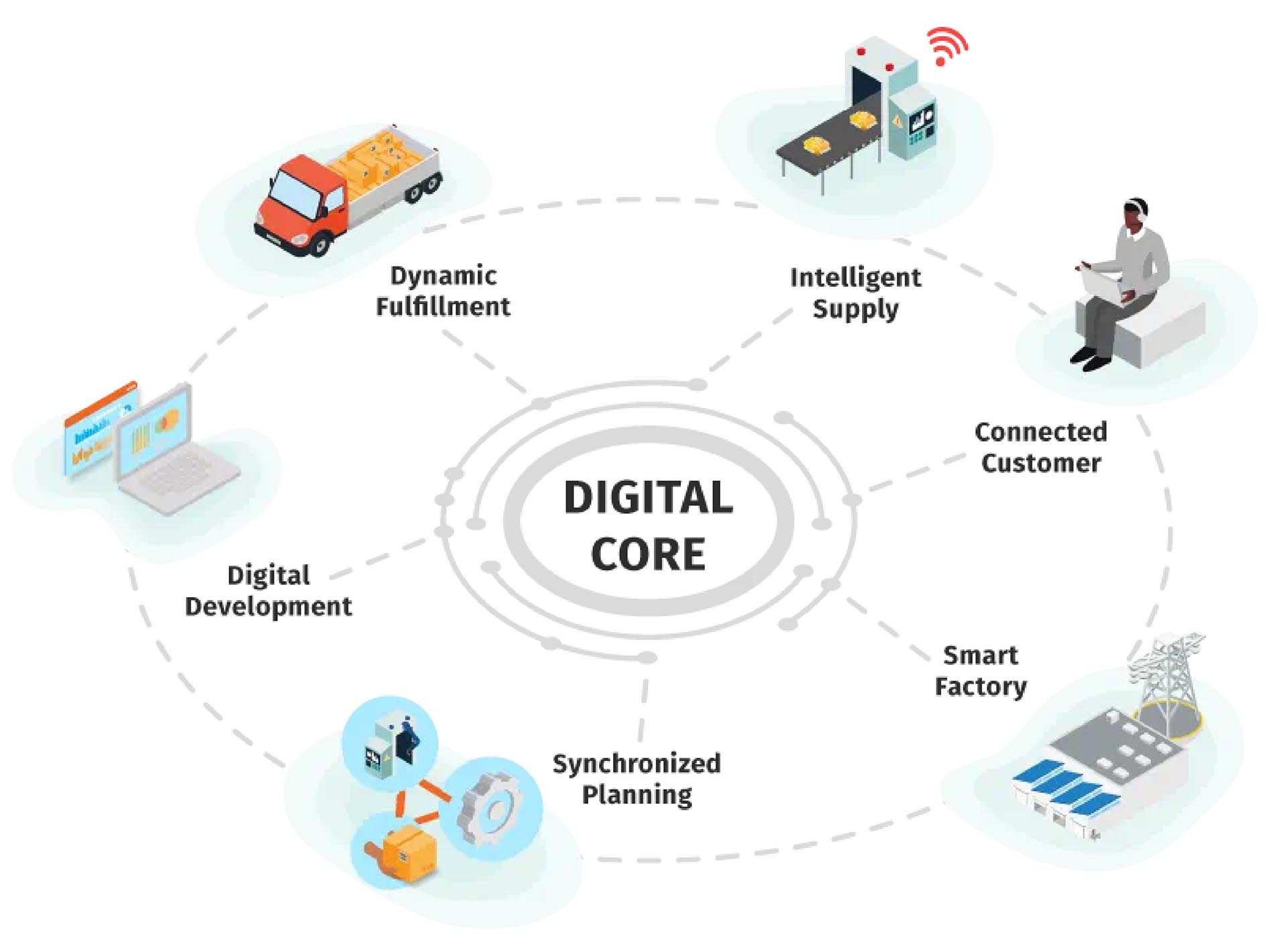
Why is this important? While there are many market and technological changes that affect the print and packaging industry, these same types of changes are permeating through almost all industries and affecting the participating companies. Companies and even consumers are increasingly moving from very analog processes to digital data-driven processes. Connecting and/or sharing this data is what will bring siloed companies and process automation to the entire supply chain.
© Hitachi Solutions
The Drivers
The great resignation and aging out of the baby boomer generation has created many opportunities and challenges. The opportunities are evident in that it opens the door to a younger workforce. The challenge is that the skills that were developed and maintained by that retiring workforce usually take years to develop.
Fortunately, the new digital and digitized manufacturing equipment and processes help reduce some of those previously needed skills and streamline many of the processes as well. Furthermore, they help engage an emerging workforce that may mistakenly assume printing is an old and dirty industry. However, as we covered in the previous articles in this series, to truly take advantage of these new developments, the individual processes need to be connected and the data shared.
The cloud and its growth have become the platform for the connection of these disparate participants in the supply chain. With this, we are finally able to bring real-world experiences to machine learning and ultimately use that as a base for AI-driven supply chains. As I have previously discussed, it will ultimately be a combination of intelligent automation (IA) and artificial intelligence (AI) in combination to achieve the maximum advantage.
John McCarthy, widely recognized as one of the godfathers of AI, defines AI as “the science and engineering of making intelligent machines.” However, at its core it is about making systems that can mimic human intelligence and/or behavior. We regularly speak of automating processes, when the reality is that much of this automation is a simple form of IA. In the automation process, we design process decisions based on pre-determined sets of data and/or instructions (if, then, else, e.g.).
Most of the true AI that we see today in print and packaging systems are based around machine learning (ML). In ML, the machine or software has the ability to modify its behavior dynamically when exposed to more data. The “learning” part of machine learning describes the ML algorithms which attempt to optimize behavior along a certain dimension; i.e., they usually try to minimize error or maximize the likelihood of their predictions being true. Taking it one step further, systems like Amazon AWS and Microsoft Azure have developed data science-based cloud platforms and frameworks specifically designed to increase the amount of available data and algorithms’ “deep learning.” By expanding the amount of collected data used to compare against and make predictions, it increases the likelihood of the decisions being true.
IA and AI in Practice in Print and Packaging
Various levels of IA have been included with many of the hardware and software systems currently available, usually in the form of rule-based decision-making. Although AI as a result of ML enhanced by deep learning, platforms like AWS and Azure are now starting to become available. Today, they are usually in the form of business system enhancements, like estimating, CRM, and some limited production optimization.
BOBST introduced BOBST Connect, their vision for an infrastructure platform for packaging converters and their value chain, with a longer term goal of connecting to a full supply chain. The concept is designed to provide inter-operability with a converter’s customers’ manufacturing execution systems, cloud-based platforms from other partners, and plant-level platforms through the use of APIs. Initially, it is focused on connecting the production hardware data and a few processes like job submission, remote maintenance, and value chain production data availability, although they envision a much broader implementation. Recent features will include centralized job and production setup and monitoring, process optimization, and performance benchmarking.
The Data Challenge
All of this is exciting, but it requires consistency of data. Today, this is a challenge, although there are two new solutions that have been developed to address it which can be implemented. These are the Unified Printing Taxonomy and Processing Steps.
Unified Printing Taxonomy
As an industry, while we may produce different products, we all share most of the same complement of technologies, yet there is no standardized common language for much of it. Taking it even further, as a result of the increased segmentation of application and use, trying to collect a useful cache of machine learned data as a base for AI is a challenge at best. The inability for printing customers to easily and consistently search and discover ever-expanding print options, the inability of the Department of Labor Statistics or the Census Bureau to comprehensively roll up print market data or drill down for more details, and the difficulty to calculate the full economic contribution of the printing industry to the economy have allowed the narrative of the value of print to become distorted.
A Taxonomy is an open standard of classification that allows anyone to quickly roll up or dive down into details of a given industry. A taxonomy allows the user to quickly find and identify assets using a single global, consistent way of defining them. Standardized taxonomies are widely used across a multitude of industries. An example would be the National Library of Medicine’s Medical Subject Heading (MeSH) used for indexing, cataloging, and searching of biomedical and health-related information.
The Unified Printing Taxonomy (UPT) is a comprehensive, standards-based classification system built to align how products, services, and technologies are described across the global print and graphic arts industry. It has been created by PRINTING United Alliance in partnership with top industry leaders. The primary goal is to create uniformity of nomenclature, which helps discoverability of content and information online, at events, and across the industry. Using the same names and definitions in the same way will allow printers, OEMs and suppliers, and everyone else involved in printing to utilize a common “language” that eliminates some of the confusion that currently exists. It will also be very useful in providing statistical tracking and analysis across the industry in a more coherent manner. Unified terms improve machine learning, chatbot accuracy, and recommendation engines by creating cleaner, more structured data for training and NLP applications. As print and packaging becomes more global, printing commerce, marketing and buying of print becomes ever more virtual, making the need for a printing industry standard taxonomy is even more critical.
Processing Steps: Going Beyond Print Content
In the more than 23 years since its founding, the Ghent Workgroup (GWG) has done a lot of work primarily directed at developing the foundations for Intelligent Workflows for print and packaging. As the market requirements and technology developments evolved to include more digital and digitalized processes the group expanded its scope. It now includes commercial print, digital print, sign, display, and packaging workflows for print and packaging with the ultimate goal of facilitating best practice workflows for each of those industries and, in the end, Intelligent Supply Chain Automation.
To drive this, the development of standardized process communication beyond content, identified as Processing Steps(PS), has become a strong focus. The initial development was targeted at the more complex production of packaging and labels. What you see on the label or package is usually more than just print. Minimally, there is at least some varnish and perhaps a die outline. However, once you start to look deeper into the entire process, you begin to realize how much more needs to be identified and managed.
Underlay colors like opaque white on foil or other flexible media, structural information beyond the die outline, and scoring, embellishment, stamping, folding, and gluing are all important process functions. Historically, designers have used different colors and randomly named layers to communicate this information, but as in the case of versioning, there were no standards or best practices to support this. Therefore, the existing workflow processes do not support ease of use, interoperability or automation.
The development of PS also supports other areas that include global accessibility requirements—for example, Braille—which is increasingly being mandated on certain types of packaging. Additionally, as the complexity of requirements for packaging and non-packaging print processes increases with the use of security features and interactivity tools like holograms, NFC, etc., the number of inherent variables will only increase and become a more important part of packaging design and production processes.
PS combined with standardized naming, and the ubiquitous nature of PDF and availability of PDF-based workflow tools, offer the potential for much more interoperable, automated, and secure workflows across many, if not most, print and packaging applications as standardized data bridge to an Intelligent Supply Chain.
Exciting Times Ahead
Like many other industries, print and packaging is at the cusp of some big changes. Nothing occurs overnight, and often the hype outweighs the realities. However, the demand is growing and the pieces are falling in to place. While an Intelligent Supply Chain seems like a big lift for our print industries, it has already started.
More to Come…
I would like to address your interests and concerns in future articles as it relates to the manufacturing of Print, Packaging, and Labels, and how, if at all, it drives future workflows including “Industry 4.0 and 5.0.” If you have any interesting examples of hybrid and bespoke manufacturing, I am very anxious to hear about them as well. Please feel free to contact me at [email protected] with any questions, suggestions, or examples of interesting applications.