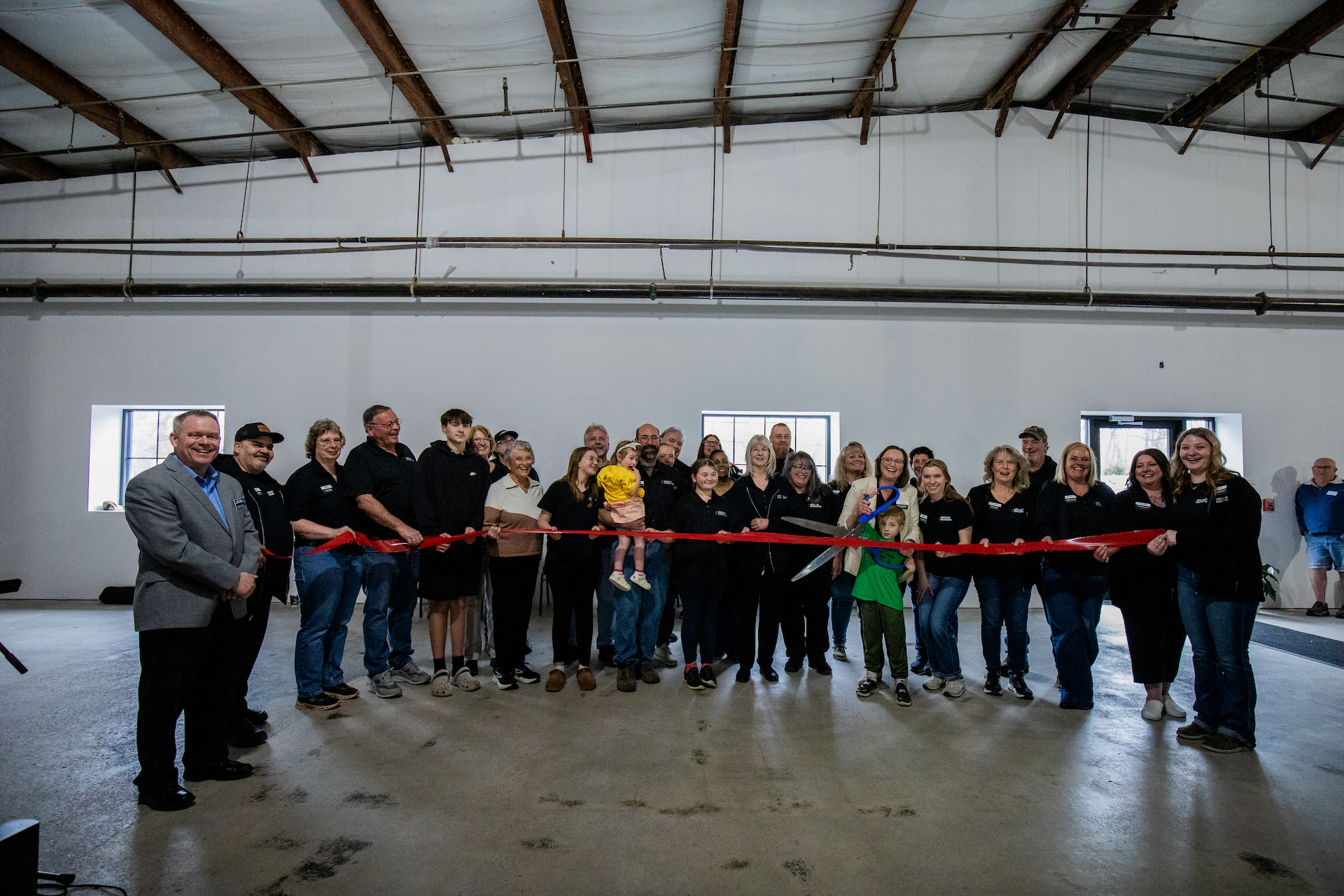
Crystal Violette, instructor at Regional Career & Technical Center (RCTC) at Coventry High School, Coventry, R.I., and her students
One of the many good things about the alliance between PGAMA and PGCA is the continuing lease on life that it gives to Print[ED], a nationally recognized school accreditation program that has been enriching the quality of education for careers in graphic communications for almost 40 years. By inheriting Print[ED] from PGAMA, PGCA will be able to promote the program not just to schools and educators in its membership region, but to eligible participants everywhere.
The message will be that the industry has its own powerful tool for assuring high standards of training at high schools and junior colleges in the skill areas that are most essential for new employees to possess. Businesses that hire graduates of Print[ED]-accredited programs get motivated people with a full set of basic skills and a built-in understanding of how production works—a grounding that often takes months for employees without the benefit of Print[ED] training to acquire.
Mike Vares, PGCA’s Director of Development, started working with Print[ED] when he joined PGAMA five years ago. “We're a national accreditation program for high schools and post-secondary college programs, basically saying, these guys know what they're doing,” Vares states. “They are teaching up to date, consistent competencies and curricula for printing and graphic communications across the country.”
Already Up to Speed
Because Print[ED] accredited programs and curricula reflect what the industry believes students of graphic communications should be learning, graduates of Print[ED] programs get a fast break from the gate when they enter the job market. As Vares explains, “if they were to leave either their program and go into a job on day one, or if they were going to college to pursue a degree there, they can walk in and say, I already have this base set of knowledge.”
Schools can earn the Print[ED] distinction by demonstrating that their teaching programs come up to the benchmarks that the Print[ED] methodology applies. These have been developed over many years by experts in trade associations and research foundations with deep knowledge of both the technology and the business of graphic communications.
Print[ED] currently offers accreditation to school programs in six skill areas: Introduction to Graphic Communications; Graphic Design; Digital File Preparation and Output; Digital Production Printing; Offset Press Operations & Bindery and Finishing; and Screen Printing.
Vares says that a goal for 2025 is to develop new skill areas such as wide-format output for signage and fabrication “because that is such a growing part of our industry.”
Print[ED] identifies six operational and administrative standards as the baselines of an accreditation-worthy training program. A program seeking to become accredited must show that it can meet these standards in the classroom and teach at least two of the six skill areas, one of which must be Introduction to Graphic Communications.
Straight to the Core
Curricula seeking accreditation must also align with the competencies that Print[ED] has defined for each of the six skills areas. The competencies provide frameworks for the learning outcomes that Print[ED] expects the schools’ programs to achieve. Vares says that as long as the coursework imparts the core knowledge that students need, how the material is presented is up to the instructor.
“Our goal with the competencies is to give the instructors a road map on the core subjects of what needs to be taught, and the freedom to teach it the way that they want.” Vares adds that instructors need to cover only 85% of the competencies for a skill area if they so choose. “This gives the instructor the ability to focus more on certain areas they ?nd more prudent for their students,” he says.
Accreditation begins with completing an application for review by the Print[ED] team. The program then has 12 months to complete the process. A team of industry professionals conducts a review of the Standards and final evaluation, and if accreditation is granted, the program holds it for five years until reaccreditation is required.
Achieving Print[ED] accreditation used to mean accumulating volumes of hard-copy documents in ring binders. This is no longer how the process works. As Vares says, “we've converted everything to a digital file format. We tried to consolidate a lot of the redundancies that were part of the original accreditation process.” Vares says digitization has cut the completion timeframe from 12 months to an average of four to six—and in one case, to just two.
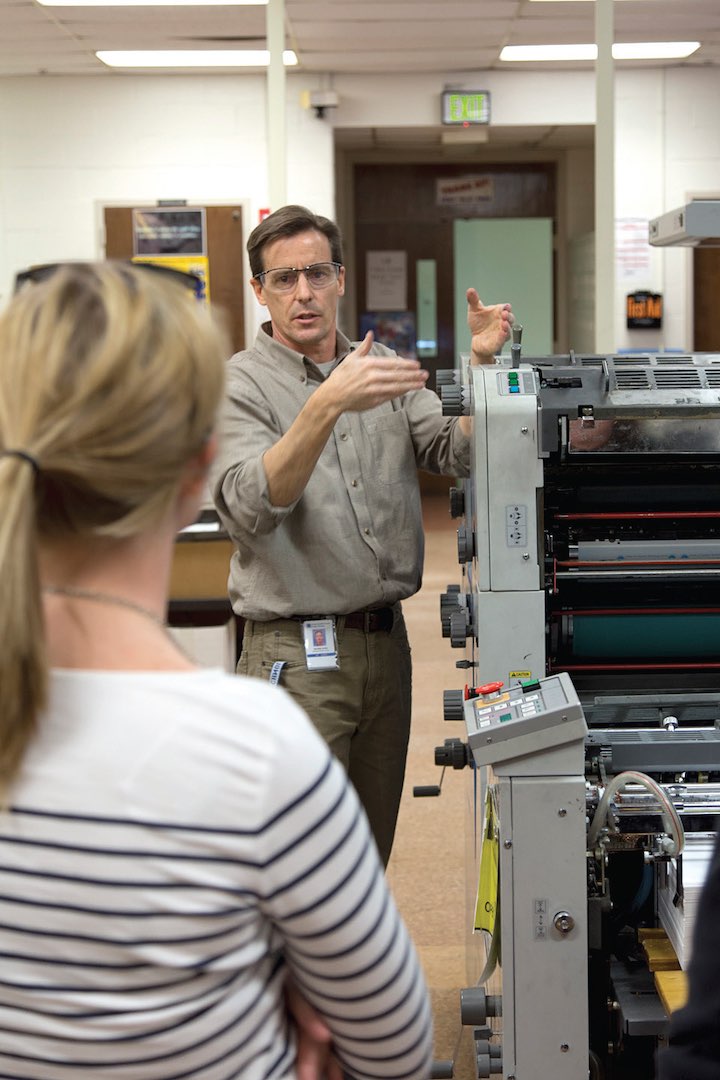
Michael Born, instructor at Center for Applied Technology North, Severn, Md., teaching Offset Press Operations
Keeping the Credential
Once accreditation has been earned, it isn’t administratively burdensome to maintain. At the five-year mark, the Print[ED] team looks at the instructor’s record of professional development, updates to the curriculum, additions of classroom equipment, and the program’s budget. But the entire wheel of accreditation does not have to be reinvented as it did in the past.
“Our main goal is to make it easier on the instructor to be able to get through this so they can focus on teaching the students versus making sure that they have triplicates of some form that we're only going to see every five years,” Vares says.
Vares says that digitizing the Print[ED] program also has included creating an online professional learning community where instructors can share teaching materials and answer each other’s questions.
Vares points out that a school seeking Print[ED] accreditation isn’t required to have heavy-duty printing equipment on the floor, as few schools nowadays do. A small-format digital printer or a heat transfer press would be enough as long as the unit can give students an idea of what an actual production environment consists of.
“If you're teaching your students graphic design, we want to make sure that they’re getting that proper industry instruction as well,” he explains. “Safe space, margins, and bleed for example—not just learning how to run a program.”
Another benefit of accreditation is eligibility for Perkins V funding: a federal program that supports industry-approved career and technical education (CTE) programs in fields like the ones Print[ED] endorses. The money, administered at the state level, can be used to help cover the cost of classroom equipment and supplies, field trips and conferences, teacher compensation, and more.
“Still Going Strong”
Currently, about 125 programs taught by 250 to 300 instructors throughout the country are fully accredited. Vares estimates that more than 500 other programs are eligible for Print[ED] accreditation. He says that to get them interested in applying, the task will be to “get the word back out that Print[ED] is still here, we're going strong, and we're ready to shake it up a bit.”
Vares says that as custodian of the program, PGCA will use its close-knit connections with other regional printing trade groups to put “boots on the ground” in support of Print[ED] wherever eligible programs exist.
“The main thing is helping the students,” he declares. It’s important for employers to know that “if you see a kid come through your shop with a Print[ED] accreditation, you know that they're ready to go right out of the gate.”
This highlights the fact that Print[ED] accredits individual learners as well as the programs they graduate from. Students can earn the credential by taking a test of their knowledge in the program’s six skill areas. The Print[ED] competencies also form the basis of the SkillsUSA national competition in graphic communications.
“The biggest thing we hear from companies who hire from Print[ED] programs (is that the students) don't have to take that however many months training period,” Vares says. “In terms of actual production skills and things like industry terminology, they’re already tons of steps ahead on that.”
Class Is in Session
The first steps toward proficiency are taken in classrooms where Print[ED] keynotes the instruction and prepares students for the opportunities that await them in graphic communications.
At Moreno Valley High School in Moreno Valley, Calif., Ricardo Torres teaches a graphic design class built around a textbook that is correlated to Print[ED]’s skill competencies in graphic communications. He says that the class, which currently enrolls 144 students in five sections, is always popular and always full.
Torres expects to complete accrediting his program at Moreno Valley by the end of the current school year. He also teaches the subject in an accredited program at Riverside City College in Riverside, Calif. He describes the accreditation process as “pretty smooth” now that most of its documentation has been digitized. “A lot of the duplication has been taken out,” he observes.
He notes that the measurements Print[ED] uses to track student outcomes can also be used in applying for Perkins V funding, which is granted to professionally certified teaching programs.
According to Torres, accreditation has worked well for his programs because they were already teaching the content and the competencies that Print[ED] is based upon. Earning the designation also lets his students become individually certified by taking a final exam in the skill areas of their choice.
Being known as a graduate of a Print[ED]-accredited program is a “great added bonus” for students entering the job market, Torres says.
Schoolroom Is A Print Shop
Crystal Violette, an Instructor in Advertising, Marketing and Design, teaches five 20-seat classes in graphic communications in the Regional Career & Technical Center (RCTC) at Coventry High School, Coventry, RI. Her resources for teaching production include a Konica Minolta digital press, a direct-to-garment printer, a pair of embroidery machines, a 10-station screen press, along with postpress and laminating equipment.
The shop, which has qualified for tens of thousands of dollars in Perkins V funding by virtue of its Print[ED] accreditation, prints for the local police department and nonprofit organizations.
Violette first achieved Print[ED] accreditation at Coventry in 2005 and has reaccredited there at five-year intervals ever since. Over the years, she has earned the distinction in all six Print[ED] skill areas.
Violette says that maintaining Print[ED] accreditation has helped her curriculum to evolve in step with the times while keeping students grounded in print’s essential skills.
“You have to go with the flow of the industry,” she explains. “Now you have AI coming around the corner, so you have to incorporate some of that. But I try to tell the students, you can't just rely on AI to build your logo. AI is not going to know how to trap or register. You have to have the other basic skills.”
Violette measures the value of Print[ED] accreditation in the professional success some of her students have achieved since graduation. “It’s quite the list now,” she says.
Several have started their own businesses, including Zack Deus, who runs an advertising and marketing firm; and Garrett Cole, who launched a screen printing and embroidery company while he was still a senior in Violette’s program.
A Formative Experience
After graduating from Coventry in 2012 and from New England Institute of Technology in 2014, Deus spent several years as a freelancer for an agency specializing in industrial design. In 2019, he and three partners founded BLK MKT Studios*, a multidisciplinary creative agency in West Warwick, RI.
“Our main niche right now is with content creation and social media management for a lot of different local companies, specifically in the restaurant and construction industry,” Deus says. The business, which employs 10 people, offers a variety of branding and production services that include apparel, print, and promotional products.
Deus regards his Print[ED]-accredited studies at Coventry as a formative professional experience. He says the things he learned in Violette’s classes “showed me what was out there and led me down the road of eventually doing what I do now. It provided a lot of the base skills and base knowledge that were easily applied with jumping into college and then allowing me to start freelancing pretty much immediately in college.”
“It definitely gave me a leg up,” Deus observes. “I think if had I not had that opportunity, it's hard for me to say that I'd be in the same place that I am now.” He returns the favor by serving on Coventry High School’s RCTC Advisory Board, where he helps Violette and other instructors to keep their study programs up to date with trends and developments in the subject areas they are teaching.
Couldn’t Wait for the Diploma
Cole was still enrolled in the Advertising, Marketing, and Design program at Coventry High School when he launched his business in 2013. Today, High Octane Print Studio in Coventry is a full-service facility that provides screen printing, embroidery, and promotional products to businesses, churches, and other organizations in the area.
Cole credits Print[ED] training with jump-starting his entrepreneurial ambitions. He says that what he learned in the program “gave me the knowledge I needed to start my business, and it's what really inspired me to want to be involved in the industry from the start. Working in the print shop in class showed me the workflow of the print industry, from understanding work orders to fulfilling orders accurately and on time for customers.”
“This is what I really enjoyed and is what led me to be inspired to run my own print shop today,” Cole says.
For more information about Print[ED], contact Mike Vares at [email protected] or (443) 276-3146.
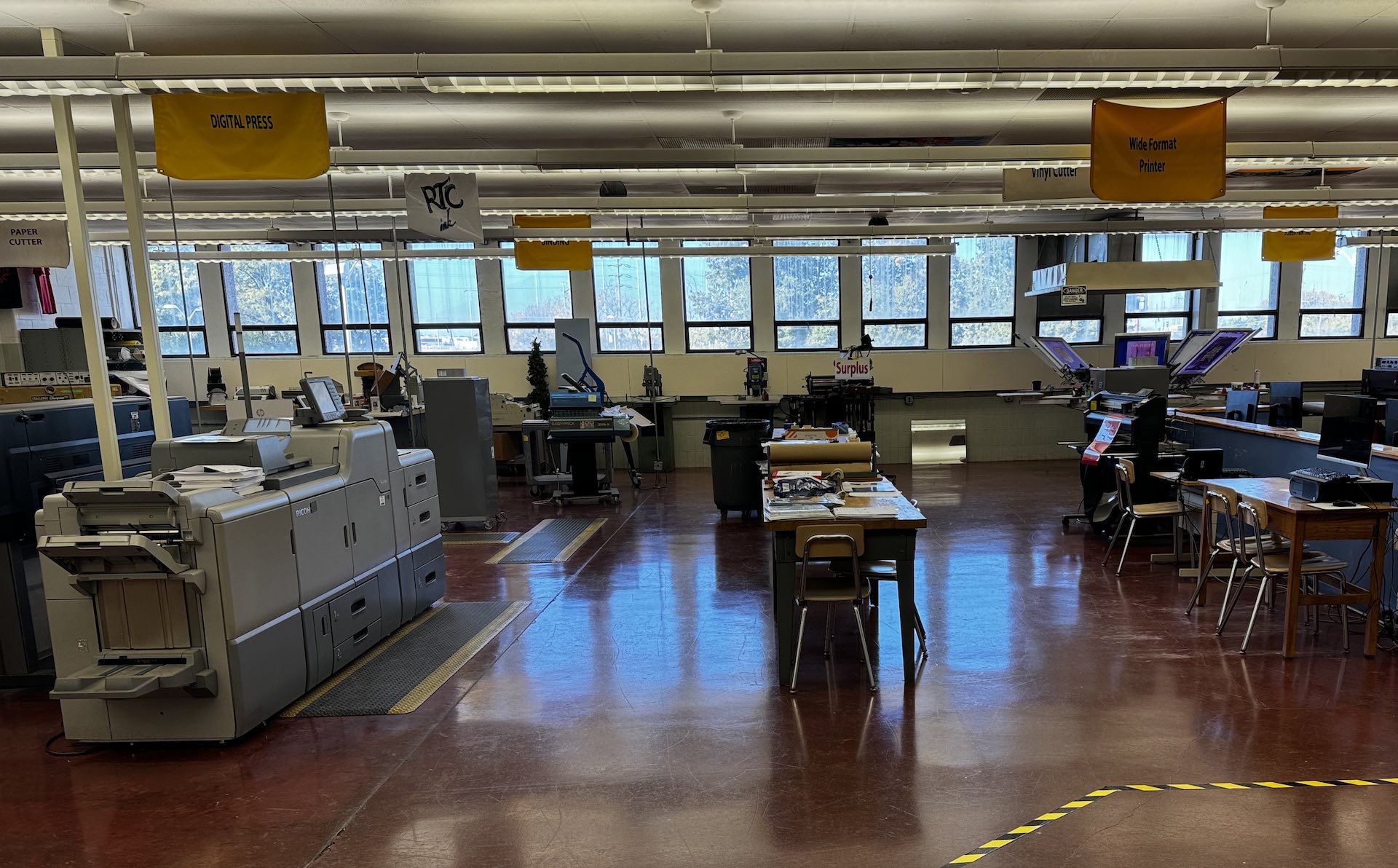
Example of a Print[ED] classroom at Richmond Technical Center, Va.