Nutella Guru
If you’re like us and we know we are, you’re very fussy about breakfast. In this vein, Boing Boing asks, “How many times have you tried to spread something on a slice of toast, only to end up with too much, too little, or worst of all, jam on your fingers?” (Yes, this is sounding a bit like an infomercial.) Anyway, if you need to get the perfect film of…your substance of choice on, say, a slice of bread, why not fill a 3D printer with Nutella?
Is it a gross misuse of expensive equipment? Absolutely not – it's a delicious misuse of expensive equipment. But Nutella is worth it, and the sheer perfection of the end product is a true thing of beauty.
We’re not sure we grant the premise, but it’s a unique experiment.
Mushroom Art
For whatever reason, we seem to be seeing more and more examples of people using plants or fungi to paint or make music, or what have you. The latest is a mushroom (an oyster mushroom, to be specific) whose bioelectric signals power a set of robotic arms that hold a set of paintbrushes and paint a picture of what is said to be a human head. Says the creator/mushroom wrangler:
This is an oyster mushroom painting. The movement of the arms and paint brushes are controlled by its bio-electrical signals. The mushroom is even controlling the rotation of the canvas. We think it's the first painting that a fungi has ever created.
We don’t know about that; there were clearly some Grateful Dead songs in whose creation mushrooms were clearly involved.
Whole Lotta Rosie
Could Rosie, the Jetsons’ robot housekeeper, be on the way to a home near you? Via Core77, Norwegian company 1X has unveiled EVE, its humanoid robot. But:
Whereas EVE was designed for industrial and commercial environments, the company has since rolled out NEO Gamma, their wheels-free ’bot designed for performing menial tasks in a domestic environment.

Core77’s Rain Noe is mildly creeped out:
Something about its humanoid form, its bland fashion sense and its motion style is unnerving. At first I thought it was its dispirited shuffling gait, but upon reflection, I wouldn't feel any better about it if it strode with confidence. It may just be that I'm middle-class and uneasy with the idea of having humanoid servants.
Oh, just wait until the revolt…
It also seems very weird to me that they let the thing sit on the couch. However, as with its gait, the alternative seems no better; what are they supposed to do, have the thing stand facing the corner? If I was forced to live with one of these, I think I'd want a dedicated closet to park the thing in. I can't imagine sitting down on a sofa to watch TV with this thing right next to me.
Depends…can it make wisecracks about bad movies?
Still, it is kinda creepy.
Let Then Eat RoboCake
If you have a wedding coming up and are in need of a wedding cake, why not try one that combines baking with robotics? (Actually, we can think of many plausible answers to that question.) Anyway, via Laughing Squid:
Researchers from EPFL and the Istituto Italiano di Tecnologia (Italian Institute of Technology) collaborated with pastry chefs and food scientists from EHL Hospitality School to create an absolutely fantastic wedding cake that combines baking with robotics. This inventive cake features two edible robotic gummy bears that dance at the top of the cake and comestible rechargeable batteries made from chocolate that light up LED candles on the cake.
The researchers add, in a passage that will haunt your dreams:
Creating edible robots also offers brand new culinary experiences.
We bet.
The RoboCake, a robotic wedding cake, is an innovative demonstration of the progress made by the RoboFood project, which aims to develop a new generation of edible robots and intelligent food.
Do we really need intelligent food? And wouldn’t “intelligent food” do whatever it could to not be eaten?
Close Calls
While in the US, the phone booth has been relegated to the annals of obscurity, in the UK, there is still a segment that wants to preserve its iconic red phone boxes. To wit, the village of Sharrington in Norfolk was told by British Telecom that not enough calls were being made with the village phone box to justify its continued support. So, via GoodNewsNetwork, the town held a drive to make the requisite number of calls (52) to keep the phone in service.
“It just goes to show you that communities can achieve incredible things when we stand together to protect what matters to us,” said North Norfolk MP Steffan Aquarone. “The K6 phone box is a lifeline in this small, rural village and, when BT said they were planning to remove it, the whole of Sharrington stood up and said ‘absolutely not’.
And they do mean “lifeline.” Given the spotty cell service, it has been needed for some important calls.
it had been used last year not only to call 911 (999 in the UK) but also by an ambulance driver to make a call during an emergency when he had no cell reception.
So:
On March 15th, residents gathered in the nippy morning air to place enough phone calls from the box to ensure BT kept the lifeline connected, which a spokesperson from the company told BBC was indeed what would happen.
Hear the Wind Sing
There are uses for phone booths that don’t involve making calls. There has emerged a type of phone booth that is constructed as a shrine to someone who has passed away. Called the Wind Phone, it originated in Japan.
The original Wind Phone was created in Japan by Itaru Sasaki while grieving his cousin who died of cancer. He purchased an old-fashioned phone booth and set it up in his garden. He installed an obsolete rotary phone that was not connected to wires or any "earthly system." Here, Itaru felt a continued connection to his cousin and found comfort and healing amid his grief. Itaru gave his phone booth a name, Kaze No Denwa (????), translated as The Wind Phone.
Over the years, others have seized in the idea and installed their own Wind Phones to commemorate departed loved ones. At present, there are 260 Wind Phones in the US, 109 internationally, and 14 coming soon, according to MyWindPhone. If you decide to install one, you can even arrange to have it listed on their site.
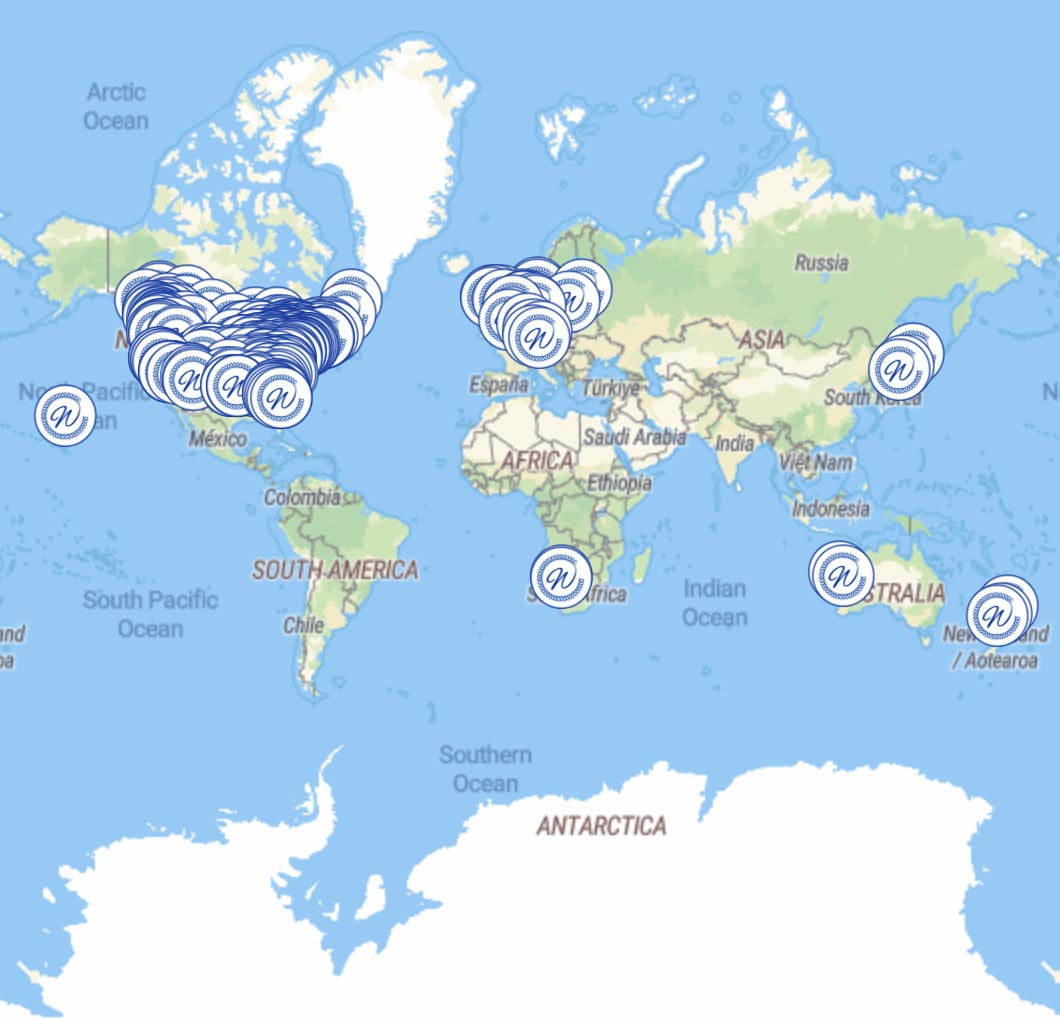
There is also a photo gallery and many other resources.

In addition to the public Wind Phones listed on the My Wind Phone Map, there are various kinds of Wind Phones. All are crafted with the same beautiful spirit of giving. These sacred spaces offer grievers a place to visit, find peace, and begin the healing process.
Ni!
One of the classic comedies of all time is Monty Python and the Holy Grail, and while we have always preferred Life of Brian out of the three (arguably four) feature-length films in the Pythons’ oeuvre, you really can’t beat Holy Grail for complete, unabashed silliness. From faux-Swedish subtitles in the opening credits, the Trojan Rabbit, the Knights Who Say “Ni!,” the Holy Hand Grenade of Antioch, the Killer Rabbitt, the ongoing debate about whether swallows are strong enough to carry coconuts, and of course the Black Knight and his “only a flesh wound.” Anyway, released in 1975, the film is celebrating its 50th anniversary this year and the BBC has a look back with Pythons Michael Palin and Terry Gilliam.
“We had to do something that used all six of us,” says Palin, “and of course the Round Table was the perfect template for that because we could each play one of the knights. And also because the Holy Grail legend was something that everyone had heard of, but nobody really knew anything about it. You could create any sort of story based around the search for a Grail.”
… The film has, arguably, offered happiness to many others who watched it during dark times, too. The Pythons weren't on a quest for the secret of immortal comedy, but somehow they stumbled on that Grail. “I just think Python was the perfect chemical balance, the six of us,” says Gilliam. “We’re all very different, and to put those six people in the same room, and they all basically agree on what they're doing, it's an extraordinary thing. Without any one of us, it was not the same. When Graham died [in 1989], it was already changing. And with Terry [Jones] gone [in 2020]… people say, ‘Wouldn't it be great for Python to get together again?’ It would be pointless to get together again! It wouldn’t work. It was a magical chemical balance. It was spectacular.”
If you’re a big Python fan, John Cleese is touring behind the anniversary and will be introducing a screening of Holy Grail and select venues around the country.
OK…So What Is Graphene Anyway?
Was it a good week for graphene news? It’s always a good week for graphene news! OK, so this has become something of a running joke, and longtime Around the Web readers (both of you) may recall its origins in several articles Cary Sherburne wrote a couple of years ago, touting graphene as a new wonder material. Last week, Graphene-Info had a nice round up/primer on graphene, what its advantages are, and what it is being used for.
Graphene is a one-atom-thick sheet of carbon atoms arranged in a honeycomb-like pattern. Graphene is considered to be the world's thinnest, strongest and most conductive material - of both electricity and heat. All of these properties are exciting researchers and businesses around the world - as graphene has the potential to revolutionize entire industries - in the fields of electricity, conductivity, energy generation, batteries, sensors and more.
The good news will continue!
Siren Call
Could life exist elsewhere in our Solat System? This has been a perennial question for both science and science-fiction, and the jury is still out on what Mars may be hiding. But one place that always comes up on scientists’ lists of potential life-harboring locales is Saturn’s moon Titan. A new study confirms that it’s possible for life to exist on Titan‚ but incredibly unlikely. Says Gizmodo:
Titan is known for being the only moon in the solar system with a dense atmosphere, and it also has bodies of liquid, including liquid water hidden under deep shells of ice. But alas, with all that going for it, an international team of astronomers determined that conditions on Titan would only be able to sustain enough biomass to equal one moderately chunky cat.
There’s a science-fiction story that just writes itself, really. Much of what we know about Titan came from the 2005 Cassini-Huygens mission to Saturn, a joint effort by NASA, the European Space Agency (ESA), and the Italian Space Agency, and the mission included a drop-in on Titan, with the Huygens lander touching down on Titan on January 15, 2005. What Huygens found was a dense atmosphere in which organic compounds—the building blocks of life—are capable of forming. Alas:
However, just as an egg yolk is not a chicken
Dang, that explains why that dinner party was such a disaster…
organic compounds don’t necessarily indicate that life can form. To explore the possibility of microbial life on Titan, Antonin Affholder, a postdoctoral researcher at the University of Arizona, led a team to assess how likely that scenario might be. They did so by assuming that if life did arise on Titan, it would survive by one of the most primitive processes known: fermentation, in which an organism converts organic compounds to energy without using any oxygen.
…They determined that the organic compound most likely to be involved in Titan fermentation is glycine, an amino acid valuable to building protein. Glycine has been found on Titan’s surface, but scientists wondered whether enough of it could make its way to the moon’s liquid oceans. Those oceans—where life would have the best chance of surviving—are buried beneath ice that’s 31 to 124 miles (50 to 200 kilometers) thick.
Unfortunately, the amount of glycine that would reach the liquid water would only be able to support 16.5 pounds—about the weight of a very large house cat. Still…
“Such a tiny biosphere would average less than one cell per liter of water over Titan’s entire vast ocean,” he concluded.
Oh, well. Now, what’s happening on Mars?
Pastamaster General
What is the world’s rarest pasta? According to Atlas Obscura, the top candidate is an elusive noodle forged in the countryside of Sardinia. Called su filindeu, or “threads of God” in the local Sardo dialect, to make them requires stretching a mass of semolina flour, water, and salt into 256 “threads,” each barely wider than a human hair.
Historically, these labor-intensive noodles were made only twice a year for the Feast of San Francesco. They were reserved for faithful Christians who made the trek from the city of Nuoro to Lula for 20 miles in the dark of night.
The art of making su filindeu was passed down through a single familial line and, like many recipes (and old traditions in general) the number of living women capable of making the pasta declined—at one point, there were only three in the world. Paola Abraini is one of these last pastamasters.
“Our first introduction to su filindeu and to Paola was like a ceremony,” Gentile says. She arrived dressed in her best with her husband by her side holding the fondo, the tray used to dry the strands. “At the time, the tradition of su filindeu was very Old World. As it was explained to me, they can’t just teach anybody. It was a thing that was passed down mother to daughter.”
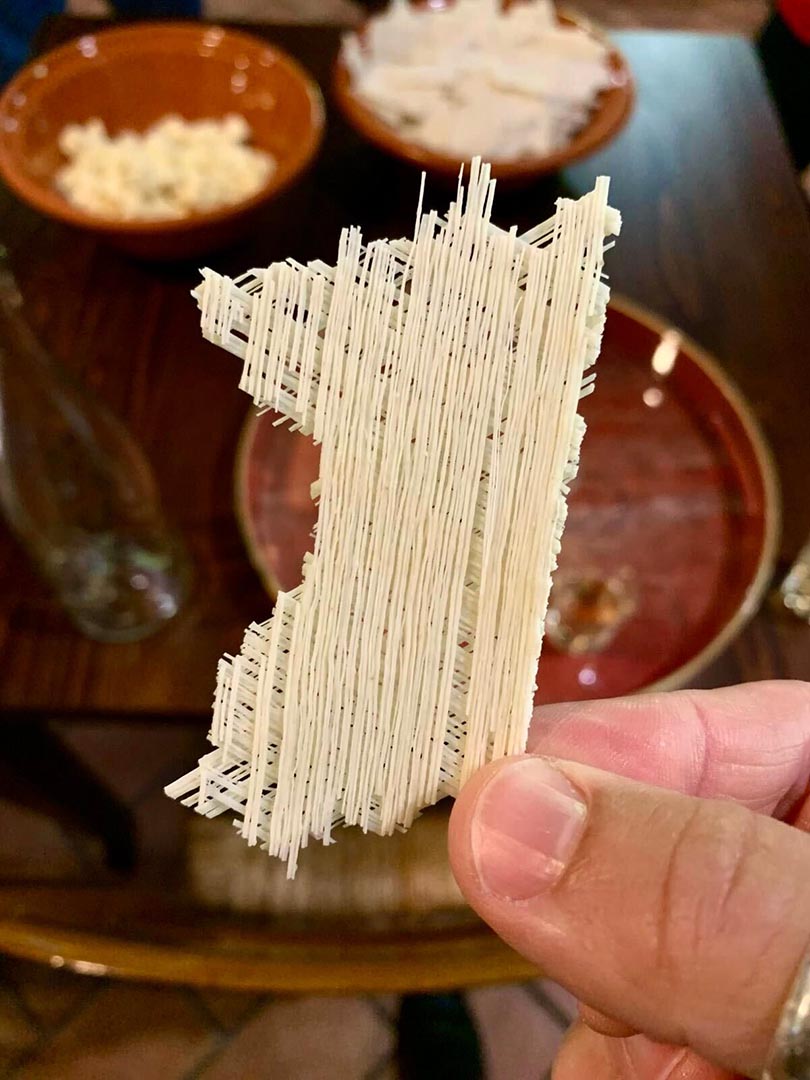
“Watching her make it is like magic,” Gentile says. “It’s such a special thing to see her do it because the amount of perfection in her movements is wild.”
Needless to say, Albini has probably never been to Olive Garden.
Under a Banana Moon
Who among us has never pondered the question, what if, instead of the moon, a giant banana orbited the Earth?
Well, live in darkness no longer, with this amusing video.
Dunked
If you’re a fan of Dunkin’ (no, not flashy basketball plays but rather the chain formerly called Dunkin’ Donuts), they have a new summer beverage lineup that (who else?) Food & Wine was going bananas over (no, there is not a banana flavor).
Two new drinks are joining the current lineup, the brand confirms, along with a new pastry. The brand-new Tropical Guava Dunkin’ Refresher is described as a “vibrant, fruit-forward sip” with B vitamins and a jolt of energy. (Medium Refreshers typically contain around 100 milligrams of caffeine.)
But wait, there’s more.
Dunkin’ also introduces the Pistachio Signature Latte, which reimagines the existing Pistachio Swirl as a creamy, espresso-based beverage. Meanwhile, the Iced Strawberry Lemon Loaf adds a fruity twist to the classic treat.
Sometimes you wonder if these product names are the result of someone playing around with one of those refrigerator magnet poetry kits.
They have also enlisted some…celebrities(?) to help spread the word.
The Massachusetts-based brand enlisted stars like James Marsden, Charles Melton, Tramell Tillman, Gavin Casalegno, Dylan Efron, and Zarna Garg to emphasize the significance of the value deal.
Call it the age gap but we have no idea who they are. Didn’t James Marsden play Spike the vampire in Buffy: the Vampire Slayer back in the 1990s? (Oops, no, that was James Marsters.) Ah, well.
The commercial positions the $6 meal deal as “cheaper than therapy” — which, for those who have fielded out-of-network bills lately, is unfortunately true.
But then they’d need physical therapy as well.
This Week in Printing, Publishing, and Media History
May 5
1809: Mary Kies becomes the first woman awarded a U.S. patent, for a technique of weaving straw with silk and thread.
1813: Danish philosopher and author Søren Kierkegaard, born.
1835: The first railway in continental Europe opens between Brussels and Mechelen.
1864: American journalist and author Nellie Bly born.
1866: Memorial Day first celebrated in United States at Waterloo, N.Y.
1891: The Music Hall in New York City (later known as Carnegie Hall) has its grand opening and first public performance, with Tchaikovsky as the guest conductor.
1905: The trial in the Stratton Brothers case begins in London, England; it marks the first time that fingerprint evidence is used to gain a conviction for murder.
1912: Pravda, the “voice” of the Communist Party of the Soviet Union, begins publication in Saint Petersburg.
1927: Semi-colon lovers’ national holiday—To the Lighthouse by Virginia Woolf is first published.
1943: English actor and screenwriter Michael Palin born.
1959: English singer-songwriter and guitarist Ian McCulloch born.
2001: American publisher, creator of CliffsNotes Clifton Hillegass dies (b. 1918).
2020: The National Telecommunications Commission issued a cease and desist order to ABS-CBN to stop the operations of its free TV and radio stations one day after their 25-year congressional franchise was expired.
May 6
1536: King Henry VIII orders English-language Bibles be placed in every church. In 1539 the Great Bible would be provided for this purpose.
1835: James Gordon Bennett, Sr. publishes the first issue of the New York Herald.
1840: The Penny Black postage stamp becomes valid for use in the United Kingdom of Great Britain and Ireland.
1862: American essayist, poet, and philosopher Henry David Thoreau dies (b. 1817).
1889: Typographer, known for work on Times New Roman font, Stanley Morison born.
1915: American actor, director, producer, and screenwriter Orson Welles born.
1940: John Steinbeck is awarded the Pulitzer Prize for his novel The Grapes of Wrath.
1949: EDSAC, the first practical electronic digital stored-program computer, runs its first operation.
1960: American singer-songwriter and guitarist (They Might Be Giants) John Flansburgh born.
May 7
1539: Italian printer Ottaviano Petrucci dies (b. 1466).
1711: Scottish economist, historian, and philosopher David Hume born.
1812: English poet and playwright Robert Browning born.
1824: World premiere of Ludwig van Beethoven’s Ninth Symphony in Vienna, Austria.
1840: Russian composer and educator Pyotr Ilyich Tchaikovsky born.
1846: The Cambridge Chronicle, America’s oldest surviving weekly newspaper, is published for the first time in Cambridge, Mass.
1952: The concept of the integrated circuit, the basis for all modern computers, is first published by Geoffrey Dummer.
May 8
1880: French novelist Gustave Flaubert dies (b. 1821).
1886: Pharmacist John Pemberton first sells a carbonated beverage named “Coca-Cola” as a patent medicine.
1912: Paramount Pictures is founded.
1920: American graphic designer and director Saul Bass born.
1926: English environmentalist and television host David Attenborough born.
1926: American comedian and actor Don Rickles born.
1937: American novelist Thomas Pynchon born.
1980: The World Health Organization confirms the eradication of smallpox. (Well, for now, anyway...)
1984: American publisher, co-founder of Reader’s Digest Lila Bell Wallace dies (b. 1890).
1985: American author and critic Theodore Sturgeon dies (b. 1918).
1988: American science fiction writer and screenwriter Robert A. Heinlein dies (b. 1907).
May 9
1911: The works of Gabriele D’Annunzio are placed in the Index of Forbidden Books by the Vatican.
1958: Alfred Hitchcock’s film Vertigo has world premiere in San Francisco.
May 10
1824: The National Gallery in London opens to the public.
1869: The First Transcontinental Railroad, linking the eastern and western United States, is completed at Promontory Summit, Utah with the golden spike.
1902: American director and producer David O. Selznick born.
1954: Bill Haley & His Comets release “Rock Around the Clock,” the first rock and roll record to reach number one on the Billboard charts.
1962: Marvel Comics publishes the first issue of The Incredible Hulk.
1975: Sony introduces the Betamax videocassette recorder in Japan.
May 11
868: A copy of the Diamond Sutra is printed in China, making it the oldest known dated printed book.
1811: Thai-American conjoined twins Chang and Eng Bunker born.
1854: German-American engineer, invented the Linotype machine Ottmar Mergenthaler born.
1904: Spanish painter and illustrator Salvador Dalí born. (Fish.)
1942: William Faulkner's collections of short stories, Go Down, Moses, is published.
2001: English novelist and screenwriter Douglas Adams dies (b. 1952). So long, and thanks for all the fish.