Lotus Position
Do you watch “The White Lotus”? No, nor do we, but the folks at Print magazine apparently do and were happy to geek out chatting with the creators of the program’s opening credits sequence about the design elements.
The best television shows feel like fully realized worlds in which we can immerse ourselves entirely as viewers. And the best opening title sequences open the doors to those worlds at the start of each episode, quite literally setting the tone for a series, establishing a language for the show, and beckoning viewers inside. When thinking about shows on air right now that do this most successfully, The White Lotus undoubtedly comes to mind for many.
The show’s third season just dropped, and creative studio Plains of Yonder again created the opening. Print spoke with the studio’s co-founders Mark Bashore and Katrina Crawford.
MB: All three seasons’ titles have a language that developed, and that doesn’t get talked about much. People just think, It’s whatever, it’s a title sequence. In season one, we pitched wallpaper, which is a still form; it’s better for print and rooms than for film. So we accidentally developed a language of making films out of still art. They animate and move a little bit, and we’ve developed these interesting slide moves in the last two seasons. Season one started us on this journey, with these wallpapers based on fictional suites in the script. We had to think, How do we tackle a season two that isn’t wallpaper but is still in the language of still art, and uses interesting, decorative metaphors? In the case of season two that was frescoes, and then on to season three.
Ship of Fools
During the First World War, naval vessels used a kind of “battleship wrapping” called “dazzle” (aka “razzle dazzle” in the States) camouflage, which involved applying geometric patterns to ships’ hulls.
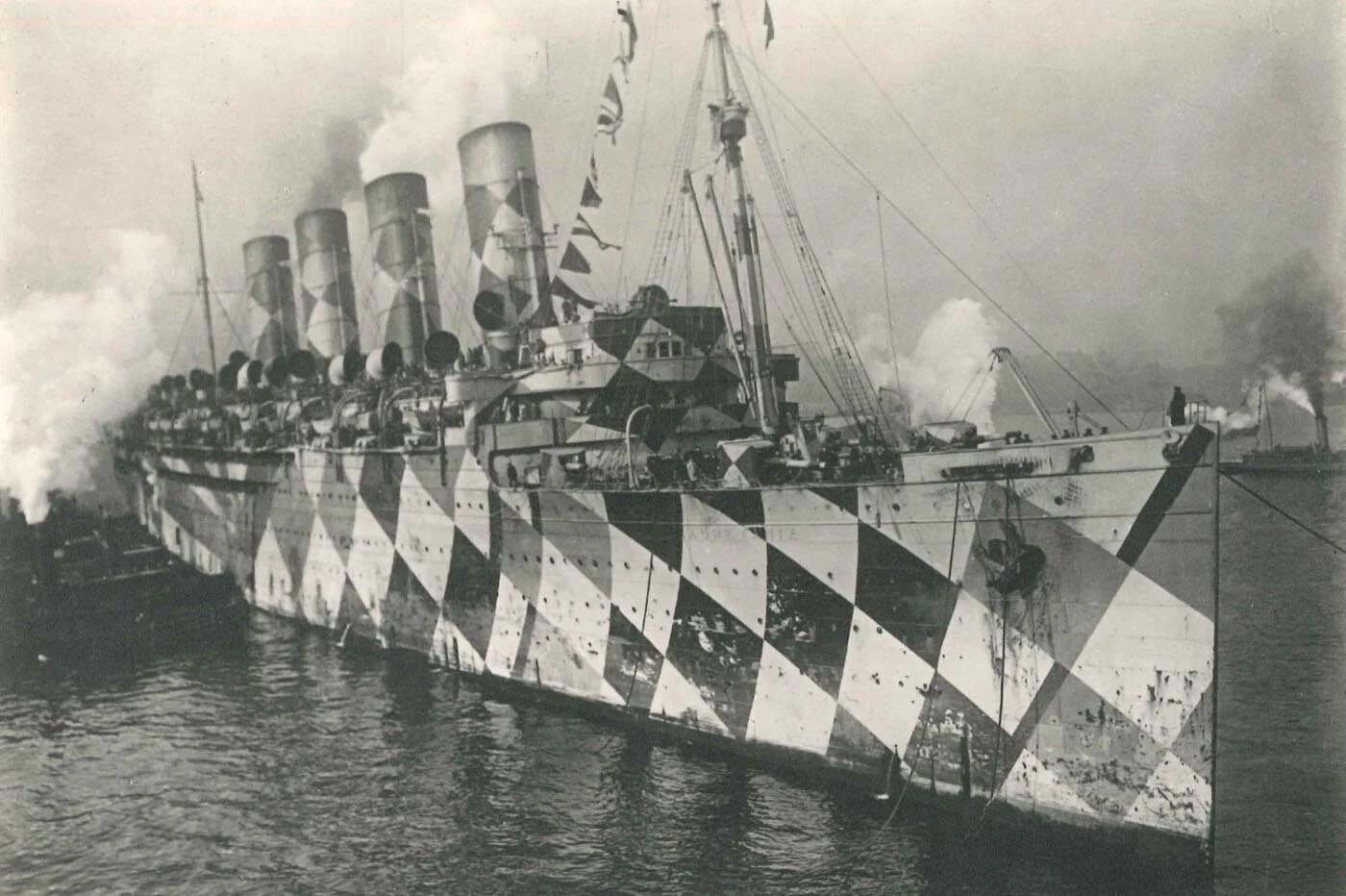
© Australian National Maritime Museum on The Commons, No restrictions, via Wikimedia Commons/Gizmodo
Now, you might say to yourself “Come on, I can see that!” But the idea behind dazzle wasn’t to conceal a vessel but rather to confuse, say, German U-boat captains’ perception of the vessel’s direction and speed, thus making it more difficult to target. It sounds (and looks) kind of goofy, but it was actually very effective. A study published in 1919 attempted to explain why it worked, claiming that it was due to due to a “twist” effect from forced perspective. But a new analysis, published March 14 in Sage Journals, calls the original study’s conclusions into question. Says Gizmodo:
According to the new paper, the unintentional “horizon effect”—when a boat seems to be traveling along the horizon, even if it’s not—was a far greater source of deception than the dazzle paint itself, exposing a key oversight in the 1919 analysis.
… If dazzle camouflage were single-handedly responsible for the visual deception noted in Blodgett’s study, viewers should have consistently seen the front of the ship, called the bow, “twist” away from the direction of travel, according to the researchers. Meese and Strong, however, pointed out that in certain instances—specifically, when the model boat was moving away from the viewer—the onlooker saw the bow “twisting” toward them. This indicates that another factor, beyond dazzle camouflage, was influencing the illusion.
Namely, the “horizon effect.” QED.
Leaning Toward Bookends
Anyone who has bookshelves knows intimately well that, in most cases, if you remove a book or two, an adjacent book closes the gap by plopping over and leaning at an angle (unless it’s a thick tome). Now, for most of us, leaning books are not a major aesthetic disaster. But one Japanese company has wrestled this problem to the ground. Via Core 77, stationery brand Lihit Lab has developed the Firm Book End which keeps books (and other book-shaped media) standing upright.
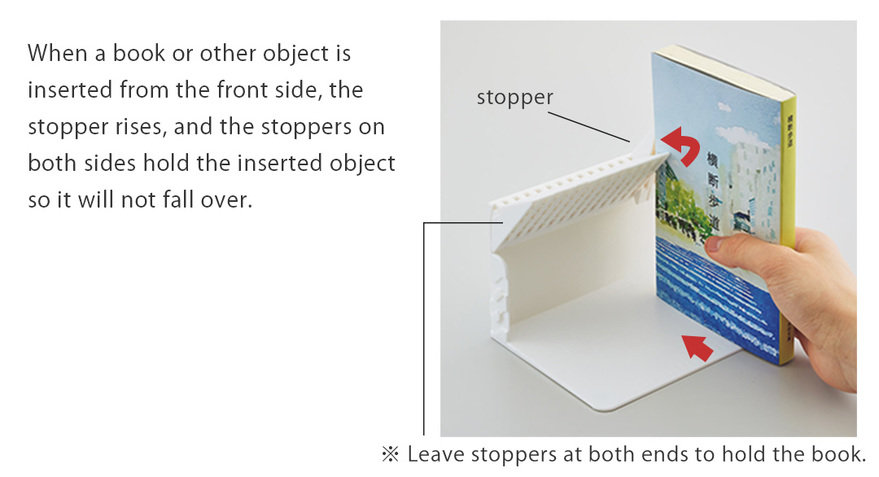
For those of us who still cling, barnacle-like, to physical media, it can come in handy:
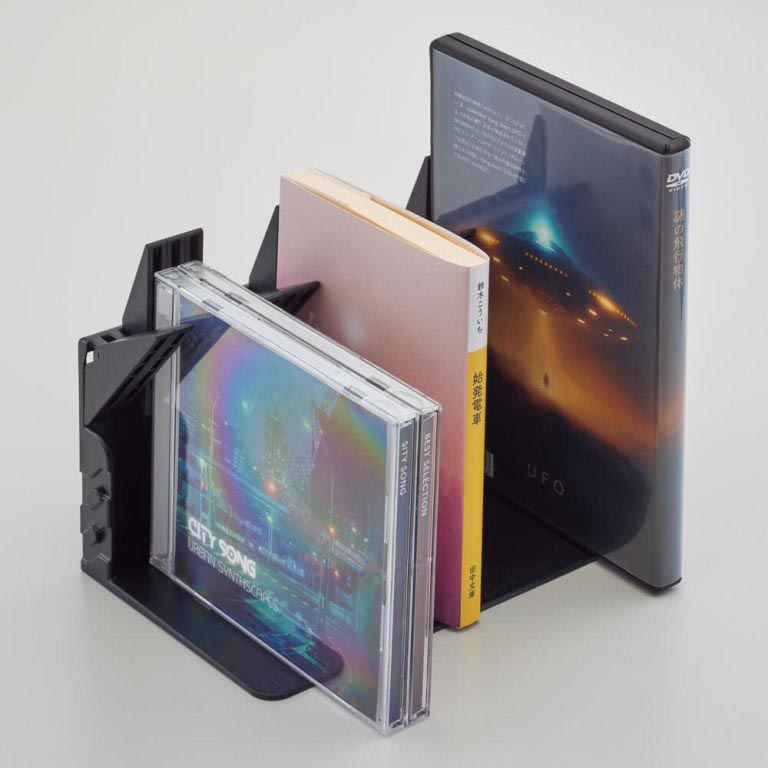
It comes in a couple of different sizes. The A5 runs ¥1,300 (USD $9) , and the A4 is ¥2,300 (USD $15).
Watch List
It seems lately that one of the most highly desired feature of an electronic device is a lack of features. Take, for example, a forthcoming line of Atari-branded watches, that do little more than simulate classic Atari 2600 games. Says the company:
Designed with Selective Tech, the My Play Watch has all your favorite smartwatch features without the data tracking and distractions. No Bluetooth and no Wi-Fi means freedom from nonstop notifications. Your My Play Watch will never update and therefore never become obsolete. Keep your fitness goals on track with the Fitness Arcade interface inspired by the 2600. The built-in fitness tracker monitors heart rate, steps, and calories burned throughout your day.
OK, so it has some features, as well as the ability to play Centipede, Missile Command, Pong, and Super Breakout. The crown and button replicate the look and feel of the classic controller buttons, whilst the rotating crown functions like a paddle controller. Oh, and it also functions as a, you know, watch. Almost forgot about that.

They will be released this summer, and you can preorder now. A steal at $80.
Watch This
Or, if you do need features beyond the ability to replicate the 1980s, try the WP200Pro 5G from Chinese manufacturer Oukitel. Via Core 77, it is a “ruggedized” smartphone featuring a shockproof casing, aluminum frame, impact-resistant glass, and reinforced rubber—and it’s also water- and dust-resistant.
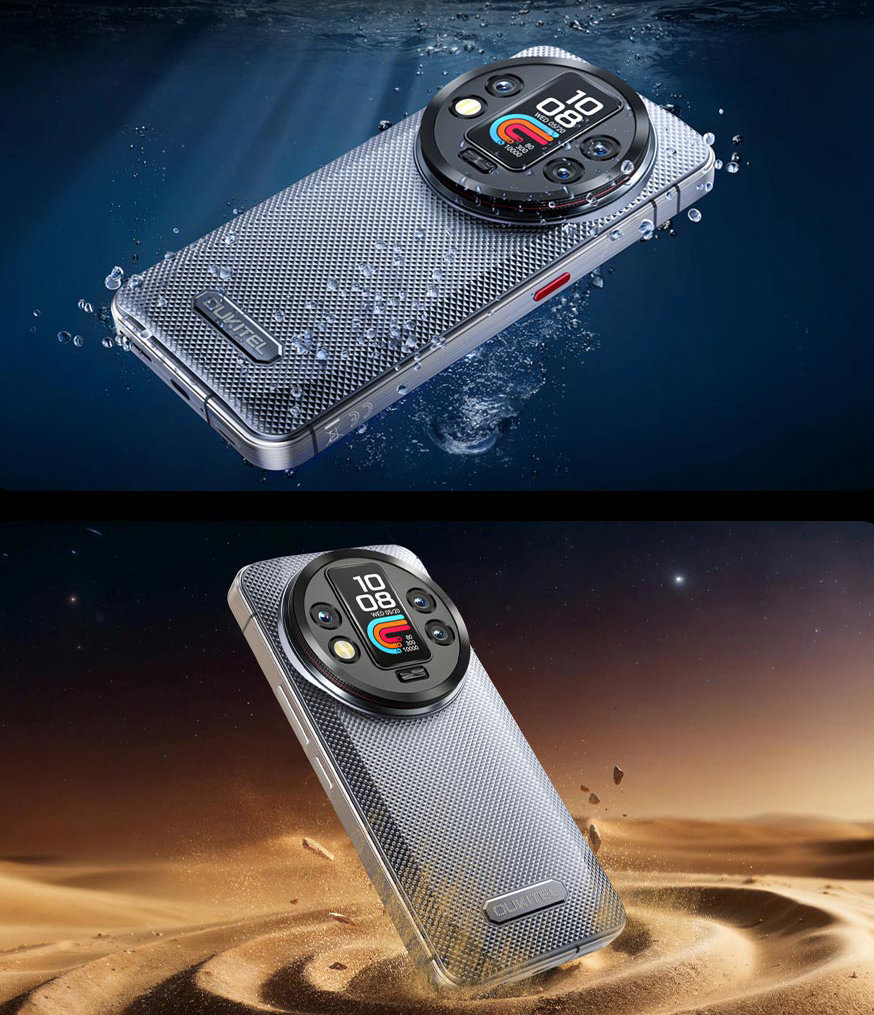
It does have one weird yet kind of neat feature:
On the back of the phone is a small additional screen that can display notifications. This screen can be popped out and placed into a wristwatch accessory, and connects to your phone via Bluetooth.
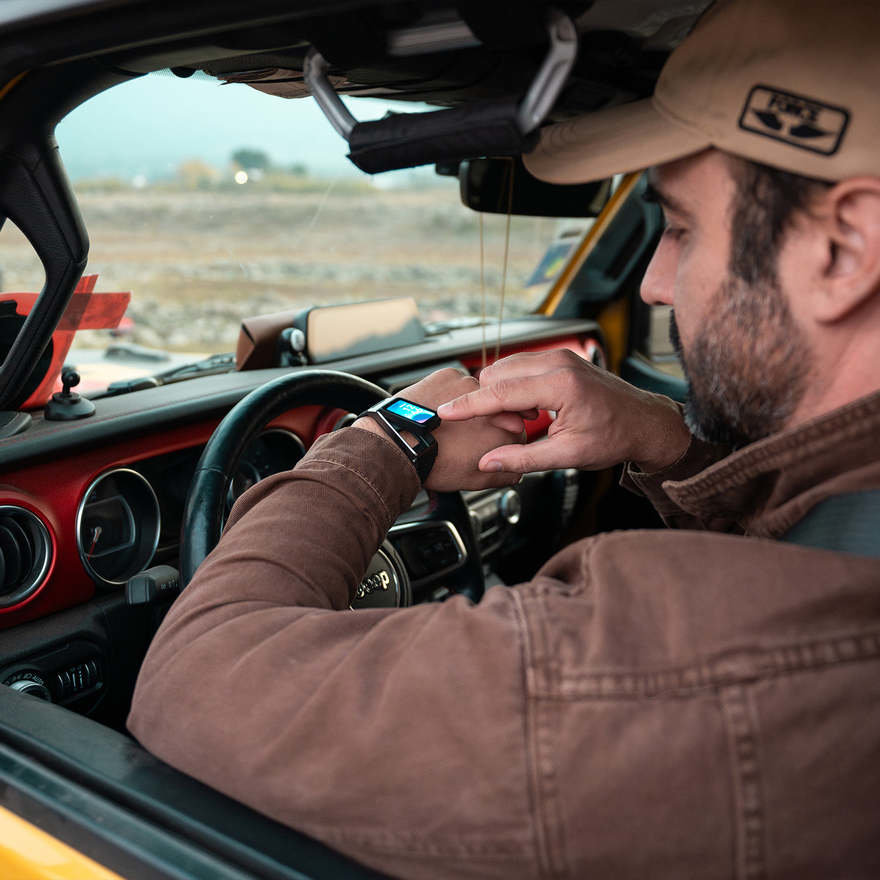
But wait! There’s more! That little removable screen also has an earbud on the back of it, so you can put it in your ear.

This has got to be the most James Bond device we’ve seen in ages.
It’s available for pre-order, although Oukitel has not yet announced a price or release date.
“What Would You Like on Your Tombstone?”
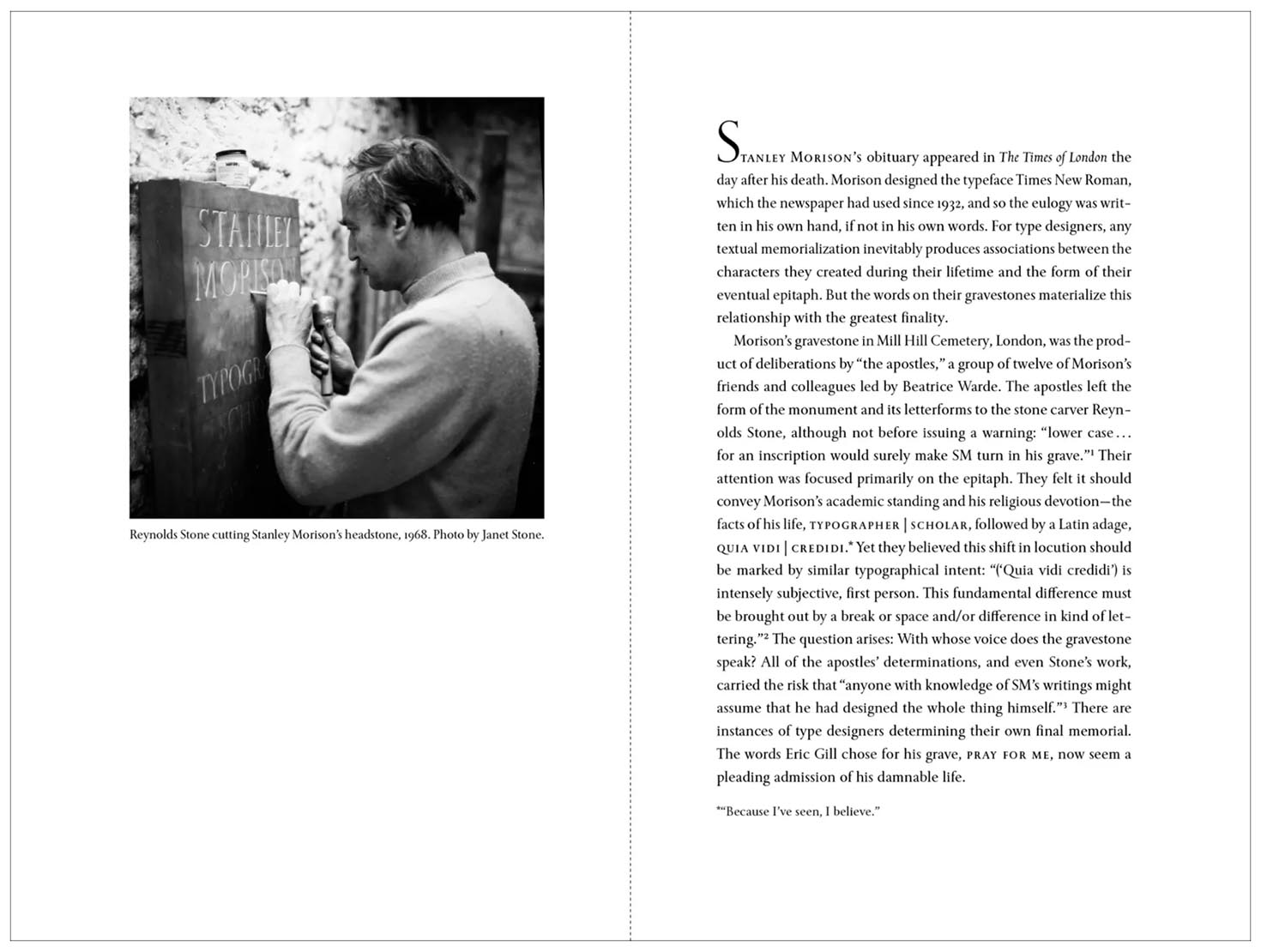
Here’s something you probably never considered: what font would you like on your headstone? Well, apparently type designers have pondered this issue and, via Print magazine, a new book even provides a gallery of them. Gavin Morrison and Scott Myles’ Last Words: Gravestones of Type Designers is the eighth and final edition of the Katherine Small Gallery’s “Design Brief” series. From the Katherine Small Gallery:
They’ve traveled the world making rubbings (more or less) of stones and we show the full pieces with details at 100% of the original. A brief introduction by Morrison provides a case study of Stanley Morison’s stone and addresses the difficulties involved with one’s final letters.
A steal at $16.
In the Cage
Avant-garde composer John Cage was known for some pretty out-there compositions. His most famous is “4’33”” in which the players are instructed to not play their instruments for 4:33, the only sound being silence as well as whatever ambient noise there may be. (We recall that a high school friend had at the time a John Cage album that consisted of nothing more than rubbing a phonograph stylus over various surfaces. It was great for clearing out party guests.)
Anyway, one of his other outré works was “Organ2/ASLSP,” with the abbreviation meaning “As Slow As Possible.” One question that has plagued prospective performers of the piece was, “What exactly did he mean by that?” NPR recently highlighted the John Cage Organ Foundation in Halberstadt, Germany. Now, that refers to performing John Cage’s works on an organ, not some sort of weird biological fetishism. Anyway, the Foundation set about staging a performance of it—and they, like many others, hotly debated what Cage meant.
“And they said, ‘Oh, the organist must sometimes go to the loo or sometimes to eat,’” recalls foundation member Rainer Neugebauer. “And then one person — he was a theologian — said, ‘No, the organist must play until he dies from the seat.’”
Naturally, they had trouble finding an organist prepared to die for his or her art (or, actually, John Cage’s), so they came up with a more sensible solution: small sandbags to hold the organ keys down.
After further debate, the group decided the piece would be played for 639 years, to mark the time between the construction of the world's first 12-tone Gothic organ in Halberstadt, in 1361 CE, and the new millennium. The city donated an abandoned 11th century convent for the performance, and on Sept. 5, 2001, what would have been Cage's 89th birthday, the performance began.
The organ tasked with playing the composition is actually being built as the piece plays. And the foundation did the math to “calibrate” how the piece would need to be played to stretch over 639 years. The composition actually begins with a pause—and one that, properly calibrated—lasted 17 months, meaning that for 17 months, the only sound was the sound of air whooshing through the organ’s bellows. (It’s still better than anything by Drake.) But, alas, they discovered that someone had done the math wrong and it was not properly calibrated; the pause should have lasted 28 months. Doh!
But, that was only one of many mistakes.
For example, there was the time he allowed a movie crew to film the organ at night and the crew accidentally knocked one of the pipes loose, changing the note for a few hours. Or the time when a local politician couldn't make one of the chord-change ceremonies, so they delayed it by a couple of weeks — a delay that proved to be the final straw for one of the project founders, who fancied himself a Cage purist and who had had enough. He quit in a huff.
Or perhaps a minute and a huff.
Alive, He Cried
Elvis sightings have died down in recent years, probably because he’d be 90 this year if he were still alive. In a similar vein, a new documentary by director Jeff Finn called Before the End looks at the “theory” that Doors lead singer Jim Morrison faked his own death back in 1971 and is still alive. Says the NME:
It will examine the “evidence” of the theories that Morrison may still be alive, including one revolving around a man named ‘Frank X’, who works in maintenance in Syracuse, New York, but who some believe is Morrison in disguise.
Well, Morrison was “the Lizard King” so we’d expect him to hang out at Dinosaur Bar-B-Q.
Graphene Hits the Roof
Was it a good week for graphene news? It’s always a good week for graphene news! Graphene-enhanced roofing materials.
Garland Company, Inc., a manufacturer of high-performance solutions for the commercial building industry, has added to its StressPly family of modified bitumen roofing “membranes”: StressPly Max, developed to impart maximum strength, fire resistance, and weathering. From (who else?) Graphene-Info:
The StressPly Max membrane features a dual polyester and fiberglass reinforcement, delivering a high-tensile value further enhanced by a graphene modified bitumen. The incorporation of graphene into the asphaltic compound provides superior strength, with an internal reinforcement exceeding one thousand pounds.
Press Shroom
Do you go to loud concerts? Or, perhaps more appropriately, do you work in a loud pressroom, paper mill, or other location that has the potential to damage your hearing? If so, chances are you use some kind of ear protection. But now, via Core 77, there is a sustainable alternative to foam rubber: wellness products company GOB has developed an earplug from “mycelium foam.” Says the company:
Our aerial mycelium foam naturally dampens sound by evenly knocking down all frequencies, ensuring a balanced acoustic experience without distorting what you hear. Unlike traditional foam earplugs, which can muffle certain frequencies, our mycelium-based earplugs provide superior sound absorption while maintaining clarity and comfort.”
…“Made entirely from lab-grown mycelium, they are 100% home-compostable and free from any harmful chemicals or additives—because what touches your body matters. Engineered for 12dB noise reduction while prioritizing the planet and your health, GOB earplugs are the world's first truly sustainable hearing solution.”


“Mycelium” means “mushrooms,” basically, so if you spend a lot of time at Infected Mushroom gigs, you’ll want to pick up a pair.
Roachbots
We’re not ones to question scientific advancement, but is this really a good idea? Says Science Alert: “Scientists Turned Cockroaches Into Cyborgs, Giving Them Navigation Superpowers.” (Wasn’t that the plot of an X Files episode?) Anyway, why would one want to do this?
The flattened bodies of cockroaches can get into places that no human can, without leaving a trace. They'll eat just about anything, and they're darn near indestructible.
All these qualities make them the perfect steed for search-and-rescue operations, among other more questionable applications, like surveillance. That's why a team from the University of Osaka in Japan and Diponegoro University in Indonesia decided that cyborg cockroaches would be a good idea.
Surveillance? Taking the word “bug” a bit too literally, wethinks.
The concept involves combining the best of both worlds: the organic cockroach anatomy, fine-tuned across millions of years of evolution to navigate small spaces and hostile environments, guided to a target destination of human choosing by a few electronic nudges from a high-tech backpack.
…The whole shebang is called the 'biohybrid behavior-based navigation (BIOBBN) system,' and it's based on reach-avoid programming, which involves the goal of reaching a set location while avoiding whatever obstacles arise en route.
That doesn’t make it better! Still:
The authors hope these bug-bots could be used to inspect the dangerous rubble left in the wake of war and natural disaster, and even detect survivors and rescue workers in trouble.
The trick will be to keep people from stomping on them.
I Can’t Believe It’s Not Egg
The rising cost of eggs is perpetually in the news, if not the cultural zeitgeist. So, via (who else?) Food & Wine, here is an intriguing idea (and we stress the word “idea”): a plant-based egg substitute called Just Egg. Kind of a misnomer, as it is so not egg in virtually any respect:
In March, the company unveiled the latest iteration of its plant-based “eggs,” made with water, mung bean protein isolate, canola oil, and sugars, which it claims makes it “lighter and fluffier.” This release comes at a time when supply chain issues make it difficult for consumers — including restaurant owners — to find eggs.
… These new eggs
They’re not eggs.
are even taking center stage in the "Bird Flu Bailout" campaign at 50 bodegas across New York City, which will feature Just Egg in their classic breakfast sandwiches, including the beloved bacon, egg, and cheese.
What about health benefits?
As for how the product stacks up, Just Egg boasts that it contains zero cholesterol and less saturated fat while offering the same amount of protein as a regular egg. The company also stated that its main ingredient, the mung bean, “is not susceptible to bird flu and the inflationary pressures currently pushing conventional egg prices to record highs.”
However, one small crack in the shell:
The primary factor to consider is the average price of a dozen eggs, which the Federal Reserve Bank of St. Louis reported is around $5. A carton of Just Egg, which is equivalent to about 10 eggs, is priced at $7.36 at Walmart currently, making it significantly more expensive.*
* Update: Since the Food & Wine article ran, FRED updated the price of a dozen eggs to just under $6—or 50¢ an egg. Walmart’s Just Egg, at $7.36 for the equivalent of 10 non-eggs, works out to 74¢ per pseudo-egg. (Fortunately, in France, one egg is un oeuf.)
Anyway, looks like someone has Just Egg on their faces.
This Week in Printing, Publishing, and Media History
March 17
1941: American singer-songwriter and guitarist Paul Kantner born.
1956: American actor, comedian, screenwriter, and author Fred Allen dies (b. 1894).
1973: The Pulitzer Prize-winning photograph Burst of Joy is taken, depicting a former prisoner of war being reunited with his family, which came to symbolize the end of United States involvement in the Vietnam War.
March 18
1733: German author and bookseller Christoph Friedrich Nicolai born.
1768: Irish novelist and clergyman Laurence Sterne dies (b. 1713).
1850: American Express is founded by Henry Wells and William Fargo.
1932: American novelist, short story writer, and critic John Updike born.
1961: American singer-songwriter and guitarist Grant Hart born.
March 19
1813: Scottish missionary and explorer David Livingstone born, we presume.
1895: Auguste and Louis Lumière record their first footage using their newly patented cinematograph.
1928: Irish-American actor, director, producer, and screenwriter Patrick McGoohan born. Be seeing you.
1931: Gambling is legalized in Nevada. (What are the odds it’ll catch on?)
1933: American novelist Philip Roth born.
1962: Bob Dylan releases his first album, Bob Dylan.
2008: British science fiction writer Arthur C. Clarke dies (b. 1917).
March 20
43 BC: Roman poet Ovid born.
1828: Norwegian poet, playwright, and director Henrik Ibsen born (not in a doll’s house).
1852: Harriet Beecher Stowe’s Uncle Tom’s Cabin is published.
1896: With the approval of Emperor Guangxu, the Qing dynasty post office is opened, marking the beginning of a postal service in China.
1915: Albert Einstein publishes his general theory of relativity.
1922: American actor, director, producer, and screenwriter Carl Reiner born.
1923: The Arts Club of Chicago hosts the opening of Pablo Picasso's first United States showing, entitled Original Drawings by Pablo Picasso, becoming an early proponent of modern art in the United States.
1948: With a Musicians Union ban lifted, the first telecasts of classical music in the United States, under Eugene Ormandy and Arturo Toscanini, are given on CBS and NBC.
1950: English drummer, percussionist, and songwriter Carl Palmer born.
1964: Irish republican and playwright Brendan Behan dies (b. 1923).
March 21
1952: Alan Freed presents the Moondog Coronation Ball, the first rock and roll concert, in Cleveland, Ohio.
2006: The social media site Twitter is founded.
March 22
1765: The British Parliament passes the Stamp Act that introduces a tax to be levied directly on its American colonies. (Spoiler alert: it didn’t go well.)
1832: German novelist, poet, playwright, and diplomat Johann Wolfgang von Goethe dies (b. 1749).
1887: American actor Chico Marx born. (Why a duck?)
1931: Canadian actor William Shatner born.
2020: Indian Prime Minister Narendra Modi announces the country's largest ever self-imposed curfew, in an effort to fight the spread of COVID-19.
March 23
1842: French novelist Stendhal (né Marie-Henri Beyle) dies (b. 1783).
1857: Elisha Otis’s first elevator is installed at 488 Broadway New York City.
1910: Japanese director, producer and screenwriter Akira Kurosawa born. (Everyone who witnessed his birth described it differently.)
1965: NASA launches Gemini 3, the United States’ first two-man space flight (crew: Gus Grissom and John Young).