This article is sponsored by Canon as part of WhatTheyThink’s Print Product Spotlight series. In preparing this article, the WhatTheyThink Print Product Section editors conducted original, in-depth research into Canon’s sheetfed inkjet production series. This Product Spotlight describes what the editors feel are the product’s strengths in the marketplace. Canon previewed the final article for accuracy but had no editorial control over the content.
(Watch David Zwang’s interview with Jane Nerf, Sheetfed Inkjet Marketing Advisor, Canon USA, here.)
Production inkjet technologies have roots dating back to the 1970s but really didn’t see any commercial impact until the early 2000s. From the beginning, inkjet printing was envisioned in the short term as a higher productivity option to toner-based machines, with the longer-term goal as a replacement for analog technologies like offset and flexography.
Like any new technology it initially found its home in niche applications, in this case transactional and direct mail printing where it easily replaced existing toner and web offset devices. For these applications it was ideal since the productivity over toner was significant. Although, for wider commercial adoption the inkjet quality in the earlier machines was one of the impediments. The other big impediment to growth was that those inkjet presses were all rollfed, which was fine for those niche applications but not for general commercial printing.
The vast majority of commercial printers, and more importantly their customers, are used to working with many different substrates. In fact, a study I did identified that the majority of printing companies used more than eight different substrates on a regular basis, and of course not all the same eight across different companies. Furthermore, many printers use different media in the same job. This is one of the reasons why sheetfed EP (electrophotographic) printing, without the substrate limitations inherent in a rollfed environment (availability and time and labor to change rolls for a substrate change) was so successful.
There were some early entrants in the sheetfed production inkjet market, but they were all running at around 2,500 sheets per hour simplex, which didn’t really justify the shift from offset or even toner to many.
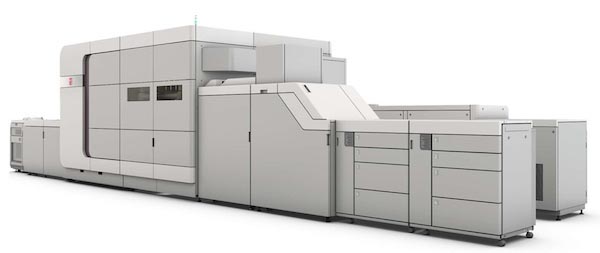
Canon varioPRINT i300 © Canon
Enter the Canon varioPRINT i300
In 2015, Canon, who was one of the early entrants and a leader in rollfed production inkjet, introduced the Canon varioPRINT i300, which had been a while in the making. This very unique press was not the first sheetfed production inkjet machine to be introduced, but it was the fastest, running at 294 letter size ipm and about 8,820 letter size sheets per hour. It was the first sheetfed production inkjet press that began to address the varied needs of the commercial printer.
As a duplex machine, the varioPRINT i300 was a differentiator from some of the earlier sheetfed inkjet presses which either slowed down on duplex printing or required sheets to be manually fed back through the single engine for printing on the second side.
The imaging is based on their recognized ColorStream imaging technology. The press supported four ink colors, CMYK. It used the Kyocera KJ4B 600 dpi aqueous inkjet print head, which had been designed for a long life. The printhead resolution is 600x600, however with the same addressability offered by a 1200 dpi print head by using variable control of the drop size (12 pl drops or less). The drop sizes are defined for each media using a Default Media Entry (DME) and stored in the DFE. The aqueous based pigment ink was designed specifically for the varioPRINT i300, affording it a wide gamut on each media type.
The varioPRINT i300 press included a built-in quality inspection system which performs a nozzle failure detection and correction at the start of every print job and intermittently throughout the production run, and an automated printhead maintenance routine. While the printheads reside in a conditioned environment to keep the nozzles open and flowing, when the press is printing it ejects the smallest drop sizes from the nozzles when not being used for printing. Additionally, during printing and in between pages, the ink in the print head is “stirred” by a piezo pulse. When the press is idle, the printheads are parked in a vacuum maintenance station. The nozzles are automatically purged and then the print heads are wiped by a wet tissue material. This automated maintenance process ensures that the printhead is ready for print as needed, providing a new level of reliability.
As the needs of the customers and the technologies continued to evolve, in 2016, Canon upgraded the imaging system on the i300, with the introduction of ColorGrip, an optional spot pre-coat, jetted only on the areas that will receive ink allowing the ink to sit high on the sheet and providing better print contrast. The company also introduced a new ink that enhances image quality on commodity grade untreated media, and also provided support for a wider range of media. All of these technologies are targeted at providing significantly enhanced print output in an effort to expand i300 adoption in the commercial print segment. The evolved varioPRINT i-series included two speed models to select from, a 205 images per minute and 312 images per minute model.
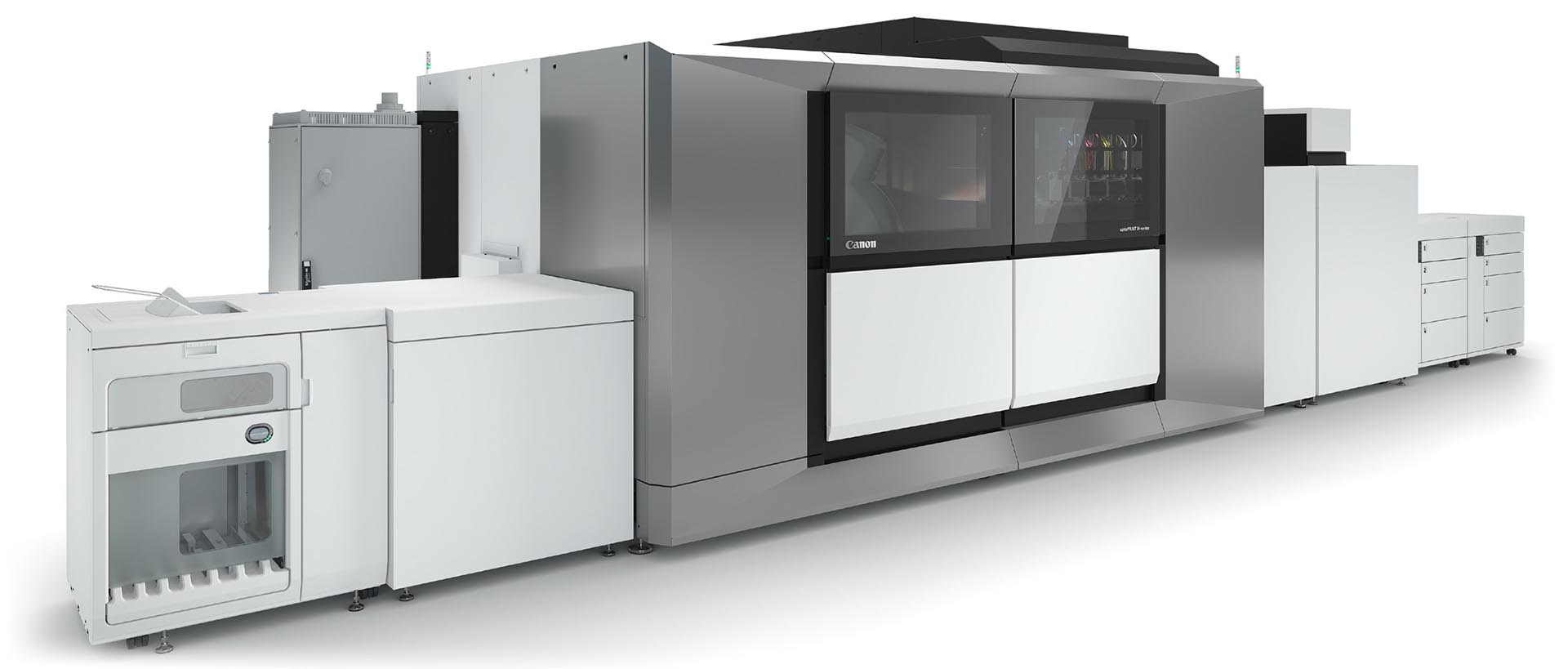
varioPRINT iX-series © Canon
varioPRINT iX-Series
Canon has a history of continued development and is always looking to support the shifting needs of a growing customer base, and in 2020, Canon introduced a new sheetfed press on an updated platform. The platform currently includes the varioPRINT iX3200 and the varioPRINT iX2100, which builds on the experiences of Canon and their customers with the i-series platform.
The emphasis in the development of this new platform was to create a commercial printing press that could produce high-quality printing with readily available untreated commercial substrates and produce it at a very competitive cost. With this new platform, they introduced four main technology innovation areas; paper transport, quality control, ink innovation, and drying technology.
Transport
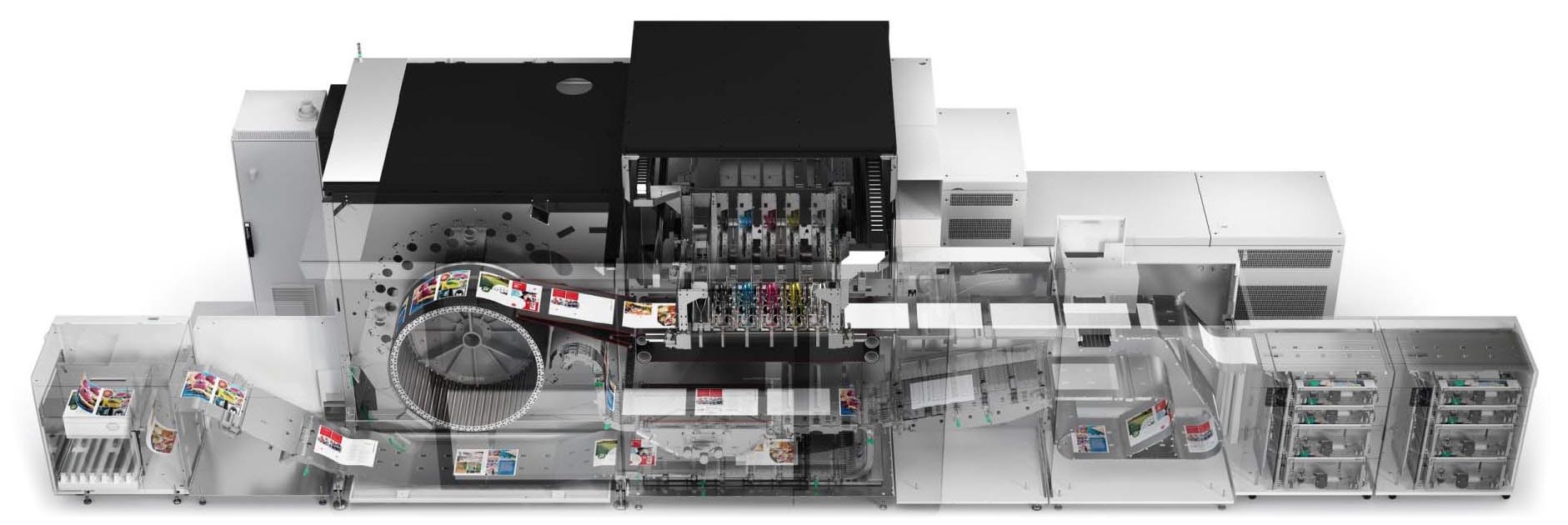
Unlike webfed presses, paper feeding on a sheetfed press requires significantly different design and control. On the iX, the paper input module (PIM) has four trays that can each contain different media weights and sizes, holding a total of 4,500 80gsm/50# text sheets up to 14 x 20 in. Up to three PIMs can be connected to increase the capacity to 13,500 sheets in 12 trays. Each PIM has a moisture control unit to maintain a constant humidity for the media condition.
The paper transport uses a stainless-steel belt that uses vacuum suction and airflow. This provides the ability to keep all media from 60 gsm–350 gsm flat, maintaining a small automatically adjusted print gap between the media and the printhead for better drop control. The transport also contains a “sentry” which scans every incoming sheet for deformities and automatically ejects non-conforming media. Additionally, the sheets are measured when they are fed from the PIM, and again after printing to ensure that front to back registration is controlled by taking any shrinkage that may occur during fixation into account. The varioPRINT iX3200 can run at speeds up to 312 letter-size images per minute or 9,360 sheets per hour, the iX2100 up to 205 letter-size ipm or 6,150 sheets per hour, providing a 6% increase in speed over the current i-series.
© Canon
Quality Control/Imaging
Like the i300, the press supports four ink colors, CMYK. The varioPRINT iX uses three Kyocera KJ4B 1200 dpi printheads per color, optimized for the series. In order to achieve offset quality and high reliability, the printheads are kept in a conditioned chamber in both the print module and the maintenance module to prevent moisture formation or ink drying at the nozzles. To further control the printing performance, the ink is cooled before entering the printhead and while in the printhead. It delivers 2pl and 5pl droplets to provide high color laydown as well as fine detail. Inline quality control includes nozzle activity control (NAC), in which the system automatically prints a QA sheet which gets scanned for defects and ejected, with the checking frequency set by the operator. This provides automatic correction for defects (nozzle outs) through the use of neighboring nozzles. The system also provides nozzle uniformity control (NUC) in which, a printed target gets scanned and adjusts any uniformity differences between printheads for smooth transitions across gradients and solid fills, even during a run.
Nozzle maintenance is performed at the start of printing, or every 3.5 hours during a long run. The process includes both a purge and dry wipe and then a wet wipe, automatically. When the heads are not in use they rest in a conditioned maintenance liquid. No operator interaction is required for any of the above. The only operator-replaced consumable in this process is replacement of a tissue cassette. All of this increases the reliability and available up time of the press.
Inks and ColorGrip
The iX press comes with a new aqueous-based polymer ink set that was developed and is manufactured by Canon. This allows them to control the imaging process, media choice and printhead performance. The ink set provides a high color gamut and should exceed that of offset printing inks and support existing color imaging standards. The inks are environmentally friendly and produce odorless prints with excellent de-inking capabilities. ColorGrip is a pre-coat that is jetted at 600 dpi on only the imaged areas that will receive ink, allowing the ink to sit high on the sheet and providing fine line details and better print contrast. It also prevents pigments from bleeding through light weight media and prevents dot gain on coated media by helping to bind (pin) them to the surface ColorGrip has been optional on the i-series presses, however is included in the iX platform, and considering the targeted print applications is understandably so.
Drying, Fixing, and Cooling
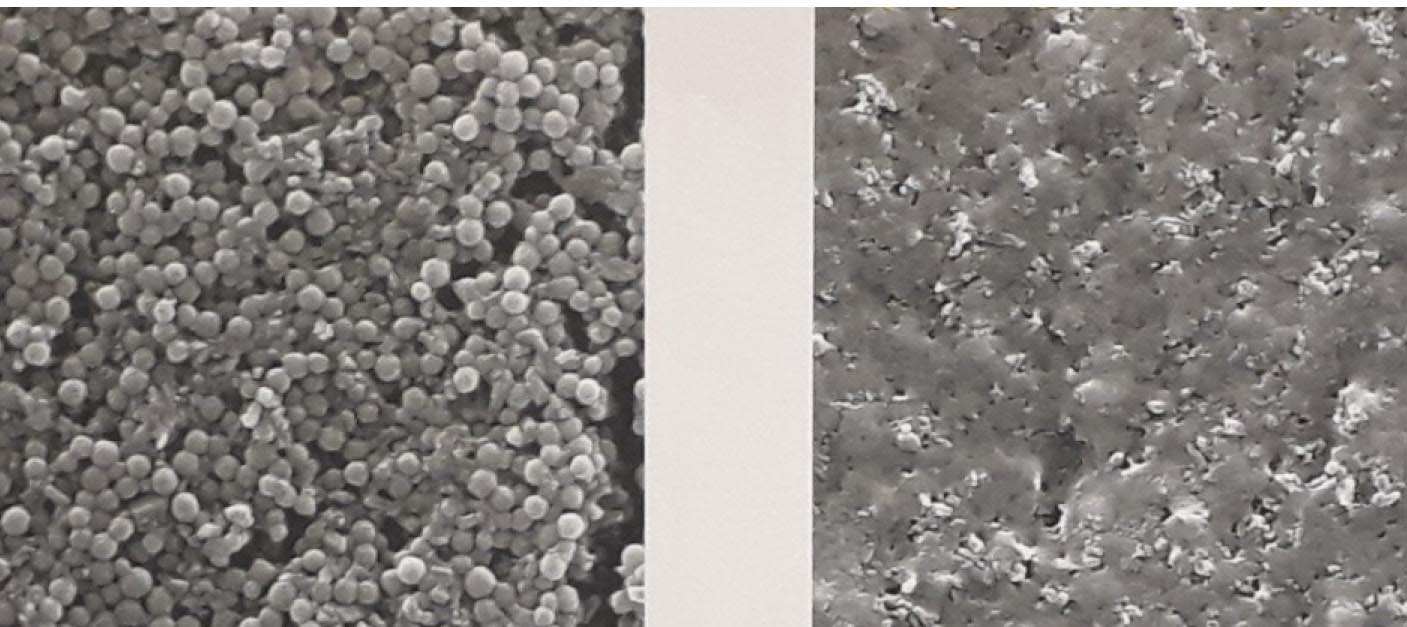
Fixing the Image (Before and After)
Drying and Fixing
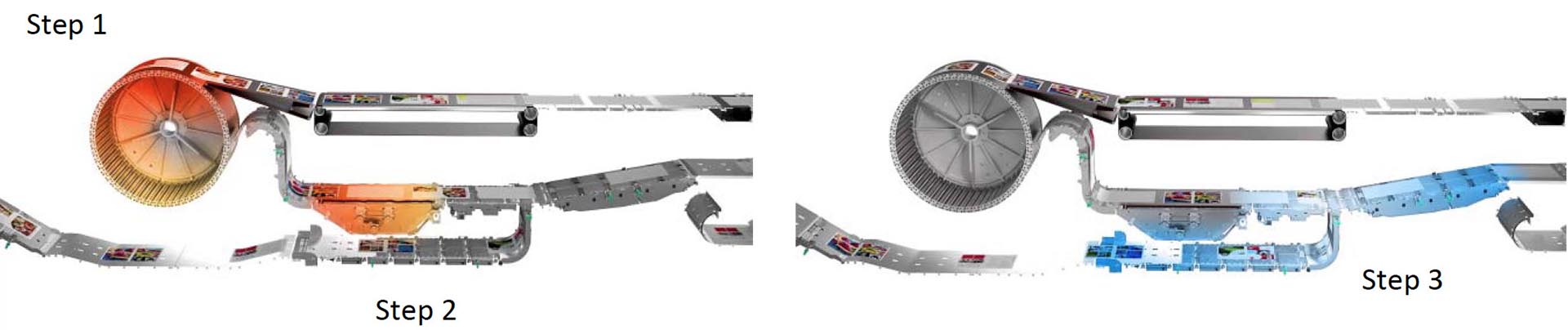
Drying in an inkjet press is always interesting and challenging. You are putting water on a sheet and now you need to get it out, while still preserving the image and the sheet integrity. We have seen many unique solutions to this problem, and Canon added a new one. It is actually a three-step process: drying the ink with a hot air-heated drum to evaporate the water and dry the ink; fixing the ink, which actually melts the polymer particles using a steam blast to provide a firm layer (see image above); and finally cooling the sheet so it can provide a lay flat quality for more reliable inline finishing.
Front End
The iX is driven by the PRISMAsync controller which natively supports PDF via an APPE (Adobe PDF Print Engine). It also contains technology shared from the Océ SRA® MP controller used in the Canon continuous feed inkjet systems. In transaction processing mode it can support AFP/IPDS, PCL, Line Data, LCDS, Metacode, Postscript, PPML supported through the PRISMAproduction print manager. The PRISMAsync digital front end (DFE) uses a scalable multiprocessor system to ensure that input processing can keep up with the press at full speed. It has been one of the cornerstones of the Canon front end software, and has been constantly evolving. In fact, it is now fully compatible with PRISMA Home, which is a unique platform that brings valuable analytical applications, document composition, ink estimating and tools, to the cloud to manage and support print production processes throughout your plant.
Conclusion
Today, production inkjet has moved beyond the early adopter phase and is rapidly entering mainstream. In fact, since the introduction of Canon sheetfed inkjet 10 years ago, the company has installed more than 700 sheetfed inkjet presses worldwide, which have combined to print over 66 billion pages. Add to this the recent press and technology announcements by many of the other manufacturers, the new and improved inks and wider range of media, production inkjet is poised to finally reduce the obstacles to adoption for mainstream commercial print.
Canon is undoubtedly an innovator. In fact, Canon placed fifth in U.S. patent rankings and first among Japanese companies, placing in the top five for 37 years running. The varioPRINT i-series and iX sheetfed production inkjet presses are game changers, and comfortably share the innovation spotlight with the Canon ColorStream and the Canon ProStream web roll fed presses. This continued innovation has changed the landscape of production inkjet we undoubtedly expect to see continued inkjet innovation from Canon in the years to come.