Background
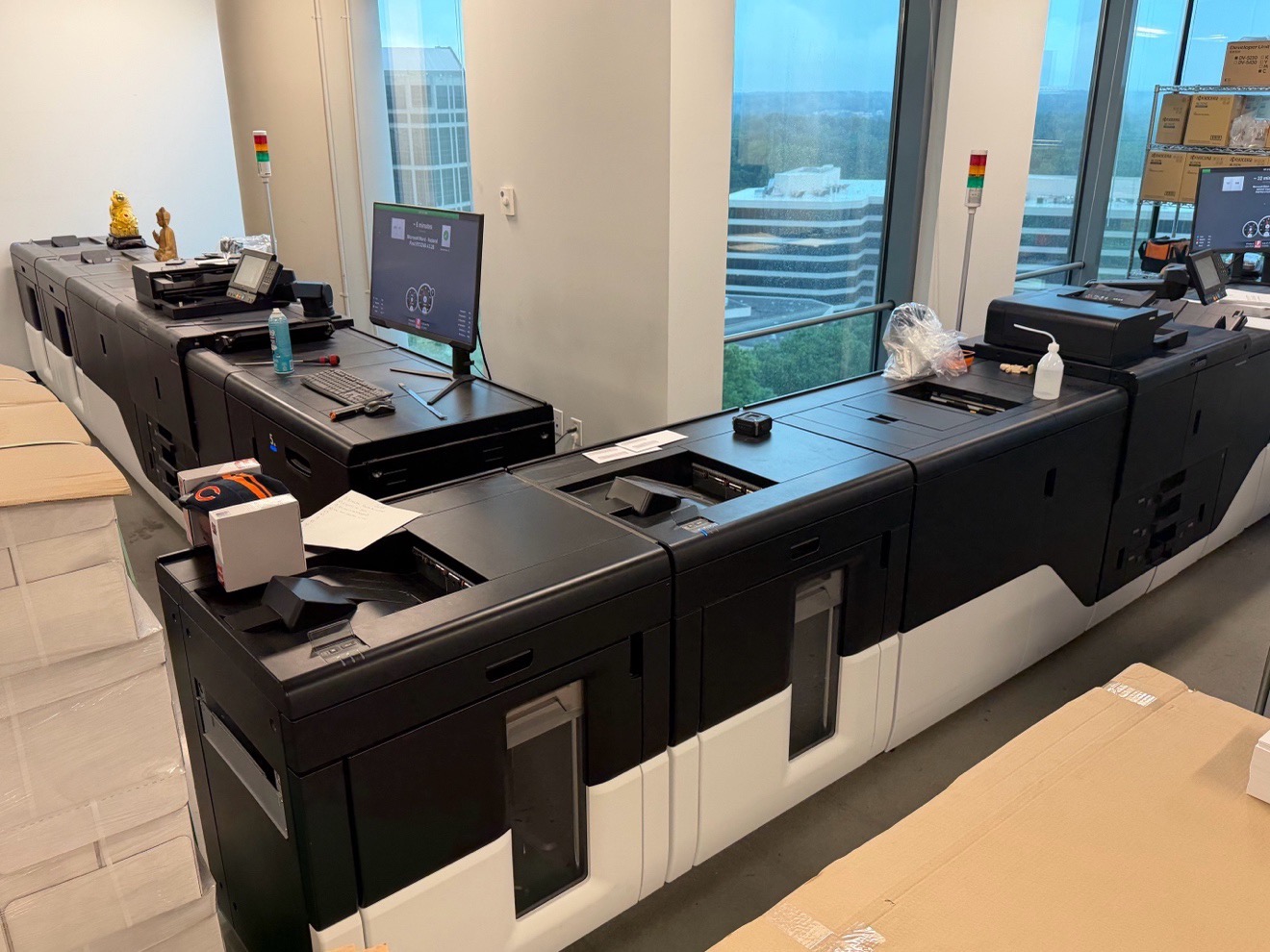
Historically recognized as a hardware provider, Kyocera has now established itself as a system and solution provider. Launched in 2019, their game-changing TASKalfa Pro 15000c press was developed as an affordable entry point into production inkjet while offering productivity and output quality to go toe to toe with its laser rivals. It produces consistent full-color output from high-pigment ratio and high-permeability water-based Kyocera inks, although it is also suited to overprinting variable data black or spots onto pre-printed offset shells.
Driven by an EFI Fiery Controller, this SRA3 format press runs at 146 letter pages a minute at a resolution of up to 600 x 1200 dpi with a duty cycle that has proven to extend up to 3 million images per month. This, along with the competitive acquisition cost, has made it very attractive to a wider audience.
I recently had the opportunity to speak with Dustin Graupman, the Senior Director of the Inkjet Division for Kyocera Document Solutions America, Inc., about the company’s successes and peek into the future.
WhatTheyThink: Tell me a little bit about the TASKalfa Pro 15000c and its adoption into the market.
 Dustin Graupman: It's a cut-sheet inkjet press that is, in our estimation, unparalleled in terms of value. It's a perfect combination of capabilities, low acquisition costs, and image quality. It uses aqueous inks, which are recognized as the industry standard for high-volume production inkjet.
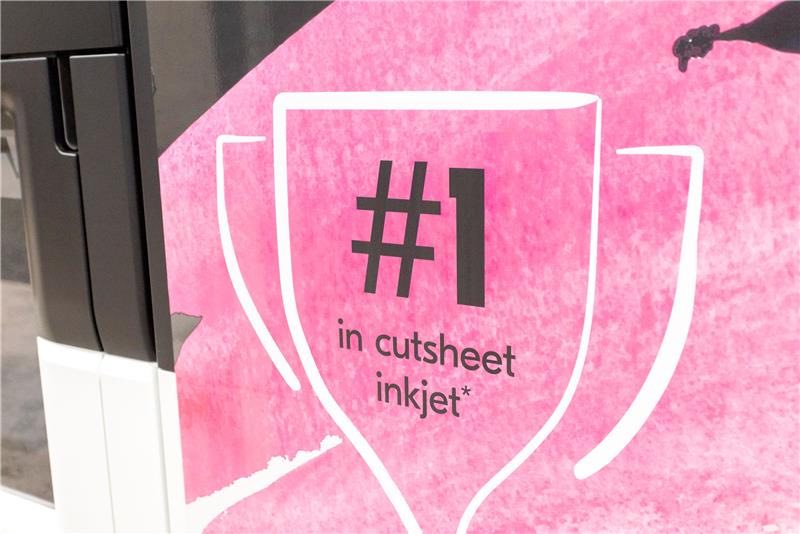
I used to say it was the best-kept secret in the industry, but we really can't say that anymore.According to recent IDC data, it has been the number one best-selling inkjet press over the last three quarters. But really, when we access all the data over a few years, we’ve been the leader for quite a period of time; we're anxious to make that announcement once we see the full year’s data. Our view is that market leadership is a recognition that it's a product that hits the sweet spot of what a lot of customer environments are looking for.
WTT: What do you attribute the growth to?
DG: The growth is across all of our distribution and partnerships. While the product is a factor, I think the key factor is that the product was introduced at an acquisition cost, with the right set of capabilities, to be able to address a highly unmet market need. Our distribution strategy has enabled more customers to access it through channels that they're more comfortable with. We really don't have reach across the country, and we don't have service coverage across the country, so having partners has been integral to the adoption across the country.
WTT: What are the drivers for a cut-sheet production inkjet device in comparison to a roll-fed inkjet device?
DG: They really live in two different classes of productivity. Roll-fed is certainly remarkably productive, the economics are quite favorable, but, from a capital acquisition cost, it's not accessible for a lot of people. It's not just the equipment; it's the finishing that you have to pair with it. Oftentimes it requires a facility built out. So, it really lives in a different class of device in our estimation. A cut-sheet device is much more accessible, you can slide it into a smaller space and plug it into the wall outlet.
A big advantage of a cut-sheet is that you can change papers quite quickly. Even within a job, you can mix papers like cover weight with lightweight colored stock, etc. I think that's probably the biggest thing.
Another point that we see in our installs is the device’s flexibility. It's that versatility that makes it available to seasoned roll-fed inkjet companies who want to put their shortest runs and reprints on it. I would say we see roughly half of the machines that are in the field are paired with roll-fed. They are the most seasoned inkjet users, and the other half are people who are new to inkjet almost exclusively. The TASKalfa Pro 15000c gives them an entry-point, which is where we see the versatility and the affordability of cut-sheet inkjet really hitting a sweet spot for different types of organizations.
Ultimately, when you trade off the productivity of a roll-fed, you get versatility with the cut-sheet. When you start to mix a cut-sheet device with a roll-fed machine, you can keep everything running, scheduling tasks when you need them. As such, you get a higher OEE for the plant itself, which makes a lot more sense.
WTT: What are the markets and identified uses of your existing customer base?
DG: We've recently undergone a rigorous interrogation of our installed base because, as you know, we do a lot through partners. So, we don't always have visibility into the applications, but we can ascertain a lot by just looking at who the companies are and working with the partners.
In our view, the uses and markets break into thirds. A third of the machines are in transactional environments and a third are in direct mail. Then, we have a third in what we would call ‘other’, including some in-plant operations, book printers, publishing, magazines, and manuals. We also have some ballot printing devices, and we even have machines that produce checks. Most of that segment growth was before we launched the Plockmatic booklet maker.
Now, we anticipate that the last third, in-plants, publishers, and those miscellaneous types, will be a growing segment for us. With Plockmatic, they can now do more with the printer. We will also be introducing some new capabilities in the coming months to pair with the equipment to be able to open up more and more of those types of applications that really address the efficiency of white paper in and a finished product out.
WTT: What are the advantages of the TASKalfa Pro 15000c in comparison with other cut-sheet production inkjet devices, since we are seeing a lot more of those in the market now?
DG: Right out of the gate an advantage is our technology, which has been dominant in the industry for decades, Kyocera printheads. They are trusted and proven in the production space to be reliable and consistent. Beyond that, we offer affordability. It's a fraction of the cost of some other cut-sheet inkjet solutions that have been available in the market to this point in time or are even anticipated in the future.
In my opinion, it's a combination of those two things, and the productivity cost is probably the last piece of it. It’s the right level of productivity to pair with existing finishing equipment that's out there and to be able to staff with an operator who is capable of running two or three machines at a time, so it's a familiar band of productivity.
The other aspect of productivity is the reliability of the machine. When we tell people that customers are able to run upwards of 3 million prints a month on one of these devices with very few service calls, I still don't think people believe us. We've done some case studies on it, and we've had customers confirm those numbers. I can tell you with high confidence that we installed a machine last week in Georgia, and, on the first day of production, they achieved a hundred thousand prints off of it. If you extrapolate that out over 21 business days, that's 2.1 million. That's the first day they were in production running one shift, albeit one extended shift. It's that level of reliability that I think changes the view of how productive these devices can be because they're so reliable. The uptime is extremely high.
WTT: Where do you see the growth opportunities for customers, both new and existing customers, with the press?
DG: With new customers, most of the successful print operations over the last decade have made investments into inkjet or are really close to making investments.
I can talk in terms of my experience over the course of three different companies and 12 years in inkjet. In terms of applications, and enabling applications to make the investment, I've seen and been involved in situations where companies make the investment and they don't have the applications. They hope to buy a device, and they will come. That's not a winning formula most of the time. Therefore, it is important to identify enough of the right applications to get a return on the equipment, and that's where this particular product is perfect. Capable of doing a variety of different tasks, businesses can make the investment confident that they have a device to help them expand and start learning about inkjet benefits. It is about getting your foot into the door with inkjet or optimizing operations where you've done it.
Across our fleet, we see about 20% of the customers have repeated the purchase, buying a second or third device, and that's where we currently see the real growth. It is getting into inkjet and then building a part of your business around the technology.
Later this year, we will introduce the TASKalfa Pro 55000C, which will open up our inkjet solutions to coated paper, which really starts to stare down the toner market and what we do. Customers evolve around the new technology, enabling some current applications while learning the efficiencies of the technology, the features and the benefits, so that sales teams can position themselves to sell those benefits as they go into the future.
WTT: So it's not so much about certain market segments, it's more around learning thetechnology?
DG: That's right. Once you've already got a market and you have happy customers, I'm sure that's the next move.
The distribution partners are learning not just how to do business with us, but also our value proposition – our enabling printhead technology.
The sale of the business model for inkjet is fundamentally different than toner. So businesses are training their sales teams on how to engage in it. At Kyocera, we have hired a lot of toner reps, and we work with toner reps through our partners, teaching them how to sell the consumption model of inkjet – because it is a new skill set for them – it’s not just about cost, it's about selling value.
All of those muscles are new for those people that we're putting in front of customers; that's where I anticipate most of our success. The TASKalfa Pro 15000C dealers and distribution partners will be the ones that are most successful with the new TASKalfa Pro 55000C, not just because they have the end customer, but also because the environments that are best positioned for it.
If you’d like to learn more about Kyocera and its commercial printing services, be sure to follow them on LinkedIn or check out their website.
More to Come…
I would like to address your interests and concerns in future articles as it relates to the manufacturing of Print, Packaging, and Labels, and how connected Industry 4.0 and 5.0 are changing the landscape. If you have any interesting examples of hybrid and bespoke manufacturing, I am anxious to hear about them. Please feel free to contact me at [email protected] with any questions, suggestions, or examples of interesting applications.