About ten days ago, we conducted our quarterly Economic Outlook webinar, and I had the usual discussion whether or not we were in a recession, presenting the case for and the case against. I mentioned that it really didn't matter because what we have is worse: very slow economic growth and high inflation created by ineffective monetary policy. Last week, nothing happened with the bailout bill to change those circumstances. The cure is lower taxes on capital gains and higher interest rates. But the combination of those ideas won't fly, especially in a political season.
The decline in commodity prices is a sign that of worldwide slowing. The declining trade deficit, caused by a weaker dollar (in turn caused by a long-term loose monetary policy), lowered prices for U.S. exports but increased costs of materials and ingredients that are used in domestically manufactured and consumed goods. This is another sign. Don't fall for the stronger dollar news: it's only less weak against a weak comparison.
Friday's unemployment report looks better than it actually was. The unemployment rate was 6.1%, but that was only because 122,000 people left the workforce, mainly as discouraged workers. The rate would have been 6.2% without those departures. I chuckle when talking heads say it was a good report because average hourly wages were steady, a sign that inflation is not a problem. Of course average wages are steady: commodity, health care, benefits, energy, and other rising prices got there first, so there's no room for wages to rise. Productivity is going up and wages are flat. That means workers are not seeing the fruits of their additional labors because the dollars have been hijacked for use elsewhere.
The initial jobless claims 4-week moving average is up to 474,000. Talking heads say this is a recessionary level. It's not. The average percentage of initial claims over the last forty years is the equivalent of 480,000. Doesn’t anyone else do the math? We haven’t reached that level yet, but we will. This will not be an early 1980s type of recession. It will be a long period of stagnation of below-average growth, increasing prices, and disappointing employment levels.
The worst report this week was the Institute of Supply Management's manufacturing report. The overall reading was 43.5. Remember, a reading of 50 implies no growth or decline; around 42 implies recession, and we're obviously close. It's worth looking at their report in greater detail, since this is such an important economic measure.
The PMI (Purchasing Managers Index, as ISM used to be named the National Association of Purchasing Managers) is the composite of the above indices: new orders, production, employment, supplier deliveries, and inventories. The values for September are compared to August, and the Percentage Point Change column shows the general direction since that month. Because 50 is the key value that determines growth or decline, even if the percentage point change is negative, if the value is over 50, it's still marked as growing.
Exports are growing, and have been for 70 months. Prices backed off a lot last month, but are still rising. I had difficulty believing this trend had been occurring for 21 months, though. The ISM's historical data actually reflects that prices have contracted for only three months out of six and a half years. Remember, anytime prices drop rapidly, there are always buyers who are still taking deliveries at the higher prices, even though the “spot price” today might be low.
The worst part of the report is production, which is now in recessionary mode. Production won't be helped by new orders, or by order backlogs, which turned negative some time ago. This tells us that the weaker dollar did not help bolster exports except in the short term. Exports were growing anyway
The ISM non-manufacturing report was somewhat better. The index dropped to 50.2, prices were still very high (70.0), and employment dropped to 44.2. A recessionary manufacturing sector can be countered by a service sector. Capital investments do not limit flexibility in the service sector and thus it can be more responsive. A factory produces a small range of products and cannot he easily changed; a service business can more easily adapt its tactics to address short-term opportunities and problems. Growth business sectors were mining, educational services, agriculture, forestry, fishing & hunting, utilities, retail trade, construction, health care & social assistance, transportation & warehousing, and information. Contracting industries were: arts, entertainment & recreation, real estate, rental & leasing, accommodation & food services, public administration, finance & insurance, management of companies & support services, wholesale trade, and professional, scientific & technical services.
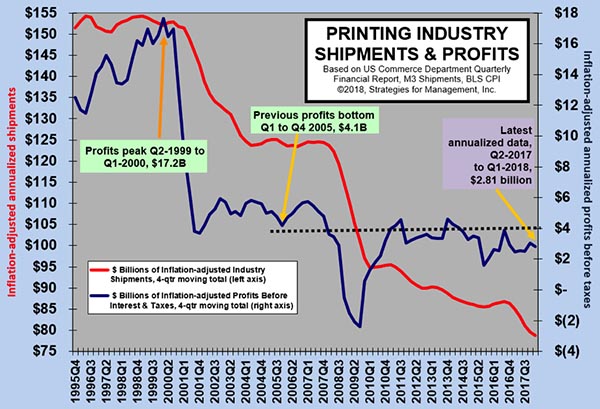
Printing shipments were horrid in August: there's no other way to describe it. Its -4.9% decline compared to August 2007 was the worst year-to-year monthly comparison in current dollars since November 2003, when shipments were down -5.3%. Its -9.7% inflation-adjusted decline was the worst year-to-year inflation-adjusted monthly decline since March 2002, when it fell -10.0%. Year to date, commercial printing shipments are down -2.0% in current dollars and -6.3% in inflation-adjusted dollars, and the monthly comparisons to 2007 are actually getting worse. Full details can be found in our Monthly Shipments Report.
The Fourth Quarter: It's Almost Over, and It Just Started!
You know your business is in trouble when at the beginning of the month or a quarter you say, “We need to make this month (or quarter) look good.” Such actions are likely to be fruitless and do not do anything about the underlying business creation engine that drives long-term growth.
For the industry, the fourth quarter is already over. We have a general sense of how this quarter will be because we already know what happened with employment levels this summer in content creation businesses like ad agencies and graphic designers. We also have seend the trend in ad pages in magazines, and we know that declining newspaper advertising and circulation affects the number of newspaper inserts needed. We also know that e-commerce is the only part of retail sales that is growing. All of these trends are the result of media plans set in place months ago. This is an example of why going out and “selling harder” today is rarely the answer.
Are there parts of the printing business for whom the short-term future is not already written? Definitely yes. Not all of the industry is subject to long-range media planning. There are businesses that need our assistance today to develop and implement communications programs to counter negative economic conditions. This is where small and mid-sized commercial printers have greater freedom of action and opportunity than their larger brethren.
Often the first response to economic problems is to start cutting back and cower in a corner until it is over. Step back and think about it.
There are are smaller businesses that are more scared than you are, such as small retail shops, restaurants, and other service businesses. Many of them are seasonal businesses that rely on Thanksgiving, Christmas, New Year's and other holidays for a bump in sales. They may not get it this year. They need to do something. Most do not have effective communications plans in place. They think about what they did last year, and they not it won’t work this year, but that’s about as far as they go.
These retailers, professional and personal services businesses and others need your help. Direct marketing, signage and public relations activities, are all needed to save their year. Get them to regularly use coupons or discounts of some kind to focus on product areas that might be slow, or to increase order size, or to simply build traffic.
Save them money. They may be concerned that a mailing incurs prohibitive postal costs. Create a mailing that includes other non-competitive businesses to help defray the costs. Work with the landlords of the retail spaces on business growth ideas for their tenants; after all, if they do not have healthy tenants, they will end up with vacant spaces. Have them focus on price discounts and special limited-time offers to emphasize the urgency of response, reminding these businesses that when prices go up, consumers become bargain hunters.
Remind customers that with the high cost of mailing, it is more critical than ever before to clean up customer lists. This is an investment that delivers ROI more quickly than ever. Help them use direct mail to clean up their e-mail lists (e-mail addresses change about three times faster than mailing addresses) and keep them up to date. Help them develop ways to grow (or start) their e-marketing lists with small in-store displays. Lower their long-term postal costs by, paradoxically, using the mail to make their e-mail better. Manage the process for them. By maintaining their lists, you retain their business.
There are some things over which we have only limited influence (long-term decisions that big media customers make about their strategies). But there are many other things that we can influence in a very proactive way, where decisions made are the ones that we help create. Developing communications opportunities for others and supplying the tools needed to execute them is a proactive approach that printing businesses can take, in good times or bad, to stimulate growth. Unfortunately, many print businesses are not used to this approach. The good news is that partnering with a designer or small agency can set your business on this proactive road to success. After all, they are small businesses who are having problems as well.
This is not a time for business as usual, but time to conduct business as unusual. Understanding what's stressing customers and prospects and helping them to address those stresses is at the core of entrepreneurship.
Continue reading your article
with a WhatTheyThink membership.