Since Gerber Technology first automated the fashion and apparel industry 50 years ago, Gerber Technology’s software and hardware solutions have been helping the world’s leading apparel brands and manufacturers maximize quality and profitability and get their products to market faster, smarter and better. Karsten Newbury, Senior Vice President and General Manager, and Mary McFadden, Executive Director, CAD Product Management, chat with Senior Editor Cary Sherburne, sharing Gerber’s latest developments and his thoughts about the future of the industry.
WhatTheyThink: Karsten and Mary, thanks for speaking with us today. Can you provide, at a high level, an overview of how Gerber is supporting the fashion and apparel industry?
 Karsten Newbury: At a high level, we serve customers in industries that handle flexible materials, and especially from a software perspective, apparel and fashion are a primary focus for us. Our view is that, as everyone in the industry knows, there is a significant transformation underway driven by consumers. We are living in an on-demand world where consumers like to have choices in apparel and fashion. They want to be able to personalize their experiences, and speed to market is the primary driver for the brands and manufacturers that are our customers. Cost and quality are important, but more and more our customers are looking for agility and the ability to respond quickly to trends, produce on demand, and be more agile and efficient, shortening the time from consumer request to actual product. We’ve been innovating and automating in this industry for 50+ years, but over the last few years, we have been reinventing ourselves as well as looking at this agility and speed trend and ways to better address it.
WTT: How does Gerber fit into the value chain, then?
KN: We think of our offerings from the initial planning stages with Product Lifecycle Management (PLM) systems that help design lines and collections, to the technical design area with computer-aided design (CAD) all the way through to manufacturing. On the manufacturing side, we help with optimization tools and equipment that cover a significant part of the value chain. One of our key drivers is to integrate our products into a platform to as seamlessly as possible connect brands, suppliers, and consumers, and through that digital integration, help them become more efficient and manage data better. In addition, we are also looking at ways to make adoption of our technology easier using cloud technology, so our customers can easily leverage the software without huge implementation cycles. The ultimate goal is to go from consumer selection of product through digitally manufactured goods as seamlessly and with as much automation as possible.
WTT: How would you describe your go-to-market strategy? How do you address any gaps in the value chain that you don’t cover with your own products?
KN: One of the important parts of our go-to-market strategy is to complement our solutions with partnerships. On the sewing side, for example, there is a long-term trend toward automation, working with Softwear Automation on some products, ensuring our cut files can integrate with their sewing machines. We are cooperating at TexProcess with Kornit for digital printing. We don’t cover 100% of the value chain, but where we don’t play, we integrate with other partners to ensure end-to-end integration. Some of it is work in progress, but we will continue integration across the entire value chain more and more. E.g., We make digitizers, plotters for the CAD design room, and we also make spreaders and cutters, but we don’t do sewing. A lot of that is still manual. At TexProcess, we will also be showing a concept of an integrated factory with end-to-end workflow, and Kornit Digital and Henderson Sewing Machine Co. is part of that.
WTT: Can you talk a little more about your CAD solution and what some of the important evolutions have been?
 Mary McFadden: AccuMark is our design to production platform. For more than 30 years, we have traditionally offered pattern making, grading, and marker making. A few years ago, we added the ability for our customers to put artwork inside the 2D pattern. That was when Under Armour was doing its Alter Ego line, such as having Spiderman on front of a shirt. With AccuMark, you can make a marker and the marker can be used to generate a digital print file. In a traditional workflow, you would export the 2D pattern to a DXF file and bring it into Adobe Illustrator. If you are doing a range of sizes, like extra small to XXXL, you need an individual pattern set for each size, and you have to manually scale the artwork for each size. It’s very manual and time-consuming. It’s a different workflow when you can bring the artwork into pattern environment where we grade it automatically. Users can control the effect, but the software will proportionately scale the image so it fits in the same position across all sizes, controlling placement within the pattern. You can apply rules, such as leaving two inches of space under the center front neck location. And we also maintain the color profile when the artwork is added using our patented color matching to the original artwork. Then you save that marker in a life-sized dimension to a PDF or other file format, and that is the file you bring into the RIP software. That way you get maximum fabric utilization; you can make a tight marker whereas in Illustrator, you manually place pieces, and that is again, time-consuming, and doesn’t always make the best use of the fabric.
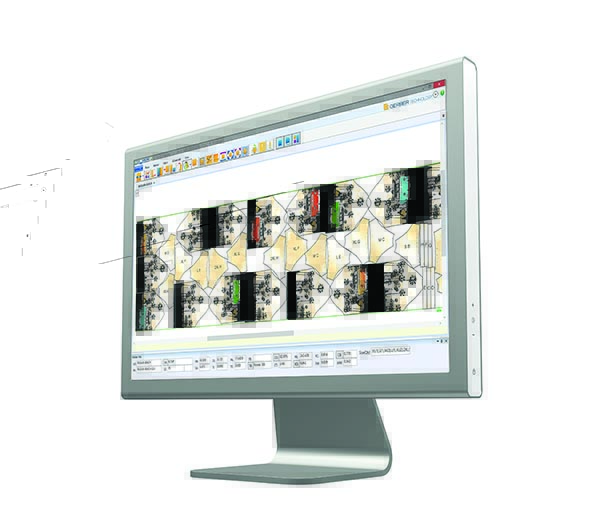
Marker Making with AccuMark
WTT: What about 3D? Do you integrate 2D and 3D in any way?
MM: Yes, we also take those 2D patterns and create a 3D simulation. This is helpful if, for example, if there is a flower that needs to be accurately positioned on a garment. You can do your graphical alterations in the 3D view and save changes back to the 2D pattern, and then send it back to the marker. We put the 3D workflow inside of AccuMark 2D PDS so the pattern maker works in same environment to do it all, including placement of stitching, etc. One interesting approach is to generate the simulation using the Blender open source app. We have many customers who are already using Blender; it’s a large and vibrant community.
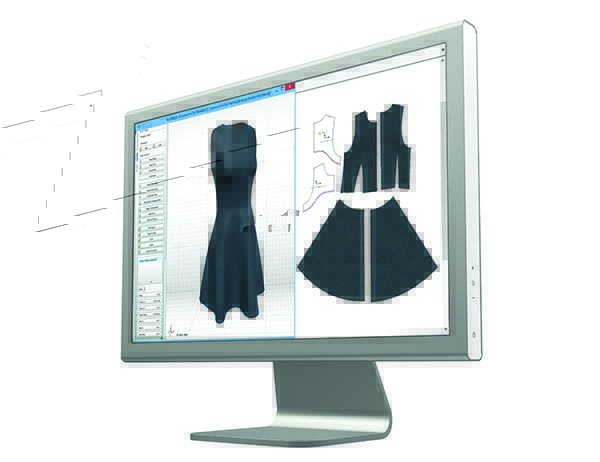
3D Marker Making
KN: The 3D simulator is not a standalone application. There is a lot of opportunity and savings potential for virtual sample management by simulating 2D patterns in 3D before making physical samples. But the core 3D simulation engine also empowers things like virtual try-on in ecommerce, where you can take that same simulation and plug it into website so that consumers can look at a 3D simulation. They want that experience, and we have partners that do 3D product configs you can use on websites. Our view is there needs to be integration across the various steps of the process, and we are working with our partners to make that happen. There are many applications where users want to take the 3D rendering and do other things with it, such as photo-realistic rendering work or for ecommerce. So, the 3D simulator needs to be easily consumable by other tools where it doesn’t make sense to use the same interface you would in pattern-making. The goal of our technology roadmap is to reduce friction points, especially for pattern makers, but across the entire product creation cycle.
WTT: I have read that you are working with folks like X-Rite on advanced scanning technologies to build digital material libraries.
MM: Yes, we have met with both X-Rite and Vizoo and will be integrating both solutions into AccuMark. That’s not commercially ready yet; it’s still in development. But we will be able to import the output of either of those systems into our fabric information to leverage it in 3D simulations. Today we can take the output of their systems, but we are working on an automated connection between the two systems. We recently released Version 11, and this integration is scheduled for Version 12 in the fall.
WTT: Can you provide an example of a customer that is using the 2D/3D aspects of AccuMark?
MM: GStar Raw is a great example. They are using AccuMark for pattern design. They want to reduce physical samples, and with AccuMark they have the possibility to virtually simulate their products using 2D pattern data. GStar chose AccuMark because our vision for 3D was aligned with theirs. They didn’t want a 3D product that just created pretty pictures. The ability to produce 3D simulations that can be made in real production through seamless integration with 2D patterns was critical to them.
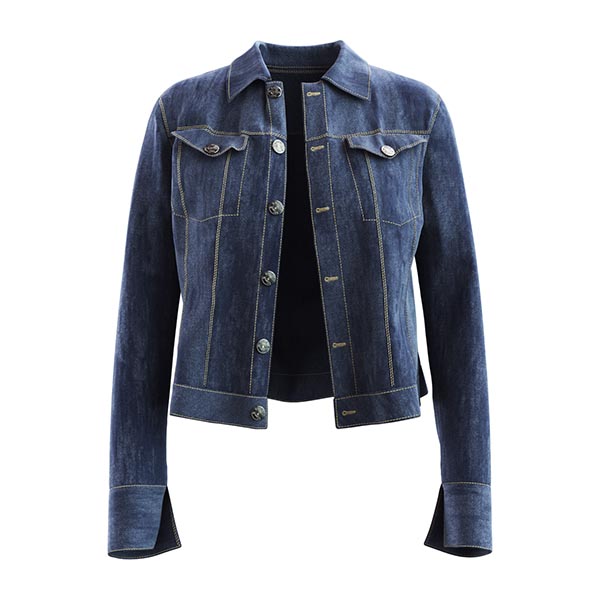
GStar Jacket