WhatTheyThink

Premium Commentary & Analysis

Economic Round-Up, Factory Orders, Productivity, Tribute to Bryon Ramseyer

Economic Round-

Friday, November 07, 2003

Economic Round-Up

Last week’s big jump in GDP sent most everyone into a tizzy, and as I said in last week’s column, there is a good chance it will be revised down. Even then it will be a stunning performance. And there is always the outside chance that it could actually be revised upward. That would be scary.

This has been a busy week for economic news beyond the GDP report, and we’ll be covering a number of items this week. Links to data and reports that are referenced are provided at the end of the column. So here we go.


The Institute for Supply Management’s manufacturing report was stronger than expected, and promises further strength for the months ahead. Production and new orders were very strong, and inventories were considered to be too low both for the manufacturers and their customers. Those inventories will have to be replenished. Employment in manufacturing was still contracting, indicating that some the upcoming productivity numbers would be quite good, and they were.

The ISM also released a global manufacturing report, and that was very positive as well, at its highest levels in three years. Some non-U.S. economies are starting to "warm," indicated by the fact that central banks in Australia and the UK increased their interest rates this week.

The advance GDP data do not yet include corporate profits, which will be available in another month or so. But in both the GDP and personal income reports, there is an important gauge of the health of small business—"proprietor’s income,"—which also had a marvelous showing, up 3.6% from the previous quarter, as depicted in Figure 1.


This is important for several reasons, one of which is not so obvious. Of course, the increase is a sign of economic recovery. It also tells us that something is wrong with the way we look at unemployment data. For months now, there has been a big gap between the data contained in payroll reports and what is called the "household survey." The latter is where the Bureau of Labor Statistics contacts households and asks if anyone is seeking work. The payroll data are from businesses filing Social Security tax withholdings.

Both the household survey data and the increase in proprietor's income indicate that new businesses are being formed, often by discouraged workers. This is quite good for the economy. A recent survey conducted by Federal Express indicates a great desire on the part of a large portion of the U.S. population to own their own businesses. In the 1980s, a growing economy stimulated growth in the number of businesses, so much so that government agencies had to constantly readjust their data in order to keep up. What happened then, and what appears to be happening now, is that new businesses are being formed that are not large enough yet to have their own payrolls. This is a reason to be skeptical of unemployment reports, because these sole proprietors will not show up in the government payroll reports for many months, if at all.

The increase in productivity over past quarters (discussed below) and other employment data (such as that in the Conference Board and Institute for Supply Management) indicate that corporations are reluctant to hire additional employees when they have to increase salaries to share productivity gains and also cover increased benefit costs, especially health care. There is also great pressure to keep newly-earned breakeven points low, and adding more employees is not in that calculus. Large companies will be employment laggards in this economy. The Challenger survey of major companies projects that more than 170,000 jobs are yet to be cut. Corporate belt-tightening is still well-entrenched.

The other factor in play here is that corporate downsizing is especially helping the service sector as more services are outsourced in lieu of having these jobs performed by employees. The ISM non-manufacturing report was higher than expected, and new orders and employment (what? more jobs? yes!) were the strongest gainers in their index. The strongest sectors were health services, entertainment, utilities, finance & banking, and retail. This means that the planned cutbacks by corporations that make up the bulk of the Challenger survey on layoffs will be counterbalanced and exceeded by new jobs created in the service sector. I think that the Challenger survey includes a great deal of pessimism about the nature and sustainability of the economic upturn, and that the dour assessment is overdone.

Initial jobless claims reported on Thursday fell to 348,000, a decrease of 43,000 from the prior week. The bulk of this probably came from hiring by small and mid-size businesses, especially in the services sector.

Factory Orders

It may be interesting to look at all of these data from a general economic perspective, but when will our industry see all this prosperity everyone else seems to be enjoying? The good news is that printing and print service shipments increased by $140 million in September compared to August. Though this was down from September 2002, in recent years September has been a slower month than August, so this increase is a departure from our often depressing sales pattern. My suspicion is that retailers were prepping for a strong holiday season, getting catalogs, newspaper inserts, and direct marketing promotions ready for an advertising and promotion bombardment of consumers. I had thought an increase was not likely until the October data, so this was encouraging. Is the freefall over? I suspect it finally is, for now at least.

The chart below shows my inflation-adjusted 12-month moving total of industry shipments for 2001 to September 2003. Each data point is an annualized total of what the previous 12 months’ shipments would have been. The difference between the years is quite evident, but the 2003 line will finally start to flatten if the slight September uptick is to be believed and is repeated in October and November shipments data.

Figure 2


Continue reading your article
with a WhatTheyThink membership.

WhatTheyThink Annual Membership

Less than $4/week.

Get unlimited access to in-depth commentary and analysis covering the latest trends, emerging technologies, operational strategies, and key events across every segment of today's printing industry.

Stay informed. Stay competitive. Stay ahead.
WhatTheyThink Day Pass

$5 for 24 hours

Unlimited access to all of WhatTheyThink. Get your Day Pass

Already a member?
Sign In

About Dr. Joe Webb

Dr. Joe Webb is one of the graphic arts industry's best-known consultants, forecasters, and commentators. He is the director of WhatTheyThink's Economics and Research Center.

Recent Articles from Dr. Joe Webb

Big Printers' Writedowns and Interest Payments Are a Big Drag on Printing Industry Profits

Big Printers' Writedowns and Interest Payments Are a Big Drag on Printing Industry Profits

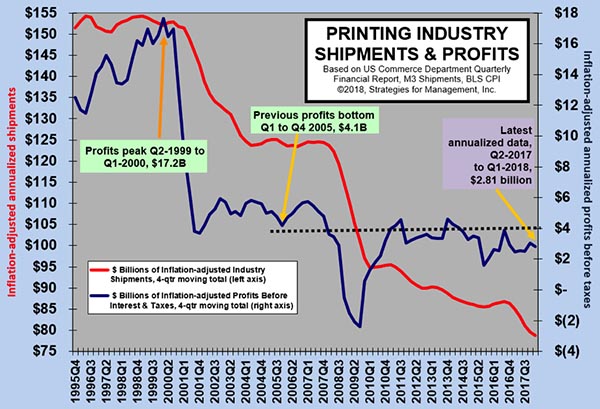
Writedowns in the first quarter of 2018 for commercial printers with $25 million or more in assets were $157 million, or 1.9% of sales. The assets may be written down, but the borrowing that was created to finance them remains. Interest expense was 4.8% of sales. For the quarter, losses were -1.47% of sales. That rate of loss made average profits before taxes for the industry a mediocre 3% of sales—which means that printers with less than $25 million in assets must have done well. Read More

The Final Column: The Security Guard Will Take Your Badge and Escort You to the Lobby

Back in 2002, Dr. Joe agreed to do a regular column for WhatTheyThink for “only one year and no more”...for 15 years. This farewell column explains how it started, behind-the-scenes intrigue, the problems, and why it turned out the way it did. And then…he explains the exciting adventures ahead. Read More
Full-Time Employment, Sets New Record, Up +904,000, But Does It Really Feel that Good?

Full-Time Employment, Sets New Record, Up +904,000, But Does It Really Feel that Good?

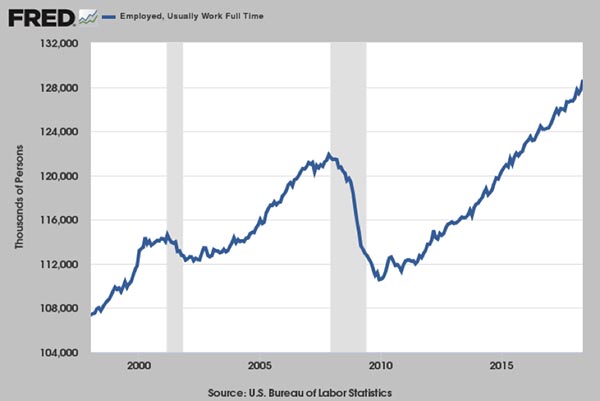
The May employment report was regarded as good, but when you dig past the top-level numbers, it was better than it looked. However, while the 3.8% unemployment rate looks good on the surface, it really can’t be compared to when it was last attained nearly 20 years ago. So many workers left the workforce that this figure implies a tighter labor than it really is. We will really know we have a strong economy when the active labor force starts increasing. Read More

Good News Could Be a Full-Time Job, but for Most Economists It’s Only Part-Time

Some people say that the news is always bad, and they wish someone would report good news now and then. There is good news but no one seems to report it. You’d think that would be a full time job for someone. The economy has set a record for full time employment, and all we hear are crickets. The economy has been doing better lately in some key measures of employment, but the Fed is scaring markets by preparing to raise rates. TINA, meet TAMA, the result of the Fed’s actions; don’t worry, we’ll explain it. The statisticians at the Commerce Department revised printing shipments data. Revising data seems to be a full time job in the Beltway. Dr. Joe clarifies it all for one nearly last time. Read More
Consumer Durable Goods Orders Moving at Almost 2X GDP Rate

Consumer Durable Goods Orders Moving at Almost 2X GDP Rate

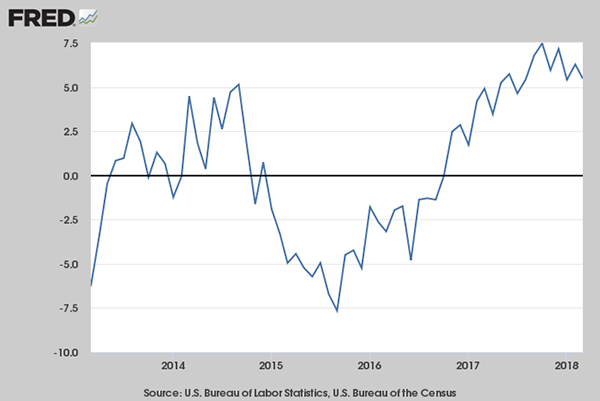
Durable goods orders for consumers (less transportation) are growing at a rate almost two times faster than Real GDP. This data series remains -14% below where it was at the start of the recession in December 2017, and is a critical one to monitor for indications of an improved economy. Read More