WhatTheyThink

Premium Commentary & Analysis

Personal Print Job: Today's Web-to-print Automates Artwork Production

Developments in web-to-print are moving the industry toward automated artwork generation, says Sean Smyth of Digital Demand World, the publication for the digital print industry.

Tuesday, December 11, 2012

Web-to-print systems have been around since the first e-commerce boom in the late 1990s – and have been steadily increasing their share of the commercial print market since. The capabilities include ordering static products from stock via an online shop; or more sophisticated templating systems that allow buyers to customise print products, such as business cards, stationery, and point-of-sale items. The process functions include user administration, order processing and approval process, payment, shopping cart, and dispatch.

Processes that traditionally took place after discussion with sales and customer service reps at printers can be implemented by customers, who have to take an active role. When it works well the customer is guided through the necessary steps by a self-explanatory system. This can also be a drawback though: often printers will report, with some surprise, low levels of acceptance by customers – but this is changing as e-commerce becomes more common.

Intuitive
For business-to-business applications it is necessary to provide support and training for users. Systems should be designed to be easy and intuitive to use. If a consumer application is planned, then getting the message out to potential customers is critical; but this can be difficult to achieve, as there is now a lot of competition for online print. The successful suppliers have used the technology to open new print markets, allowing individuals and micro-businesses to specify and order professional print at reasonable prices.

The burgeoning photobook market is a good example of the new markets enabled by web-to-print. The declining analogue photo-processing sector developed its online design and ordering software, and fostered a $5 billion (€3.8 billion) marketplace for photo products. These range from a simple 10cm x 15cm photo, to albums and yearbooks, and even large-format canvas prints.

In some cases the early adopters have built significant businesses using the technology, with Vistaprint probably the leading example. The printer was one of the first to spot the opportunity of selling to individuals via the Internet, and subsequently invested heavily in promotion and advertising. Today it is one of the fastest-growing print companies, with a 2011 turnover of around $817 million.

Vistaprint uses web-to-print and slick workflow for long-run, low-cost economics to short-run production jobs that it identifies as a $25 billion market. The company delivers a range of branded and promotional products.

Vistaprint flyer design screenshot. Source: Vistaprint

In Q3 2011 the company acquired 1.9 million new customers, processing 5.9 million orders at an average value of $36.38. The firm recorded a total unique customer base of 11.9 million. Vistaprint is developing new opportunities, pushing an easy-to-use application on Facebook, which gives users the opportunity to create a printed calendar, with photos and reminders of important dates. This brings in the account information – including tagged photos, profile images and friends' birthdays – to create a basic design that can be further customised and bought easily in a few clicks.


Continue reading your article
with a WhatTheyThink membership.

WhatTheyThink Annual Membership

Less than $4/week.

Get unlimited access to in-depth commentary and analysis covering the latest trends, emerging technologies, operational strategies, and key events across every segment of today's printing industry.

Stay informed. Stay competitive. Stay ahead.
WhatTheyThink Day Pass

$5 for 24 hours

Unlimited access to all of WhatTheyThink. Get your Day Pass

Already a member?
Sign In

About Sean Smyth

Sean Smyth is print consultant at Smithers Pira, the worldwide authority on the packaging, paper and print industry supply chains. Sean has spent over 25 years in the industry in senior technology positions for a variety of print businesses across the supply chain, in hands on and consultancy roles. He helps companies make money through the appropriate use of technology.

Recent Articles from Sean Smyth

After the Flood: BOBST Opens New Competence Center in Florence, Italy

After the Flood: BOBST Opens New Competence Center in Florence, Italy

Sean Smyth reports from the opening ceremony at BOBST’s new 1,200 square meter Competence Center in Florence, Italy, where they showed off six of their label, flexible packaging, and carton presses. Read More

Musings on drupa, 2024

Industry analyst Sean Smyth offers some initial impressions of drupa 24.   Read More
Global Perspectives: Print in Western Europe

Global Perspectives: Print in Western Europe

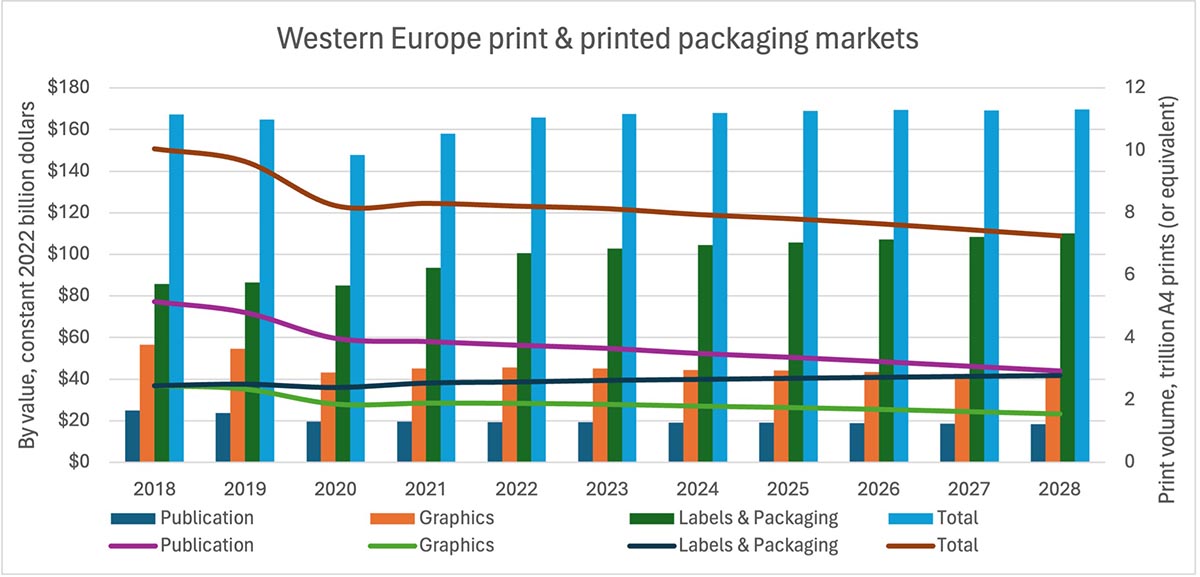
Each edition of the drupa daily featured a Global Perspectives article that looked at the state of the printing industry in a specific nation or region. In this article, Sean Smyth profiles Western Europe. Read More

PCMC to Host Two Exciting Open House Events in Packaging Innovation Center

PCMC to Host Two Exciting Open House Events in Packaging Innovation Center

Smithers Analyst and Consultant Sean Smyth talks to Windell Mcgill of PCMC about two recent open houses they'll be hosting in their Packaging Innovation Center in Green Bay, Wis. Read More

The Whole Package: From Economics to Ecology, What the Does the Future Hold?

The Whole Package: From Economics to Ecology, What the Does the Future Hold?

Contributor Sean Smyth looks into his crystal ball at what the future of packaging production will entail, from trends in sustainability to automation and robotics, and more. Read More