WhatTheyThink

Premium Commentary & Analysis

Business Development Is Not a Sales Lead Qualification Process

In Part One of this two-part column, Dr. Joe explains how the changing dynamics in the printing industry are dynamically changing the sales process. It used to be that a sales call didn't need to start with explaining print-everyone already knew what it was, and the needed it. Not so much today…successful businesses are increasingly turning to business development practices. This is much more than sales lead generation and that will be the topic of Part Two.

Monday, November 26, 2012

Project after project, year after year, print business owners have always indicated in surveys and in discussions that their biggest challenge was finding ways to increase sales... now!

This is understandable. The stereotypical print business had high levels of debt, and if small or mid-sized, their cash flow made many of their decisions for them. This gave rise to industry maxims like, "If we're busy, we must be making money." This meant that the evaluation of new equipment purchases was based not on the return on investment as taught in financial textbooks (profit / investment), but rather, based on the payback period for that investment. This translated to how much time the increased cash from the new equipment would take to pay back its purchase price, to be "free and clear." If the equipment was leased, then the concern would be the minimum revenue required to surpass its monthly payment. Covering the monthly costs was critical for these businesses. Gaining new business, even on a contribution-margin basis (pays for costs of production plus a contribution to fixed costs), was worth it if it was determined that the pricing would not spread to core customers.

In markets with rising demand, or niches that are rising, these actions had little downside. Growth always covers most of management's minor sins. Declines in demand turn minor sins into deadly ones, however. Fixed costs become more exposed, and obsession with cash flow becomes a panic.

No one really appreciates how difficult the sales profession really is until demand declines or products offer new competition. Sales is a skill, despite its reputation. When you meet good sales people, you know it. Despite the reputation for hard-driving, opportunistic, hard-partying types, great sales people always knew more about their customers than their competitors, including their personal lives (in some cases, this might be unfortunate). This was more than "let's go to lunch," or "let's go out on my boat," but sincerity beyond glad-handing. It was not always possible with every customer, but with enough of them. Customers would rely on their sales people for information about what was going on in the industry, with competitors, with others. The aggregate actions of sales people helped keep the industry together. Some was idle chatter and gossip, some true and some not; but in the end, it could be dignified as industry intelligence. Customers and sales people developed a symbiotic relationship of trust and reliance.

Stable industries fostered these kinds of relationships. Upheavals of change can destroy them. Rampant sales force turnover means that every sales cycle starts new, every ounce of sales productivity is difficult.

When the use of print was standard, there were accepted formats like brochures, mailers, catalogs, newsletters, and other common forms. Print client and sales representative had a common language because the applications were similar from client to client. Mailing regulations standardized many of those procedures and formats. Only the content changed.

Everyone knows the digital media story and what happened next. The common language of print was not as common anymore, and replaced by jargon that seemed to change hourly. The full-time print buyer is disappearing except in the most print-reliant and biggest budget situations. Most print executives have not fully realized that the nature of the sales process has changed radically. The common language of print was established decades before. Even if you joined the industry in the middle of the 20th century, the change was gradual enough from hot type to cold type, letterpress to offset, etc., because the industry was in charge of the changes. Its language was its own, and it was easy to adapt. Because buyers did not have access to content production technology, which changed with desktop publishing, they had to adapt to our jargon, and if they wanted something printed, they had to adapt to our process. Print buyers expected that because they needed to use print.

Now, print is one option among many. Communications professionals are focused more on results and less on media production processes. The nature of the sales process is markedly different with a client who must use print compared to someone with numerous other options, and more choices than budget.

Cold calls to print buyers were usually designed to introduce a particular print business and its sales representative to the prospect. The cold call was rarely to introduce the concept of print, because the prospect already knew about it.

Times have undeniably changed. There are new communicators who are using multiple media for their businesses every day. Print? What does it do? I'm getting along fine without it. Show me, and I'll think about it.

Many print businesses are now focusing on "business development." In my experience, these printers are already healthier than typical, and are unlike their panicked cash flow competitors. They have realized that there is a new sales cycle.

In my next column, I will address what this sales cycle is, and why it's not "sales lead qualification." Business development is not just tangibly different, it's strategically different. It's more than hiring a marketing person who may have worked in an ad agency. It's more than hiring someone experienced in a niche or "silo." It's a long-term strategy that affects all aspects of company management, when done right.

My How Things Have Changed...

One of my favorite daily destinations is the Woot! website. The company is now owned by Amazon, but still retains its smart-alecky culture and its strategy of offering just one product for sale a day (it now "cheats" by having multiple Woot sites). It is known for its creative and funny product descriptions. It recently offered a laptop computer special with the comment "they're smart phones, but bigger." It's a subtle reminder that iPhones and other smartphones are computers. Telephony is just another computer application that the little computers run.


Continue reading your article
with a WhatTheyThink membership.

WhatTheyThink Annual Membership

Less than $4/week.

Get unlimited access to in-depth commentary and analysis covering the latest trends, emerging technologies, operational strategies, and key events across every segment of today's printing industry.

Stay informed. Stay competitive. Stay ahead.
WhatTheyThink Day Pass

$5 for 24 hours

Unlimited access to all of WhatTheyThink. Get your Day Pass

Already a member?
Sign In

About Dr. Joe Webb

Dr. Joe Webb is one of the graphic arts industry's best-known consultants, forecasters, and commentators. He is the director of WhatTheyThink's Economics and Research Center.

Recent Articles from Dr. Joe Webb

Big Printers' Writedowns and Interest Payments Are a Big Drag on Printing Industry Profits

Big Printers' Writedowns and Interest Payments Are a Big Drag on Printing Industry Profits

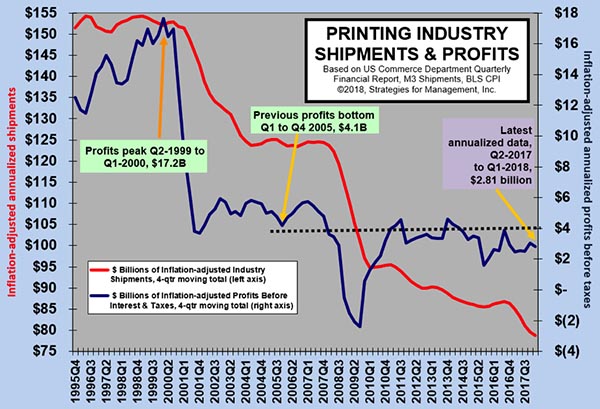
Writedowns in the first quarter of 2018 for commercial printers with $25 million or more in assets were $157 million, or 1.9% of sales. The assets may be written down, but the borrowing that was created to finance them remains. Interest expense was 4.8% of sales. For the quarter, losses were -1.47% of sales. That rate of loss made average profits before taxes for the industry a mediocre 3% of sales—which means that printers with less than $25 million in assets must have done well. Read More

The Final Column: The Security Guard Will Take Your Badge and Escort You to the Lobby

Back in 2002, Dr. Joe agreed to do a regular column for WhatTheyThink for “only one year and no more”...for 15 years. This farewell column explains how it started, behind-the-scenes intrigue, the problems, and why it turned out the way it did. And then…he explains the exciting adventures ahead. Read More
Full-Time Employment, Sets New Record, Up +904,000, But Does It Really Feel that Good?

Full-Time Employment, Sets New Record, Up +904,000, But Does It Really Feel that Good?

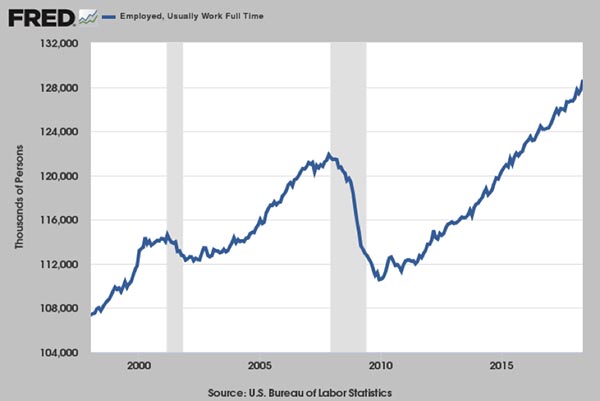
The May employment report was regarded as good, but when you dig past the top-level numbers, it was better than it looked. However, while the 3.8% unemployment rate looks good on the surface, it really can’t be compared to when it was last attained nearly 20 years ago. So many workers left the workforce that this figure implies a tighter labor than it really is. We will really know we have a strong economy when the active labor force starts increasing. Read More

Good News Could Be a Full-Time Job, but for Most Economists It’s Only Part-Time

Some people say that the news is always bad, and they wish someone would report good news now and then. There is good news but no one seems to report it. You’d think that would be a full time job for someone. The economy has set a record for full time employment, and all we hear are crickets. The economy has been doing better lately in some key measures of employment, but the Fed is scaring markets by preparing to raise rates. TINA, meet TAMA, the result of the Fed’s actions; don’t worry, we’ll explain it. The statisticians at the Commerce Department revised printing shipments data. Revising data seems to be a full time job in the Beltway. Dr. Joe clarifies it all for one nearly last time. Read More
Consumer Durable Goods Orders Moving at Almost 2X GDP Rate

Consumer Durable Goods Orders Moving at Almost 2X GDP Rate

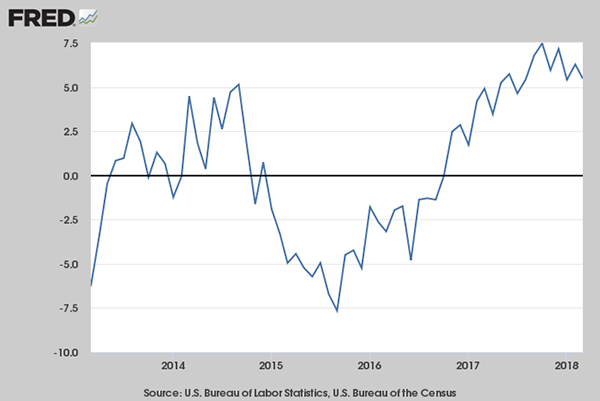
Durable goods orders for consumers (less transportation) are growing at a rate almost two times faster than Real GDP. This data series remains -14% below where it was at the start of the recession in December 2017, and is a critical one to monitor for indications of an improved economy. Read More