WhatTheyThink

Premium Commentary & Analysis

Hunker Down Financially, Market Aggressively

Dr. Joe explains the bearish outlook for the economy but explains how the advertising agency business has been rising and adding employees. It's important to know who your competitors are, especially in terms of an overlooked factor in decision making, the cost of failure, which sometimes trumps common sense.

Monday, September 26, 2011

Nearly 200 printing industry professionals took time out at a busy Graph Expo to attend our annual breakfast meeting, sponsored by manroland. This was the 9th year WhatTheyThink and manroland have sponsored this popular event.

Missed it?  No worries. Download audio and visuals (no fee or registration required).

The general economy is having problems again, and the confusing signals that it produces should not be that confusing. We're bouncing along a bottom, and the risks of recession are becoming more broadly accepted.

I'm still tiring of the constant drumbeat that "uncertainty" is what is causing businesses to be reluctant to expand or hire. It's exactly the opposite. It's dead certainty. All businesses know that tax rates are rising, they know that it will be more expensive to hire employees and include benefits, and they know that inflation or erosion of purchasing power are ahead of them. All of these are matters of fact or law, and there's nothing uncertain about them.

The snapshot of our macroeconomic indicators tell the tale. GDP is well below the post-WWII average of +3.4%, and even below the sub-par levels of the last decade (+1.6%), as well as below the decade prior to the start of the recession (+3.0%). The final revision of Q2 GDP will be released on Thursday, September 29, and it should be in line with the last release of +1%.

As followers of this column know, we prefer to use the year-to-year comparison for economic reports. The Bureau of Economic Analysis reports GDP as an annualized figure compared to the prior quarter. This can be misleading because of the extent of the revisions they make every month, but comparing the 3-month and 6-month trends with the Y-Y one can give a sense of the underlying trends.

Productivity remains higher than GDP, so we know that national employment will not be improving. When GDP is greater than productivity, only then do companies start to hire. The productivity data indicate that businesses continue to focus on efficiency rather than expansion. Until that changes, employment will contract in many businesses and industries.

Lately, inflation has started to slow, but the Y-Y comparison shows some figures of great concern. The key number here is real earnings. The inflation rate may be slowing, but earnings are going down. Workers are being paid less, and what they are being paid is eroding in purchasing power.

Why are earnings so bad when productivity has been mildly good? That productivity is never being seen by workers because it is being used to pay for increased costs of production materials and other factors that affect operating businesses. (Personal anecdotal report: my consulting practice just had a +30% increase in medical insurance; other businesses are grappling with similar changes).

These indicators do not bode well for the economic outlook. Yet, there are some prognosticators who believe that the economy will rebound.

There are some economic forecasters who rely on interest rate levels as a gauge of future economic growth. The Leading Economic Indicators published by the Conference Board is one of those models, but there are many others. Because these models rely so heavily on interest rate levels, they can't be trusted. A common forecasting rule of thumb is the shape of the yield curve. That is, when short-term rates are lower than long-term rates, it is bullish for the economy. When it is the other way around, it is bearish. Because the Fed actions have been so grand, these rules of thumb and quantitative models built on them are prone to give false signals of any direction. Now that the Fed will be working to bring down longer term rates, false signals may increase.

It is likely that a recession is already underway, and that real earnings are already showing it. Instead of classical inflation, we are seeing an erosion in purchasing power that has the same result: goods are more expensive to buy.


Continue reading your article
with a WhatTheyThink membership.

WhatTheyThink Annual Membership

Less than $4/week.

Get unlimited access to in-depth commentary and analysis covering the latest trends, emerging technologies, operational strategies, and key events across every segment of today's printing industry.

Stay informed. Stay competitive. Stay ahead.
WhatTheyThink Day Pass

$5 for 24 hours

Unlimited access to all of WhatTheyThink. Get your Day Pass

Already a member?
Sign In

About Dr. Joe Webb

Dr. Joe Webb is one of the graphic arts industry's best-known consultants, forecasters, and commentators. He is the director of WhatTheyThink's Economics and Research Center.

Recent Articles from Dr. Joe Webb

Big Printers' Writedowns and Interest Payments Are a Big Drag on Printing Industry Profits

Big Printers' Writedowns and Interest Payments Are a Big Drag on Printing Industry Profits

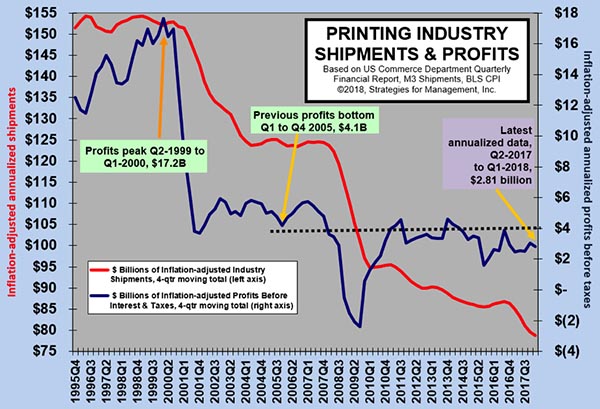
Writedowns in the first quarter of 2018 for commercial printers with $25 million or more in assets were $157 million, or 1.9% of sales. The assets may be written down, but the borrowing that was created to finance them remains. Interest expense was 4.8% of sales. For the quarter, losses were -1.47% of sales. That rate of loss made average profits before taxes for the industry a mediocre 3% of sales—which means that printers with less than $25 million in assets must have done well. Read More

The Final Column: The Security Guard Will Take Your Badge and Escort You to the Lobby

Back in 2002, Dr. Joe agreed to do a regular column for WhatTheyThink for “only one year and no more”...for 15 years. This farewell column explains how it started, behind-the-scenes intrigue, the problems, and why it turned out the way it did. And then…he explains the exciting adventures ahead. Read More
Full-Time Employment, Sets New Record, Up +904,000, But Does It Really Feel that Good?

Full-Time Employment, Sets New Record, Up +904,000, But Does It Really Feel that Good?

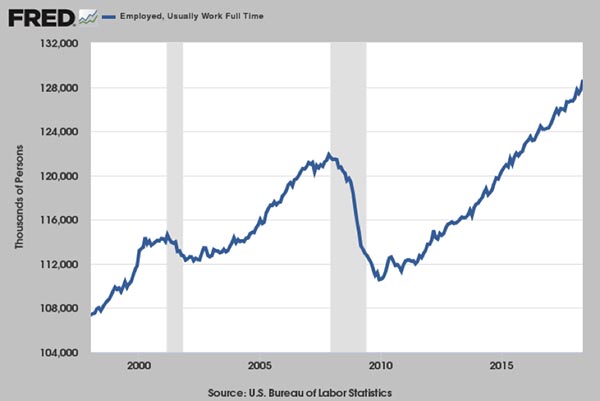
The May employment report was regarded as good, but when you dig past the top-level numbers, it was better than it looked. However, while the 3.8% unemployment rate looks good on the surface, it really can’t be compared to when it was last attained nearly 20 years ago. So many workers left the workforce that this figure implies a tighter labor than it really is. We will really know we have a strong economy when the active labor force starts increasing. Read More

Good News Could Be a Full-Time Job, but for Most Economists It’s Only Part-Time

Some people say that the news is always bad, and they wish someone would report good news now and then. There is good news but no one seems to report it. You’d think that would be a full time job for someone. The economy has set a record for full time employment, and all we hear are crickets. The economy has been doing better lately in some key measures of employment, but the Fed is scaring markets by preparing to raise rates. TINA, meet TAMA, the result of the Fed’s actions; don’t worry, we’ll explain it. The statisticians at the Commerce Department revised printing shipments data. Revising data seems to be a full time job in the Beltway. Dr. Joe clarifies it all for one nearly last time. Read More
Consumer Durable Goods Orders Moving at Almost 2X GDP Rate

Consumer Durable Goods Orders Moving at Almost 2X GDP Rate

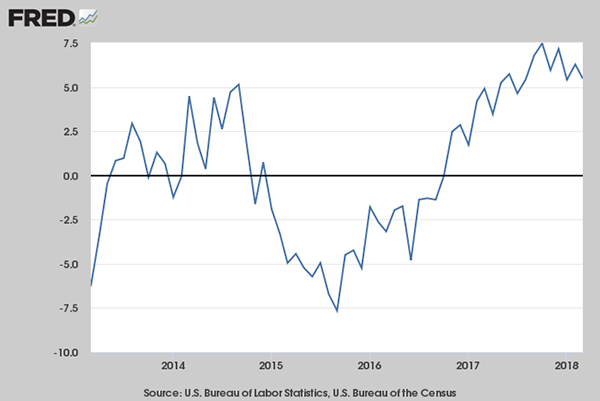
Durable goods orders for consumers (less transportation) are growing at a rate almost two times faster than Real GDP. This data series remains -14% below where it was at the start of the recession in December 2017, and is a critical one to monitor for indications of an improved economy. Read More


Recent Printing Industry News

Wednesday, June 03, 2026