(Note: this is a two-part report; Part Two will appear on July 11)
A year ago, a trade association publication carried an article by a graphic arts equipment CEO refuting the claims of a Barrons article that the iPad would usher in a new era for media. It's been almost a year since the article appeared. I've been wanting to write about the CEO's rebuttal since I first read it. Now, with the luxury of almost a year since it appeared, my sentiments are the same now as they were then. The CEO wrote nothing outlandish, other than to dispense some healthy skepticism.
"The idea that everyone will have an electronic device through which they access journalistic content is intriguing from a theoretical standpoint, but unproven from a practical one. Compatibility, formatting commonality and reliable distribution are significant hurdles."
I found this a bit hard to believe when I first read it. Immediately, I imagined the rise of the phone against the telegraph, radio against newspapers, television against radio, and the Internet's rise against all traditional media. Every single one of these media shifts required the purchase of a device. Because none really replaced the other, consumers ended up having multiple devices, and seemed just fine with it.
Computer and communication devices today are practically free in the sense that they save people time and transportation because of their instant access to the information and transactions that they want, no matter where they are at the time. They are paid for by their productivity and convenience in comparison to previous approaches. People pay for content such as cable programming, and they also pay for access, such as telephone or Internet service. They are also used to "free" content, such as broadcast radio or television, and pick and choose or ignore or abandon as they like, just like they always have.
As far as formatting compatibility and commonality problems, even those are going away. Sure, Steve Jobs didn't like Flash when the iPad came out, but compatibility of devices today is at historic levels. Gosh, even people with PCs and Macs get along today, almost seamlessly. In cloud computing (which started with the phrase "the network is the computer" a couple of decades ago), the only compatibility of concern is how well your browser works, and the operating system used becomes more irrelevant every day.
These times are not like the progression of print, radio, television, cable, Internet. This is not just about devices. It's the wide range of formats and rampant co-existence of today's information technologies, and how even old technologies are compatible with new ones. Radio? It's live and podcast and streamed. Television? It's broadcast, DVR'd, streamed, DVD'd, with highlights on YouTube (more people saw Tina Fey's Sarah Palin act online than ever saw it on television). It's accessed on home entertainment systems, desktops, notebooks, netbooks, tablets, smartphones, and other devices. Even the things that we have always known as singular media are not any more. It is a mistake is to think one device is what people need to purchase to access a particular medium. It is far simpler than that: it's whatever device they want it on. Just like households are abandoning their landlines in favor of cellular, households are abandoning cable in favor of wireless and broadband and cellular. Any place, any time, any device, whatever the user wants, whatever provides them the greatest convenience at a cost they prefer.
Just think: a single device is now used to access live radio or television (via streaming), stored audio and video are easily accessed, books and documents are conveniently retrieved or purchased. That same device can also tell you where you are geographically and then be used to provide information about transportation or destinations that are nearby. It's the same device! This would not be possible unless formatting and other issues were being addressed.
It's all about getting content to individuals, and even creation of that content is becoming easier and less expensive. This is all occurring at the very same time that media choices are becoming more numerous and sometimes more bewildering.
When Adobe started to sell its Creative Suite years ago, it was essentially comprised of Illustrator, Photo Shop, and something "new" called InDesign, and was supplemented by the GoLive product. Today's latest suite now includes 18 programs, enabling creators to get their content into formats needed for all the latest devices, from handheld to large screen televisions.
Regarding journalistic content, we are now swamped with content, with much of it more compelling than the drab traditional media. Often old media are taking their cues from what's online, with many stories in newer media groundswelling to national prominence, catching the old guard by surprise, and forcing them to report on it.
The following chart is from the State of the Media report of the Pew Research Center. It shows the change in media use just from 2009 to 2010. In 2010, online advertising surpassed those of the newspaper industry for the first time. Dollars follow the where the audience goes, as always.
More from our equipment manufacturer CEO a year ago: "Simple economics present an even more imposing barrier. The elimination of printed journalism could render that journalism – and its essential role in society – accessible only to those with the means to invest in relatively expensive electronic devices and to reinvest continuously to avoid obsolescence."
Barriers tend to be cultural and age related in developed countries, but those are falling rather quickly. In the non-developed countries, their use of traditional media was low as well. All media were too expensive. Quite interestingly, however, there is recent research about poverty in developing countries, and how citizens are often choosing to buy communications products sooner than they would use their money to buy food. Fighting boredom and increasing social activity may be stronger motivations than originally thought, and these consumers often save money that would have been spent on food to have these social connections.
There is an important distinction about journalism that should be made here. Printed journalism has no essential role in society, but journalism does. It is easy to confuse the medium with the process; today, journalism is a concept that applies to many media. During World War II, print journalists were held in extremely high regard, but radio reporters on the fronts of war began to rise in esteem. When television came to prominence in the 1960s, print still had an edge, because video reporting took time and would be often out of date – films had to be shipped to studios, and live video required many resources and logistics. Now that satellite transmission of video files can be done in seconds, both live and edited video can be broadcast quickly. Just look at the Wall Street Journal online in today's format: It has live news shows and interviews in video. In the online world, everyone's a broadcaster, even those assumed to be print publications.
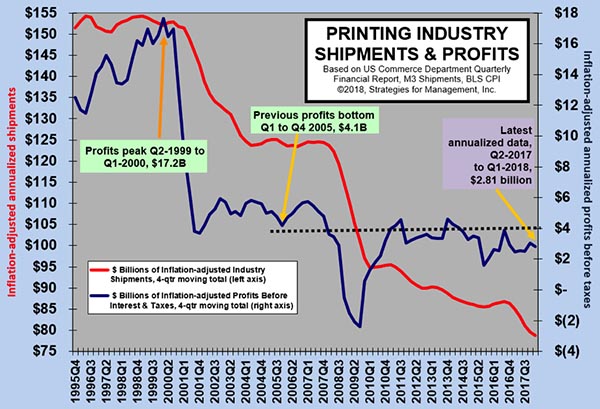
The cost of journalism is decreasing. The problem with the old journalism was that it had the old fixed costs, of buildings and office space for workers, and its reproduction and distribution systems, whether they owned them or hired others to do that for them. Workers were paid large salaries by the bigger publishers because those workers knew their production systems and workflow as well as their subject matter. As ad revenues have been decreasing, those fixed costs have been exposed in ways and at a rate that executives never anticipated. Since Netscape's IPO in 1995, U.S. employment in newspaper publishers has dropped from about 425,000 to 245,000, a decline of more than 40%, despite increases in population, households, and GDP since that time. Despite the decline in newspaper subscriptions, we are surrounded by news information more than ever.
Today, the workflow aspects of reporting news do not require special training and bureaucracies, and the reporting of news and analytic capabilities no longer have the high costs and barriers of the older organizations. Starting a new journalistic organization from scratch is far easier and far less costly than an old organization saddled with the concurrent unwinding of their obsoleted investments and business assumptions.
Publishing is essentially a marketing and distribution process for information: that's what all their fixed costs were created for. The marketing aspects are related to understanding the needs of audiences and assembling content in a manner that appeals to those audiences, creating a loyal population in which advertisers have interest. In terms of distribution, logistics of moving print were difficult and costly, just as handling any physical good would be. Those operations required significant investments, both in branding, and also in buildings and equipment.
Just look at what has happened in this past year, and very recently. Seth Godin, popular marketing author and new media guru, was frustrated by the lag time he was experiencing between submission of his book manuscripts and his books hitting the shelves, and has eschewed traditional publishing channels in favor of online venues and self-publishing. J.K. Rowling, creator of the Harry Potter franchise, announced that she would be starting her own business for the selling of e-format Potter texts, which were excluded from her original agreements with publishers. The old fixed costs of publishing have been turned on their heads, and authors are more in charge of their content than ever.
The movement to cloud computing is more important than most executives in our industry currently believe or understand. This will make the costs of devices lower and lower as they become more browser-based, and fewer applications need to reside in the devices themselves. Wireless and cellular networks will continue increase in speed, and their real costs will continue to decline. The range of content and conveniences that are available in these services will continue to rise in number and satisfaction. Cloud computing is still emerging, but will provide significantly better data security and communications reliability.
Fall 2011 through the holiday shopping season will see major product introductions that will further entrench the habits of digital media among consumers in all age groups. Surely, there will always be people who will not consider the services to be necessary or worthwhile; there were always holdouts against radio and television, and even phones. Those who choose not to use these technologies are not attractive to advertisers for other products either. But even if they choose to access the content in libraries or in the homes of others, they still benefit from the availability of digital media.
(Part Two will appear on July 11).
Dr. Joe's book, co-authored with Richard Romano, can be downloaded as a free PDF. Benefit from a different look at our industry and the business strategies needed to stay ahead. The download page has many other resources available for presentations, reports, and other uses... all for free.
Continue reading your article
with a WhatTheyThink membership.