Friday's unemployment report was certainly nothing to write home about. The ballyhooed increase of +268,000 private payroll jobs was met with the reality of a rise to 9% for the unemployment rate and decrease of -190,000 in the household survey, which includes self-employment and small business. The number of people not in the labor force went up by +131,000, not a good thing, and that same figure is more that +2.9 million than last year.
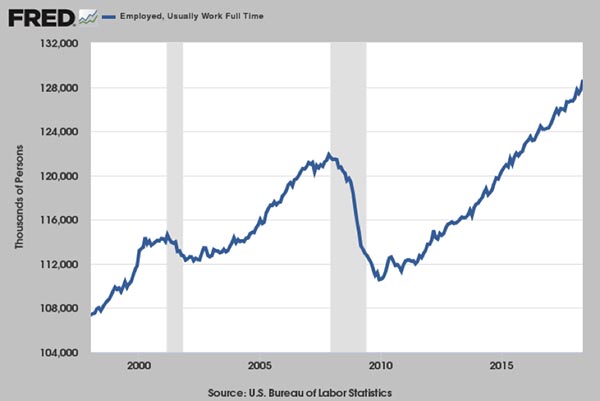
This latest report is still better than those of just a few months ago when the rate was 9.4%. There is, however, another issue. Because of the way the unemployment rate is calculated, it is common for a strongly recovering economy to result in a rising unemployment rate for a short time as more and more people re-enter the workforce. When those workers do, it takes about two or three months to absorb the additional workers before the unemployment rate starts plummeting. This is not happening; the labor participation rate is still at 25-year lows, 64.2%. Last year at this time, the unemployment rate was 9.8%, but there are only +290,000 more workers employed today than at that time, while the total workforce is down about -1.1 million.
There are obviously a lot of numbers being tossed around here, enough to make your head spin. So here's the recap: the unemployment rate is lower than it was last year because almost 3x the number of people have left the workforce than the increase in the number of employed workers.
Thursday's report of initial claims for unemployment, which occurred after the period covered by the employment report, took a surprisingly bad turn. It jumped +43,000 from the previous week, and reached an 8-month high; the more accurate 4-week moving average was 431,250, +22,250. Just weeks ago, this series was below 390,000. This does not bode well for May's unemployment report. The change was blamed on the damages from recent Midwestern tornadoes as well as the later than usual Easter holiday, which affected the timing of Spring break employment.
Earlier in the week, the Institute for Supply Management manufacturing report fell back a small bit, but is still indicating strong growth in this sector. Its non-manufacturing report was another matter. It showed a slowdown in the growth rate for these industries. The flattening out of the services sector may imply cutbacks in some corporate budgets as they pare some of their more discretionary expenses.
Productivity was reported as being +1.6% for the first quarter of 2011, but I prefer using their total output data for nonfarm businesses, which was +3.2%. I believe is a better match for judging future employment and business activity. When productivity is greater than GDP growth, employment growth will be lag or turn negative. This productivity is paying for increased costs of inputs such as raw materials. The productivity is not being used to pay workers, where it should be going, but has somehow escaped them for almost a decade.
Speaking of raw materials and commodities, it was widely viewed that last week's collapse in many commodities, especially silver, which dropped more than 25% in a week, was a sign that the rise in precious metals was just the actions of conspiracy-types, who were finally being punished for an unsustainable rally. There have been some speculative forces at work, but it is amusing that for some reason the speculative forces with short positions who make money when prices fall are rarely included in the conversation. Silver, sometimes called "poor man's gold," was considered undervalued in terms of its relationship to gold, and there have been many traders, as well as unsophisticated investors, who were playing the concerns about inflation and the supposed long-term ratio of gold and silver into profits.
Despite the drop in commodities, the underlying inflationary storyline is still in place. The Federal Reserve has been reluctant to act against the rise in commodities because they feel the prices will be self-correcting, as they were in the late Summer and Fall of 2008, when they also did not act. This is why they have been willing to stand up to the taunts of grocery shoppers when Fed executives have been claiming that inflation was tame.
The growth in the money supply that the Fed has engineered is still underway. Their "QE2" efforts expire in June, and the Fed has indicated that the effort will stop at that time. That's unlikely. First, they have expressed their intentions to replace maturing debt on their balance sheet by buying new debt. This means that they will still be buying bonds, aiming to keep interest rates as low as they are now. QE2 will be with us for quite some time, as a stealth QE3.
The drop in commodities prices in 2008 was part of the credit crisis that led to TARP and other actions to stem the drop in real estate prices. Money was pulled from wherever it was available: every asset class declined, and there was no safety in diversification. Those conditions are not the case now. The Fed bought many of those bad credit instruments and flooded the markets with more money. Commodities may pull back, but the Fed is unlikely to stop creating money. They are fearful that even more mortgages will be "under water" where the mortgage amount is greater than the value of the house it covers. As long as the Fed keeps trying to support the prices of these goods that were purchased a long time ago, there will be misallocations of resources away from the productive actions that create new goods and services. Part of that misallocation heads to where those resources can go most easily: into commodities.
Part of last week's decline in commodities was the realization that with just +1.8% GDP growth, there are unlikely to be increases in demand that would support those prices, making the run-up in prices look almost fully speculative. Many of the news reports about silver's decline attributed it to the increase in margin requirements for traders. It seems to me that so much money was made in recent months that taking profits seemed like the logical thing to do, especially in light of the rather disappointing economic news. Fear of inflation alone cannot support a rise in commodities prices in the long term. If there is no demand for the commodities, that means that there is no underlying reason to own them, other than for inflation protection. Without buyers who actually need to take possession of the commodity, things can get a bit rocky, as those precious metals don't always seem so precious.
Some of the inflation indicators may mellow a bit, but we're not done with inflation yet. Don't forget: the real value of wages is declining. If prices are flat, but wages and incomes decline, it has the same effect as a price increase: things are harder to afford.
The Silver Lining?
The price of silver played an important part in my graphic arts career. I was reminded of this when Agfa announced that it was adding a variable silver surcharge to the pricing of photographic materials. Back when I was a marketing assistant in Agfa's graphic arts film department, the silver crisis was creating havoc in the industry. The Hunt brothers were cornering the silver market and driving prices up (but at the same time, gold was running up without anyone cornering that; inflation fears were rampant). Agfa started to raise prices just like all the other film manufacturers at the time, Kodak, Dupont, 3M, and others.
The inflationary mentality had set into the economy for a few years, and it was common for companies to have new prices every six months. Suddenly, this regular approach to inflation started to give way to what seemed to be constant price increases. I seem to remember that there was a general increase in film prices in December 1979 of about 20%. It was followed by another one of about 15% at the beginning of January 1980. Then there was the price increase notice from Kodak, sent to all of its dealers, that prices were going up another 50%. Silver had hit a mid-day high of about $52, which would be about $160 today, and customers were starting to stock up on film, even to the point of buying a years' worth.
Feverishly calculating our division's prices was a young, enthusiastic, marketing assistant, with a headful of dark hair, and happily married for all of three months (it's almost 32 years now). Someone had to calculate all these prices... by hand... and do all of the competitive price analysis... by hand. There was no such thing as a PC. There was no such thing as a spreadsheet program. There were calculators. My handwritten price tables for hundreds of products and their sizes would go to data entry, so that they could make the new punch cards for the "new" mainframe computer system, where they would be used for accounting and invoicing.
It was a dangerous time. I remember Dupont sending letters to dealers explaining that it could be dangerous to speculate in metals, and even more dangerous to speculate in products that used those metals, such as film. There were no real alternatives at that time; digital prepress had barely started, and those brand new color scanners used film, which was then used in an all-photographic workflow process.
At the time, only my future employer, Chemco Photoproducts, implemented a weekly silver surcharge. All the other manufacturers would change prices as needed.
Over the next few years, prices would come down, and eventually the Hunt brothers would go bankrupt.
Sometimes, the hardest thing was to convince customers that their price increases had been rescinded. It seemed strange that a 50% increase would be removed by a 33% decrease. (Do the math: if the price is 100, then is raised to 150, a 33% decrease brings the 150 back to 100). There was always suspicion that they were somehow owed 17%.
That silver crisis created interest in direct-to-plate. It was clear that hardware and software were not ready for that to take place. It would be for another 15 years or so before direct-to-plate would be practical in all aspects in the industry.
I will never forget those few months of being the price maven that everyone relied on. Sometimes the best time to learn about an industry is when it is in crisis. There are lessons from that time that I still use today.
Continue reading your article
with a WhatTheyThink membership.